

Air-Jet Loom Market Report 2026
Global Outlook – By Product Type (Automatic Air Jet Loom, Semi Automatic Air Jet Loom), By Weaving Width (Below 190 Centimeters, 190–230 Centimeters, Above 230 Centimeters), By Application (Home Textiles, Industrial Textiles, Other Applications), By End User (Large Textile Manufacturers, Mid Sized Weaving Mills, Specialty Fabric Producers) – Market Size, Trends, Strategies, and Forecast to 2035
Air-Jet Loom Market Overview
• Air-Jet Loom market size has reached to $2.33 billion in 2025 • Expected to grow to $3.37 billion in 2030 at a compound annual growth rate (CAGR) of 7.6% • Growth Driver: Increasing Adoption Of Automation And Smart Manufacturing Driving The Market Growth Due To Rising Digital Transformation In Textile Manufacturing • Market Trend: Energy-Efficient Air-Jet Weaving Solutions Improve Textile Manufacturing Efficiency • North America was the largest region in 2025 and Asia-Pacific is the fastest growing region.What Is Covered Under Air-Jet Loom Market?
An air-jet loom is a high-speed, shuttleless weaving machine that utilizes compressed air to propel the weft yarn through the warp threads to produce woven fabrics. It is primarily used for manufacturing lightweight and medium-weight fabrics, offering high production speeds, consistent fabric quality, and reliable operational performance. Air-jet looms enable efficient production, precise process control, and reduced maintenance requirements, making them widely adopted in modern textile manufacturing. The main product types of air-jet looms include automatic air jet looms and semi automatic air jet looms. Automatic air jet looms refer to weaving machines that use high speed jets of compressed air to insert the weft yarn across the warp shed, enabling efficient and consistent fabric production with automated control functions. These looms are available in weaving widths below 190 centimeters, 190–230 centimeters, and above 230 centimeters. They find application in home textiles, industrial textiles, and others, serving end users including large textile manufacturers, mid sized weaving mills, and specialty fabric producers.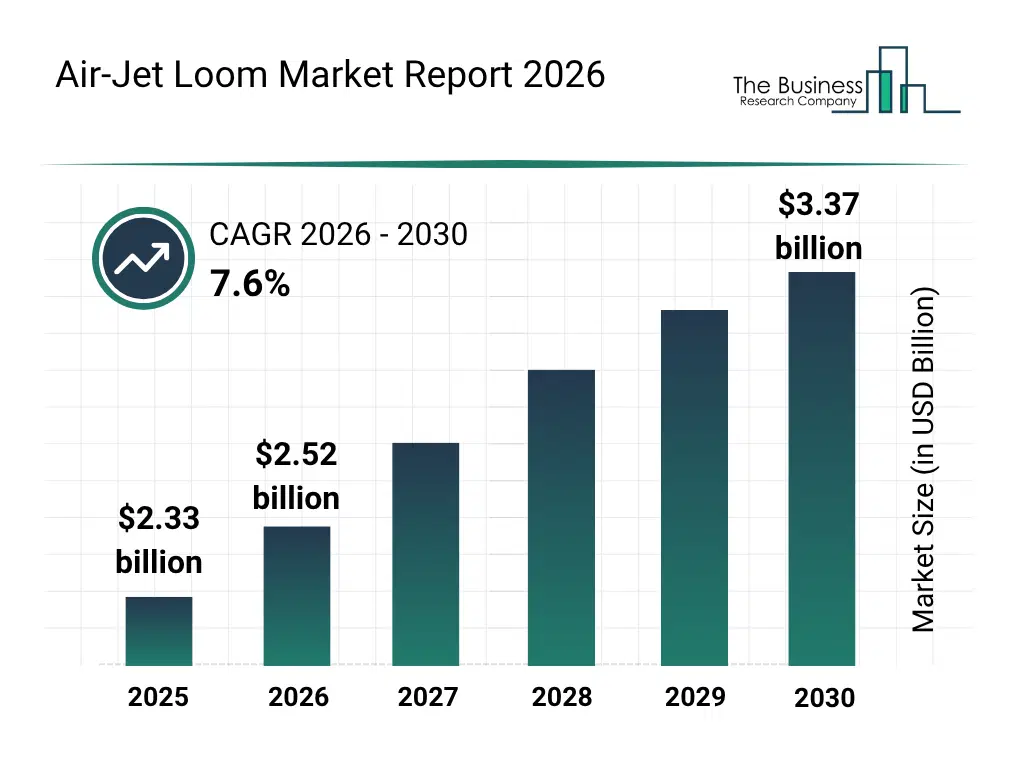
What Is The Air-Jet Loom Market Size and Share 2026?
The air-jet loom market size has grown strongly in recent years. It will grow from $2.33 billion in 2025 to $2.52 billion in 2026 at a compound annual growth rate (CAGR) of 8.0%. The growth in the historic period can be attributed to increasing demand for high-speed textile production, rising woven fabric consumption, growing textile manufacturing capacity, increasing demand for consistent fabric quality, expanding adoption of shuttleless weaving equipment.What Is The Air-Jet Loom Market Growth Forecast?
The air-jet loom market size is expected to see strong growth in the next few years. It will grow to $3.37 billion in 2030 at a compound annual growth rate (CAGR) of 7.6%. The growth in the forecast period can be attributed to increasing demand for wider fabric production, rising preference for automated weaving machinery, growing demand for flexible textile production, increasing replacement of conventional looms, expanding textile manufacturing capacity. Major trends in the forecast period include increasing adoption of high-speed air-jet looms, rising demand for wider weaving width air-jet looms, growing preference for automatic air-jet looms, increasing demand for multi-color weaving capabilities, expanding use of low-maintenance air-jet weaving equipment.Tariff Impact On Air-Jet Loom Market
Tariffs are impacting the air-jet loom market by increasing the cost of imported weaving machinery, electronic control systems, air compressors, precision components, and replacement parts required for loom manufacturing and operation. This is raising equipment acquisition and maintenance costs for textile producers, particularly in major textile manufacturing regions such as Asia-Pacific and Latin America that depend on imported machinery and components. Automatic air-jet looms and high-speed and wide-width configurations are most affected due to their higher component and equipment values. However, tariffs are also encouraging local machinery production, regional supplier diversification, and greater sourcing of components from domestic manufacturers, supporting long-term resilience in the market.
Global Air-Jet Loom Market Segmentation
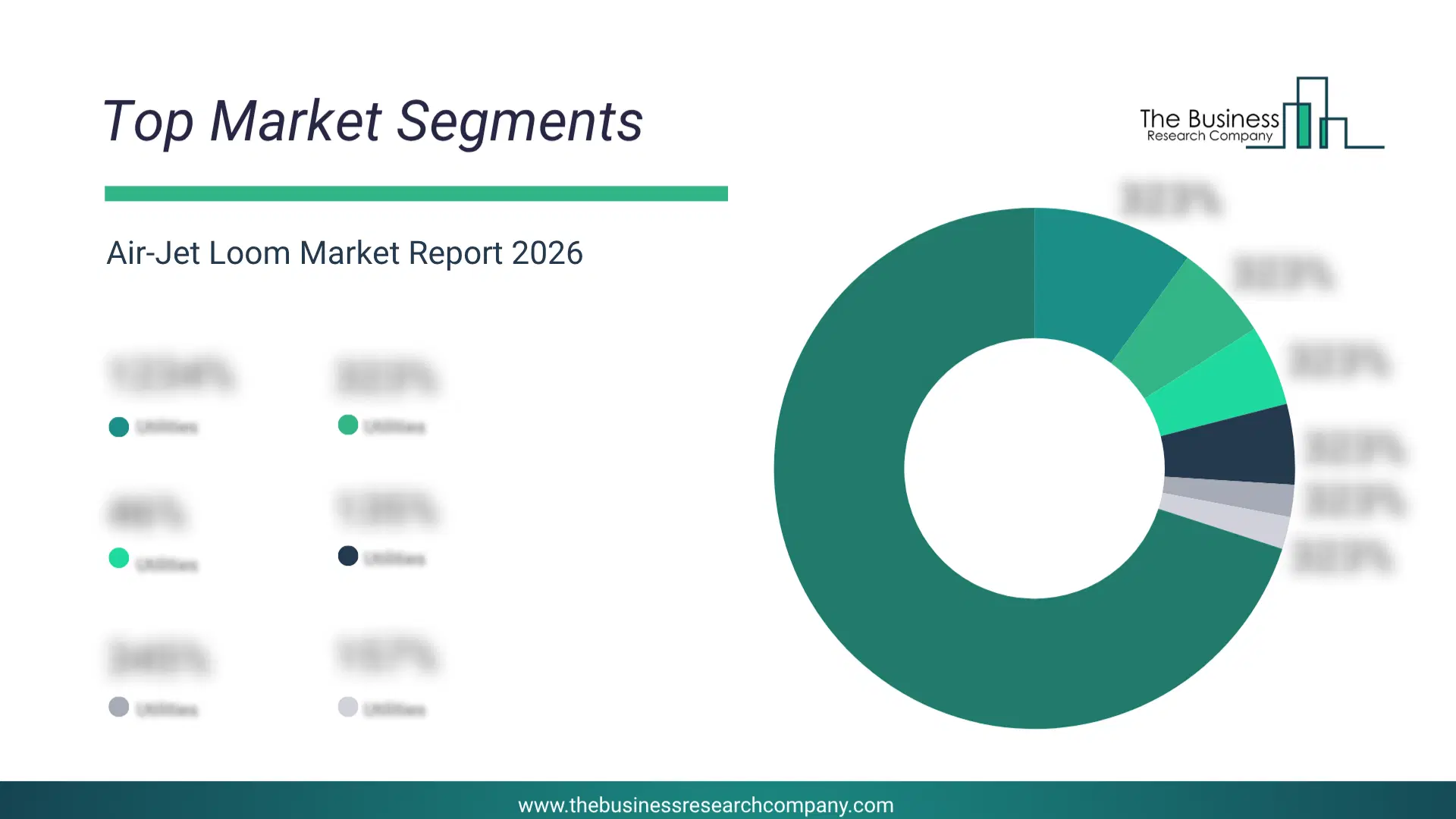
2) By Weaving Width: Below 190 Centimeters, 190–230 Centimeters, Above 230 Centimeters 3) By Application: Home Textiles, Industrial Textiles, Other Applications 4) By End User: Large Textile Manufacturers, Mid Sized Weaving Mills, Specialty Fabric Producers Subsegments: 1) By Automatic Air Jet Loom: Standard Automatic Air Jet Loom, High Speed Automatic Air Jet Loom, Wide Width Automatic Air Jet Loom, Multi Color Automatic Air Jet Loom 2) By Semi Automatic Air Jet Loom: Standard Semi Automatic Air Jet Loom, High Speed Semi Automatic Air Jet Loom, Wide Width Semi Automatic Air Jet Loom, Multi Color Semi Automatic Air Jet LoomWhat Is The Driver Of The Air-Jet Loom Market?
The increasing adoption of automation and smart manufacturing is expected to propel the growth of the air-jet loom market going forward. Automation and smart manufacturing refer to the integration of advanced technologies such as robotics, artificial intelligence, the industrial Internet of Things (IIoT), and data-driven control systems to improve the efficiency, accuracy, and flexibility of manufacturing processes. The adoption of automation and smart manufacturing is increasing due to the growing need for higher production efficiency, as manufacturers seek to reduce operational costs while improving product quality and consistency. This adoption of automation and smart manufacturing encourages the deployment of advanced air-jet looms by enabling faster, more precise, and digitally connected weaving operations that improve production performance. For instance, in January 2025, according to the Manufacturing Leadership Council (MLC), a US-based member-driven business leadership network, in 2025, the share of manufacturers reporting mid-level smart-factory maturity rose to 75%, up from 42% in 2024, while 44% anticipated increased investments in smart-factory and production technologies. Therefore, the increasing adoption of automation and smart manufacturing is driving the growth of the air-jet loom industry.Key Players In The Global Air-Jet Loom Market
Major companies operating in the air-jet loom market are Toyota Industries Corporation, Tessenderlo Group NV, Itema S.p.A., Tsudakoma Corporation, Lindauer DORNIER GmbH, Zhejiang Rifa Textile Machinery Co. Ltd., Qingdao Haijia Machinery Co. Ltd., Qingdao Haifu Textile Machinery Co. Ltd., Qingdao Weaving Machinery Co. Ltd.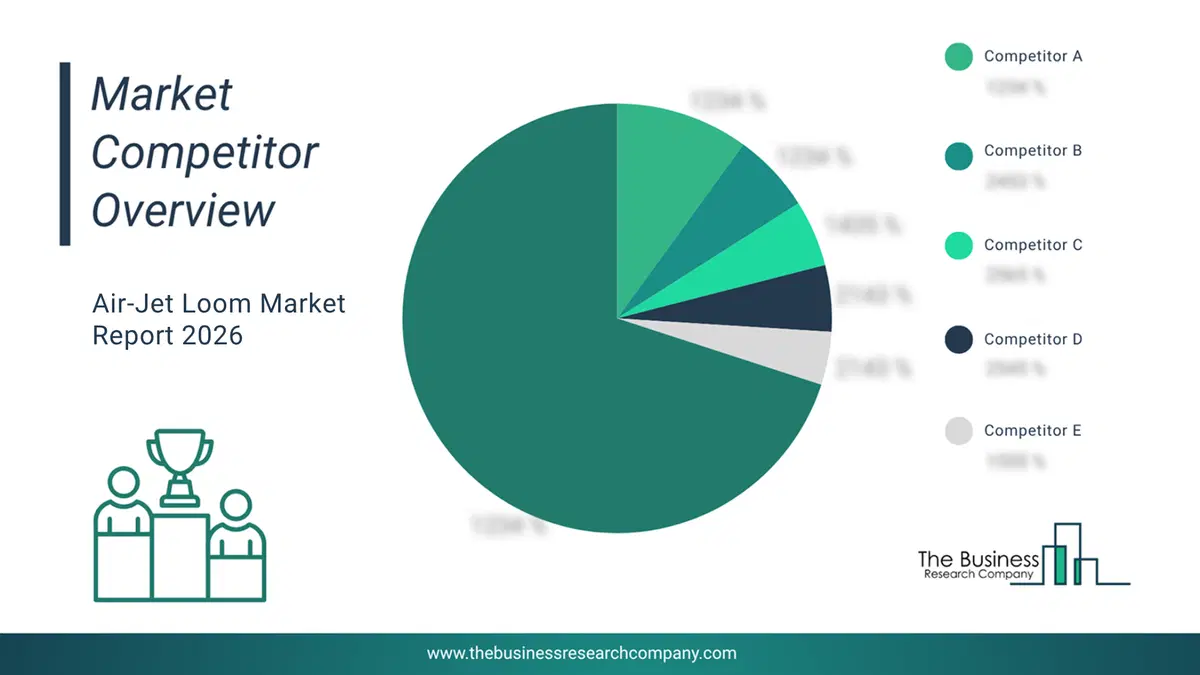
This chart is for illustrative purposes; the full report includes a detailed competitor analysis and comprehensive overview of the top 10 companies in the market.
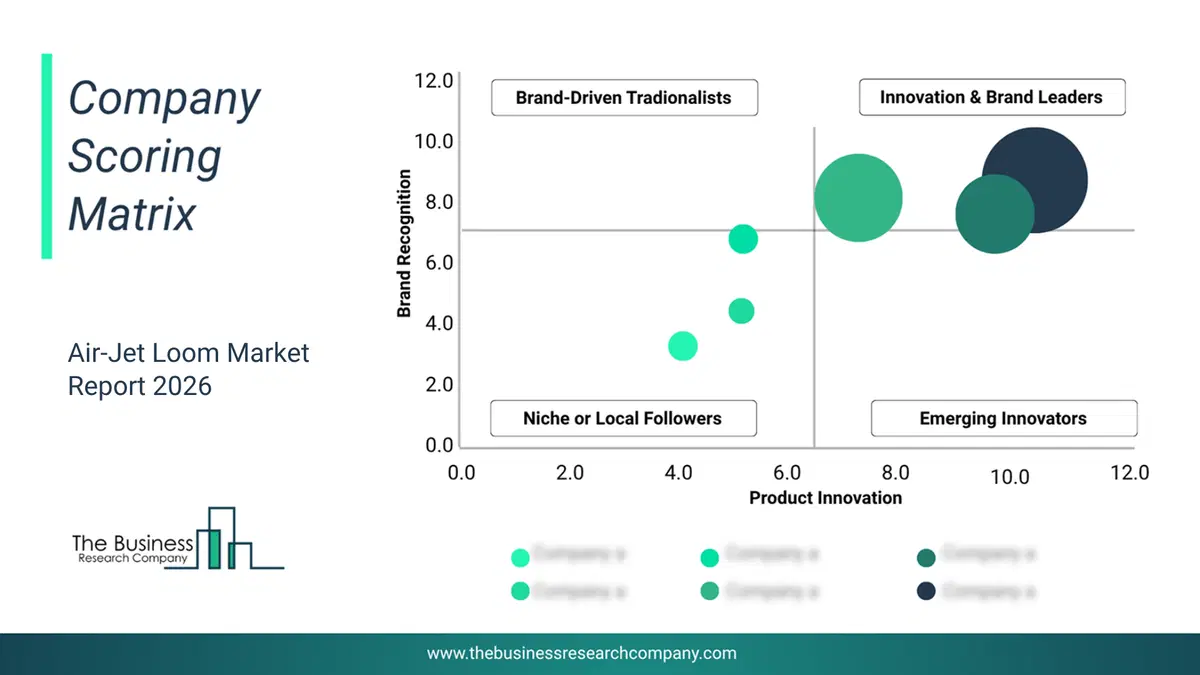
This chart maps companies by product innovation and brand strength, with bubble size indicating relative revenue, helping identify market leaders, challengers, and niche players. This is an illustrative chart; the full report provides a complete and accurate competitive analysis.
Global Air-Jet Loom Market Trends and Insights
Major companies operating in the air-jet loom market are focusing on developing energy-efficient air-jet weaving solutions, such as advanced air-jet weaving machines with optimized pneumatic and weft-insertion systems, to reduce air consumption and improve weaving performance. Advanced air-jet weaving machines with optimized pneumatic and weft-insertion systems refer to air-jet looms that use improved compressed-air systems and enhanced mechanisms to efficiently insert weft yarn across the warp, reducing air consumption while maintaining high-speed weaving and fabric quality. For instance, in September 2025, Itema Group, an Italy-based textile machinery manufacturer, launched the Galileo-AX air-jet weaving machine at ITMA Asia + CITME 2025 in Singapore. The new machine combines energy-efficient weaving technology with competitive costs and optimized pneumatic and weft-insertion systems, supporting reduced air consumption, improved weaving performance, and more efficient textile manufacturing.What Are Latest Mergers And Acquisitions In The Air-Jet Loom Market?
In January 2026, Haijia Machinery, a China-based textile machinery manufacturer, partnered with Shandong Weiqiao Group through the deployment of 720 Air-Jet Looms. Through this partnership, Haijia Machinery aims to strengthen the adoption of its Air-Jet Loom technology by supporting Weiqiao Group’s weaving operations with high-speed, energy-efficient machinery, thereby enhancing production efficiency and weaving capacity. Shandong Weiqiao Group is a China-based textile manufacturer engaged in cotton spinning, weaving, dyeing, and related textile production.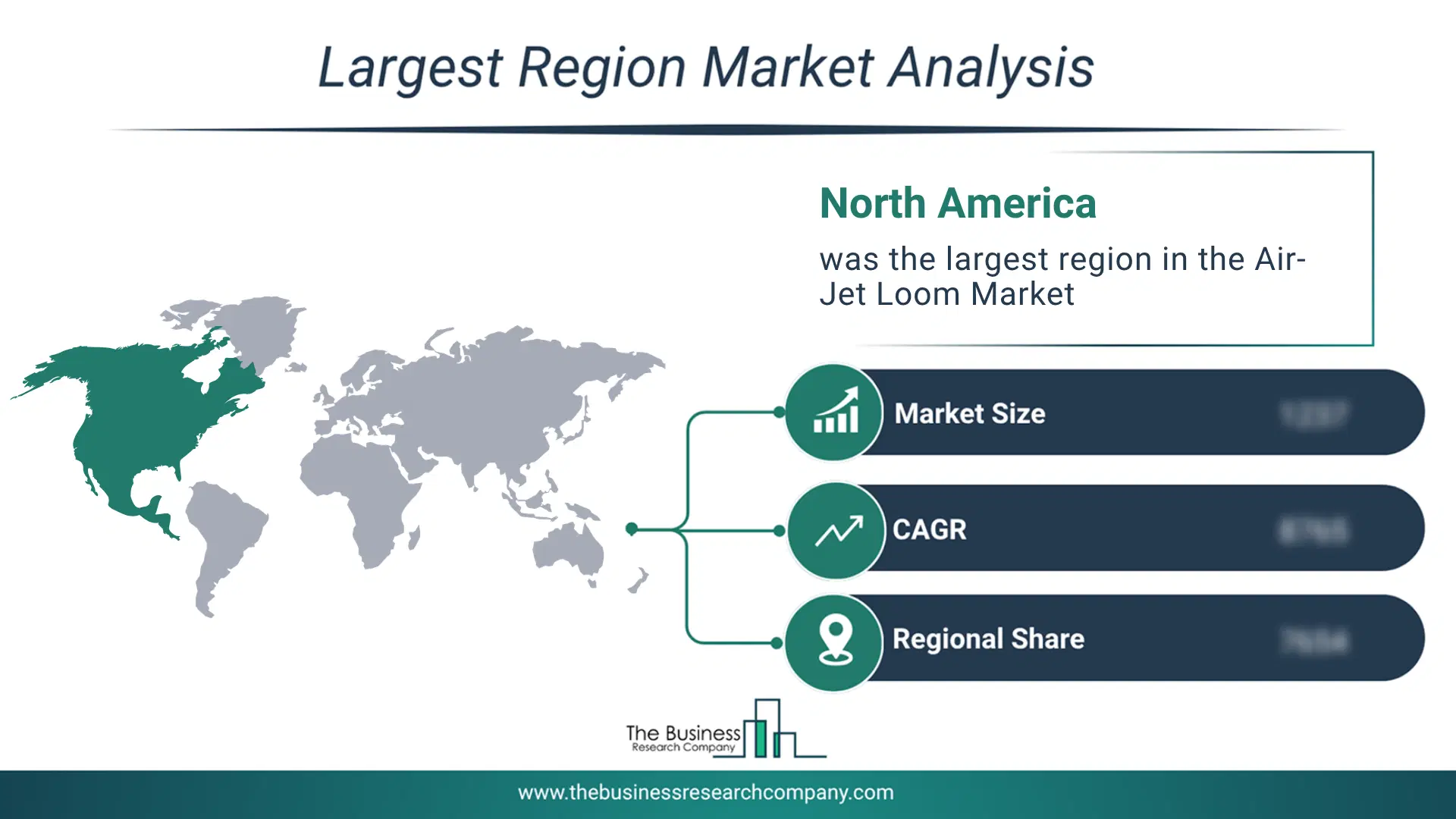
Regional Outlook/Insights
North America was the largest region in the air-jet loom market in 2025. Asia-Pacific is expected to be the fastest-growing region in the forecast period. The regions covered in this market report are Asia-Pacific, South East Asia, Western Europe, Eastern Europe, North America, South America, Middle East, Africa. The countries covered in this market report are Australia, Brazil, China, France, Germany, India, Indonesia, Japan, Taiwan, Russia, South Korea, UK, USA, Canada, Italy, Spain.What Defines the Air-Jet Loom Market?
The air-Jet loom market consists of sales of air compressor systems, electronic weft feeders, reeds and heald frames, air nozzles and relay nozzles, and electronic loom control systems. Values in this market are ‘factory gate’ values, that is, the value of goods sold by the manufacturers or creators of the goods, whether to other entities (including downstream manufacturers, wholesalers, distributors and retailers) or directly to end customers. The value of goods in this market includes related services sold by the creators of the goods.How is Market Value Defined and Measured?
The market value is defined as the revenues that enterprises gain from the sale of goods and/or services within the specified market and geography through sales, grants, or donations in terms of the currency (in USD unless otherwise specified). The revenues for a specified geography are consumption values that are revenues generated by organizations in the specified geography within the market, irrespective of where they are produced. It does not include revenues from resales along the supply chain, either further along the supply chain or as part of other products.
This chart presents market attractiveness based on a quantitative evaluation of growth, competition, strategic alignment, and risk, offering a clear view of opportunity areas for decision-making. This chart is for illustrative purposes; the full report contains the complete analysis.

This chart highlights the Total Addressable Market (TAM) by estimating the maximum revenue opportunity using an assumption-driven approach, supporting strategic planning and opportunity sizing across markets. The chart is illustrative; the full report provides a more comprehensive analysis.
What Key Data and Analysis Are Included in the Air-Jet Loom Market Report 2026?
The air-jet loom market research report is one of a series of new reports from The Business Research Company that provides market statistics, including industry global market size, regional shares, competitors with the market share, detailed market segments, market trends and opportunities, and any further data you may need to thrive in the air-jet loom industry. The market research report delivers a complete perspective of everything you need, with an in-depth analysis of the current and future state of the industry.Air-Jet Loom Market Report Forecast Analysis
| Report Attribute | Details |
|---|---|
| Market Size Value In 2026 | $2.52 billion |
| Revenue Forecast In 2030 | $3.37 billion |
| Growth Rate | CAGR of 7.6% from 2026 to 2035 |
| Base Year For Estimation | 2025 |
| Actual Estimates/Historical Data | 2020-2025 |
| Forecast Period | 2026 - 2030 |
| Market Representation | Revenue in USD Billion and CAGR from 2026 to 2030 |
| Segments Covered | Product Type, Weaving Width, Application, End User |
| Regional Scope | Asia-Pacific, Western Europe, Eastern Europe, North America, South America, Middle East, Africa |
| Country Scope | The countries covered in the report are Australia, Brazil, China, France, Germany, India, Indonesia, Japan, Taiwan, Russia, South Korea, UK, USA, Canada, Italy, Spain. |
| Customization Scope | Request for Customization |
| Pricing And Purchase Options | Explore Purchase Options |