
Air Quality Control System Market Report 2026
Global Outlook – By Product Type (Indoor, Ambient), By Pollutant Type (Gas, VOC, Dust, Other Pollutant Types), By Application (Tunnels, Air Terminals, Underground Garages, Public Transportation Stations, Air Pollution Control, Automobile, Other Applications), By End-User Industry (Energy And Power, Mining, Agriculture, Medical And Pharma, Commercial And Residential, Transportation, Other End-User Industries) – Market Size, Trends, Strategies, and Forecast to 2030
Air Quality Control System Market Overview
• Air Quality Control System market size has reached to $125.4 billion in 2025 • Expected to grow to $160.14 billion in 2030 at a compound annual growth rate (CAGR) of 5.1% • Growth Driver: Surge In Concerns Over Indoor Air Pollution Fuels Growth Of Air Quality Control System Market • Market Trend: Technological Advancements Drive Market Leaders To Integrate Smart Iot Solutions In Air Quality Control Systems • Asia Pacific was the largest region in 2025 and North America is the fastest growing region.What Is Covered Under Air Quality Control System Market?
An air quality control system, or air pollution control system, refers to a system, apparatus, or piece of equipment placed primarily to lower or completely stop the release of air pollutants into the environment. An air quality control system may be used to track climate change, monitor air quality, find the origins of pollutants, and aid in research and development. The main types of paint strippers are solvent type, caustic type, and acidic type. Solvent-based paint strippers refer to chemical products designed to remove paint, finishes, and coatings from surfaces while also cleaning the underlying surface. The various packaging types are bucket, drum, can, and Plastic Bottle & Jerry Bottle with various grades including industrial grade, technical grade, and Commercial Grade used by various end users such as aerospace, automotive, marine, oil & gas, packaging, and others.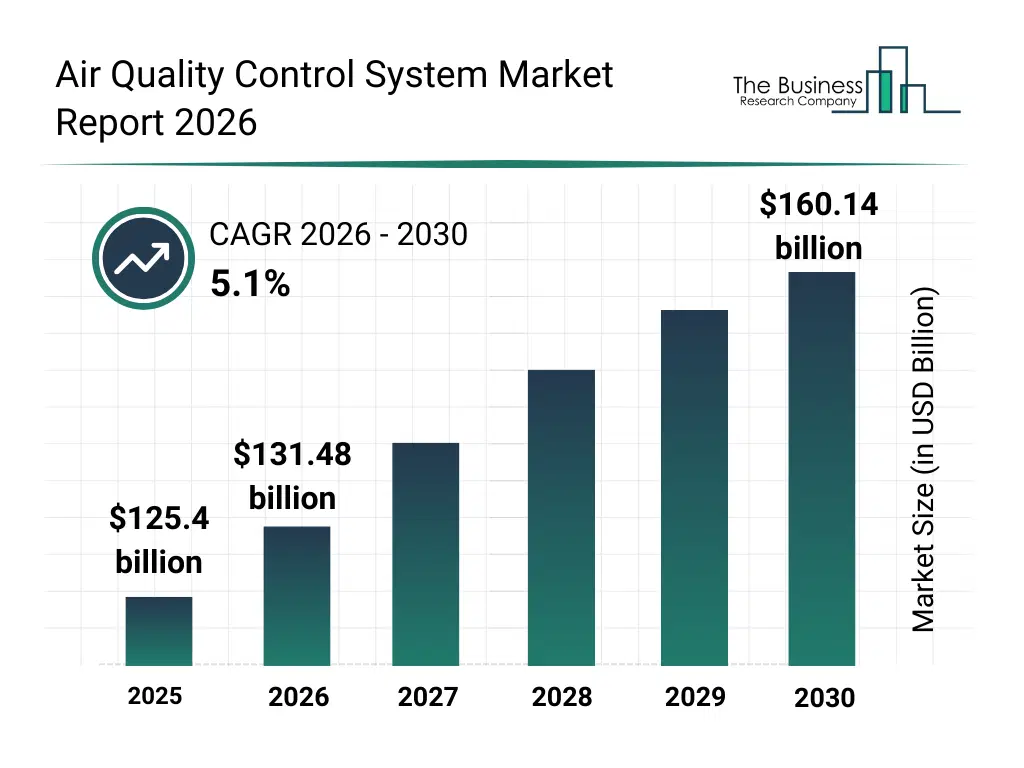
What Is The Air Quality Control System Market Size and Share 2026?
The air quality control system market size has grown steadily in recent years. It will grow from $125.4 billion in 2025 to $131.48 billion in 2026 at a compound annual growth rate (CAGR) of 4.9%. The growth in the historic period can be attributed to growing urbanization and industrialization, increased awareness of air pollution, implementation of environmental regulations, adoption of indoor air quality monitoring, rise in public health initiatives.What Is The Air Quality Control System Market Growth Forecast?
The air quality control system market size is expected to see strong growth in the next few years. It will grow to $160.14 billion in 2030 at a compound annual growth rate (CAGR) of 5.1%. The growth in the forecast period can be attributed to expansion of smart city projects, advancements in ai-powered air monitoring, increased investment in clean energy solutions, rising demand for industrial emission control, growth in connected iot-based environmental systems. Major trends in the forecast period include real-time air quality monitoring, predictive pollution analytics, integration with smart infrastructure, automated emission control systems, portable and indoor air quality solutions.
Global Air Quality Control System Market Segmentation
1) By Product Type: Indoor, Ambient 2) By Pollutant Type: Gas, VOC, Dust, Other Pollutant Types 3) By Application: Tunnels, Air Terminals, Underground Garages, Public Transportation Stations, Air Pollution Control, Automobile, Other Applications 4) By End-User Industry: Energy And Power, Mining, Agriculture, Medical And Pharma, Commercial And Residential, Transportation, Other End-User Industries Subsegments: 1) By Indoor: Air Purifiers, HVAC Systems, Air Quality Monitors 2) By Ambient: Industrial Air Quality Monitors, Outdoor Air Quality Sensors, Emission Control SystemsWhat Is The Driver Of The Air Quality Control System Market?
Growing concerns about indoor air quality are expected to propel the growth of the air quality control system market. Indoor air quality (IAQ) refers to the quality of the air within and surrounding buildings and other structures, with a focus on how it affects the comfort and health of building inhabitants. Air quality control systems offer comprehensive solutions for addressing and improving indoor air quality by removing pollutants, controlling ventilation, regulating humidity, and enhancing overall indoor environmental quality. For instance, in April 2023, according to the American Lung Association, a US-based professional organization, 119.6 million Americans, or almost 36% of the country's population, continue to reside in areas with unfavorable ozone or particle pollution ratings. Therefore, the growing concerns about indoor air quality will drive the growth of the air quality control system industry.Key Players In The Global Air Quality Control System Market
Major companies operating in the air quality control system market are Siemens AG; General Electric Company; Thermo Fisher Scientific; Honeywell International Inc.; 3M; Mitsubishi Hitachi Power Systems Ltd.; Anguil Environmental Systems, Inc.; ENVEA Group; Daikin Industries Ltd.; Johnson Controls International plc; Alstom SA; Camfil AB; ANDRITZ AG; GEA Group Aktiengesellschaft; MANN+HUMMEL Group; Donaldson Company Inc.; Pall Corporation; Dürr AG; Thermax Limited; Babcock & Wilcox Enterprises Inc.; Calgon Carbon Corporation; Clyde Bergemann Power Group; Doosan Lentjes GmbH; Balcke-Dürr GmbH; Fuel Tech Inc.; Sierra Instruments Inc.; Bühler Technologies GmbH; Foster Wheeler AG; Hamon Corporation
This chart is for illustrative purposes; the full report includes a detailed competitor analysis and comprehensive overview of the top 10 companies in the market.
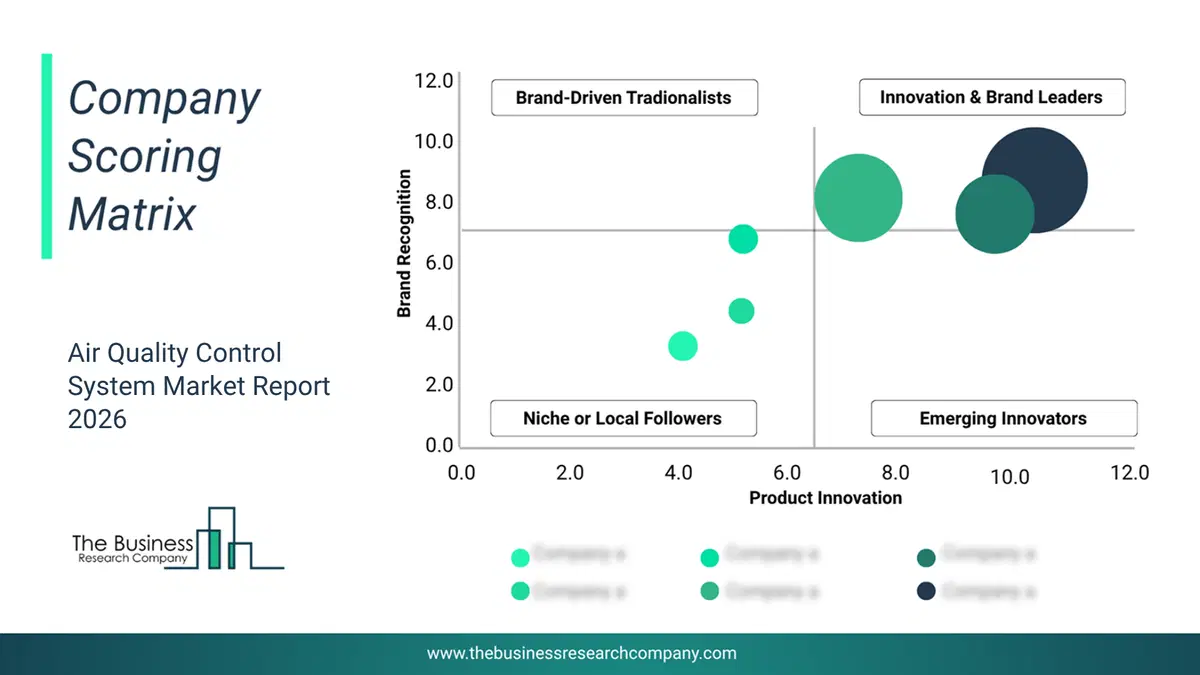
This chart maps companies by product innovation and brand strength, with bubble size indicating relative revenue, helping identify market leaders, challengers, and niche players. This is an illustrative chart; the full report provides a complete and accurate competitive analysis.
Global Air Quality Control System Market Trends and Insights
Major companies operating in the air quality control system market are focused on developing products with advanced technologies, such as smart IoT solution integration in the AQCS system, to strengthen their position in the market. Internet of Things (IoT) solutions make use of data that is collected by IoT devices, focusing on data from a single kind of sensor as well as several sensors to uncover a wider variety of insights. For instance, in March 2023, Siemens AG, a Germany-based automation and digitalization company, through its subsidiary Siemens Smart Infrastructure (SI), introduced Connect Box, an open-source, user-friendly Internet of Things solution for managing small to medium-sized buildings. Connect Box, the newest product in the Siemens Xcelerator line, is an easy-to-use method of tracking building performance that has the potential to dramatically improve indoor air quality and maximize energy efficiency in small to medium-sized buildings like apartments, retail stores, schools, and small offices by up to 30%.What Are Latest Mergers And Acquisitions In The Air Quality Control System Market?
In June 2024, ENVEA, a France-based company that provides environmental management solutions and instrumentation for industries, acquired Asia Pacific Air Quality Group (APAQ Group) for an undisclosed amount. This strategic move aims to enhance ENVEA's presence in Asia, complementing its existing product portfolio and customer base. Asia Pacific Air Quality Group is a Singapore-based air quality company provide planning, consultancy and integration services for ambient air and emission analyser systems.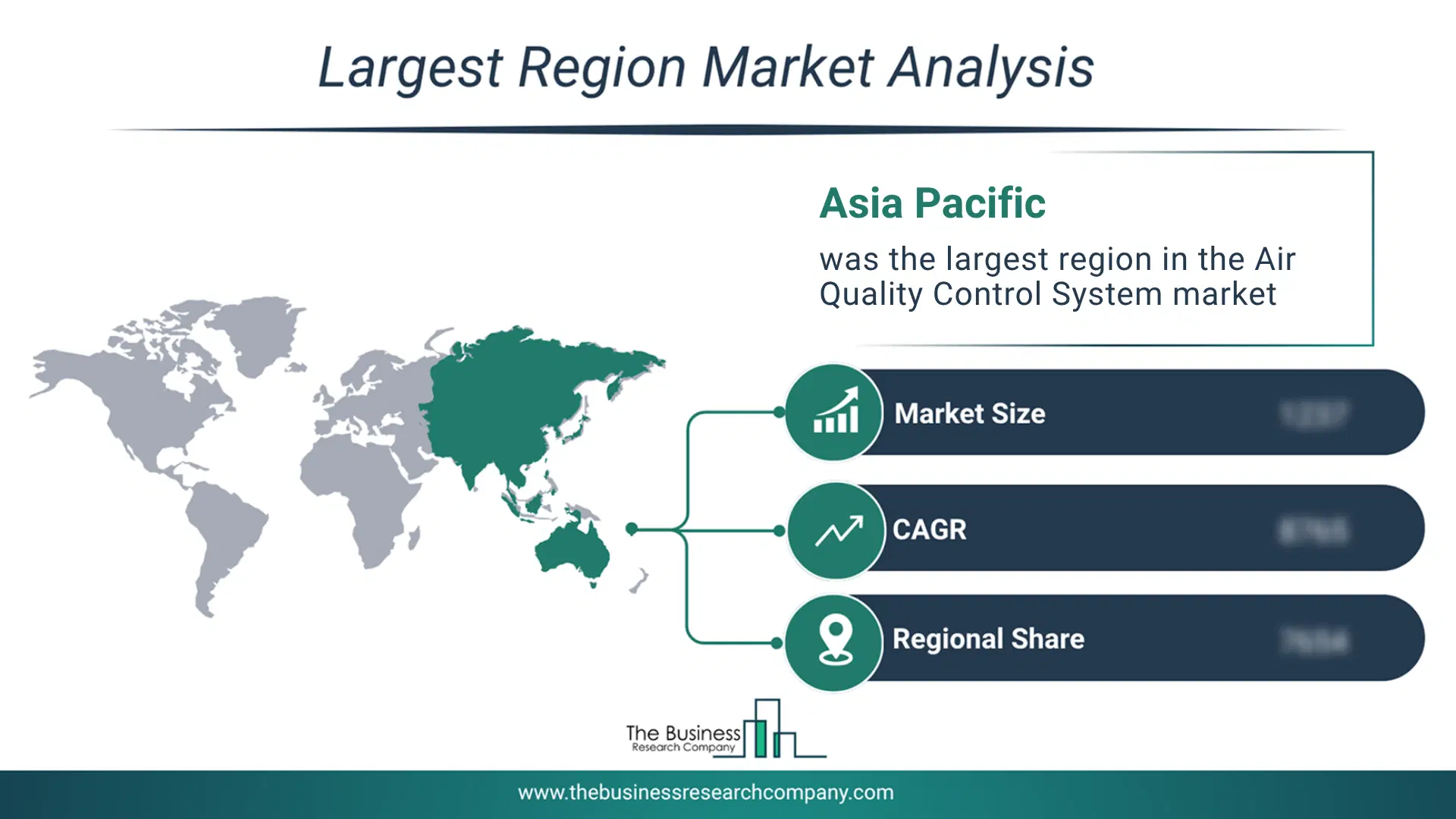
Regional Insights
Asia Pacificwas the largest region in the air quality control system market in 2025. North America is expected to be the fastest-growing region in the forecast period. The regions covered in this market report are Asia-Pacific, South East Asia, Western Europe, Eastern Europe, North America, South America, Middle East, Africa. The countries covered in this market report are Australia, Brazil, China, France, Germany, India, Indonesia, Japan, Taiwan, Russia, South Korea, UK, USA, Canada, Italy, SpainWhat Defines the Air Quality Control System Market?
The air quality control system market consists of sales of selective catalytic reduction (SCR), electrostatic precipitator (ESP), flue gas desulfurization (FGD) system, and fabric filters. Values in this market are ‘factory gate’ values, that is, the value of goods sold by the manufacturers or creators of the goods, whether to other entities (including downstream manufacturers, wholesalers, distributors, and retailers) or directly to end customers. The value of goods in this market includes related services sold by the creators of the goods.How is Market Value Defined and Measured?
The market value is defined as the revenues that enterprises gain from the sale of goods and/or services within the specified market and geography through sales, grants, or donations in terms of the currency (in USD unless otherwise specified). The revenues for a specified geography are consumption values that are revenues generated by organizations in the specified geography within the market, irrespective of where they are produced. It does not include revenues from resales along the supply chain, either further along the supply chain or as part of other products.
This chart presents market attractiveness based on a quantitative evaluation of growth, competition, strategic alignment, and risk, offering a clear view of opportunity areas for decision-making. This chart is for illustrative purposes; the full report contains the complete analysis.

This chart highlights the Total Addressable Market (TAM) by estimating the maximum revenue opportunity using an assumption-driven approach, supporting strategic planning and opportunity sizing across markets. The chart is illustrative; the full report provides a more comprehensive analysis.
What Key Data and Analysis Are Included in the Air Quality Control System Market Report 2026?
The air quality control system market research report is one of a series of new reports from The Business Research Company that provides market statistics, including industry global market size, regional shares, competitors with the market share, detailed market segments, market trends and opportunities, and any further data you may need to thrive in the air quality control system industry. The market research report delivers a complete perspective of everything you need, with an in-depth analysis of the current and future state of the industry.Air Quality Control System Market Report Forecast Analysis
| Report Attribute | Details |
|---|---|
| Market Size Value In 2026 | $131.48 billion |
| Revenue Forecast In 2030 | $160.14 billion |
| Growth Rate | CAGR of 5.1% from 2026 to 2030 |
| Base Year For Estimation | 2025 |
| Actual Estimates/Historical Data | 2020-2025 |
| Forecast Period | 2026 - 2030 |
| Market Representation | Revenue in USD Billion and CAGR from 2026 to 2030 |
| Segments Covered | Product Type, Pollutant Type, Application, End-User Industry |
| Regional Scope | Asia-Pacific, Western Europe, Eastern Europe, North America, South America, Middle East, Africa |
| Country Scope | The Countries Covered In This Market Report Are Australia, Brazil, China, France, Germany, India, Indonesia, Japan, Taiwan, Russia, South Korea, Uk, Usa, Canada, Italy, Spain. |
| Key Companies Profiled | Siemens AG, General Electric Company, Thermo Fisher Scientific, Honeywell International Inc., 3M, Mitsubishi Hitachi Power Systems Ltd., Anguil Environmental Systems, Inc., ENVEA Group, Daikin Industries Ltd., Johnson Controls International plc, Alstom SA, Camfil AB, ANDRITZ AG, GEA Group Aktiengesellschaft, MANN+HUMMEL Group, Donaldson Company Inc., Pall Corporation, Dürr AG, Thermax Limited, Babcock & Wilcox Enterprises Inc., Calgon Carbon Corporation, Clyde Bergemann Power Group, Doosan Lentjes GmbH, Balcke-Dürr GmbH, Fuel Tech Inc., Sierra Instruments Inc., Bühler Technologies GmbH, Foster Wheeler AG, Hamon Corporation |
| Customization Scope | Request for Customization |
| Pricing And Purchase Options | Explore Purchase Options |