
Air Traffic Control Market Report 2026
Global Outlook – By Component (Hardware, Software, Services), By Airport Size (Small, Medium, Large), By Airspace (Air Route Traffic Control Centers (ARTCC), Terminal Radar Approach Control (TRACON), Air Traffic Control Tower (ATCT), Remote Tower (RT)), By Application (Communication, Navigation, Surveillance, Automation) – Market Size, Trends, Strategies, and Forecast to 2030
Air Traffic Control Market Overview
• Air Traffic Control market size has reached to $9.46 billion in 2025 • Expected to grow to $12.73 billion in 2030 at a compound annual growth rate (CAGR) of 6% • Growth Driver: The Rise In Air Passenger Traffic Driving The Growth Of The Air Traffic Control Market Due To Rising Disposable Incomes • Market Trend: Pioneering Air Mobility With Device Advancement • North America was the largest region in 2025.What Is Covered Under Air Traffic Control Market?
Air traffic control is a service given by ground-based controllers to safely direct numerous aircraft in the aviation to their destinations while preventing collisions or unforeseen mishaps caused by excessive air traffic in an air space. The main point of sales included in air traffic control are hardware, software, and services. Hardware includes tangible components of an air traffic control system that can be used to provide input and display output or transmit or receive signals of the ATC system. It includes components such as radars, antennas, cameras, display systems, and others. The different airport sizes in air traffic control are small, medium, and large, which run for airspace type such as air route traffic control centers (ARTCC), terminal radar approach control (TRACON), air traffic control tower (ATCT), remote tower (RT). These are applied for communication, navigation, surveillance, and automation.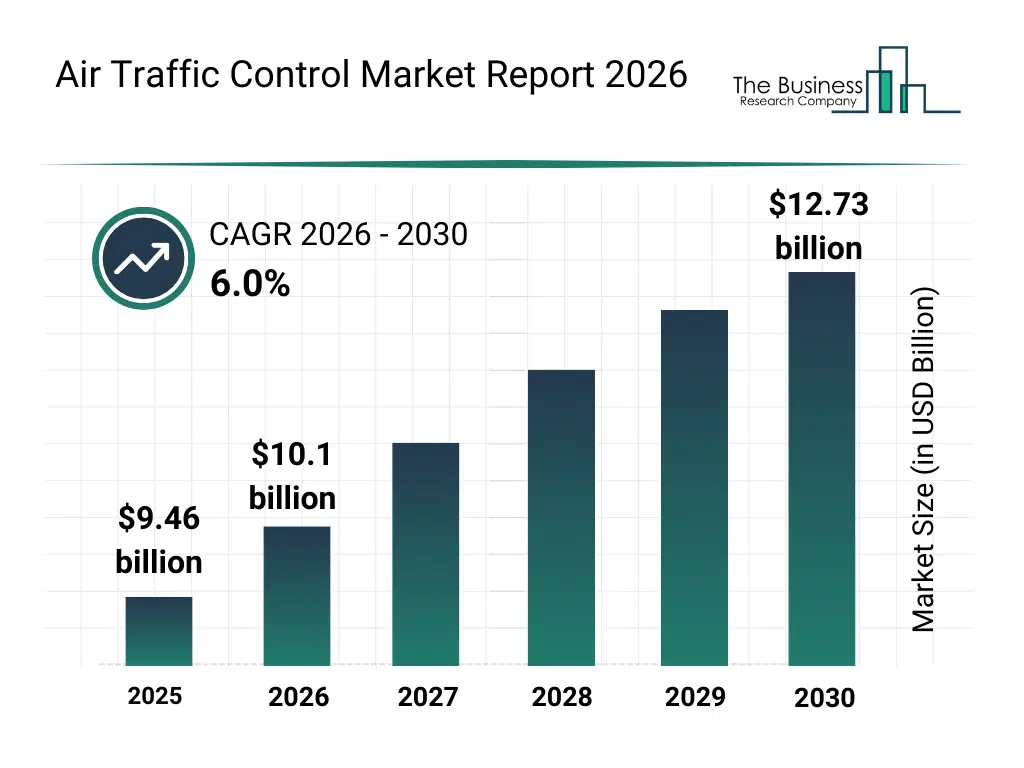
What Is The Air Traffic Control Market Size and Share 2026?
The air traffic control market size has grown strongly in recent years. It will grow from $9.46 billion in 2025 to $10.1 billion in 2026 at a compound annual growth rate (CAGR) of 6.7%. The growth in the historic period can be attributed to increasing global air traffic volumes, expansion of commercial aviation networks, modernization of legacy atc infrastructure, rising safety and compliance requirements, adoption of radar and surveillance technologies.What Is The Air Traffic Control Market Growth Forecast?
The air traffic control market size is expected to see strong growth in the next few years. It will grow to $12.73 billion in 2030 at a compound annual growth rate (CAGR) of 6.0%. The growth in the forecast period can be attributed to increasing investments in smart airspace management, rising adoption of ai-assisted traffic control, expansion of unmanned traffic management systems, growing focus on reducing airspace congestion, increasing deployment of digital atc platforms. Major trends in the forecast period include increasing integration of AI in air traffic management systems, rising deployment of automated decision support tools, growing use of remote and virtual towers, expansion of data-driven traffic optimization systems, enhanced focus on airspace safety and efficiency.
Global Air Traffic Control Market Segmentation
1) By Component: Hardware, Software, Services 2) By Airport Size: Small, Medium, Large 3) By Airspace: Air Route Traffic Control Centers (ARTCC), Terminal Radar Approach Control (TRACON), Air Traffic Control Tower (ATCT), Remote Tower (RT) 4) By Application: Communication, Navigation, Surveillance, Automation Subsegments: 1) By Hardware: Radar Systems, Communication Equipment, Surveillance Systems, Navigation Aids 2) By Software: Air Traffic Management Software, Flight Data Processing Software, Simulation Software, Decision Support Tools 3) By Services: Installation And Integration Services, Maintenance And Support Services, Training And Consultancy ServicesWhat Is The Driver Of The Air Traffic Control Market?
The increasing air passenger traffic is expected to propel the growth of the air traffic control market in the coming years. Air passenger traffic is the total number of people that fly aboard commercial aircraft in a certain amount of time and is a crucial indicator for measuring air travel demand and overall activity in the aviation sector. The increase in air passenger traffic is primarily driven by rising disposable incomes, as more people can afford air travel for leisure, business, and other personal purposes. Air traffic control is critical to ensuring the safety, efficiency, and dependability of air passenger traffic and making travel from departure to arrival, both inside and beyond borders. For instance, in January 2025, the International Air Transport Association, a Canada-based organization, in 2024, international full-year traffic grew by 13.6% compared to 2023, while capacity increased by 12.8%. Therefore, the increasing air passenger traffic drives the growth of the air traffic control industry.Key Players In The Global Air Traffic Control Market
Major companies operating in the air traffic control market are Raytheon Technologies Corporation; BAE Systems PLC; Thales Group; Indra Sistemas S.A.; Frequentis AG; Harris Corporation; Adacel Technologies Ltd.; Leonardo S.p.A; Honeywell International Inc.; Northrop Grumman Corporation; Saab AB; SkySoft-ATM; NAV Canada; Searidge Technologies Inc.; NATS Holdings Limited; Telephonics Corp.; The Aeronav Group; Becker Avionics Inc; L3Harris Technologies Inc.; Atech Negocios em Tecnologias S/A; COMSOFT Solutions GmbH; Intelcan Technosystems Inc.; Lockheed Martin Corporation; Serco Group PLC; Slovenia Control; Finavia Corporation; Airservices Australia; Irish Aviation Authority; Swiss International Air Lines Ltd.
This chart is for illustrative purposes; the full report includes a detailed competitor analysis and comprehensive overview of the top 10 companies in the market.
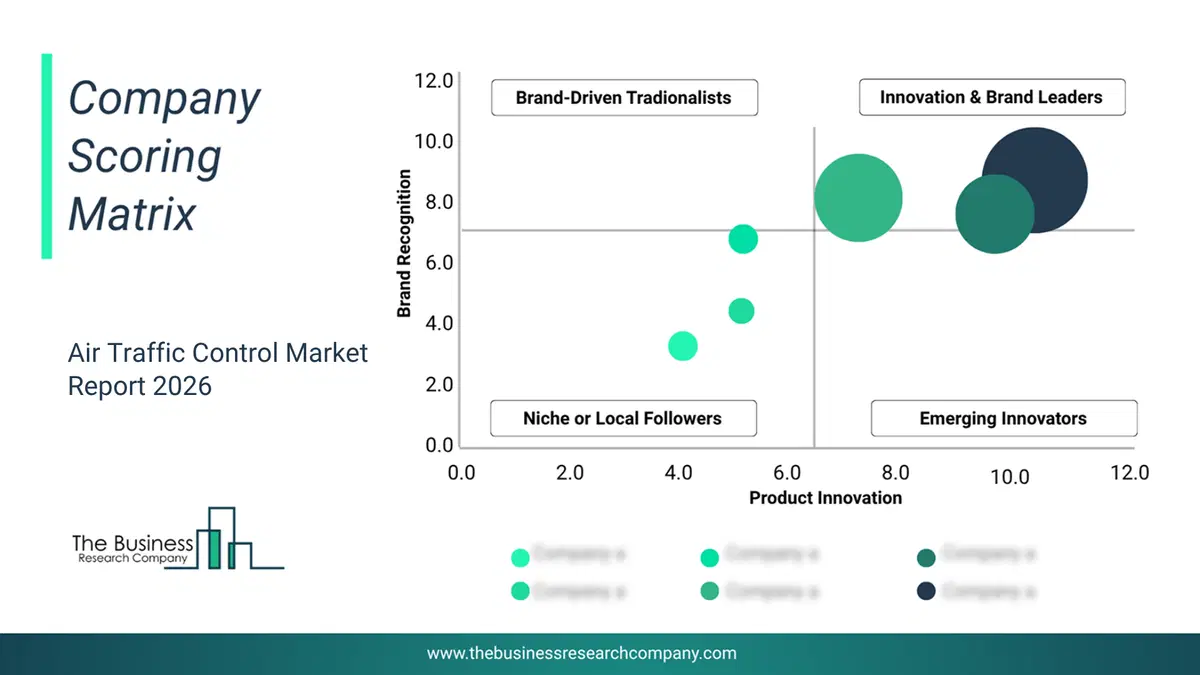
This chart maps companies by product innovation and brand strength, with bubble size indicating relative revenue, helping identify market leaders, challengers, and niche players. This is an illustrative chart; the full report provides a complete and accurate competitive analysis.
Global Air Traffic Control Market Trends and Insights
Major companies operating in the air traffic control market are innovating advance air traffic receivers devices aiming to create traffic management services better and efficient. Advanced air traffic receivers refer to state-of-the-art systems designed to improve the safety, efficiency, and capacity of air transportation. These receivers are used in air traffic control centers. For instance, in March 2023, Involi, a Switzerland-based provider of hardware and software solutions for air traffic detection, launched the G-1090 product line of air traffic signal receivers. The system consists of a collection of Swiss-made ground-based receivers designed to capture cooperative air traffic signals. These receivers offer airspace managers and operation managers a cost-effective alternative to traditional radar equipment by providing real-time and historical Air Traffic Data. Specifically, the G-1090 receivers are engineered to identify aviation transponder signals such as ADS-B, Mode S, Mode A/C, and FLARM. Additionally, they inherently support INVOLI Multilateration, providing a holistic perspective of air traffic.What Are Latest Mergers And Acquisitions In The Air Traffic Control Market?
In April 2024, Thales, a France-based technology company, acquired Cobham Aerospace SAS for an undisclosed amount. This acquisition aims to strengthen Thales's position in the aerospace and defense sectors by enhancing its capabilities in advanced avionics, connectivity solutions, and system integration. Cobham Aerospace SAS is a UK-based aerospace and defense company.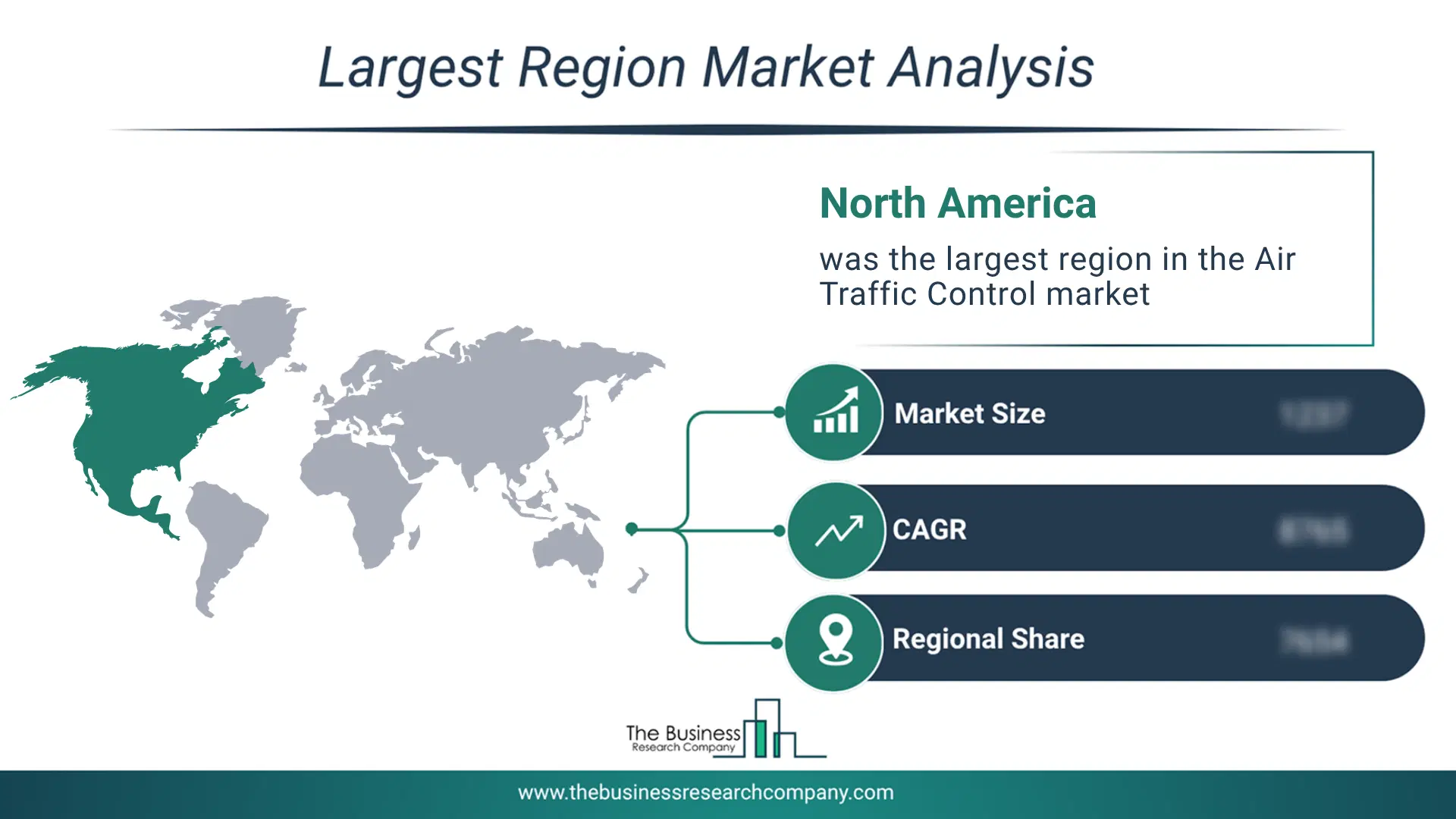
Regional Insights
North America was the largest region in the air traffic control market in 2025. The regions covered in this market report are Asia-Pacific, South East Asia, Western Europe, Eastern Europe, North America, South America, Middle East, Africa. The countries covered in this market report are Australia, Brazil, China, France, Germany, India, Indonesia, Japan, Taiwan, Russia, South Korea, UK, USA, Canada, Italy, SpainWhat Defines the Air Traffic Control Market?
The air traffic control market includes revenues earned by entities by providing collision prevention, flight control, advisory, runway and traffic management services. The market value includes the value of related goods sold by the service provider or included within the service offering. Only goods and services traded between entities or sold to end consumers are included.How is Market Value Defined and Measured?
The market value is defined as the revenues that enterprises gain from the sale of goods and/or services within the specified market and geography through sales, grants, or donations in terms of the currency (in USD unless otherwise specified). The revenues for a specified geography are consumption values that are revenues generated by organizations in the specified geography within the market, irrespective of where they are produced. It does not include revenues from resales along the supply chain, either further along the supply chain or as part of other products.
This chart presents market attractiveness based on a quantitative evaluation of growth, competition, strategic alignment, and risk, offering a clear view of opportunity areas for decision-making. This chart is for illustrative purposes; the full report contains the complete analysis.

This chart highlights the Total Addressable Market (TAM) by estimating the maximum revenue opportunity using an assumption-driven approach, supporting strategic planning and opportunity sizing across markets. The chart is illustrative; the full report provides a more comprehensive analysis.
What Key Data and Analysis Are Included in the Air Traffic Control Market Report 2026?
The air traffic control market research report is one of a series of new reports from The Business Research Company that provides market statistics, including industry global market size, regional shares, competitors with the market share, detailed market segments, market trends and opportunities, and any further data you may need to thrive in the air traffic control industry. The market research report delivers a complete perspective of everything you need, with an in-depth analysis of the current and future state of the industry.Air Traffic Control Market Report Forecast Analysis
| Report Attribute | Details |
|---|---|
| Market Size Value In 2026 | $10.1 billion |
| Revenue Forecast In 2030 | $12.73 billion |
| Growth Rate | CAGR of 6% from 2026 to 2030 |
| Base Year For Estimation | 2025 |
| Actual Estimates/Historical Data | 2020-2025 |
| Forecast Period | 2026 - 2030 |
| Market Representation | Revenue in USD Billion and CAGR from 2026 to 2030 |
| Segments Covered | Component, Airport Size, Airspace, Application |
| Regional Scope | Asia-Pacific, Western Europe, Eastern Europe, North America, South America, Middle East, Africa |
| Country Scope | The Countries Covered In This Market Report Are Australia, Brazil, China, France, Germany, India, Indonesia, Japan, Taiwan, Russia, South Korea, Uk, Usa, Canada, Italy, Spain. |
| Key Companies Profiled | Raytheon Technologies Corporation, BAE Systems PLC, Thales Group, Indra Sistemas S.A., Frequentis AG, Harris Corporation, Adacel Technologies Ltd., Leonardo S.p.A, Honeywell International Inc., Northrop Grumman Corporation, Saab AB, SkySoft-ATM, NAV Canada, Searidge Technologies Inc., NATS Holdings Limited, Telephonics Corp., The Aeronav Group, Becker Avionics Inc, L3Harris Technologies Inc., Atech Negocios em Tecnologias S/A, COMSOFT Solutions GmbH, Intelcan Technosystems Inc., Lockheed Martin Corporation, Serco Group PLC, Slovenia Control, Finavia Corporation, Airservices Australia, Irish Aviation Authority, Swiss International Air Lines Ltd. |
| Customization Scope | Request for Customization |
| Pricing And Purchase Options | Explore Purchase Options |