
Air Traffic Flow And Capacity Management Market Report 2026
Global Outlook – By Component (Solutions, Hardware, Services), By Airport Class (Class A, Class B, Class C), By Deployment Mode (On Premises, Cloud Based, Hybrid), By Application (Air Traffic Control, Airport And Runway Operations, Terminal Airspace Management, Network Operations Management), By End User (Air Navigation Service Providers, Civil Aviation Authorities, Airports And Airport Operators, Military And Defense Aviation Authorities) – Market Size, Trends, Strategies, and Forecast to 2035
Air Traffic Flow And Capacity Management Market Overview
• Air Traffic Flow And Capacity Management market size has reached to $26.52 billion in 2025 • Expected to grow to $49.73 billion in 2030 at a compound annual growth rate (CAGR) of 13.3% • Growth Driver: Growing Air Passenger Traffic Worldwide Fueling The Growth Of The Market Due To Increasing Demand For Air Travel And Fleet Utilization • Market Trend: Advancements In Digital Platforms Enhancing Collaborative Air Traffic Coordination And Capacity Optimization • North America was the largest region in 2025 and Asia-Pacific is the fastest growing region.What Is Covered Under Air Traffic Flow And Capacity Management Market?
Air traffic flow and capacity management (ATFCM) refers to the strategic planning, coordination, and optimization of air traffic flows to balance aircraft demand with available airspace and airport capacity. It uses real-time data, predictive analytics, and traffic management measures to reduce congestion, minimize delays, and improve the efficiency and safety of air transportation operations. The main components of air traffic flow and capacity management include solutions, hardware, and services. Solutions refer to integrated systems and tools that help manage aircraft movements, optimize airspace capacity, and improve the efficiency and predictability of air traffic operations. These solutions are available across class A, class B, and class C airports and are deployed through on premises, cloud based, and hybrid modes. They find application in air traffic control, airport and runway operations, terminal airspace management, and network operations management, serving end users including air navigation service providers, civil aviation authorities, airports and airport operators, and military and defense aviation authorities.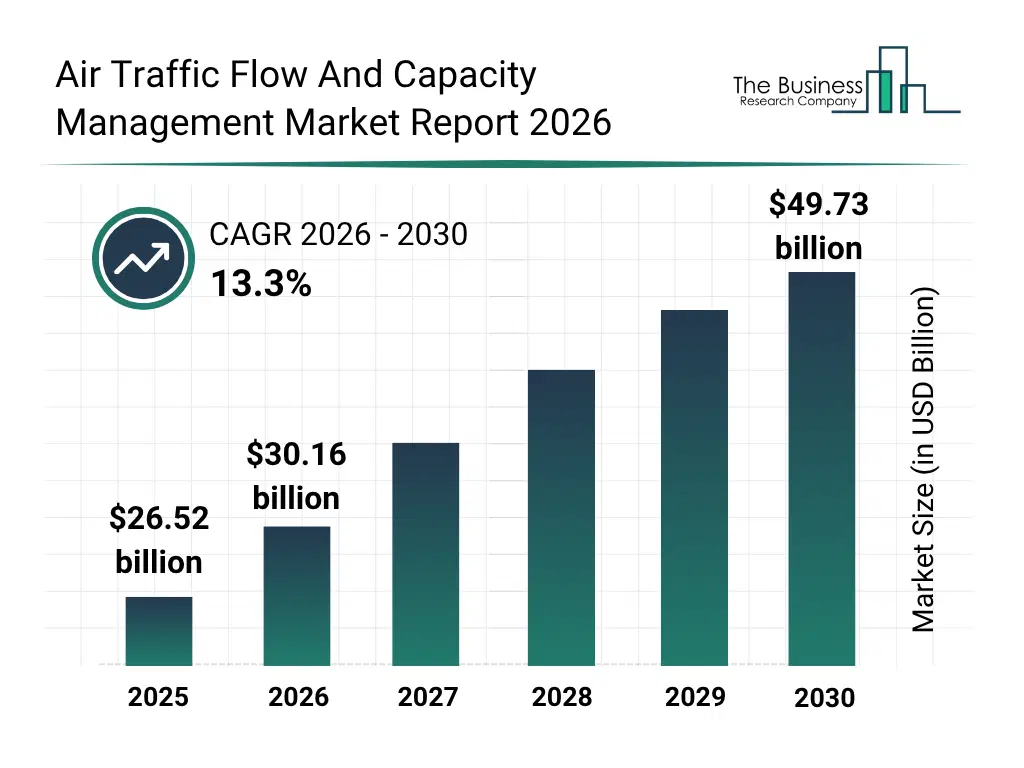
What Is The Air Traffic Flow And Capacity Management Market Size and Share 2026?
The air traffic flow and capacity management market size has grown rapidly in recent years. It will grow from $26.52 billion in 2025 to $30.16 billion in 2026 at a compound annual growth rate (CAGR) of 13.7%. The growth in the historic period can be attributed to increasing air passenger traffic, growing airport congestion, rising demand for airspace capacity optimization, increasing adoption of radar and surveillance systems, growing need to reduce flight delays.What Is The Air Traffic Flow And Capacity Management Market Growth Forecast?
The air traffic flow and capacity management market size is expected to see rapid growth in the next few years. It will grow to $49.73 billion in 2030 at a compound annual growth rate (CAGR) of 13.3%. The growth in the forecast period can be attributed to rising adoption of trajectory-based operations, increasing demand for predictive traffic management, expansion of airport infrastructure, growing deployment of digital air traffic management systems, increasing focus on efficient airspace utilization. Major trends in the forecast period include real-time air traffic flow optimization, predictive airspace capacity management, dynamic flight trajectory management, collaborative decision-making in air traffic management, integrated weather-based traffic management.Tariff Impact On Air Traffic Flow And Capacity Management Market
Tariffs are impacting the air traffic flow and capacity management market by increasing the cost of imported radar systems, communication equipment, navigation systems, surveillance sensors, and controller workstations. Hardware-intensive segments and airport and air navigation service providers may face greater cost pressures, particularly in North America, Europe, and Asia-Pacific due to globally interconnected aerospace technology supply chains. However, tariffs can encourage regional sourcing, domestic production of air traffic management equipment, and greater investment in software-based solutions that improve capacity without requiring equivalent increases in physical infrastructure.
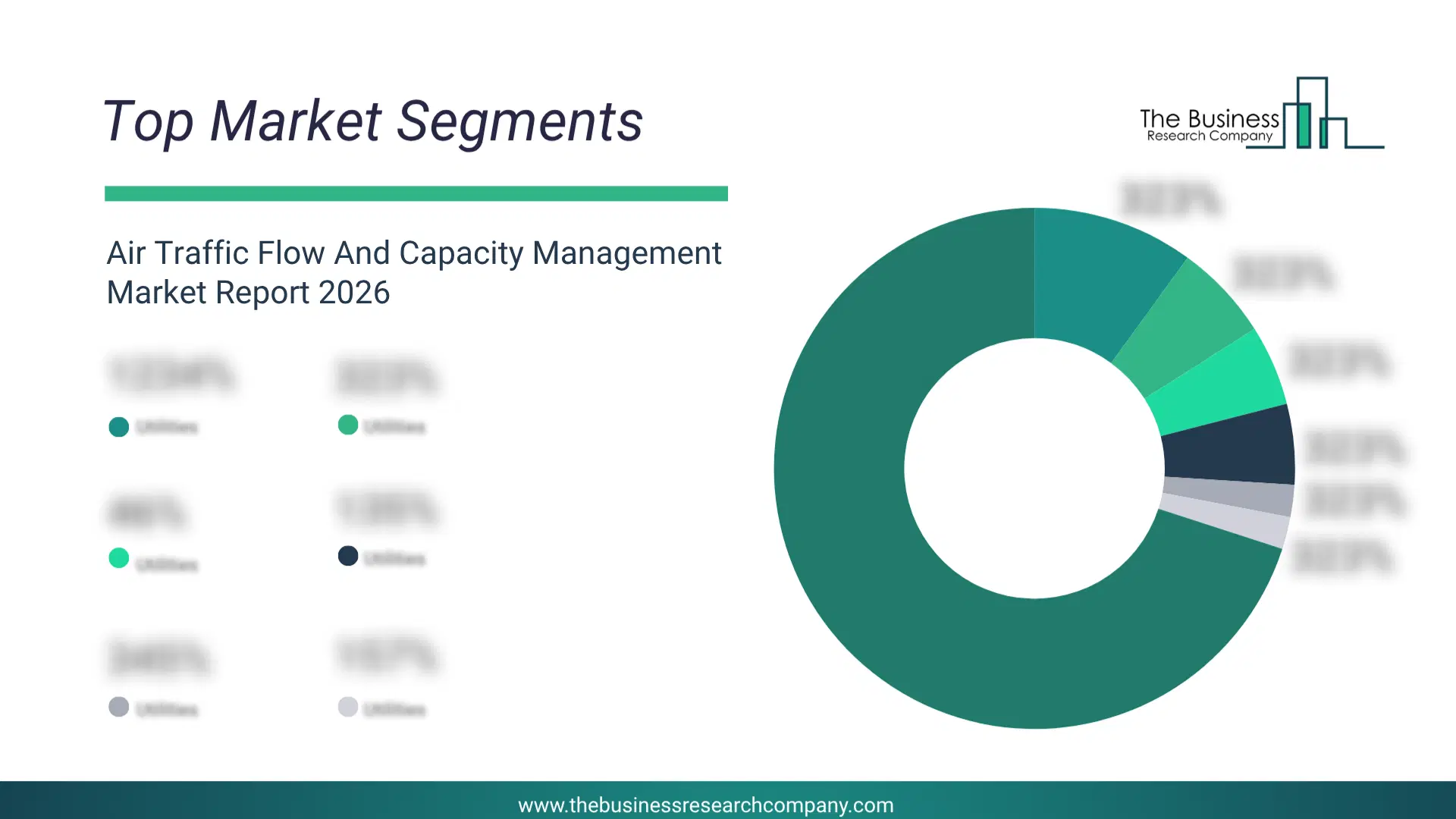
Global Air Traffic Flow And Capacity Management Market Segmentation
2) By Airport Class: Class A, Class B, Class C 3) By Deployment Mode: On Premises, Cloud Based, Hybrid 4) By Application: Air Traffic Control, Airport And Runway Operations, Terminal Airspace Management, Network Operations Management 5) By End User: Air Navigation Service Providers, Civil Aviation Authorities, Airports And Airport Operators, Military And Defense Aviation Authorities Subsegments: 1) By Solutions: Flight Planning And Trajectory Management Solutions, Network Operations Management Solutions, Predictive Analytics And Decision Support Solutions, Weather Information Integration Solutions, Traffic Simulation And Forecasting Solutions 2) By Hardware: Radar Systems, Communication Systems, Navigation Systems, Surveillance Sensors, Controller Workstations 3) By Services: Consulting Services, System Integration Services, Installation And Commissioning Services, Maintenance And Support Services, Training ServicesWhat Is The Driver Of The Air Traffic Flow And Capacity Management Market?
The growing air passenger traffic worldwide is expected to propel the growth of the air traffic flow and capacity management market going forward. Air passenger traffic refers to the movement of travelers carried by commercial airlines on domestic and international routes. The volume of air passenger traffic is rising due to increasing disposable incomes, enabling more people to travel by air for business and leisure purposes. Air passenger traffic growth drives the need for advanced air traffic flow and capacity management (ATFCM) solutions by enabling efficient demand forecasting, congestion management, and optimal utilization of available airspace and airport capacity. For instance, in September 2025, according to the International Civil Aviation Organization (ICAO), a Canada-based specialised agency of the United Nations, the global number of airline passengers is expected to reach 18.7 billion by the year 2045, approximately doubling the 2024 level. Therefore, the growing air passenger traffic worldwide is driving the growth of the air traffic flow and capacity management industry.Key Players In The Global Air Traffic Flow And Capacity Management Market
Major companies operating in the air traffic flow and capacity management market are RTX Corporation, Airbus SE, Lockheed Martin Corporation, Honeywell International Inc., Thales S.A., L3Harris Technologies Inc., Leidos Holdings Inc., Serco Group plc, Embraer S.A., Indra Sistemas S.A., Saab AB, DFS Deutsche Flugsicherung GmbH, NAV CANADA, SITA SC, NATS Holdings Limited, Airservices Australia, ENAV S.p.A., Frequentis AG, Airways International Limited, SkySoft ATM GmbH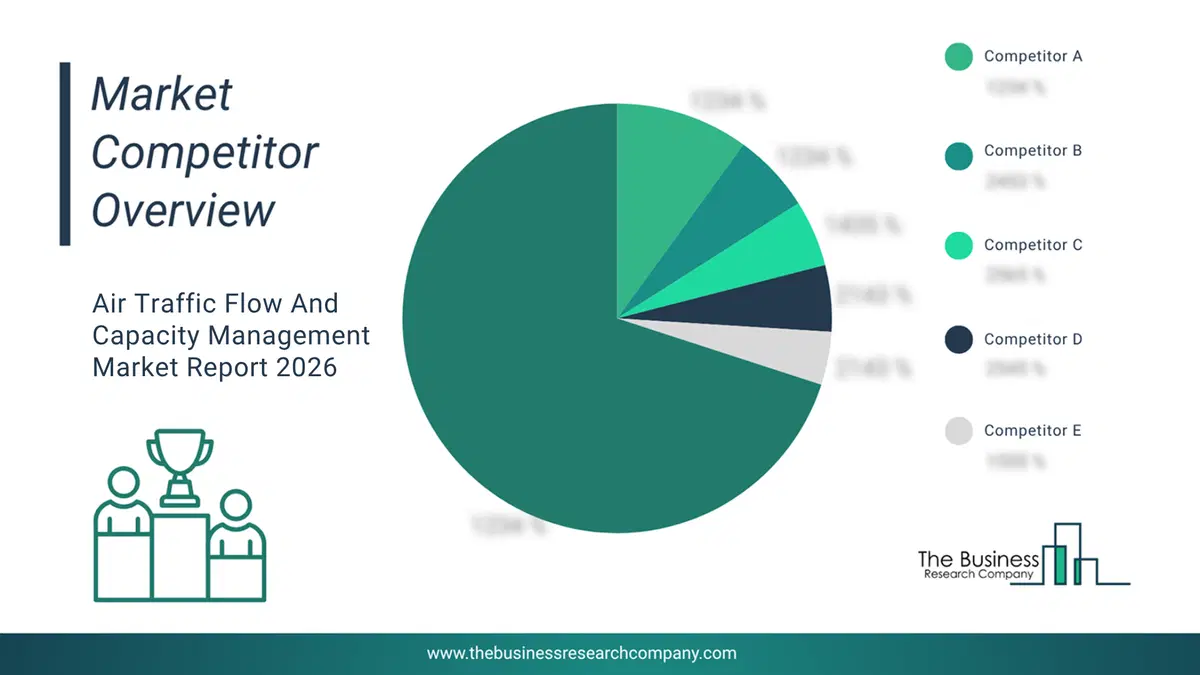
This chart is for illustrative purposes; the full report includes a detailed competitor analysis and comprehensive overview of the top 10 companies in the market.
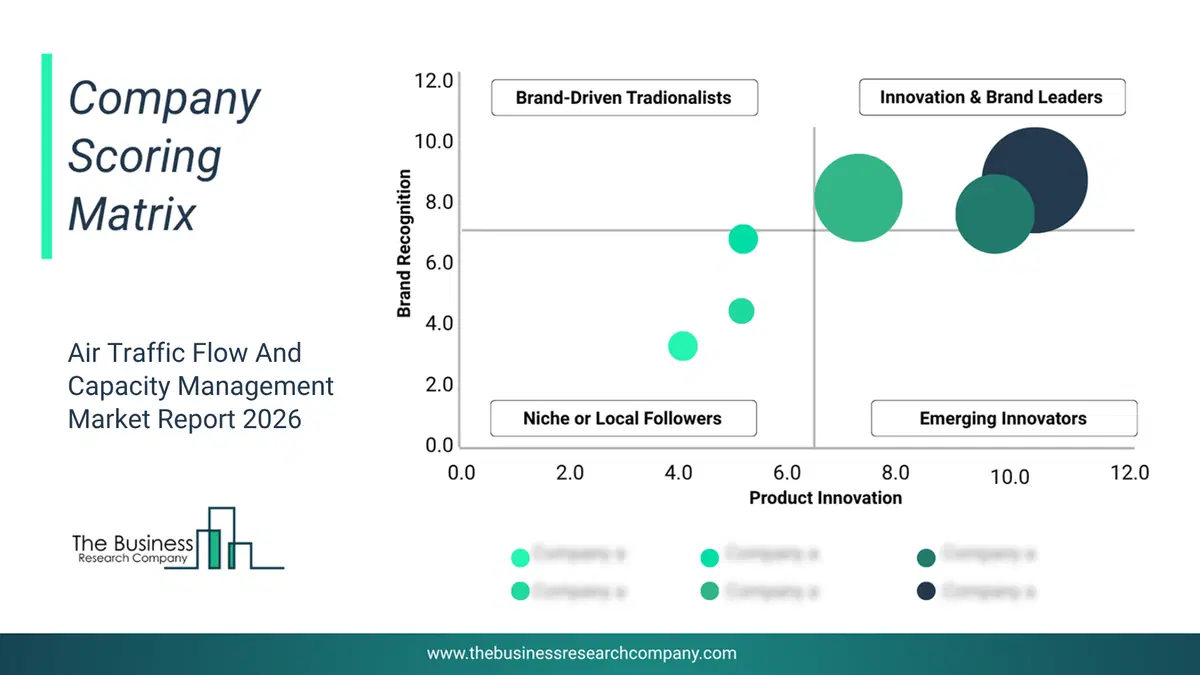
This chart maps companies by product innovation and brand strength, with bubble size indicating relative revenue, helping identify market leaders, challengers, and niche players. This is an illustrative chart; the full report provides a complete and accurate competitive analysis.
Global Air Traffic Flow And Capacity Management Market Trends and Insights
Major companies operating in the air traffic flow and capacity management market are focusing on developing innovative platforms, such as digital air traffic flow management data-sharing platforms, to enhance collaborative decision-making, real-time situational awareness, airspace efficiency, and demand-capacity balancing across aviation networks. Digital air traffic flow management data-sharing platforms are advanced software systems that enable real-time exchange, integration, and synchronization of air traffic information among airlines, airports, and air navigation service providers to improve traffic coordination, capacity management, and operational efficiency. For instance, in May 2026, Metron Aviation Inc., a US-based air traffic management (ATM) and air traffic flow management (ATFM) solutions company, partnered with Civil Air Navigation Services Organisation (CANSO), a Netherlands-based trade association, to launch COMPASS (CANSO Operational Messaging Platform for Air Traffic Flow Management Sharing and Synchronization). The platform provides a shared digital operating environment that enables air navigation service providers, airports, and airlines to exchange real-time operational data and coordinate ATFM decisions across global airspace networks. COMPASS addresses the limitations of fragmented regional ATFM systems by establishing a standardized framework for cross-border information sharing, improving collaborative decision-making and operational visibility. By delivering a unified view of traffic conditions, capacity limitations, and disruptions, the platform enhances situational awareness and supports predictive demand and capacity management. It also enables automated synchronization of operational constraints, allowing aviation stakeholders to proactively manage congestion, improve airspace efficiency, and strengthen the resilience and coordination of global air traffic operations.What Are Latest Mergers And Acquisitions In The Air Traffic Flow And Capacity Management Market?
In March 2025, Stratify Aerospace LLC, a US-based aviation and aerospace company, acquired Metron Aviation Inc. from Airbus for an undisclosed amount. As a result of the acquisition, Stratify Aerospace strengthened its aviation technology and air traffic management capabilities while ensuring a seamless transition for customers and employees through an integrated operational strategy. Metron Aviation Inc. is a US-based provider of air traffic flow and capacity management (ATFCM) solutions that optimize airspace capacity, manage traffic demand, and improve operational efficiency.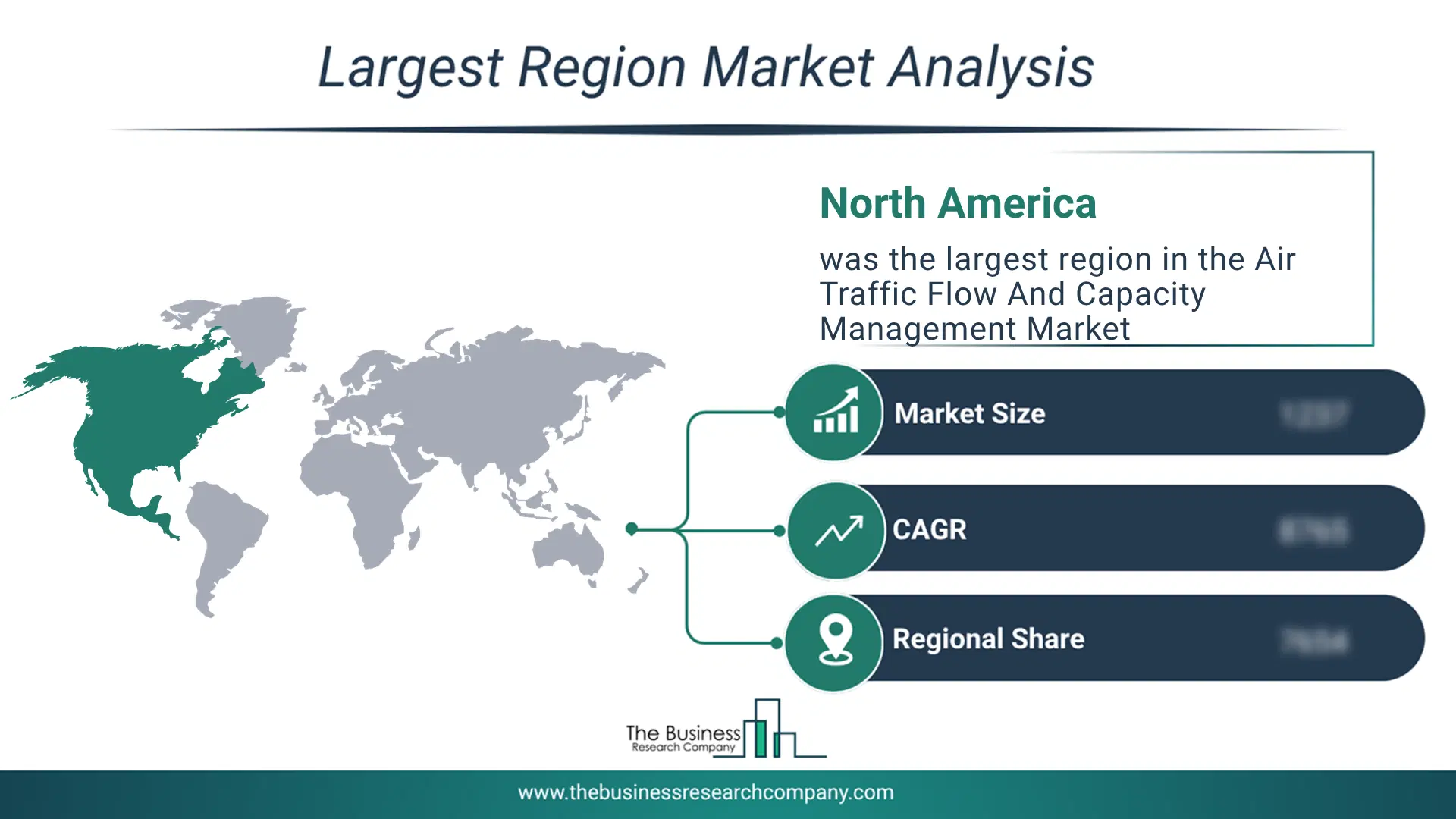
Regional Outlook/Insights
North America was the largest region in the air traffic flow and capacity management market in 2025. Asia-Pacific is expected to be the fastest-growing region in the forecast period. The regions covered in this market report are Asia-Pacific, South East Asia, Western Europe, Eastern Europe, North America, South America, Middle East, Africa. The countries covered in this market report are Australia, Brazil, China, France, Germany, India, Indonesia, Japan, Taiwan, Russia, South Korea, UK, USA, Canada, Italy, Spain.What Defines the Air Traffic Flow And Capacity Management Market?
The air traffic flow and capacity management market consists of revenues earned by entities by providing services such as air traffic flow optimization services, airspace capacity planning and management services, air traffic monitoring and congestion management services, and traffic flow forecasting and predictive analytics services. The market value includes the value of related goods sold by the service provider or included within the service offering. The air traffic flow and capacity management market also includes sales of air traffic management decision-support systems, flight data processing and management systems, and traffic prediction and simulation systems. Values in this market are ‘factory gate’ values, that is the value of goods sold by the manufacturers or creators of the goods, whether to other entities (including downstream manufacturers, wholesalers, distributors and retailers) or directly to end customers. The value of goods in this market includes related services sold by the creators of the goods.How is Market Value Defined and Measured?
The market value is defined as the revenues that enterprises gain from the sale of goods and/or services within the specified market and geography through sales, grants, or donations in terms of the currency (in USD unless otherwise specified). The revenues for a specified geography are consumption values that are revenues generated by organizations in the specified geography within the market, irrespective of where they are produced. It does not include revenues from resales along the supply chain, either further along the supply chain or as part of other products.
This chart presents market attractiveness based on a quantitative evaluation of growth, competition, strategic alignment, and risk, offering a clear view of opportunity areas for decision-making. This chart is for illustrative purposes; the full report contains the complete analysis.

This chart highlights the Total Addressable Market (TAM) by estimating the maximum revenue opportunity using an assumption-driven approach, supporting strategic planning and opportunity sizing across markets. The chart is illustrative; the full report provides a more comprehensive analysis.
What Key Data and Analysis Are Included in the Air Traffic Flow And Capacity Management Market Report 2026?
The air traffic flow and capacity management market research report is one of a series of new reports from The Business Research Company that provides market statistics, including industry global market size, regional shares, competitors with the market share, detailed market segments, market trends and opportunities, and any further data you may need to thrive in the air traffic flow and capacity management industry. The market research report delivers a complete perspective of everything you need, with an in-depth analysis of the current and future state of the industry.Air Traffic Flow And Capacity Management Market Report Forecast Analysis
| Report Attribute | Details |
|---|---|
| Market Size Value In 2026 | $30.16 billion |
| Revenue Forecast In 2030 | $49.73 billion |
| Growth Rate | CAGR of 13.3% from 2026 to 2035 |
| Base Year For Estimation | 2025 |
| Actual Estimates/Historical Data | 2020-2025 |
| Forecast Period | 2026 - 2030 |
| Market Representation | Revenue in USD Billion and CAGR from 2026 to 2030 |
| Segments Covered | Component, Airport Class, Deployment Mode, Application, End User |
| Regional Scope | Asia-Pacific, Western Europe, Eastern Europe, North America, South America, Middle East, Africa |
| Country Scope | The countries covered in the report are Australia, Brazil, China, France, Germany, India, Indonesia, Japan, Taiwan, Russia, South Korea, UK, USA, Canada, Italy, Spain. |
| Customization Scope | Request for Customization |
| Pricing And Purchase Options | Explore Purchase Options |