
Airborne Collision Avoidance System Market Report 2026
Global Outlook – By Component (Hardware, Software, Services), By System Type (Traffic Collision Avoidance System I, Traffic Collision Avoidance System II, Automatic Dependent Surveillance Broadcast Based Collision Avoidance Systems, Portable Collision Avoidance Systems), By Platform (Fixed Wing Aircraft, Rotary Wing Aircraft, Unmanned Aerial Vehicles), By Application (Collision Detection, Traffic Advisory, Resolution Advisory, Situational Awareness), By End User (Commercial Aviation, Military Aviation, General Aviation) – Market Size, Trends, Strategies, and Forecast to 2035
Airborne Collision Avoidance System Market Overview
• Airborne Collision Avoidance System market size has reached to $1.6 billion in 2025 • Expected to grow to $2.22 billion in 2030 at a compound annual growth rate (CAGR) of 6.7% • Growth Driver: Rising Air Passenger Traffic Drives The Market Due To Higher Passenger Capacity Requirements • Market Trend: Advancements In Traffic Awareness And Collision Avoidance Systems Enhance Airborne Collision Avoidance Capabilities • North America was the largest region in 2025 and Asia-Pacific is the fastest growing region.What Is Covered Under Airborne Collision Avoidance System Market?
Airborne collision avoidance systems are onboard aviation safety systems that monitor nearby aircraft and identify potential collision threats using surveillance and traffic data. They provide flight crews with traffic information and, where applicable, automated avoidance guidance or resolution advisories to maintain safe separation between aircraft and reduce the risk of mid-air collisions. The main components of airborne collision avoidance systems include hardware, software, and services. Hardware refers to the physical equipment used to detect nearby aircraft, process traffic information, and support collision avoidance decisions. These systems include traffic collision avoidance system I, traffic collision avoidance system II, automatic dependent surveillance broadcast based collision avoidance systems, and portable collision avoidance systems and are deployed on fixed wing aircraft, rotary wing aircraft, and unmanned aerial vehicles. The various applications involved are collision detection, traffic advisory, resolution advisory, and situational awareness, and they are used by several end users such as commercial aviation, military aviation, and general aviation.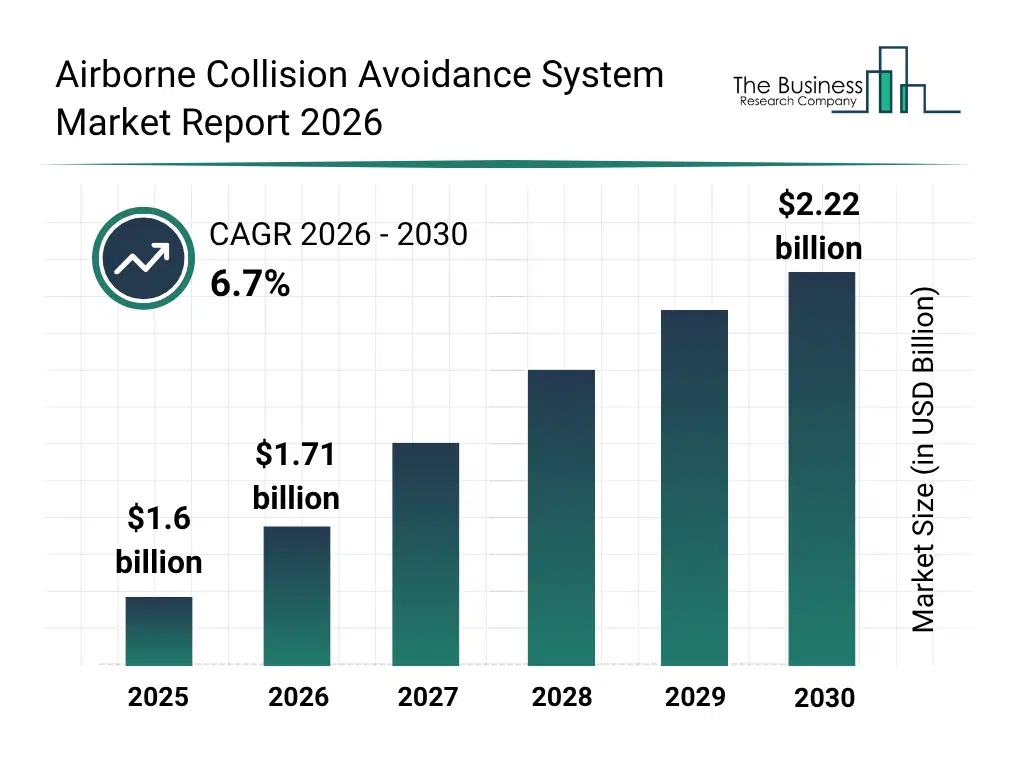
What Is The Airborne Collision Avoidance System Market Size and Share 2026?
The airborne collision avoidance system market size has grown strongly in recent years. It will grow from $1.6 billion in 2025 to $1.71 billion in 2026 at a compound annual growth rate (CAGR) of 7.2%. The growth in the historic period can be attributed to increasing emphasis on aircraft collision prevention, rising adoption of airborne traffic surveillance systems, growing regulatory focus on aircraft separation safety, expanding commercial aircraft fleet operations, increasing demand for enhanced cockpit situational awareness.What Is The Airborne Collision Avoidance System Market Growth Forecast?
The airborne collision avoidance system market size is expected to see strong growth in the next few years. It will grow to $2.22 billion in 2030 at a compound annual growth rate (CAGR) of 6.7%. The growth in the forecast period can be attributed to rising demand for next-generation collision avoidance systems, increasing integration of advanced traffic detection capabilities, growing adoption of unmanned aircraft collision avoidance solutions, expanding deployment of portable collision avoidance systems, increasing need for interoperable aircraft surveillance systems. Major trends in the forecast period include increasing adoption of automatic collision avoidance capabilities, growing integration of enhanced traffic surveillance sensors, rising demand for improved aircraft-to-aircraft data exchange, expanding use of real-time traffic conflict detection systems, increasing deployment of advanced cockpit traffic displays.Tariff Impact On Airborne Collision Avoidance System Market
Tariffs are impacting the airborne collision avoidance system market by increasing the cost of imported collision avoidance processors, antennas, transponders, cockpit display units, and other specialized aviation electronics. This is raising system procurement and integration costs and may slow new installations and upgrades, particularly in regions dependent on imported aerospace components such as Asia-Pacific and Latin America. Hardware-intensive segments including processors, antennas, transponders, and display interfaces are most affected because of global semiconductor and electronic component supply chains. However, tariffs are also encouraging localized manufacturing, regional supplier diversification, and greater investment in domestic aerospace electronics production, supporting long-term supply chain resilience.
Global Airborne Collision Avoidance System Market Segmentation
2) By System Type: Traffic Collision Avoidance System I, Traffic Collision Avoidance System II, Automatic Dependent Surveillance Broadcast Based Collision Avoidance Systems, Portable Collision Avoidance Systems 3) By Platform: Fixed Wing Aircraft, Rotary Wing Aircraft, Unmanned Aerial Vehicles 4) By Application: Collision Detection, Traffic Advisory, Resolution Advisory, Situational Awareness 5) By End User: Commercial Aviation, Military Aviation, General Aviation Subsegments: 1) By Hardware: Collision Avoidance Processors, Directional Antennas, Omnidirectional Antennas, Transponders, Control Display Units, Cockpit Display Interfaces 2) By Software: Collision Risk Assessment Software, Traffic Monitoring Software, Resolution Advisory Software, Flight Data Processing Software, System Management Software 3) By Services: Installation Services, System Integration Services, Calibration Services, Maintenance Services, Repair Services, Inspection Services, Testing Services, Certification Support ServicesWhat Is The Driver Of The Airborne Collision Avoidance System Market?
The rising air passenger traffic is expected to propel the growth of the airborne collision avoidance system market going forward. Air passenger traffic is the total number of passengers traveling by air through airlines, airports, or regions over a specific period, reflecting the overall demand for air travel. Air passenger traffic is increasing due to the expansion of airline networks and routes, which improves connectivity between cities and countries, making air travel more accessible and convenient for passengers. Air passenger traffic drives the airborne collision avoidance system by increasing the number of aircraft operating in shared airspace, which raises the need for advanced safety systems to prevent mid-air collisions and improve flight safety. For instance, in December 2025, according to the International Air Transport Association (IATA), a Canada-based trade association, for 2026, passenger traffic is forecast to grow by 4.9% year over year (YoY), measured in revenue passenger kilometers (RPK), with the Asia-Pacific region expected to lead growth at 7.3%. Therefore, the rising air passenger traffic is driving the growth of the airborne collision avoidance system industry.Key Players In The Global Airborne Collision Avoidance System Market
Major companies operating in the airborne collision avoidance system market are Lockheed Martin Corporation, RTX Corporation, Aviation Communication & Surveillance Systems LLC, Northrop Grumman Corporation, BAE Systems plc, Honeywell International Inc, Thales Group, L3Harris Technologies Inc, Leonardo SpA, Elbit Systems Ltd, Garmin Ltd, Indra Sistemas SA, Saab AB, ASELSAN Elektronik Sanayi ve Ticaret AS, HENSOLDT AG, General Atomics Aeronautical Systems Inc, Trig Avionics Limited, Avidyne Corporation, FreeFlight Systems Inc, Sagetech Avionics Inc, uAvionix Corporation, FLARM Technology Ltd, Dynon Avionics Inc, Aspen Avionics Inc, Air Avionics GmbH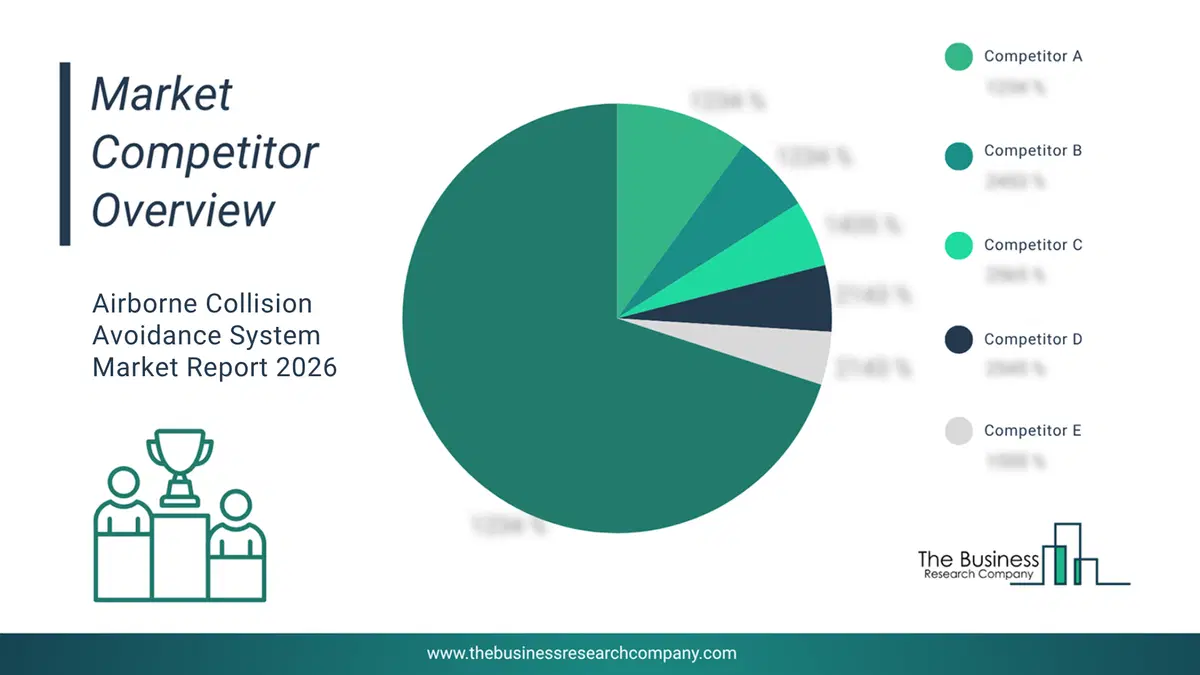
This chart is for illustrative purposes; the full report includes a detailed competitor analysis and comprehensive overview of the top 10 companies in the market.
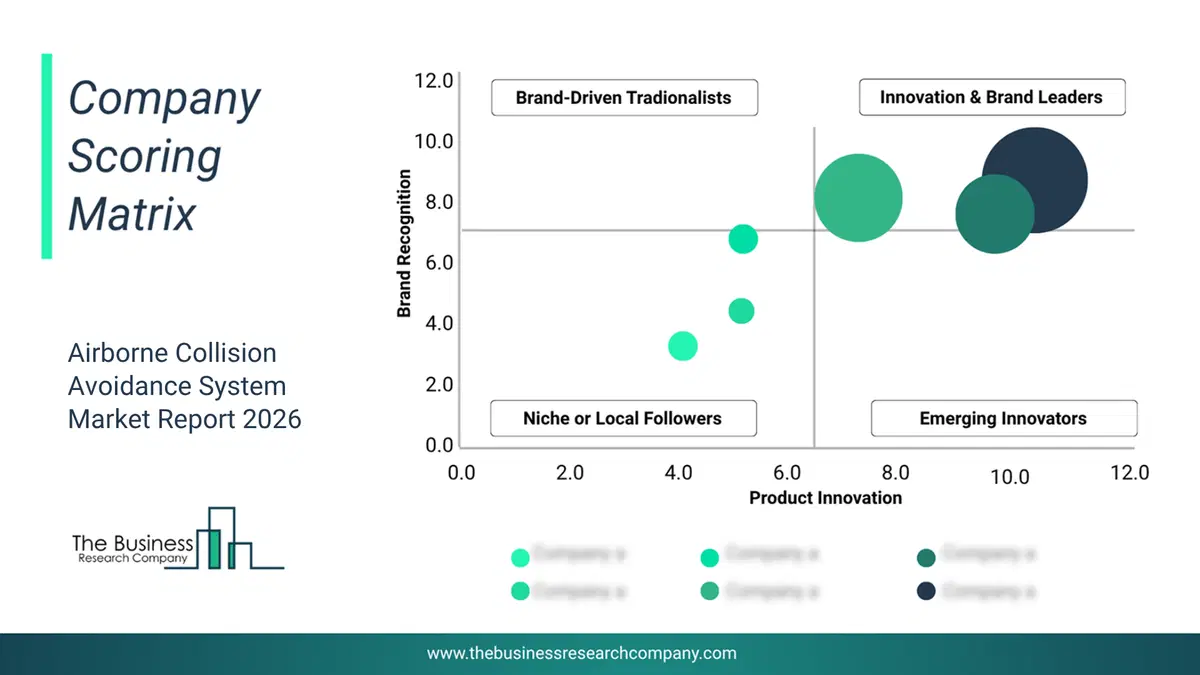
This chart maps companies by product innovation and brand strength, with bubble size indicating relative revenue, helping identify market leaders, challengers, and niche players. This is an illustrative chart; the full report provides a complete and accurate competitive analysis.
Global Airborne Collision Avoidance System Market Trends and Insights
Major companies operating in the airborne collision avoidance system market are focusing on developing advanced systems such as traffic awareness and collision avoidance systems to improve situational awareness, enhance aircraft safety, and reduce the risk of mid-air collisions. Airborne collision avoidance systems are onboard aircraft systems that detect and track nearby aircraft and provide traffic alerts or collision avoidance guidance to pilots, helping maintain safe separation between aircraft. For instance, in October 2025, Avidyne Corporation, a US-based avionics company, launched the SkyTrax 3000 traffic awareness system. The system integrates ADS-B In traffic information with existing TCAS II equipment to provide enhanced traffic surveillance and alerting capabilities, improving pilots’ awareness of surrounding aircraft. This innovation enhances airborne traffic awareness and supports collision avoidance by providing timely traffic information while complementing existing airborne collision avoidance equipment.What Are Latest Mergers And Acquisitions In The Airborne Collision Avoidance System Market?
In April 2026, Aviation Communication & Surveillance Systems (ACSS), a US-based provider of aviation communication and surveillance systems, partnered with Airborne Maintenance & Engineering Services and Innovative Aerosystems to develop an ADS-B In retrofit solution for Boeing 757 and 767 aircraft. With this partnership, the companies aim to integrate ACSS’s ADS-B In technology and Acron Aviation’s TCAS 3000 with Innovative Aerosystems’ flight-deck display integration, enhancing airborne traffic awareness, collision avoidance, and operational safety for commercial aircraft. Airborne Maintenance & Engineering Services is a US-based aircraft maintenance and engineering services provider, while Innovative Aerosystems is a US-based aviation technology company specializing in flight-deck display and avionics solutions.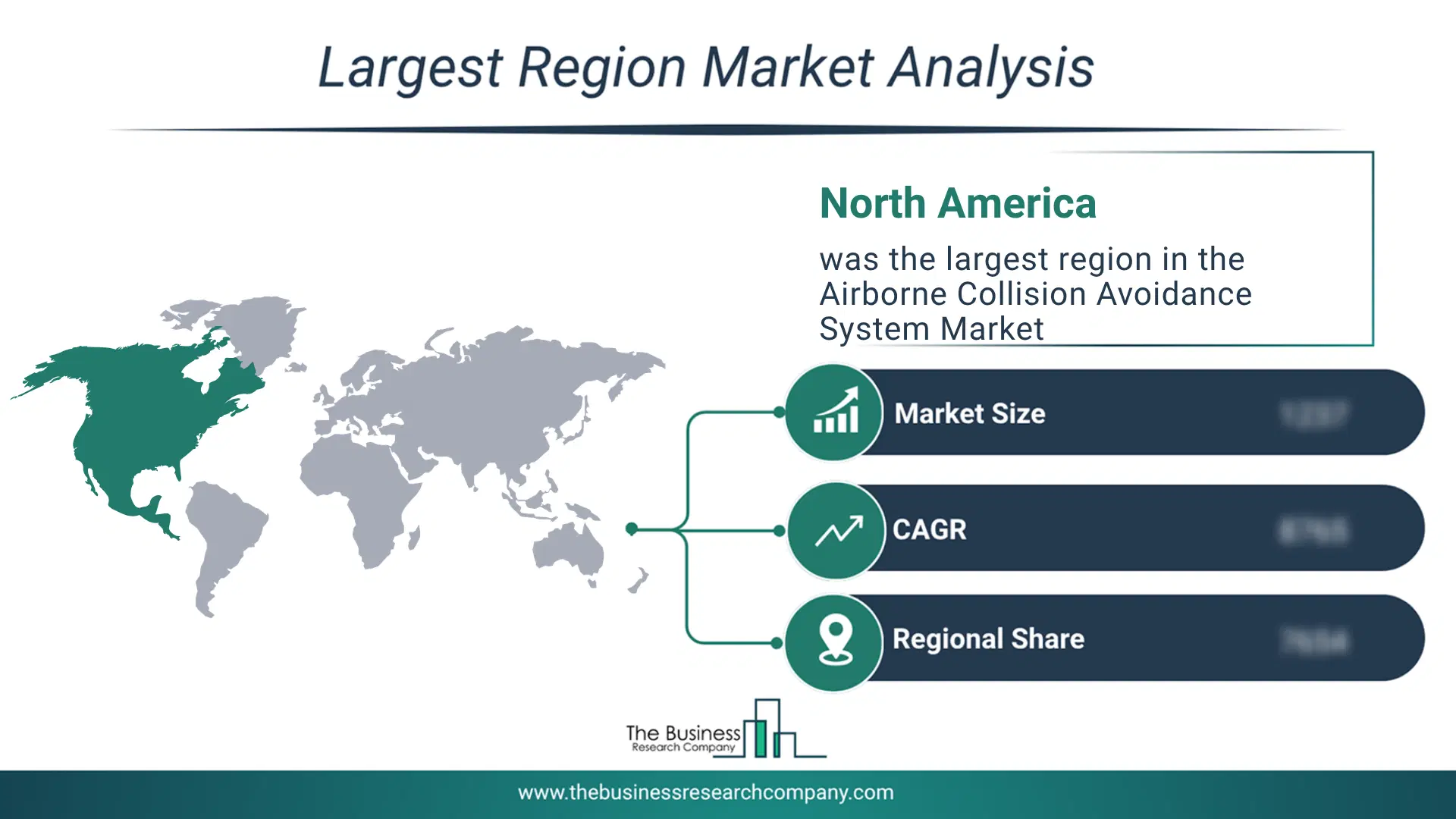
Regional Outlook/Insights
North America was the largest region in the airborne collision avoidance system market in 2025. Asia-Pacific is expected to be the fastest-growing region in the forecast period. The regions covered in this market report are Asia-Pacific, South East Asia, Western Europe, Eastern Europe, North America, South America, Middle East, Africa. The countries covered in this market report are Australia, Brazil, China, France, Germany, India, Indonesia, Japan, Taiwan, Russia, South Korea, UK, USA, Canada, Italy, Spain.What Defines the Airborne Collision Avoidance System Market?
The airborne collision avoidance system market consists of sales of traffic alert and collision avoidance system (TCAS) units, transponder systems, proximity warning systems, and airborne radar systems. Values in this market are ‘factory gate’ values, that is the value of goods sold by the manufacturers or creators of the goods, whether to other entities (including downstream manufacturers, wholesalers, distributors and retailers) or directly to end customers. The value of goods in this market includes related services sold by the creators of the goods.How is Market Value Defined and Measured?
The market value is defined as the revenues that enterprises gain from the sale of goods and/or services within the specified market and geography through sales, grants, or donations in terms of the currency (in USD unless otherwise specified). The revenues for a specified geography are consumption values that are revenues generated by organizations in the specified geography within the market, irrespective of where they are produced. It does not include revenues from resales along the supply chain, either further along the supply chain or as part of other products.
This chart presents market attractiveness based on a quantitative evaluation of growth, competition, strategic alignment, and risk, offering a clear view of opportunity areas for decision-making. This chart is for illustrative purposes; the full report contains the complete analysis.

This chart highlights the Total Addressable Market (TAM) by estimating the maximum revenue opportunity using an assumption-driven approach, supporting strategic planning and opportunity sizing across markets. The chart is illustrative; the full report provides a more comprehensive analysis.
What Key Data and Analysis Are Included in the Airborne Collision Avoidance System Market Report 2026?
The airborne collision avoidance system market research report is one of a series of new reports from The Business Research Company that provides market statistics, including industry global market size, regional shares, competitors with the market share, detailed market segments, market trends and opportunities, and any further data you may need to thrive in the airborne collision avoidance system industry. The market research report delivers a complete perspective of everything you need, with an in-depth analysis of the current and future state of the industry.Airborne Collision Avoidance System Market Report Forecast Analysis
| Report Attribute | Details |
|---|---|
| Market Size Value In 2026 | $1.71 billion |
| Revenue Forecast In 2030 | $2.22 billion |
| Growth Rate | CAGR of 6.7% from 2026 to 2035 |
| Base Year For Estimation | 2025 |
| Actual Estimates/Historical Data | 2020-2025 |
| Forecast Period | 2026 - 2030 |
| Market Representation | Revenue in USD Billion and CAGR from 2026 to 2030 |
| Segments Covered | Component, System Type, Platform, Application, End User |
| Regional Scope | Asia-Pacific, Western Europe, Eastern Europe, North America, South America, Middle East, Africa |
| Country Scope | The countries covered in the report are Australia, Brazil, China, France, Germany, India, Indonesia, Japan, Taiwan, Russia, South Korea, UK, USA, Canada, Italy, Spain. |
| Customization Scope | Request for Customization |
| Pricing And Purchase Options | Explore Purchase Options |