
Airborne Electronic Warfare Market Report 2026
Global Outlook – By Component (Hardware, Software, Services), By Platform (Manned Aircraft, Unmanned Aircraft, Helicopters), By Capability (Electronic Attack, Electronic Protection, Electronic Support), By End User (Air Force, Navy, Army) – Market Size, Trends, Strategies, and Forecast to 2035
Airborne Electronic Warfare Market Overview
• Airborne Electronic Warfare market size has reached to $13.15 billion in 2025 • Expected to grow to $19.07 billion in 2030 at a compound annual growth rate (CAGR) of 7.6% • Growth Driver: Rising Geopolitical Tensions Driving The Market Growth Due To Increasing Demand For Advanced Defense And Threat Detection Capabilities • Market Trend: Advancements In AI-Driven Multi-Mission Aircraft Strengthening Electronic Attack And ISTAR Capabilities • North America was the largest region in 2025 and Asia-Pacific is the fastest growing region.What Is Covered Under Airborne Electronic Warfare Market?
Airborne electronic warfare refers to the use of aircraft-mounted electronic systems to detect, intercept, monitor, disrupt, deceive, or suppress adversary electromagnetic signals and communication networks during military operations. These systems employ technologies such as radar warning, electronic support, electronic attack, and electronic protection to enhance situational awareness, improve mission effectiveness, and protect airborne platforms from electronic threats. Airborne electronic warfare enables secure and resilient operations by controlling and exploiting the electromagnetic spectrum in contested environments. The main components of airborne electronic warfare include hardware, software, and services. Hardware refers to the physical electronic systems used to detect, identify, disrupt, deceive, or protect against electromagnetic signals during airborne operations. These systems are deployed on manned aircraft, unmanned aircraft, and helicopters. They provide electronic attack, electronic protection, and electronic support capabilities and are used by end users including air force, navy, and army.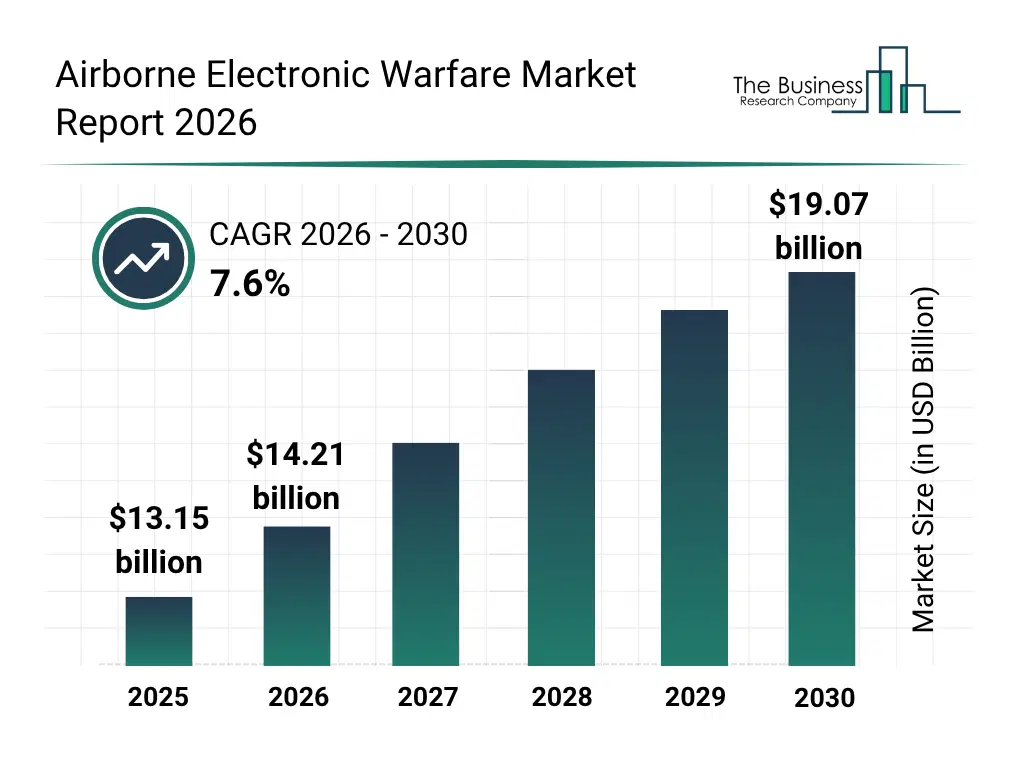
What Is The Airborne Electronic Warfare Market Size and Share 2026?
The airborne electronic warfare market size has grown strongly in recent years. It will grow from $13.15 billion in 2025 to $14.21 billion in 2026 at a compound annual growth rate (CAGR) of 8.1%. The growth in the historic period can be attributed to increasing demand for electromagnetic spectrum dominance, rising military focus on airborne threat detection, growing deployment of electronic support systems, expanding use of radar warning systems on military aircraft, increasing need for protection against hostile electronic signals.What Is The Airborne Electronic Warfare Market Growth Forecast?
The airborne electronic warfare market size is expected to see strong growth in the next few years. It will grow to $19.07 billion in 2030 at a compound annual growth rate (CAGR) of 7.6%. The growth in the forecast period can be attributed to rising demand for advanced electronic attack capabilities, increasing adoption of unmanned airborne electronic warfare platforms, growing need for resilient electromagnetic spectrum operations, expanding deployment of multifunctional electronic warfare systems, increasing demand for rapid threat identification and response. Major trends in the forecast period include increasing adoption of advanced radar warning receivers, growing deployment of electronic support measures for threat detection, rising demand for electronic attack systems for signal disruption, expanding use of electronic protection systems against electromagnetic threats, increasing integration of multifunctional electronic warfare systems.Tariff Impact On Airborne Electronic Warfare Market
Tariffs are impacting the airborne electronic warfare market by increasing the cost of imported antennas, radio frequency receivers, signal processors, electronic controllers, and other specialized defense electronics. This is raising procurement and system integration costs and may delay modernization programs, particularly in regions dependent on imported aerospace and electronic components such as Asia-Pacific and Europe. Hardware-intensive segments including radio frequency receivers, transmitters, signal processors, and antennas are most affected due to global semiconductor and electronic component supply chains. However, tariffs are also encouraging domestic defense manufacturing, regional supplier diversification, and increased investment in local electronic warfare production capabilities, strengthening long-term supply chain resilience.
Global Airborne Electronic Warfare Market Segmentation
2) By Platform: Manned Aircraft, Unmanned Aircraft, Helicopters 3) By Capability: Electronic Attack, Electronic Protection, Electronic Support 4) By End User: Air Force, Navy, Army Subsegments: 1) By Hardware: Antennas, Radio Frequency Receivers, Radio Frequency Transmitters, Signal Processors, Electronic Warfare Controllers 2) By Software: Threat Analysis Software, Signal Processing Software, Mission Planning Software, Electronic Attack Management Software, Electronic Protection Software 3) By Services: System Integration Services, Installation Services, Maintenance And Repair Services, Software Upgrade Services, Training Services, Technical Support ServicesWhat Is The Driver Of The Airborne Electronic Warfare Market?
The rising geopolitical tensions are expected to propel the growth of the airborne electronic warfare market going forward. Geopolitical tensions refer to conflicts, rivalries, or strained relationships between nations or regions arising from political, economic, territorial, or military disputes. Geopolitical tensions are increasing due to increasing territorial disputes, as governments seek to strengthen their territorial claims and national security interests. Rising geopolitical tensions drive demand for airborne electronic warfare systems by increasing the need for advanced electronic attack, electronic protection, and electronic support capabilities that enhance situational awareness, counter hostile radar and communication systems, and improve mission effectiveness in contested environments. For instance, in June 2026, according to the Institute for Economics & Peace (IEP), an Australia-based independent think tank, the number of countries involved in at least one external conflict increased to 103 in the 2026 Global Peace Index. Therefore, the rising geopolitical tensions are driving the growth of the airborne electronic warfare industry.Key Players In The Global Airborne Electronic Warfare Market
Major companies operating in the airborne electronic warfare market are The Boeing Company, RTX Corporation, Lockheed Martin Corporation, Northrop Grumman Corporation, BAE Systems plc, L3Harris Technologies Inc, General Dynamics Corporation, Thales Group, Leonardo S.p.A., Israel Aerospace Industries Ltd, Elbit Systems Ltd, Rafael Advanced Defense Systems Ltd, Sierra Nevada Corporation, Saab AB, ASELSAN A.Ş., HENSOLDT AG, QinetiQ Group plc, Honeywell International Inc, Rohde & Schwarz GmbH & Co KG, Bharat Electronics Limited, Mercury Systems Inc, Terma A/S, Teledyne Technologies Incorporated
This chart is for illustrative purposes; the full report includes a detailed competitor analysis and comprehensive overview of the top 10 companies in the market.
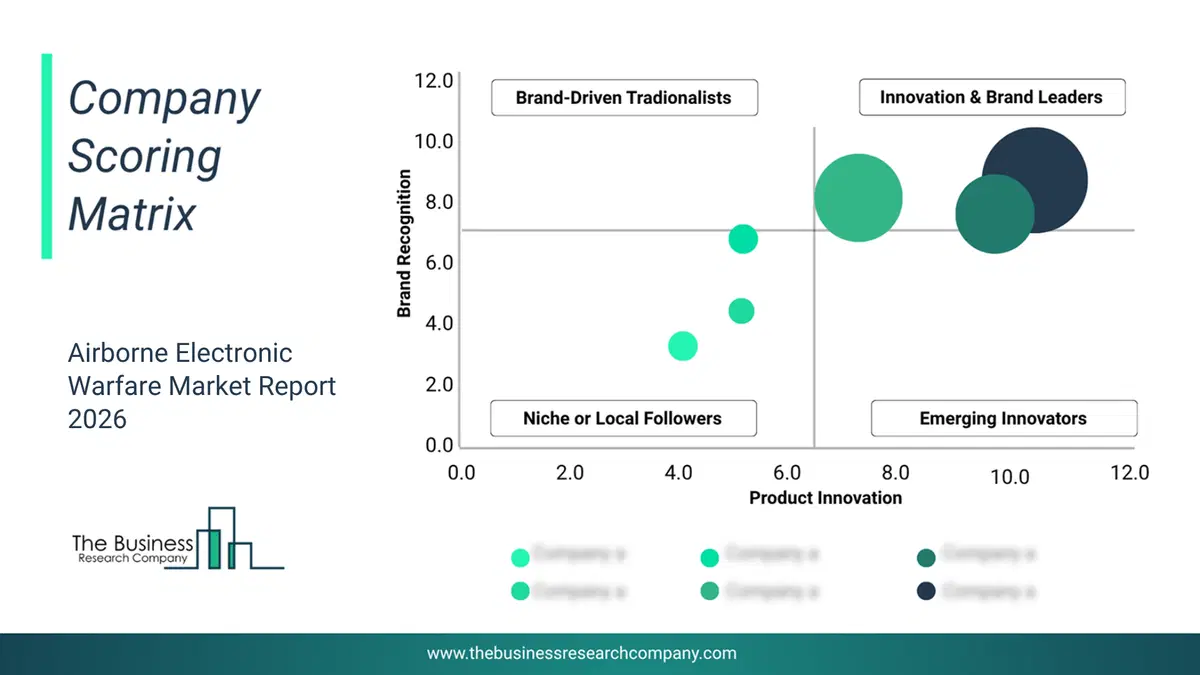
This chart maps companies by product innovation and brand strength, with bubble size indicating relative revenue, helping identify market leaders, challengers, and niche players. This is an illustrative chart; the full report provides a complete and accurate competitive analysis.
Global Airborne Electronic Warfare Market Trends and Insights
Major companies operating in the airborne electronic warfare market are focusing on developing advanced aircrafts such as, AI-enabled multi-mission electronic attack aircraft to enhance electronic warfare capabilities, intelligence gathering, electromagnetic spectrum dominance, and stand-off mission effectiveness. AI-enabled multi-mission electronic attack aircraft are advanced airborne platforms that integrate electronic attack, intelligence, surveillance, target acquisition, and reconnaissance (ISTAR) capabilities into a single system, enabling simultaneous electronic countermeasures, real-time intelligence processing, and long-range operations with greater operational flexibility than conventional single-mission electronic warfare aircraft. For instance, in July 2026, Israel Aerospace Industries Ltd., an Israel-based aerospace and defense company, unveiled ELLYON, a next-generation multi-mission aircraft featuring integrated Electronic Attack (EA) and advanced ISTAR capabilities. The platform combines full-spectrum radar and communications jamming, SIGINT, long-range SAR/GMTI radar, electro-optical sensing, and wide-band satellite communications into a unified airborne system. Powered by an AI-based multi-mission management system, ELLYON processes sensor data in real time to generate actionable intelligence and transmit it to command centers while simultaneously executing radar and communications jamming against airborne and ground-based threats. Designed to operate from stand-off distances and integrate with multiple large business jet platforms, the aircraft enhances mission survivability, accelerates intelligence-to-action cycles, and strengthens electromagnetic battlespace superiority.What Are Latest Mergers And Acquisitions In The Airborne Electronic Warfare Market?
In June 2026, Thales S.A., a France-based aerospace, defense, and advanced technology company that specializes in providing airborne electronic warfare capabilities, partnered with AURA AERO SAS, to enhance sovereign intelligence, surveillance, and reconnaissance (ISR) capabilities through the development of a Medium Altitude Long Endurance (MALE) drone solution. Through this partnership, Thales S.A. and AURA AERO SAS aim to integrate Thales’ AirMaster C airborne surveillance radar and electronic warfare systems into AURA AERO’s Enbata MALE drone, enabling advanced intelligence, surveillance, reconnaissance, maritime surveillance, electronic warfare, and counter-drone operations for the French Armed Forces. AURA AERO SAS is a France-based aerospace company specializing in the design, development, and manufacture of next-generation conventional, hybrid-electric, electric aircraft, and defense unmanned aerial systems (UAS).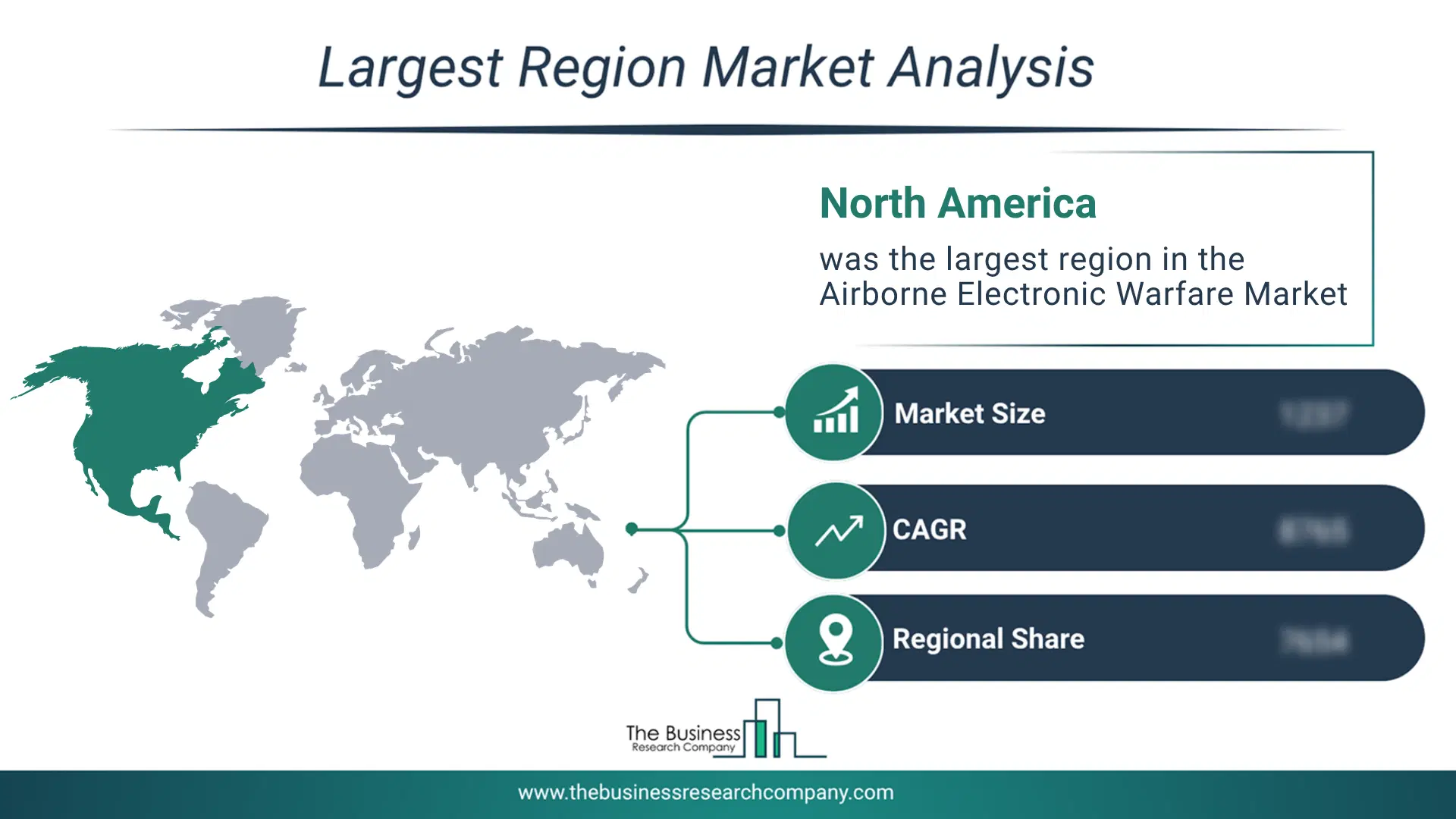
Regional Outlook/Insights
North America was the largest region in the airborne electronic warfare market in 2025. Asia-Pacific is expected to be the fastest-growing region in the forecast period. The regions covered in this market report are Asia-Pacific, South East Asia, Western Europe, Eastern Europe, North America, South America, Middle East, Africa. The countries covered in this market report are Australia, Brazil, China, France, Germany, India, Indonesia, Japan, Taiwan, Russia, South Korea, UK, USA, Canada, Italy, Spain.What Defines the Airborne Electronic Warfare Market?
The airborne electronic warfare market consists of sales of radar warning receivers, electronic support measure systems, electronic countermeasure systems, electronic attack pods, jamming systems, and towed decoys. Values in this market are ‘factory gate’ values, that is the value of goods sold by the manufacturers or creators of the goods, whether to other entities (including downstream manufacturers, wholesalers, distributors and retailers) or directly to end customers. The value of goods in this market includes related services sold by the creators of the goods.How is Market Value Defined and Measured?
The market value is defined as the revenues that enterprises gain from the sale of goods and/or services within the specified market and geography through sales, grants, or donations in terms of the currency (in USD unless otherwise specified). The revenues for a specified geography are consumption values that are revenues generated by organizations in the specified geography within the market, irrespective of where they are produced. It does not include revenues from resales along the supply chain, either further along the supply chain or as part of other products.
This chart presents market attractiveness based on a quantitative evaluation of growth, competition, strategic alignment, and risk, offering a clear view of opportunity areas for decision-making. This chart is for illustrative purposes; the full report contains the complete analysis.

This chart highlights the Total Addressable Market (TAM) by estimating the maximum revenue opportunity using an assumption-driven approach, supporting strategic planning and opportunity sizing across markets. The chart is illustrative; the full report provides a more comprehensive analysis.
What Key Data and Analysis Are Included in the Airborne Electronic Warfare Market Report 2026?
The airborne electronic warfare market research report is one of a series of new reports from The Business Research Company that provides market statistics, including industry global market size, regional shares, competitors with the market share, detailed market segments, market trends and opportunities, and any further data you may need to thrive in the airborne electronic warfare industry. The market research report delivers a complete perspective of everything you need, with an in-depth analysis of the current and future state of the industry.Airborne Electronic Warfare Market Report Forecast Analysis
| Report Attribute | Details |
|---|---|
| Market Size Value In 2026 | $14.21 billion |
| Revenue Forecast In 2030 | $19.07 billion |
| Growth Rate | CAGR of 7.6% from 2026 to 2035 |
| Base Year For Estimation | 2025 |
| Actual Estimates/Historical Data | 2020-2025 |
| Forecast Period | 2026 - 2030 |
| Market Representation | Revenue in USD Billion and CAGR from 2026 to 2030 |
| Segments Covered | Component, Platform, Capability, End User |
| Regional Scope | Asia-Pacific, Western Europe, Eastern Europe, North America, South America, Middle East, Africa |
| Country Scope | The countries covered in the report are Australia, Brazil, China, France, Germany, India, Indonesia, Japan, Taiwan, Russia, South Korea, UK, USA, Canada, Italy, Spain. |
| Customization Scope | Request for Customization |
| Pricing And Purchase Options | Explore Purchase Options |