
Airborne Fire Control Radar Market Report 2026
Global Outlook – By Frequency Band (L And S-Band, X-Band, Ku Or K Or Ka-Band), By Platform (Fighter Jets, Combat Helicopters, Other Platforms), By Application (Air To Ground, Air To Sea, Air To Air) – Market Size, Trends, Strategies, and Forecast to 2030
Airborne Fire Control Radar Market Overview
• Airborne Fire Control Radar market size has reached to $3.04 billion in 2025 • Expected to grow to $3.96 billion in 2030 at a compound annual growth rate (CAGR) of 5.2% • Growth Driver: Increasing Aircraft Demand Boosts Airborne Fire Control Radar Market • Market Trend: Innovations In Multi-Mission Airborne Fire Control Radar Systems • North America was the largest region in 2025 and Asia-Pacific is the fastest growing region.What Is Covered Under Airborne Fire Control Radar Market?
Airborne fire control radars (FCRs) on fast-strike aircraft are the quintessential pulse Doppler radars. They are used to provide target information inputs to a weapon fire control system. The frequency bands in airborne fire control radar are l and s-band, x-band, and Ku, k, or ka-band. L-band refers to the operating frequency range of 1–2 GHz in the radio spectrum. The S-band is part of the electromagnetic spectrum's microwave band, which is defined by the standards set by the IEEE for radio waves. The platforms involved are fighter jets, combat helicopters, and other platforms that are used for air-to-ground, air-to-sea, and air-to-air communications.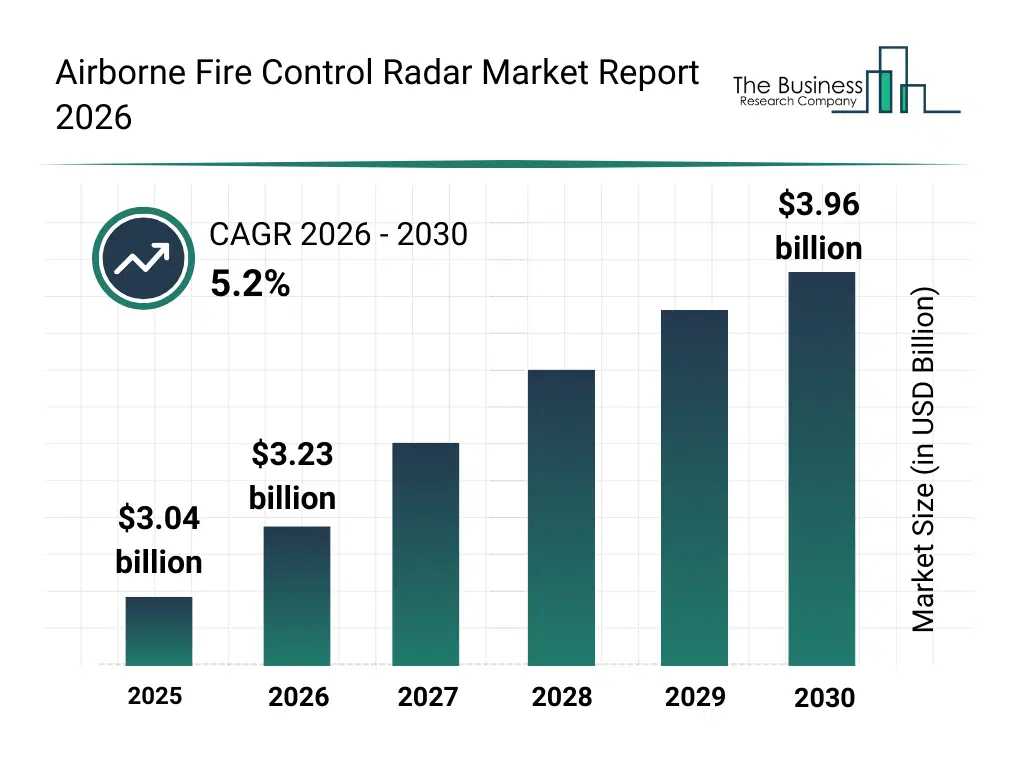
What Is The Airborne Fire Control Radar Market Size and Share 2026?
The airborne fire control radar market size has grown strongly in recent years. It will grow from $3.04 billion in 2025 to $3.23 billion in 2026 at a compound annual growth rate (CAGR) of 6.2%. The growth in the historic period can be attributed to increasing adoption of pulse-doppler radar technologies for advanced target tracking, rising procurement of fast-strike aircraft equipped with integrated fire control radars, modernization programs upgrading legacy airborne radar systems, growing need for precision engagement capabilities in military operations, advancements in radar signal processing improving detection accuracy.What Is The Airborne Fire Control Radar Market Growth Forecast?
The airborne fire control radar market size is expected to see strong growth in the next few years. It will grow to $3.96 billion in 2030 at a compound annual growth rate (CAGR) of 5.2%. The growth in the forecast period can be attributed to expansion of next-generation electronically scanned array radar deployments, rising investment in multi-mode airborne radars supporting complex mission profiles, increasing demand for high-resolution tracking to enhance weapon guidance precision, development of lightweight and power-efficient radar systems for new aircraft platforms, growing emphasis on interoperable radar architectures within network-centric warfare systems. Major trends in the forecast period include integration of ai for target detection and tracking, deployment of autonomous radar systems for rapid threat assessment, use of big data and cloud analytics to enhance radar accuracy, development of miniaturized radar components for lightweight platforms, implementation of multi-mode radar for simultaneous air-to-air, air-to-ground, and air-to-sea operations.
Global Airborne Fire Control Radar Market Segmentation
1) By Frequency Band: L And S-Band, X-Band, Ku Or K Or Ka-Band 2) By Platform: Fighter Jets, Combat Helicopters, Other Platforms 3) By Application: Air To Ground, Air To Sea, Air To Air Subsegments: 1) By L And S-Band: L-Band Radar Systems, S-Band Radar Systems 2) By X-Band: X-Band Radar Systems 3) By Ku Or K Or Ka-Band: Ku-Band Radar Systems, K-Band Radar Systems, Ka-Band Radar SystemsWhat Is Driver Of The Airborne Fire Control Radar Market?
The increasing demand for aircraft is expected to propel the growth of the airborne fire control radar market going forward. An aircraft is a machine that is held aloft in the air and is supported for flight by buoyancy or by the dynamic action of air on its surfaces, especially powered by jet engines or the shape of the aircraft's wing. The airborne fire control radar plays a crucial role in aircraft by providing accurate guidance to pilots while targeting and engaging enemy aircraft or ground targets. For instance, in January 2024, according to Airbus SE, a Netherlands-based manufacturer and developer of aerospace services, solutions, and products, in 2023, the business delivered 735 commercial aircraft to 87 customers worldwide, representing an 11% rise compared to 2022. Therefore, the increasing demand for aircraft is driving the growth of the airborne fire control radar industry.Key Players In The Global Airborne Fire Control Radar Market
Major companies operating in the airborne fire control radar market are Bharat Electronics Limited, Hensoldt AG, Israel Aerospace Industries Ltd., Leonardo S.p.A., Lockheed Martin Corporation, BAE Systems PLC, Northrop Grumman Corporation, Raytheon Technologies Corporation, Saab AB, Thales Group, General Dynamics Corporation, Airbus SE, ASELSAN A.S., Honeywell International Inc., NEC Corporation, L3Harris Technologies Inc., ELTA Systems Ltd., Curtiss-Wright Corporation, Elbit Systems Ltd., Kongsberg Gruppen
This chart is for illustrative purposes; the full report includes a detailed competitor analysis and comprehensive overview of the top 10 companies in the market.
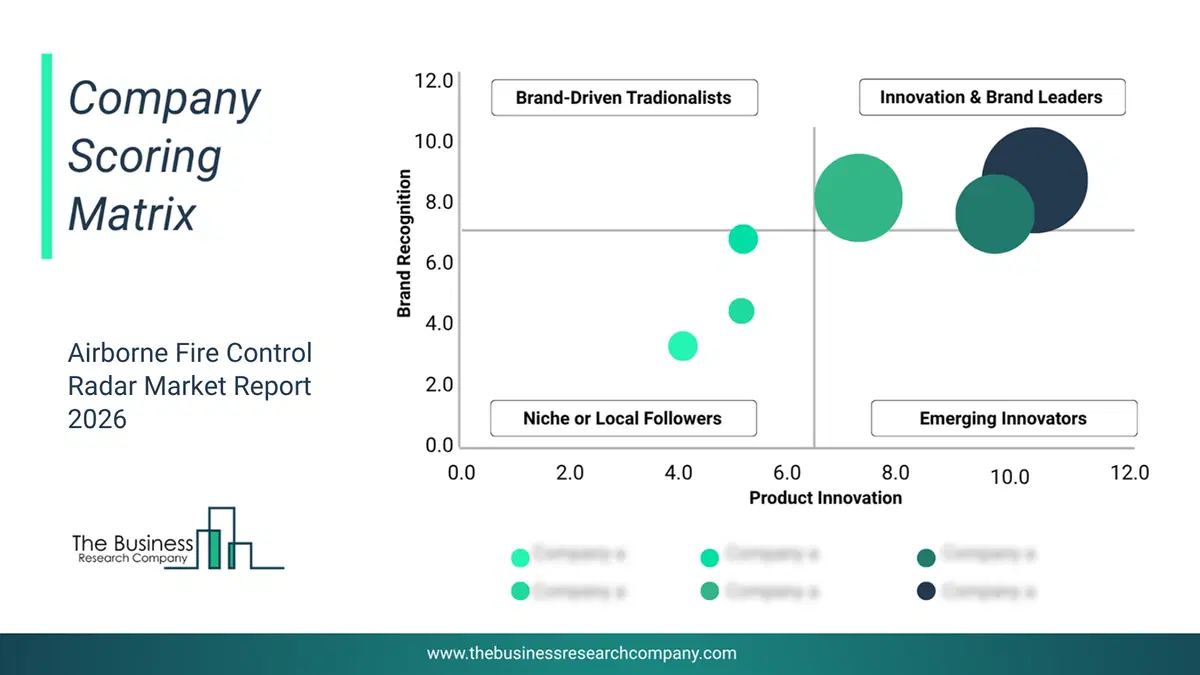
This chart maps companies by product innovation and brand strength, with bubble size indicating relative revenue, helping identify market leaders, challengers, and niche players. This is an illustrative chart; the full report provides a complete and accurate competitive analysis.
Global Airborne Fire Control Radar Market Trends and Insights
Major companies operating in the airborne fire control radar market are focusing on developing innovative solutions, such as multi-mission radar systems, to meet the rising demand for enhanced targeting capabilities in modern military operations. A multi-mission radar system is a flexible radar that performs surveillance, target tracking, and threat detection simultaneously, enhancing situational awareness and operational adaptability across military and civilian applications. For instance, in May 2025, SRC Inc., a US-based defense technology company, launched Gryphon R1430/R1440 systems to expand its Gryphon Multi-Mission Radar family. These new radar systems are designed to provide enhanced situational awareness and targeting precision for both manned and unmanned aerial platforms. The Gryphon R1430/R1440 systems incorporate advanced signal processing techniques and modular designs, allowing for rapid adaptation to evolving mission requirements. Their capabilities include high-resolution imaging, real-time data fusion, and robust performance in contested environments. These features position the Gryphon R1430/R1440 as a significant advancement over traditional radar systems, offering improved operational effectiveness and mission success rates.What Are Latest Mergers And Acquisitions In The Airborne Fire Control Radar Market? BlueHalo Acquires Verus Technology Group to Enhance Defense and Space Capabilities
In April 2023, BlueHalo LLC, a US-based defense and space manufacturing companies, acquired Verus Technology Group Inc. for an undisclosed amount. The acquisition of Verus will bolster BlueHalo’s offerings by merging Verus’s technology with BlueHalo’s AI-driven RF-based Titan c-UAS, Locust directed energy c-UAS, and Argus Perimeter Security solutions. Verus Technology Group Inc. is a US-based defense and space manufacturing company specialize in RF-based detection and fire control radar solution.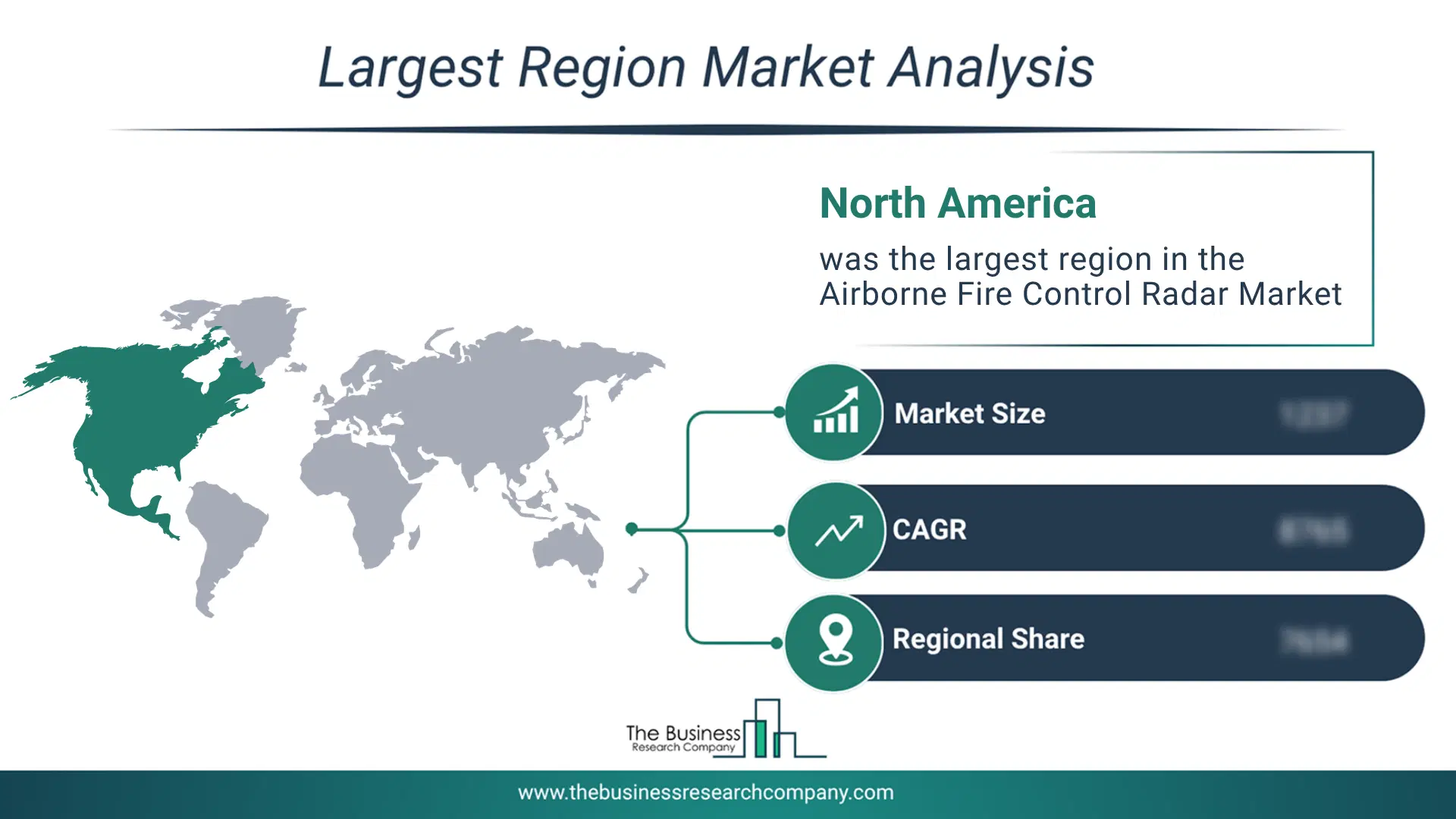
Regional Insights
North America was the largest region in the airborne fire control radar market in 2025. Asia-Pacific is expected to be the fastest-growing region in the forecast period. The regions covered in this market report are Asia-Pacific, South East Asia, Western Europe, Eastern Europe, North America, South America, Middle East, Africa. The countries covered in this market report are Australia, Brazil, China, France, Germany, India, Indonesia, Japan, Taiwan, Russia, South Korea, UK, USA, Canada, Italy, SpainWhat Defines the Airborne Fire Control Radar Market?
The airborne fire control radar market consists of sales of airborne fire control radars used to control the delivery of fire on a military target. Values in this market are ‘factory gate’ values, that is, the value of goods sold by the manufacturers or creators of the goods, whether to other entities (including downstream manufacturers, wholesalers, distributors, and retailers) or directly to end customers. The value of goods in this market includes related services sold by the creators of the goods.How is Market Value Defined and Measured?
The market value is defined as the revenues that enterprises gain from the sale of goods and/or services within the specified market and geography through sales, grants, or donations in terms of the currency (in USD unless otherwise specified). The revenues for a specified geography are consumption values that are revenues generated by organizations in the specified geography within the market, irrespective of where they are produced. It does not include revenues from resales along the supply chain, either further along the supply chain or as part of other products.
This chart presents market attractiveness based on a quantitative evaluation of growth, competition, strategic alignment, and risk, offering a clear view of opportunity areas for decision-making. This chart is for illustrative purposes; the full report contains the complete analysis.

This chart highlights the Total Addressable Market (TAM) by estimating the maximum revenue opportunity using an assumption-driven approach, supporting strategic planning and opportunity sizing across markets. The chart is illustrative; the full report provides a more comprehensive analysis.
What Key Data and Analysis Are Included in the Airborne Fire Control Radar Market Report 2026?
The airborne fire control radar market research report is one of a series of new reports from The Business Research Company that provides market statistics, including industry global market size, regional shares, competitors with the market share, detailed market segments, market trends and opportunities, and any further data you may need to thrive in the airborne fire control radar industry. The market research report delivers a complete perspective of everything you need, with an in-depth analysis of the current and future state of the industry.Airborne Fire Control Radar Market Report Forecast Analysis
| Report Attribute | Details |
|---|---|
| Market Size Value In 2026 | $3.23 billion |
| Revenue Forecast In 2030 | $3.96 billion |
| Growth Rate | CAGR of 5.2% from 2026 to 2030 |
| Base Year For Estimation | 2025 |
| Actual Estimates/Historical Data | 2020-2025 |
| Forecast Period | 2026 - 2030 |
| Market Representation | Revenue in USD Billion and CAGR from 2026 to 2030 |
| Segments Covered | Frequency Band, Platform, Application |
| Regional Scope | Asia-Pacific, Western Europe, Eastern Europe, North America, South America, Middle East, Africa |
| Country Scope | The countries covered in the airborne fire control radar market report are Australia, Brazil, China, France, Germany, India, Indonesia, Japan, Taiwan, Russia, South Korea, UK, USA, Canada, Italy, Spain |
| Key Companies Profiled | Bharat Electronics Limited, Hensoldt AG, Israel Aerospace Industries Ltd., Leonardo S.p.A., Lockheed Martin Corporation, BAE Systems PLC, Northrop Grumman Corporation, Raytheon Technologies Corporation, Saab AB, Thales Group, General Dynamics Corporation, Airbus SE, ASELSAN A.S., Honeywell International Inc., NEC Corporation, L3Harris Technologies Inc., ELTA Systems Ltd., Curtiss-Wright Corporation, Elbit Systems Ltd., Kongsberg Gruppen |
| Customization Scope | Request for Customization |
| Pricing And Purchase Options | Explore Purchase Options |