
Airborne Pathogen Detector Market Report 2026
Global Outlook – By Product Type (Fixed Or Stationary Systems, Portable Devices, Handheld Detectors, Wearable Detectors), By Pathogen Type (Viral Pathogen Detection, Bacterial Pathogen Detection, Fungal Pathogen Detection, Multi-Pathogen Detection), By Connectivity (Standalone Systems, Cloud-Based Systems, Internet Of Things Enabled Systems), By Application (Healthcare Facilities, Airports And Transportation Hubs, Industrial And Commercial Buildings, Military And Defense, Public Spaces, Other Applications), By End-User (Hospitals And Clinics, Government And Public Health Agencies, Research Institutes, Commercial And Industrial, Other End-Users) – Market Size, Trends, Strategies, and Forecast to 2030
Airborne Pathogen Detector Market Overview
• Airborne Pathogen Detector market size has reached to $1.86 billion in 2025 • Expected to grow to $3.63 billion in 2030 at a compound annual growth rate (CAGR) of 14.4% • Growth Driver: The Rise In Infectious Diseases Driving The Growth Of The Market Due To Globalization And Travel • Market Trend: Innovative Hands-Free Biosensor Platform Enables Real-Time Pathogen Detection And Mitigation • North America was the largest region in 2025 and Asia-Pacific is the fastest growing region.What Is Covered Under Airborne Pathogen Detector Market?
An airborne pathogen detector is a device or system designed to identify and monitor the presence of harmful microorganisms, such as bacteria, viruses, or fungi, in the air. It works by capturing airborne particles and analyzing them in real time or near real time to provide early warnings for potential health risks or contamination. The main product types of airborne pathogen detector include fixed or stationary systems, portable devices, handheld detectors, and wearable detectors. Fixed or stationary systems refer to permanently installed detection solutions designed to continuously monitor air quality and identify the presence of harmful airborne pathogens within enclosed or high-risk environments. They are designed to detect viral pathogen detection, bacterial pathogen detection, fungal pathogen detection, and multi-pathogen detection with different connectivities including standalone systems, cloud-based systems, and internet of things enabled systems. They find application in healthcare facilities, airports and transportation hubs, industrial and commercial buildings, military and defense, public spaces, and other applications, serving end users including hospitals and clinics, government and public health agencies, research institutes, commercial and industrial, and other end-users.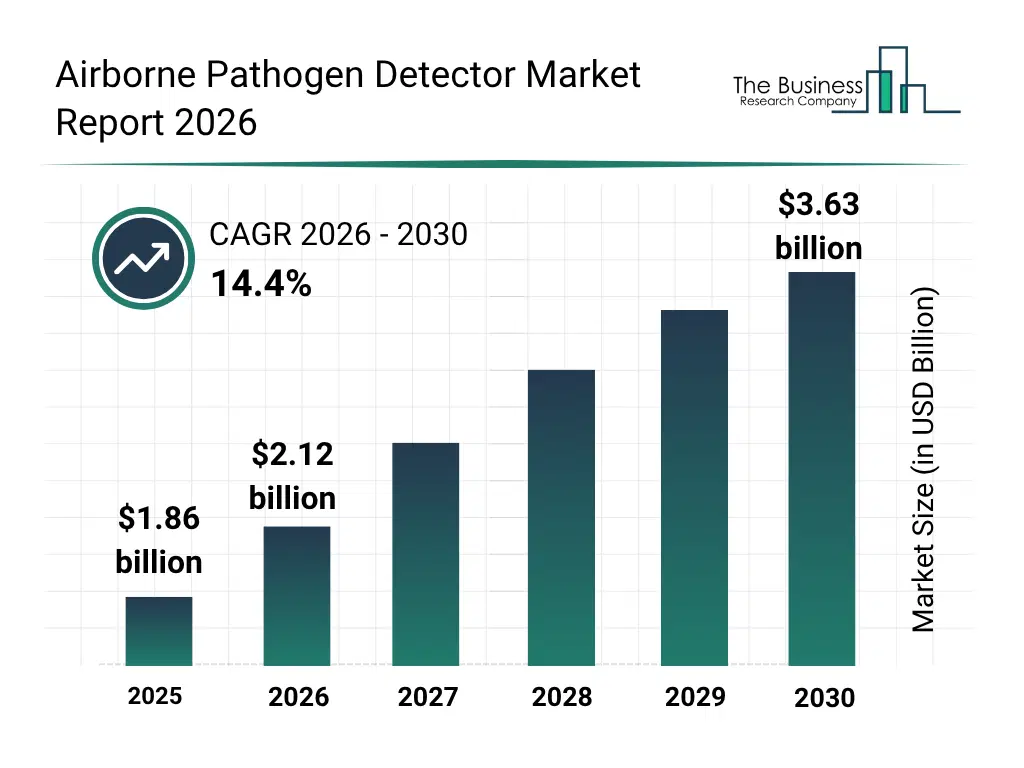
What Is The Airborne Pathogen Detector Market Size and Share 2026?
The airborne pathogen detector market size has grown rapidly in recent years. It will grow from $1.86 billion in 2025 to $2.12 billion in 2026 at a compound annual growth rate (CAGR) of 14.1%. The growth in the historic period can be attributed to increasing awareness of airborne diseases, rising public health monitoring initiatives, adoption of fixed and stationary detection systems, technological advances in pathogen sensing, expansion of healthcare infrastructure.What Is The Airborne Pathogen Detector Market Growth Forecast?
The airborne pathogen detector market size is expected to see rapid growth in the next few years. It will grow to $3.63 billion in 2030 at a compound annual growth rate (CAGR) of 14.4%. The growth in the forecast period can be attributed to growing demand for IoT-enabled detection devices, increasing integration with AI-driven analytics, rising need for portable and wearable pathogen monitors, expansion of industrial and commercial air safety regulations, growing adoption in transportation hubs and public spaces. Major trends in the forecast period include increasing adoption of portable and wearable detectors, rising demand for real-time pathogen monitoring, growing integration with cloud-based systems, expansion of multi-pathogen detection capabilities, rising focus on healthcare and public safety applications.
Global Airborne Pathogen Detector Market Segmentation
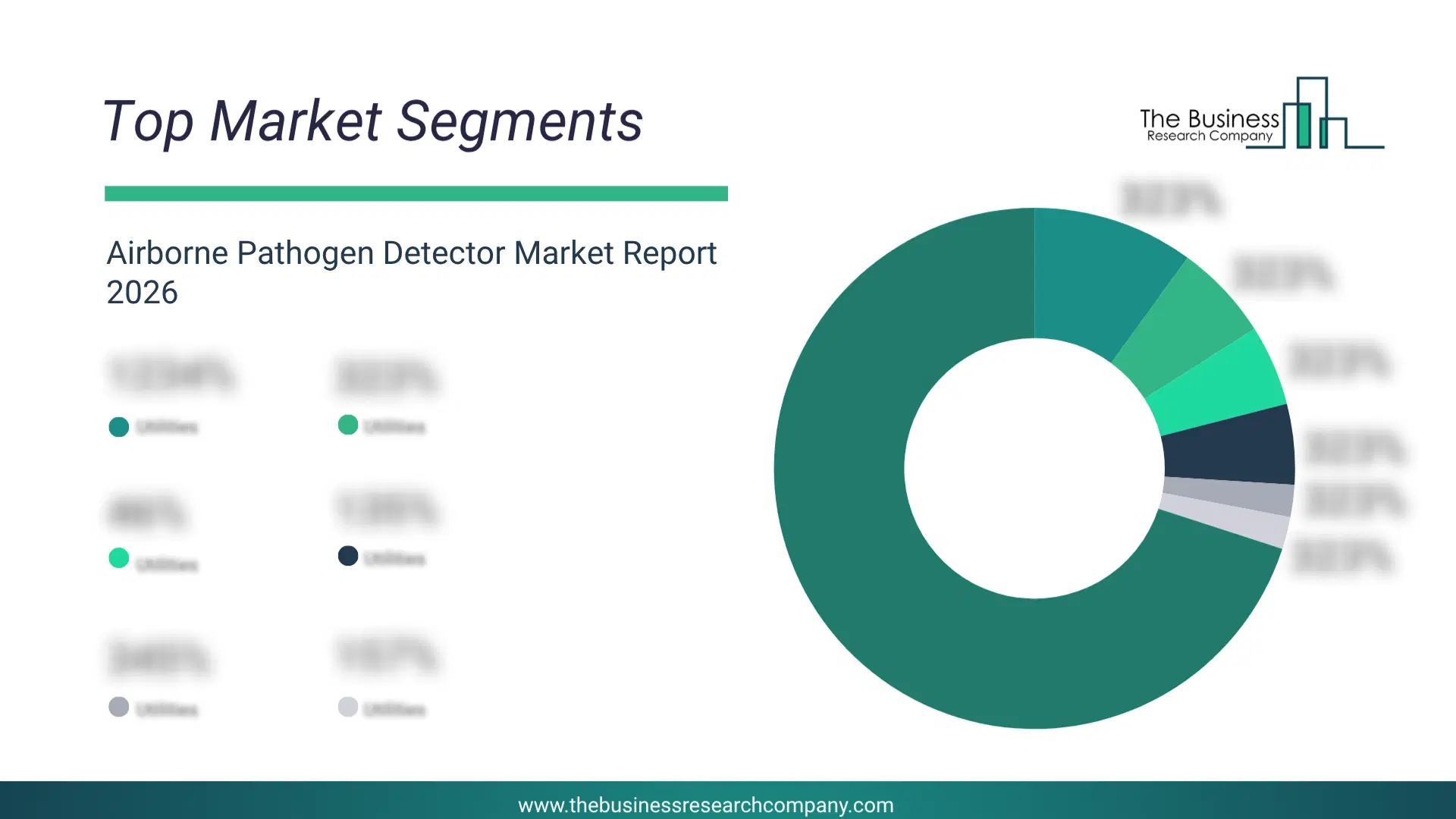
1) By Product Type: Fixed Or Stationary Systems, Portable Devices, Handheld Detectors, Wearable Detectors 2) By Pathogen Type: Viral Pathogen Detection, Bacterial Pathogen Detection, Fungal Pathogen Detection, Multi-Pathogen Detection 3) By Connectivity: Standalone Systems, Cloud-Based Systems, Internet Of Things Enabled Systems 4) By Application: Healthcare Facilities, Airports And Transportation Hubs, Industrial And Commercial Buildings, Military And Defense, Public Spaces, Other Applications 5) By End-User: Hospitals And Clinics, Government And Public Health Agencies, Research Institutes, Commercial And Industrial, Other End-Users Subsegments: 1) By Fixed Or Stationary Systems: Room Air Monitors, Duct Mounted Detectors, Facility Wide Surveillance Systems, Centralized Laboratory Based Systems, Industrial Grade Air Samplers 2) By Portable Devices: Battery Operated Air Samplers, Backpack Mounted Detectors, Transportable Laboratory Systems, Field Deployable Units 3) By Handheld Detectors: Single Pathogen Testers, Multiplex Assay Devices, Real Time Polymerase Chain Reaction Analyzers, Immunoassay Based Testers 4) By Wearable Detectors: Personal Exposure Monitors, Badge Style Detectors, Clip On Sensors, Smart Clothing Integrated SensorsWhat Is The Driver Of The Airborne Pathogen Detector Market?
The increasing prevalence of infectious diseases is expected to drive the growth of the airborne pathogen detector market over the forecast period. Infectious diseases are caused by pathogenic microorganisms that can spread through environmental exposure, including airborne transmission. The rising incidence of these diseases is attributed to multiple factors, including increased globalization and international travel, growing urbanization and population density, antimicrobial resistance, and the impacts of climate change on pathogen survival and transmission. Airborne pathogen detectors support early identification and continuous monitoring of infectious agents in indoor and outdoor environments, enabling timely public health interventions, outbreak prevention, and enhanced infection control measures in healthcare facilities, transportation hubs, and public spaces. For instance, in March 2024, according to the Centers for Disease Control and Prevention, a US-based government agency, the number of tuberculosis cases in the United States increased from 8,320 in 2022 to 9,615 in 2023, representing an increase of 1,295 cases. Therefore, the increasing prevalence of infectious diseases is driving the growth of the airborne pathogen detector industry.Key Players In The Global Airborne Pathogen Detector Market
Major companies operating in the airborne pathogen detector market are Thermo Fisher Scientific Inc., Honeywell International Inc., 3M Company, Charles River Laboratories International Inc., Smiths Detection Group Limited, Sartorius Aktiengesellschaft, Shimadzu Corporation, Teledyne FLIR LLC, TSI Incorporated, Particle Measuring Systems Inc., Bertin Technologies SAS, Kanomax USA Inc., RION Co Ltd., Kromek Group plc, Climet Instruments Company Inc., Varro Life Sciences Inc., Aerosol Devices Inc., SafeTraces Inc., Health Enviro Testing Inc., Scanit Technologies Pvt. Ltd.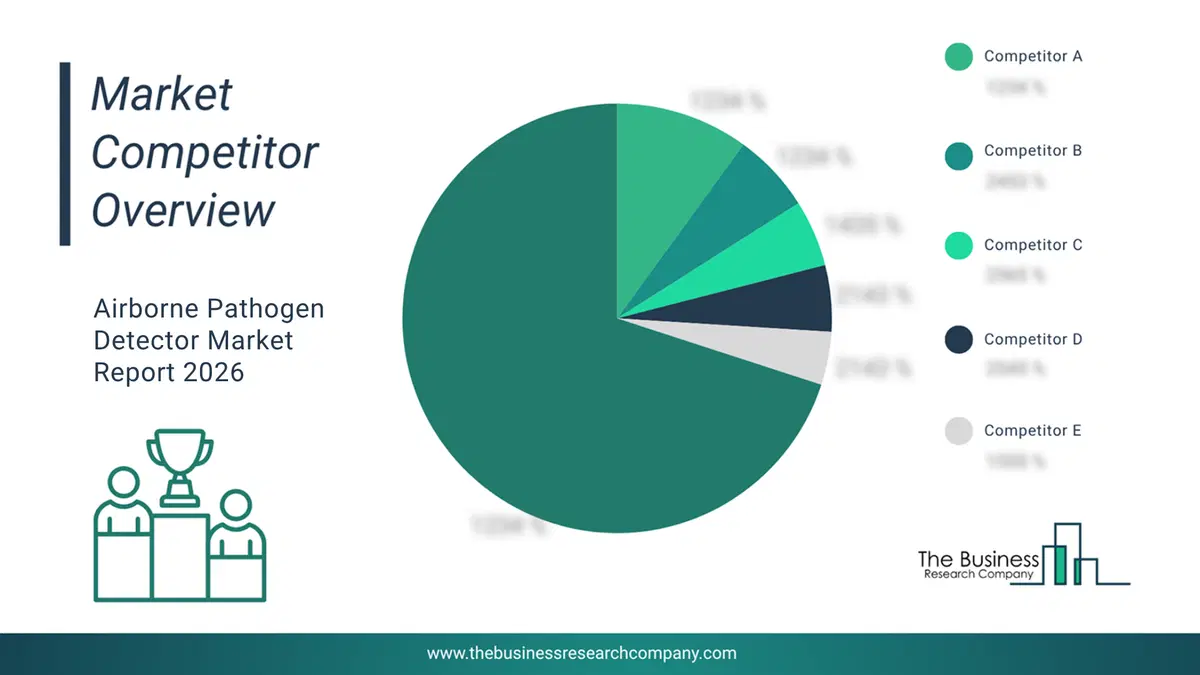
This chart is for illustrative purposes; the full report includes a detailed competitor analysis and comprehensive overview of the top 10 companies in the market.
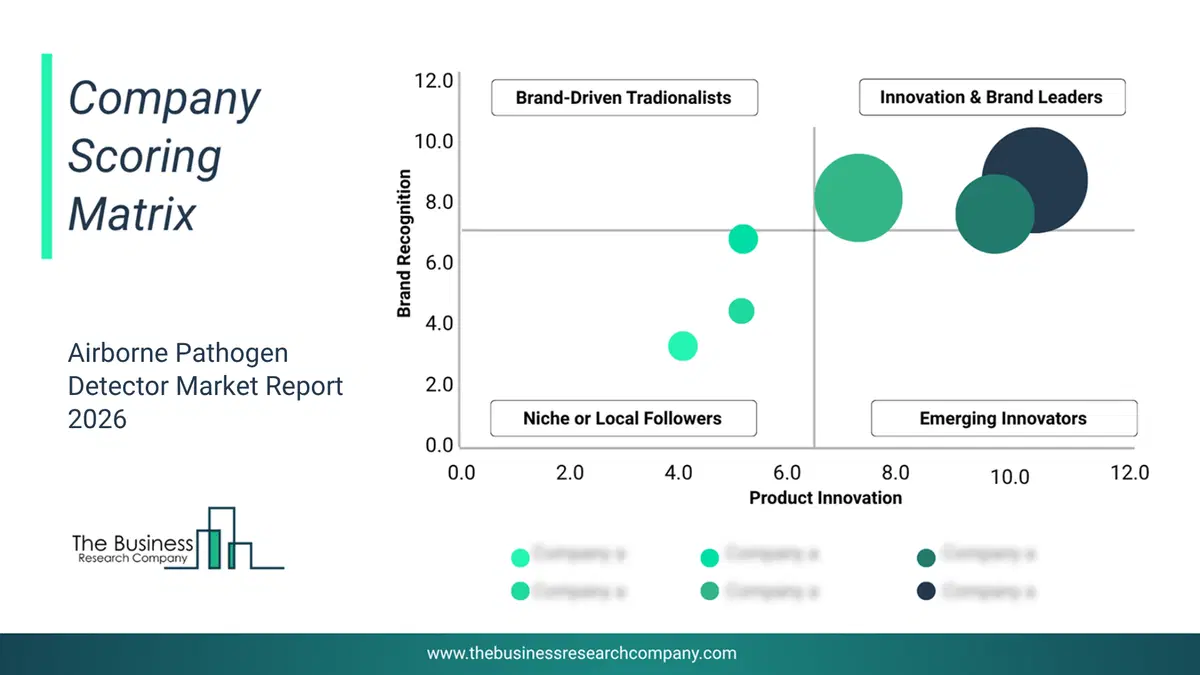
This chart maps companies by product innovation and brand strength, with bubble size indicating relative revenue, helping identify market leaders, challengers, and niche players. This is an illustrative chart; the full report provides a complete and accurate competitive analysis.
Global Airborne Pathogen Detector Market Trends and Insights
Major companies operating in the airborne pathogen detector market are focusing on developing innovative solutions such as, hands free biosensor platforms for rapid, real time detection and mitigation of airborne pathogens. A hand free biosensor platform is an automated device that continuously samples and analyzes air or surfaces for pathogens without requiring manual handling or intervention. For instance, in July 2025, SafeTraces, Inc., a U.S. based biotechnology company, launched PathogenSentinel, the first integrated qPCR-based biosensor and software platform designed for rapid detection and mitigation of airborne pathogens, marking a major advancement in airborne pathogen detection technology. The system pairs a compact, desktop-sized device with a high-flow air sampler and replaceable cartridges capable of automatically detecting up to four user-specified pathogens. Complemented by a web-based application, it provides near real-time alerts, API integration, and data trending for proactive risk management. Its hands-free operation and laboratory-quality results substantially improve responsiveness and scalability in environments such as biosafety laboratories and other high-risk indoor settings.What Are Latest Mergers And Acquisitions In The Airborne Pathogen Detector Market?
In September 2024, BIOASTER, a France-based microbiology innovation institute, entered into a new partnership with ZYNNON AG, a Switzerland-based company specializing in pathogen VOC detection technology. Through this partnership, BIOASTER and ZYNNON aim to advance volatile organic compound (VOC)-based methods for the rapid detection and identification of bacterial and fungal pathogens in clinical and industrial microbiology settings, streamlining pathogen detection workflows and improving diagnostic speed and accuracy. ZYNNON AG is a technology company that develops advanced VOC measurement solutions for real-time pathogen monitoring and environmental biosurveillance.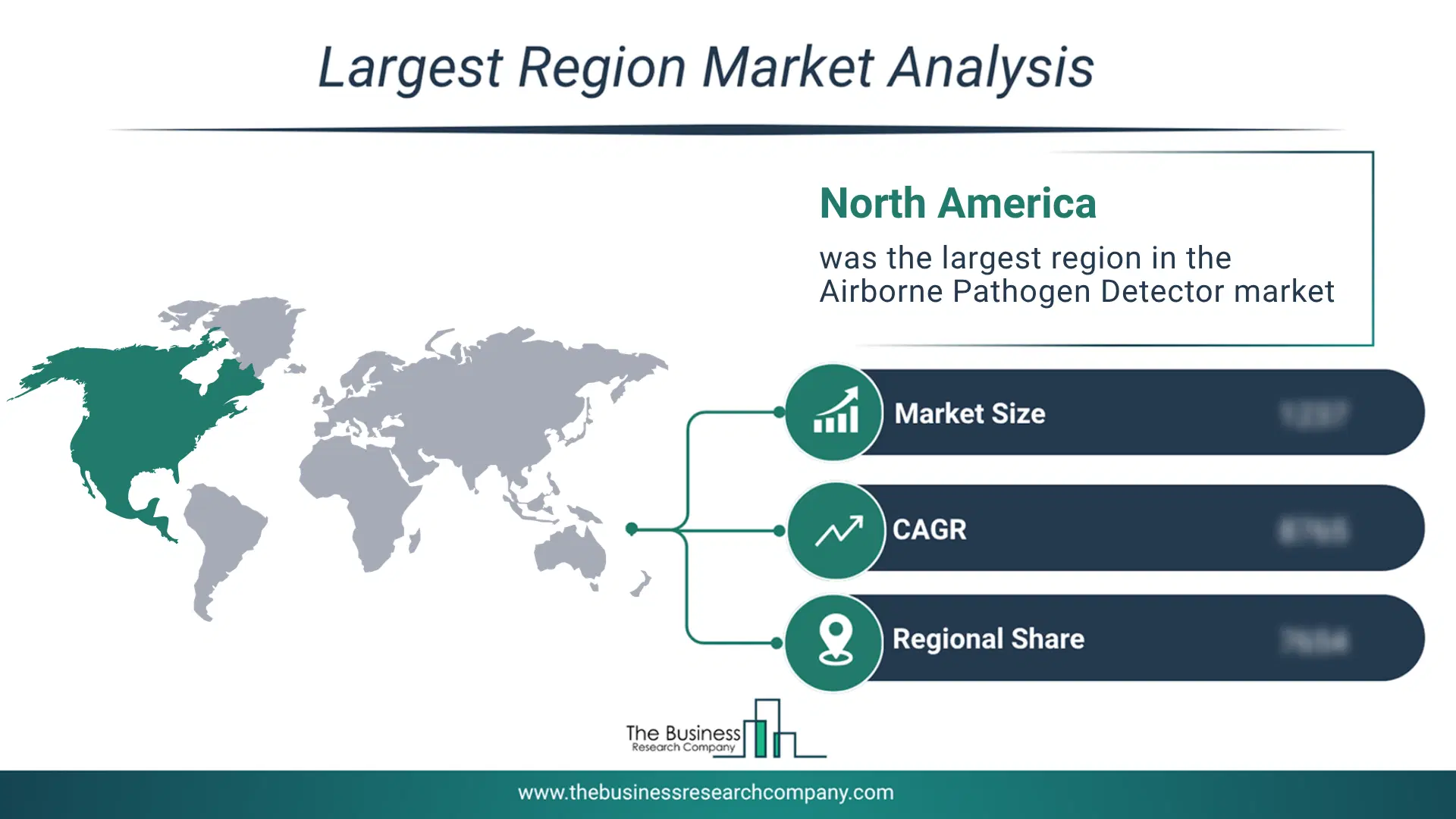
Regional Insights
North America was the largest region in the airborne pathogen detector market in 2025. Asia-Pacific is expected to be the fastest-growing region in the forecast period. The regions covered in this market report are Asia-Pacific, South East Asia, Western Europe, Eastern Europe, North America, South America, Middle East, Africa. The countries covered in this market report are Australia, Brazil, China, France, Germany, India, Indonesia, Japan, Taiwan, Russia, South Korea, UK, USA, Canada, Italy, Spain.What Defines the Airborne Pathogen Detector Market?
The airborne pathogen detector market consists of sales of bioaerosol samplers, real-time airborne pathogen monitors, fluorescence particle counters, electrostatic air samplers, and environmental biosensors. Values in this market are ‘factory gate’ values, that is, the value of goods sold by the manufacturers or creators of the goods, whether to other entities (including downstream manufacturers, wholesalers, distributors, and retailers) or directly to end customers. The value of goods in this market includes related services sold by the creators of the goods.How is Market Value Defined and Measured?
The market value is defined as the revenues that enterprises gain from the sale of goods and/or services within the specified market and geography through sales, grants, or donations in terms of the currency (in USD unless otherwise specified). The revenues for a specified geography are consumption values that are revenues generated by organizations in the specified geography within the market, irrespective of where they are produced. It does not include revenues from resales along the supply chain, either further along the supply chain or as part of other products.
This chart presents market attractiveness based on a quantitative evaluation of growth, competition, strategic alignment, and risk, offering a clear view of opportunity areas for decision-making. This chart is for illustrative purposes; the full report contains the complete analysis.

This chart highlights the Total Addressable Market (TAM) by estimating the maximum revenue opportunity using an assumption-driven approach, supporting strategic planning and opportunity sizing across markets. The chart is illustrative; the full report provides a more comprehensive analysis.
What Key Data And Analysis Are Included In The Airborne Pathogen Detector Market Report 2026?
The airborne pathogen detector market research report is one of a series of new reports from The Business Research Company that provides market statistics, including industry global market size, regional shares, competitors with the market share, detailed market segments, market trends and opportunities, and any further data you may need to thrive in the airborne pathogen detector industry. The market research report delivers a complete perspective of everything you need, with an in-depth analysis of the current and future state of the industry.Airborne Pathogen Detector Market Report Forecast Analysis
| Report Attribute | Details |
|---|---|
| Market Size Value In 2026 | $2.12 billion |
| Revenue Forecast In 2030 | $3.63 billion |
| Growth Rate | CAGR of 14.4% from 2026 to 2030 |
| Base Year For Estimation | 2025 |
| Actual Estimates/Historical Data | 2020-2025 |
| Forecast Period | 2026 - 2030 |
| Market Representation | Revenue in USD Billion and CAGR from 2026 to 2030 |
| Segments Covered | Product Type, Pathogen Type, Connectivity, Application, End-User |
| Regional Scope | Asia-Pacific, Western Europe, Eastern Europe, North America, South America, Middle East, Africa |
| Country Scope | The countries covered in the report are Australia, Brazil, China, France, Germany, India, Indonesia, Japan, Taiwan, Russia, South Korea, UK, USA, Canada, Italy, Spain. |
| Key Companies Profiled | Thermo Fisher Scientific Inc., Honeywell International Inc., 3M Company, Charles River Laboratories International Inc., Smiths Detection Group Limited, Sartorius Aktiengesellschaft, Shimadzu Corporation, Teledyne FLIR LLC, TSI Incorporated, Particle Measuring Systems Inc., Bertin Technologies SAS, Kanomax USA Inc., RION Co Ltd., Kromek Group plc, Climet Instruments Company Inc., Varro Life Sciences Inc., Aerosol Devices Inc., SafeTraces Inc., Health Enviro Testing Inc., Scanit Technologies Pvt. Ltd. |
| Customization Scope | Request for Customization |
| Pricing And Purchase Options | Explore Purchase Options |