
Airborne Warning And Control Systems Market Report 2026
Global Outlook – By System Type (Airborne Surveillance Radar, Command And Control Systems, Electronic Support Measures, Communication Systems), By Technology (Radar Technology, Communication Technology, Sensor Fusion Technology, Artificial Intelligence), By Platform Type (Fixed Wing, Rotary Wing, Unmanned Aerial Vehicles), By Application Type (Airspace Surveillance, Early Warning, Command And Control, Battle Management, Maritime Surveillance, Border Surveillance), By End User (Air Force, Navy, Joint Command, Border Agencies) – Market Size, Trends, Strategies, and Forecast to 2030
Airborne Warning And Control Systems Market Overview
• Airborne Warning And Control Systems market size has reached to $8.92 billion in 2025 • Expected to grow to $13.24 billion in 2030 at a compound annual growth rate (CAGR) of 8.1% • Growth Driver: The Rising Geopolitical Tensions Driving The Growth Of The Market Due To Rising Territorial Disputes • Market Trend: Unmanned Early Warning Solutions Drive Persistent Surveillance Innovation • North America was the largest region in 2025 and Asia-Pacific is the fastest growing region.What Is Covered Under Airborne Warning And Control Systems Market?
Airborne warning and control systems (AWACS) are advanced airborne surveillance and command systems equipped with radar, communication, and sensor technologies to detect, track, and identify aircraft, ships, and other targets over long distances. They provide real-time situational awareness and command-and-control capabilities, enabling the coordination and management of military air operations and enhancing battlefield decision-making. The main system types of airborne warning and control systems include airborne surveillance radar, command and control systems, electronic support measures, and communication systems. Airborne surveillance radar refers to airborne radar systems designed to detect, track, and monitor aerial and surface targets over long distances, providing real-time situational awareness for defense operations. These systems integrate technologies such as radar technology, communication technology, sensor fusion technology, and artificial intelligence and are deployed on fixed wing, rotary wing, and unmanned aerial vehicles. The various applications involved are airspace surveillance, early warning, command and control, battle management, maritime surveillance, and border surveillance, and they are used by several end users such as air force, navy, joint command, and border agencies.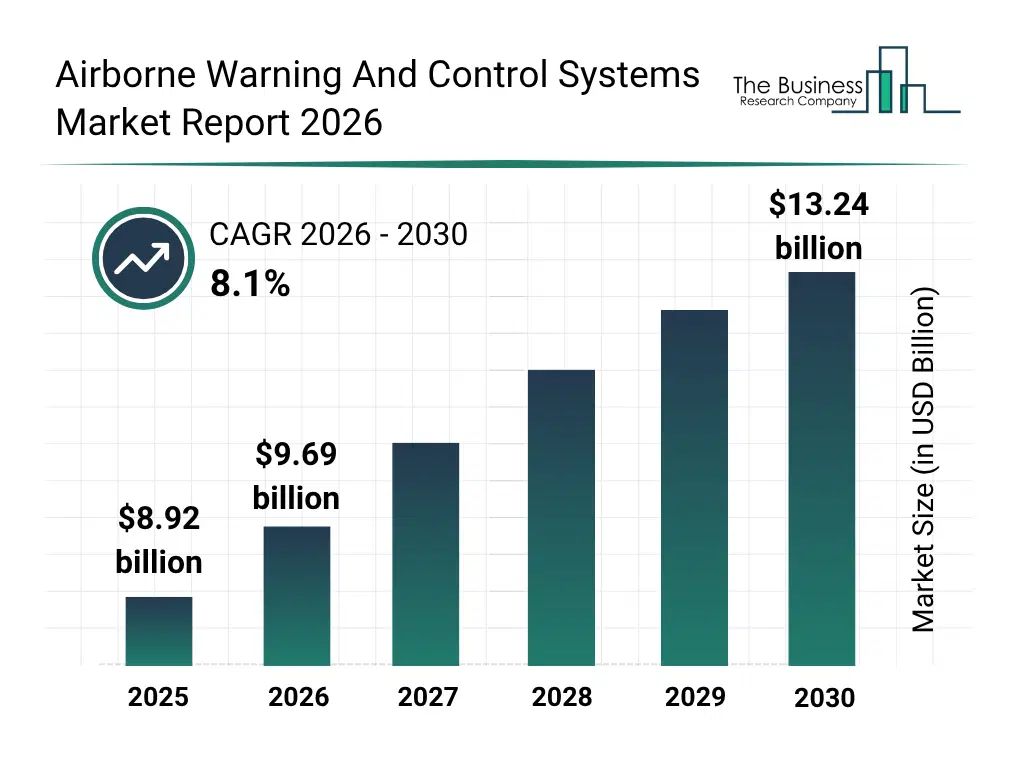
What Is The Airborne Warning And Control Systems Market Size and Share 2026?
The airborne warning and control systems market size has grown strongly in recent years. It will grow from $8.92 billion in 2025 to $9.69 billion in 2026 at a compound annual growth rate (CAGR) of 8.5%. The growth in the historic period can be attributed to growing defense modernization programs, rising military aircraft procurement, increasing geopolitical conflicts, expansion of integrated air defense networks, growing investments in airborne surveillance capabilities.What Is The Airborne Warning And Control Systems Market Growth Forecast?
The airborne warning and control systems market size is expected to see strong growth in the next few years. It will grow to $13.24 billion in 2030 at a compound annual growth rate (CAGR) of 8.1%.The growth in the forecast period can be attributed to increasing demand for next-generation command and control systems, rising procurement of advanced AWACS platforms, growing investments in border and maritime surveillance, expanding deployment of network-centric defense operations, increasing defense spending on airborne intelligence systems. Major trends in the forecast period include increasing adoption of long-range airborne surveillance systems, growing demand for multi-domain battle management platforms, rising integration of advanced multi-sensor detection systems, expansion of high-endurance airborne surveillance missions, increasing development of enhanced electronic warfare capabilities.
Global Airborne Warning And Control Systems Market Segmentation
2) By Technology: Radar Technology, Communication Technology, Sensor Fusion Technology, Artificial Intelligence 3) By Platform Type: Fixed Wing, Rotary Wing, Unmanned Aerial Vehicles 4) By Application Type: Airspace Surveillance, Early Warning, Command And Control, Battle Management, Maritime Surveillance, Border Surveillance 5) By End User: Air Force, Navy, Joint Command, Border Agencies Subsegments: 1) By Airborne Surveillance Radar: Active Electronically Scanned Array Radar, Passive Electronically Scanned Array Radar, Pulse Doppler Radar, Phased Array Radar, Long Range Surveillance Radar, Multi Mode Surveillance Radar 2) By Command And Control Systems: Mission Management Systems, Battle Management Systems, Threat Evaluation Systems, Target Tracking Systems, Decision Support Systems, Situational Awareness Systems 3) By Electronic Support Measures: Signal Detection Systems, Signal Interception Systems, Signal Identification Systems, Direction Finding Systems, Electronic Intelligence Systems, Spectrum Monitoring Systems 4) By Communication Systems: Satellite Communication Systems, Radio Communication Systems, Data Link Communication Systems, Secure Communication Systems, Voice Communication Systems, Network Communication SystemsWhat Is The Driver Of The Airborne Warning And Control Systems Market?
The rising geopolitical tensions are expected to propel the growth of the airborne warning and control systems market going forward. Geopolitical tensions refer to escalating political, military, or economic conflicts between countries or regions that increase security risks and uncertainty in international relations. Geopolitical tensions are increasing due to rising territorial disputes as countries compete over borders, strategic regions, and resources, leading to heightened military activities and strained international relations. Airborne warning and control systems enhance the management of geopolitical tensions by providing real-time surveillance, early threat detection, and situational awareness, enabling nations to monitor disputed regions, strengthen defense preparedness, and reduce the risk of strategic surprises and conflicts. For instance, in January 2025, according to Euronews SA, a France-based television network, in 2024, global conflicts intensified, with political violence increasing by 25% compared to 2023, affecting one in eight people and resulting in around 223,000 deaths, alongside a 37% rise in overall fatalities. Therefore, the rising geopolitical tensions are driving the growth of the airborne warning and control systems industry.Key Players In The Global Airborne Warning And Control Systems Market
Major companies operating in the airborne warning and control systems market are Airbus Defence and Space, ASELSAN Elektronik Sanayi ve Ticaret A.Ş., Aviation Industry Corporation of China Ltd., BAE Systems, Bharat Electronics Limited, Elbit Systems Ltd., Embraer Defesa And Segurança S.A., General Atomics Aeronautical Systems Inc., HENSOLDT AG, Indra Sistemas S.A., Israel Aerospace Industries Ltd., Korea Aerospace Industries Ltd., Leonardo S.p.A., Lockheed Martin Corporation, L3Harris Technologies Inc., Mercury Systems Inc., Northrop Grumman Corporation, RTX Corporation, Saab AB, Thales Group, Turkish Aerospace Industries Inc., United Aircraft Corporation PJSC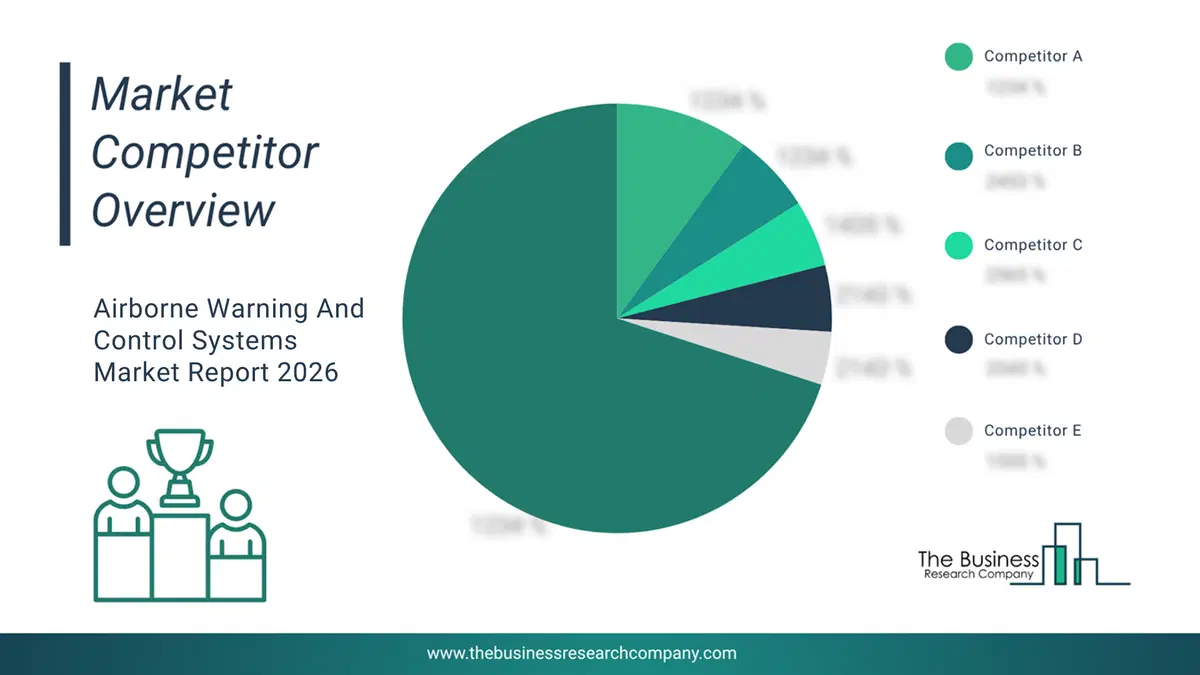
This chart is for illustrative purposes; the full report includes a detailed competitor analysis and comprehensive overview of the top 10 companies in the market.
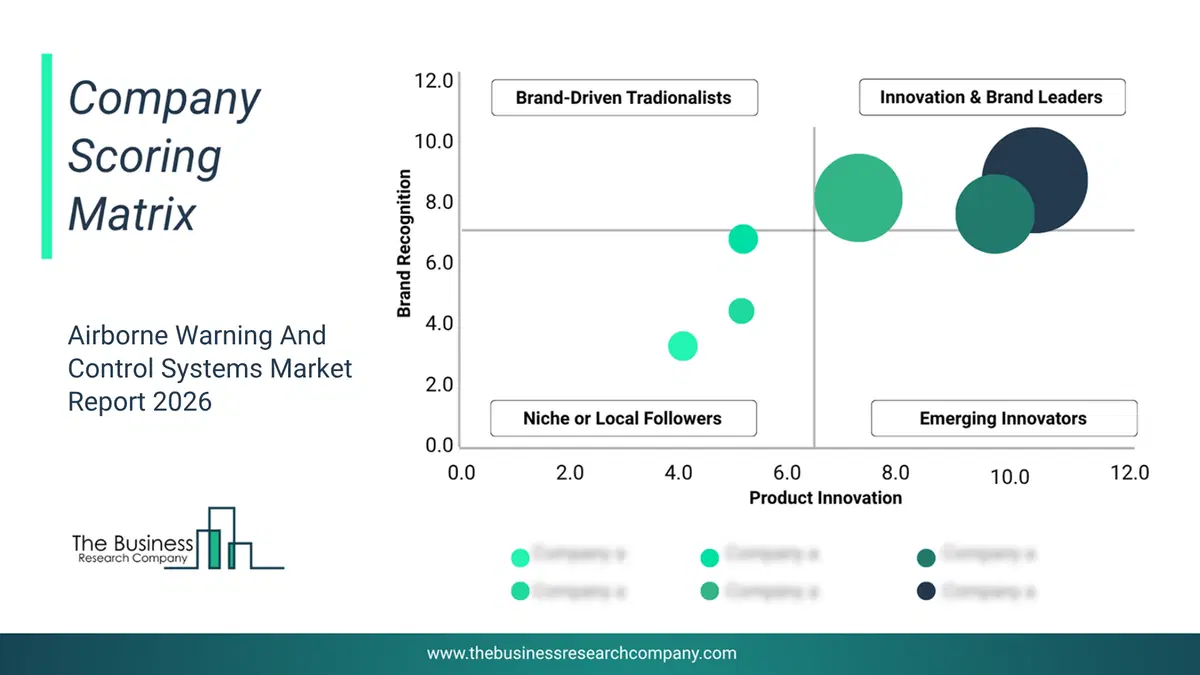
This chart maps companies by product innovation and brand strength, with bubble size indicating relative revenue, helping identify market leaders, challengers, and niche players. This is an illustrative chart; the full report provides a complete and accurate competitive analysis.
Global Airborne Warning And Control Systems Market Trends and Insights
Major companies operating in the airborne warning and control systems market are focusing on developing innovative solutions, such as unmanned airborne early warning systems, to enhance persistent surveillance, improve situational awareness, and expand mission flexibility in modern defense operations. Unmanned airborne early warning systems are advanced surveillance platforms that integrate radar and sensor technologies onto unmanned aerial vehicles to detect, track, and monitor aerial and surface threats continuously, offering a more flexible and cost-efficient alternative to traditional manned airborne warning and control aircraft while enabling extended operational endurance and reduced crew requirements. For instance, in June 2025, Saab AB, a Sweden-based aerospace and defense company, and General Atomics Aeronautical Systems Inc., a US-based technology company, announced a strategic collaboration to develop an unmanned airborne early warning solution based on the MQ-9B unmanned aerial system. The solution integrates Saab’s airborne early warning sensors with the MQ-9B platform to deliver persistent surveillance and continuous monitoring of designated operational areas. Additionally, the system is designed to support stand-alone operations and manned-unmanned teaming concepts, enabling applications such as naval surveillance and expanded airborne early warning capabilities while complementing existing manned AEW&C platforms, including GlobalEye.What Are Latest Mergers And Acquisitions In The Airborne Warning And Control Systems Market?
In July 2023, L3Harris Technologies Inc., a US-based aerospace and defense technology company, partnered with ELTA Systems Ltd. to expand the development of Airborne Early Warning and Control (AEW&C) solutions. With this partnership, L3Harris Technologies Inc. and ELTA Systems Ltd. aim to combine aircraft missionization expertise with advanced conformal airborne early warning radar technologies to deliver next-generation, U.S.- and NATO-interoperable airborne surveillance and command-and-control capabilities for allied defense markets. ELTA Systems Ltd. is an Israel-based company specializing in airborne early warning systems, radar technologies, and intelligence, surveillance, and reconnaissance (ISR) solutions.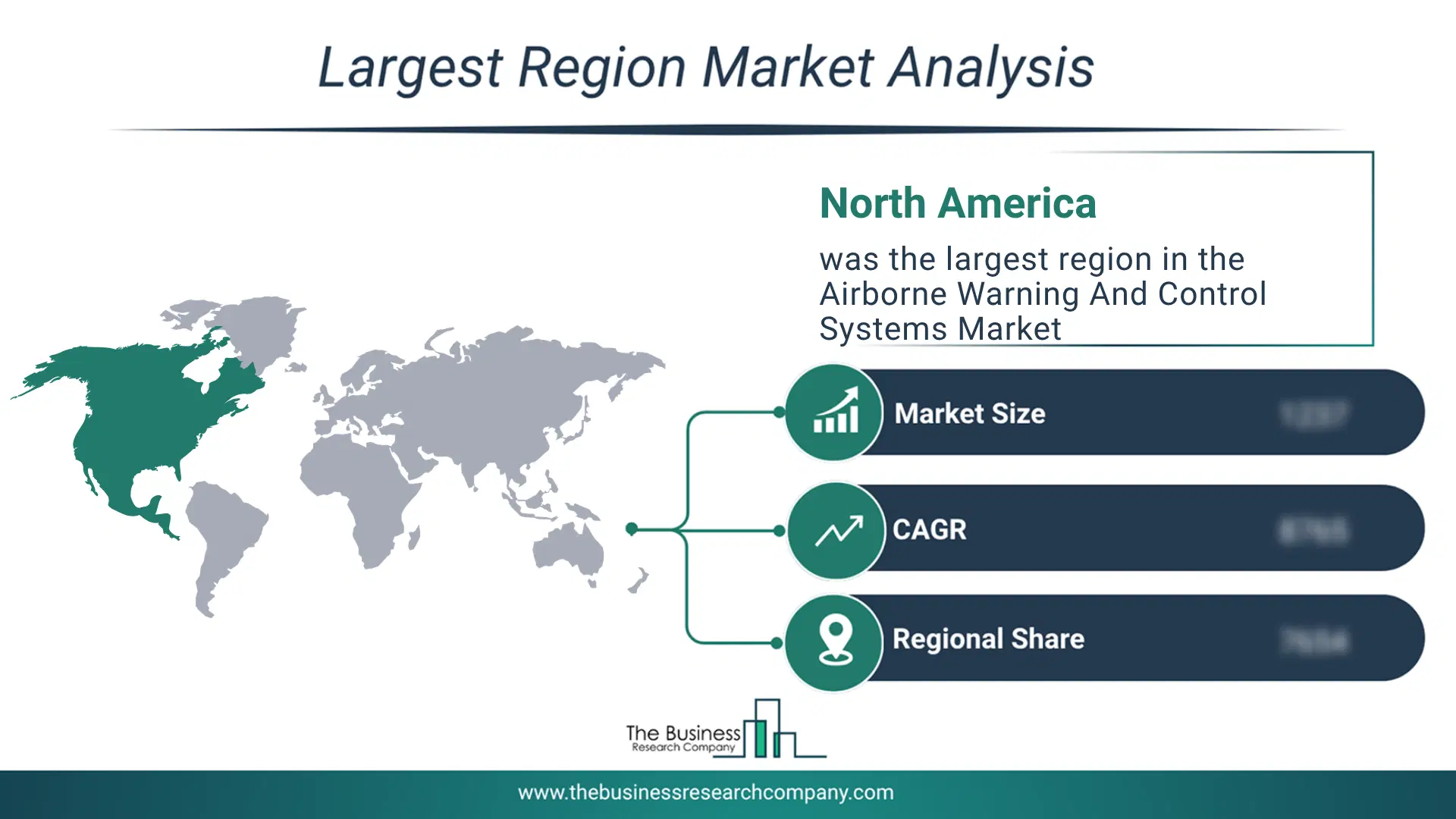
Regional Outlook/Insights
North America was the largest region in the airborne warning and control systems market in 2025. Asia-Pacific is expected to be the fastest-growing region in the forecast period. The regions covered in this market report are Asia-Pacific, South East Asia, Western Europe, Eastern Europe, North America, South America, Middle East, Africa. The countries covered in this market report are Australia, Brazil, China, France, Germany, India, Indonesia, Japan, Taiwan, Russia, South Korea, UK, USA, Canada, Italy, Spain.What Defines the Airborne Warning And Control Systems Market?
The airborne warning and control systems market consists of revenues earned by entities by providing services such as command, control, communications, and intelligence (c3i) services, target detection, tracking, and identification services, and mission planning, system integration, and operational support services. The market value includes the value of related goods sold by the service provider or included within the service offering. The airborne warning and control systems market also includes sales of data link and tactical information distribution terminals, mission computing and data processing units, operator mission consoles and display systems, and navigation and avionics systems. Values in this market are ‘factory gate’ values, that is the value of goods sold by the manufacturers or creators of the goods, whether to other entities (including downstream manufacturers, wholesalers, distributors and retailers) or directly to end customers. The value of goods in this market includes related services sold by the creators of the goods.How is Market Value Defined and Measured?
The market value is defined as the revenues that enterprises gain from the sale of goods and/or services within the specified market and geography through sales, grants, or donations in terms of the currency (in USD unless otherwise specified). The revenues for a specified geography are consumption values that are revenues generated by organizations in the specified geography within the market, irrespective of where they are produced. It does not include revenues from resales along the supply chain, either further along the supply chain or as part of other products.
This chart presents market attractiveness based on a quantitative evaluation of growth, competition, strategic alignment, and risk, offering a clear view of opportunity areas for decision-making. This chart is for illustrative purposes; the full report contains the complete analysis.

This chart highlights the Total Addressable Market (TAM) by estimating the maximum revenue opportunity using an assumption-driven approach, supporting strategic planning and opportunity sizing across markets. The chart is illustrative; the full report provides a more comprehensive analysis.
What Key Data and Analysis Are Included in the Airborne Warning And Control Systems Market Report 2026?
The airborne warning and control systems market research report is one of a series of new reports from The Business Research Company that provides airborne warning and control systems market statistics, including airborne warning and control systems industry global market size, regional shares, competitors with a airborne warning and control systems market share, detailed airborne warning and control systems market segments, market trends and opportunities, and any further data you may need to thrive in the airborne warning and control systems industry. This airborne warning and control systems market research report delivers a complete perspective of everything you need, with an in-depth analysis of the current and future scenario of the industry.Airborne Warning And Control Systems Market Report Forecast Analysis
| Report Attribute | Details |
|---|---|
| Market Size Value In 2026 | $9.69 billion |
| Revenue Forecast In 2030 | $13.24 billion |
| Growth Rate | CAGR of 8.1% from 2026 to 2030 |
| Base Year For Estimation | 2025 |
| Actual Estimates/Historical Data | 2020-2025 |
| Forecast Period | 2026 - 2030 |
| Market Representation | Revenue in USD Billion and CAGR from 2026 to 2030 |
| Segments Covered | System Type, Technology, Platform Type, Application Type, End User |
| Regional Scope | Asia-Pacific, Western Europe, Eastern Europe, North America, South America, Middle East, Africa |
| Country Scope | The countries covered in the report are Australia, Brazil, China, France, Germany, India, Indonesia, Japan, Taiwan, Russia, South Korea, UK, USA, Canada, Italy, Spain. |
| Key Companies Profiled | Airbus Defence and Space, ASELSAN Elektronik Sanayi ve Ticaret A.Ş., Aviation Industry Corporation of China Ltd., BAE Systems, Bharat Electronics Limited, Elbit Systems Ltd., Embraer Defesa And Segurança S.A., General Atomics Aeronautical Systems Inc., HENSOLDT AG, Indra Sistemas S.A., Israel Aerospace Industries Ltd., Korea Aerospace Industries Ltd., Leonardo S.p.A., Lockheed Martin Corporation, L3Harris Technologies Inc., Mercury Systems Inc., Northrop Grumman Corporation, RTX Corporation, Saab AB, Thales Group, Turkish Aerospace Industries Inc., United Aircraft Corporation PJSC |
| Customization Scope | Request for Customization |
| Pricing And Purchase Options | Explore Purchase Options |