
Aircraft Anti-Collision Lights Market Report 2026
Global Outlook – By Light Type (Beacon Lights, Strobe Lights), By Aircraft Type (Commercial Aircraft, Military Aircraft, General Aviation Aircraft, Unmanned Aerial Vehicles), By Sales Channel (Direct Sales, Distributors And Dealers, Online Sales), By Application (New Installations, Replacement And Retrofit), By End User (Aircraft Manufacturers, Maintenance And Repair Organizations) – Market Size, Trends, Strategies, and Forecast to 2030
Aircraft Anti-Collision Lights Market Overview
• Aircraft Anti-Collision Lights market size has reached to $0.35 billion in 2025 • Expected to grow to $0.5 billion in 2030 at a compound annual growth rate (CAGR) of 7% • Growth Driver: Increasing Commercial Aircraft Deliveries Driving The Market Growth Due To Rising Demand For Aircraft Safety And Visibility Systems • Market Trend: Development Of Compact And High-Output Lighting Systems • North America was the largest region in 2025 and Asia-Pacific is the fastest growing region.What Is Covered Under Aircraft Anti-Collision Lights Market?
Aircraft anti-collision lights are high-intensity flashing exterior lights, typically red rotating beacons or white strobes, installed on an aircraft to make it clearly visible to pilots, ground personnel, and other aircraft. The primary purpose is to reduce the risk of collisions by improving aircraft visibility during ground operations and flight, particularly at night or in low-visibility conditions. The main light types of aircraft anti-collision lights include beacon lights, and strobe lights. Beacon lights refer to high-intensity warning lights installed on aircraft to provide visible signals that enhance aircraft identification and awareness during flight and ground operations. These lights are used across commercial aircraft, military aircraft, general aviation aircraft, and unmanned aerial vehicles and are distributed through direct sales, distributors and dealers, and online sales. The key applications include new installations and replacement and retrofit, while the end-users include aircraft manufacturers, and maintenance and repair organizations.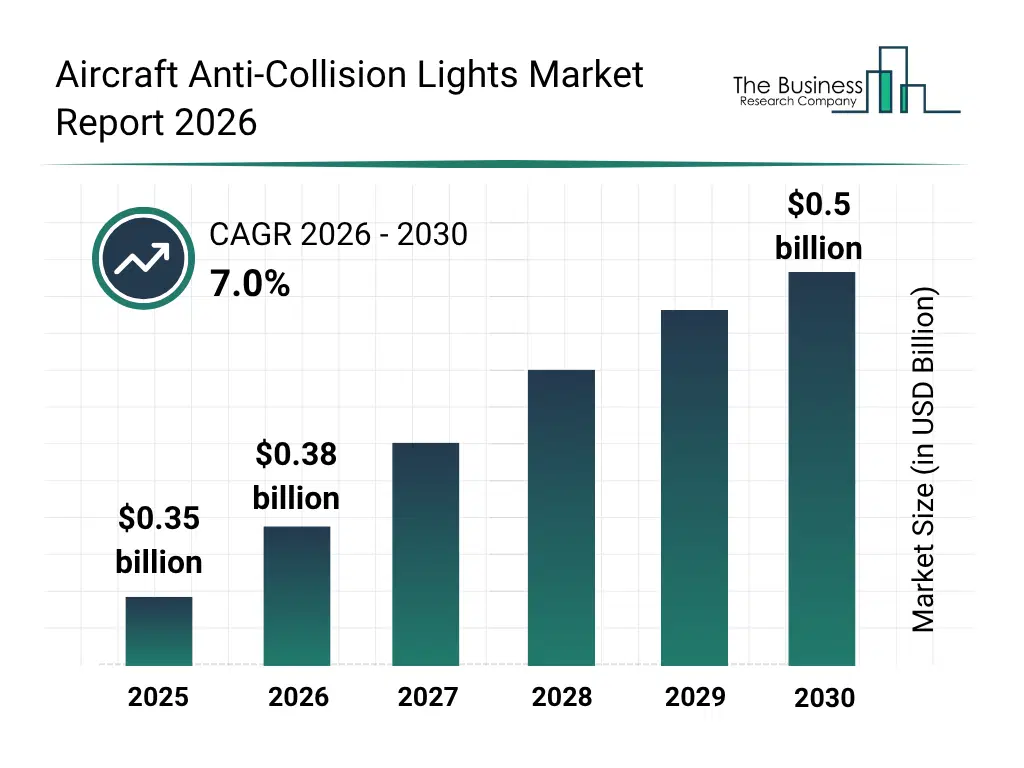
What Is The Aircraft Anti-Collision Lights Market Size and Share 2026?
The aircraft anti-collision lights market size has grown strongly in recent years. It will grow from $0.35 billion in 2025 to $0.38 billion in 2026 at a compound annual growth rate (CAGR) of 7.4%. The growth in the historic period can be attributed to increasing aircraft fleet size, rising emphasis on aircraft visibility and safety, growth in commercial aviation, increasing aircraft maintenance and retrofit activities, expansion of general aviation.What Is The Aircraft Anti-Collision Lights Market Growth Forecast?
The aircraft anti-collision lights market size is expected to see strong growth in the next few years. It will grow to $0.5 billion in 2030 at a compound annual growth rate (CAGR) of 7.0%. The growth in the forecast period can be attributed to expansion of global air passenger traffic, increasing production of commercial and military aircraft, rising adoption of UAVs, growing demand for aircraft modernization and retrofit programs, increasing replacement of conventional lights with LED-based systems. Major trends in the forecast period include increasing adoption of LED-based anti-collision lights, development of lightweight and compact aircraft lighting systems, rising demand for high-intensity and high-reliability lighting solutions, increasing adoption of low-profile aircraft anti-collision lights, growing demand for advanced strobe and beacon light configurations.Tariff Impact On Aircraft Anti-Collision Lights Market
Tariffs are impacting the aircraft anti-collision lights market by increasing the cost of imported LEDs, optical components, electronic control units, housings, wiring, and other specialized lighting components required for aircraft lighting systems. This is increasing procurement and production costs across beacon lights and strobe lights, particularly for new installations and replacement and retrofit programs, with North America, Europe, and Asia-Pacific being more exposed due to international aerospace supply chains. Aircraft manufacturers and maintenance and repair organizations are most affected by higher component costs and supply-chain disruptions. However, tariffs are also encouraging local manufacturing, regional supplier diversification, and increased investment in domestic aerospace component production, creating long-term resilience in the market.
Global Aircraft Anti Collision Lights Market Segmentation
1) By Light Type: Beacon Lights, Strobe Lights 2) By Aircraft Type: Commercial Aircraft, Military Aircraft, General Aviation Aircraft, Unmanned Aerial Vehicles 3) By Sales Channel: Direct Sales, Distributors And Dealers, Online Sales 4) By Application: New Installations, Replacement And Retrofit 5) By End User: Aircraft Manufacturers, Maintenance And Repair Organizations Subsegments: 1) By Beacon Lights: Rotating Beacon Lights, Light-Emitting Diode Beacon Lights, High Intensity Beacon Lights, Low Profile Beacon Lights, Red Beacon Lights 2) By Strobe Lights: White Strobe Lights, Light-Emitting Diode Strobe Lights, High Intensity Strobe Lights, Dual Flash Strobe Lights, Synchronized Strobe LightsWhat Is The Driver Of The Aircraft Anti-Collision Lights Market?
The increasing commercial aircraft deliveries are expected to propel the growth of the aircraft anti-collision lights market going forward. Commercial aircraft are airplanes designed and operated for the transportation of passengers or cargo as part of scheduled or chartered airline services. Commercial aircraft deliveries are increasing due to rising global air passenger traffic, as airlines procure new aircraft to accommodate increasing passenger demand. Rising commercial aircraft deliveries drive demand for aircraft anti-collision lights by increasing the need for advanced aircraft visibility and safety systems that enhance in-flight and ground visibility, reduce the risk of collisions, and ensure compliance with aviation safety regulations. For instance, in January 2026, according to Airbus, a France-based aerospace and aircraft manufacturer, the company delivered 793 commercial aircraft in 2025, compared with 766 aircraft in 2024, representing a 3.5% increase. Therefore, the increasing commercial aircraft deliveries are driving the growth of the aircraft anti-collision lights industry.Key Players In The Global Aircraft Anti-Collision Lights Market
Major companies operating in the aircraft anti-collision lights market are RTX Corporation, Honeywell International Inc., Eaton Corporation plc, Koito Manufacturing Co. Ltd., Diehl Stiftung & Co. KG, HEICO Corporation, Astronics Corporation, Thales Group, Whelen Aerospace Technologies LLC, Aveo Engineering Group s.r.o., Oxley Group Limited, AeroLEDs LLC, Talon Aerospace LLC, Soderberg Manufacturing Company Inc., Aero Dynamix Inc., KGS Electronics Inc.
This chart is for illustrative purposes; the full report includes a detailed competitor analysis and comprehensive overview of the top 10 companies in the market.
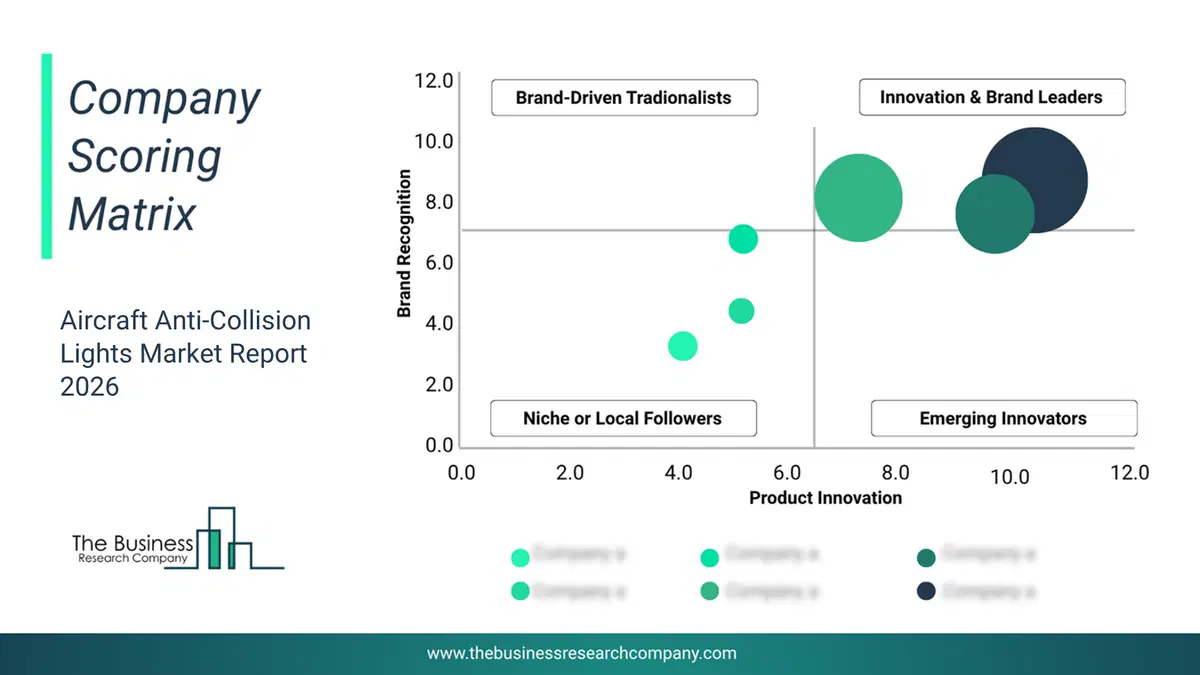
This chart maps companies by product innovation and brand strength, with bubble size indicating relative revenue, helping identify market leaders, challengers, and niche players. This is an illustrative chart; the full report provides a complete and accurate competitive analysis.
Global Aircraft Anti-Collision Lights Market Trends and Insights
Major companies operating in the aircraft anti-collision lights market are focusing on developing compact and high-output LED anti-collision lighting solutions to enhance aircraft visibility while reducing space, weight, and power requirements. LED anti-collision lights are aviation lighting solutions that use light-emitting diode (LED) technology to provide high-intensity visibility signals, offering compact designs, low power consumption, and flexible installation options compared with conventional beacon lighting systems. For instance, in September 2026, AeroLEDs, a US-based aviation lighting manufacturer, launched the NANO Beacon, a compact, high-output LED anti-collision light designed for aircraft and platforms where space, weight, and power are critical considerations. The NANO Beacon provides high-intensity anti-collision output in a compact housing measuring approximately 1.58 inches square and weighing less than 40 grams, enabling installation in locations where conventional beacons cannot be accommodated. The product operates with low power consumption and is available in red or white configurations and in 14 VDC and 28 VDC versions, supporting applications in experimental aircraft, rotorcraft, and UAV/UAS platforms.What Are Latest Mergers And Acquisitions In The Aircraft Anti-Collision Lights Market?
In April 2025, Satair, a Denmark-based commercial aerospace aftermarket company, partnered with Collins Aerospace to expand their cabin interior parts distribution collaboration. Through this partnership, Satair and Collins Aerospace aimed to strengthen aftermarket support and ensure the efficient availability of aviation products, including a range of cabin and external lighting products such as anti-collision and taxi lights, for airlines and maintenance, repair, and overhaul facilities worldwide. Collins Aerospace is an aerospace and defense company that provides integrated solutions, including aviation lighting products.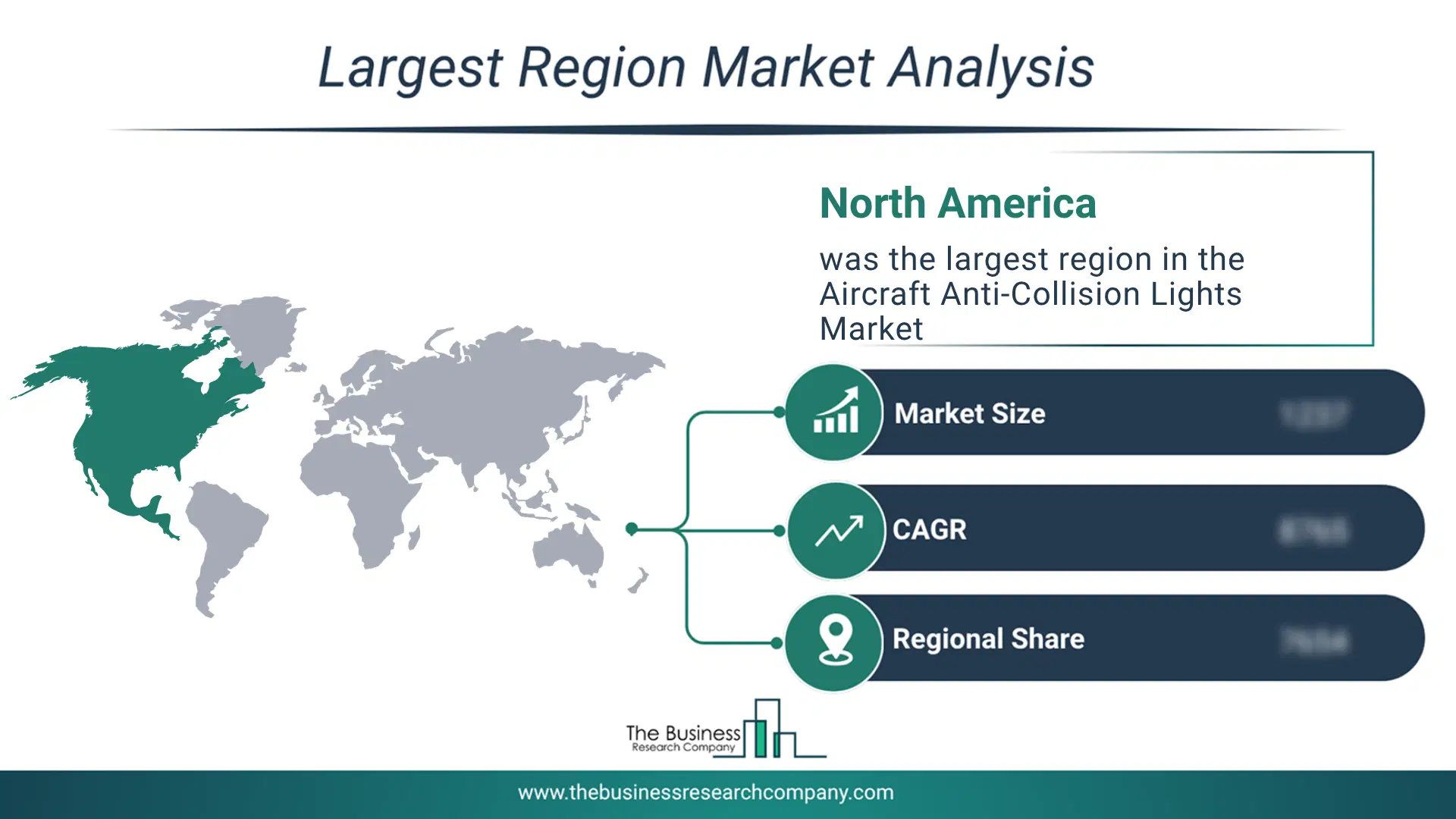
Regional Outlook
North America was the largest region in the aircraft anti-collision lights market in 2025. Asia-Pacific is expected to be the fastest-growing region in the forecast period. The regions covered in this market report are Asia-Pacific, South East Asia, Western Europe, Eastern Europe, North America, South America, Middle East, Africa. The countries covered in this market report are Australia, Brazil, China, France, Germany, India, Indonesia, Japan, Taiwan, Russia, South Korea, UK, USA, Canada, Italy, Spain.What Defines the Aircraft Anti-Collision Lights Market?
The aircraft anti-collision lights market consists of sales of products including LED anti-collision lights, rotating beacon lights, red anti-collision beacons and integrated wingtip anti-collision lights. Values in this market are ‘factory gate’ values, that is, the value of goods sold by the manufacturers or creators of the goods, whether to other entities (including downstream manufacturers, wholesalers, distributors, and retailers) or directly to end customers. The value of goods in this market includes related services sold by the creators of the goods.How is Market Value Defined and Measured?
The market value is defined as the revenues that enterprises gain from the sale of goods and/or services within the specified market and geography through sales, grants, or donations in terms of the currency (in USD unless otherwise specified). The revenues for a specified geography are consumption values that are revenues generated by organizations in the specified geography within the market, irrespective of where they are produced. It does not include revenues from resales along the supply chain, either further along the supply chain or as part of other products.
This chart presents market attractiveness based on a quantitative evaluation of growth, competition, strategic alignment, and risk, offering a clear view of opportunity areas for decision-making. This chart is for illustrative purposes; the full report contains the complete analysis.

This chart highlights the Total Addressable Market (TAM) by estimating the maximum revenue opportunity using an assumption-driven approach, supporting strategic planning and opportunity sizing across markets. The chart is illustrative; the full report provides a more comprehensive analysis.
What Key Data and Analysis Are Included in the Aircraft Anti-Collision Lights Market Report 2026?
The aircraft anti-collision lights market research report is one of a series of new reports from The Business Research Company that provides market statistics, including industry global market size, regional shares, competitors with the market share, detailed market segments, market trends and opportunities, and any further data you may need to thrive in the aircraft anti-collision lights industry. The market research report delivers a complete perspective of everything you need, with an in-depth analysis of the current and future state of the industry.Aircraft Anti-Collision Lights Market Report Forecast Analysis
| Report Attribute | Details |
|---|---|
| Market Size Value In 2026 | $0.38 billion |
| Revenue Forecast In 2030 | $0.5 billion |
| Growth Rate | CAGR of 7.0% from 2026 to 2030 |
| Base Year For Estimation | 2025 |
| Actual Estimates/Historical Data | 2020-2025 |
| Forecast Period | 2026 - 2030 |
| Market Representation | Revenue in USD Billion and CAGR from 2026 to 2030 |
| Segments Covered | Light Type, Aircraft Type, Sales Channel, Application, End User |
| Regional Scope | Asia-Pacific, Western Europe, Eastern Europe, North America, South America, Middle East, Africa |
| Country Scope | The countries covered in the report are Australia, Brazil, China, France, Germany, India, Indonesia, Japan, Taiwan, Russia, South Korea, UK, USA, Canada, Italy, Spain. |
| Key Companies Profiled | RTX Corporation, Honeywell International Inc., Eaton Corporation plc, Koito Manufacturing Co. Ltd., Diehl Stiftung & Co. KG, HEICO Corporation, Astronics Corporation, Thales Group, Whelen Aerospace Technologies LLC, Aveo Engineering Group s.r.o., Oxley Group Limited, AeroLEDs LLC, Talon Aerospace LLC, Soderberg Manufacturing Company Inc., Aero Dynamix Inc., KGS Electronics Inc. |
| Customization Scope | Request for Customization |
| Pricing And Purchase Options | Explore Purchase Options |