
Aircraft Battery Market Report 2026
Global Outlook – By Battery Type (Lead Acid Battery, Nickel Cadmium Battery, Lithium Ion Battery, Other Battery Types), By Voltage Or Power Class (Low Voltage Systems (Below 48 Volts), Medium Voltage Systems (48–400 Volts), High Voltage Systems (Above 400 Volts)), By Application (Engine Starting, Auxiliary Power Unit, Emergency Backup Power, Avionics, Cabin Systems, Flight Control Systems, Other Applications), By End User (Commercial Aviation, Defense And Military, General Aviation, Business Aviation) – Market Size, Trends, Strategies, and Forecast to 2035
Aircraft Battery Market Overview
• Aircraft Battery market size has reached to $0.94 billion in 2025 • Expected to grow to $1.51 billion in 2030 at a compound annual growth rate (CAGR) of 9.8% • Growth Driver: Growing Production And Deliveries Of Commercial And Military Aircraft Are Driving The Market Due To Increasing Demand For Reliable Onboard Electrical Power Systems • Market Trend: Advancements In Battery Technology Enhance Electric Aircraft Propulsion And Energy Storage • North America was the largest region in 2025 and Asia-Pacific is the fastest growing region.What Is Covered Under Aircraft Battery Market?
An aircraft battery is an electrochemical energy storage system specifically engineered to supply, store, and regulate electrical power for aviation applications, supporting essential onboard electrical functions through reliable energy delivery, high safety standards, resistance to demanding environmental conditions, and compatibility with the operational and certification requirements of both conventional and advanced aircraft platforms. It is used to provide power during engine start, support critical systems when primary power sources are unavailable, stabilize electrical networks, enable emergency operations, and enhance overall aircraft reliability, operational continuity, and safety throughout ground and flight operations. The main battery types of aircraft battery include lead acid battery, nickel cadmium battery, lithium ion battery, and other battery types. Lead acid battery refer to rechargeable batteries that use lead-based electrodes and sulfuric acid electrolyte to provide electrical power for aircraft systems. These batteries are available across low voltage systems below 48 volts, medium voltage systems from 48 to 400 volts, and high voltage systems above 400 volts. The various applications involved are engine starting, auxiliary power unit, emergency backup power, avionics, cabin systems, flight control systems, and others, and they are used by several end users such as commercial aviation, defense and military, general aviation, and business aviation.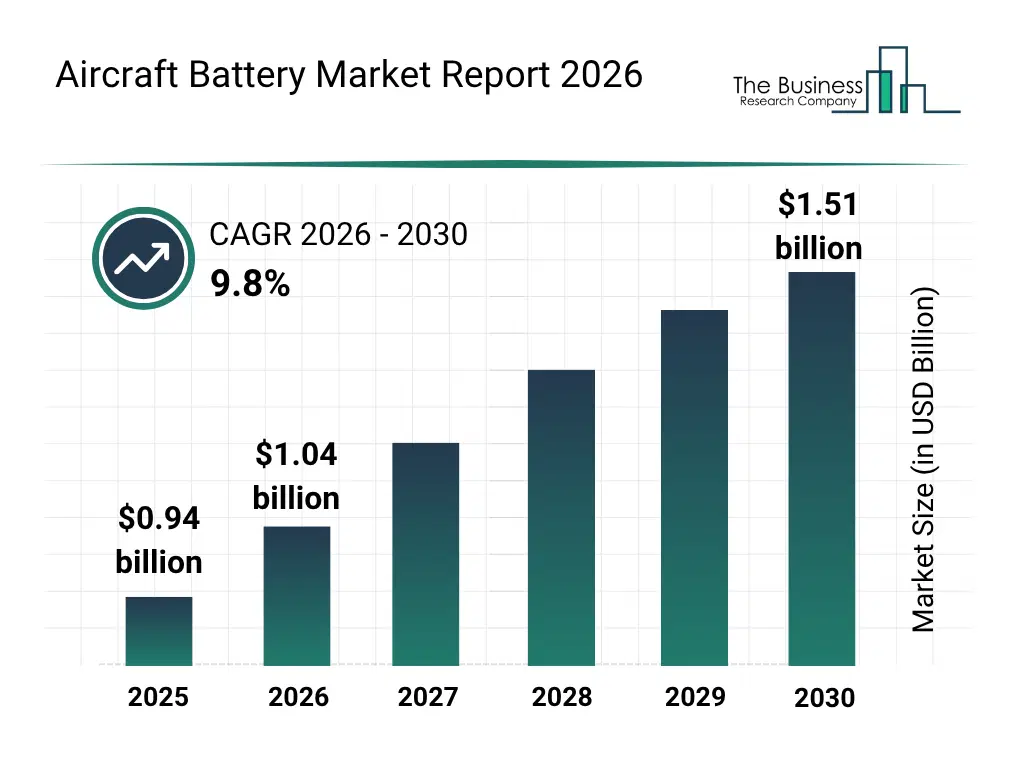
What Is The Aircraft Battery Market Size and Share 2026?
The aircraft battery market size has grown rapidly in recent years. It will grow from $0.94 billion in 2025 to $1.04 billion in 2026 at a compound annual growth rate (CAGR) of 10.3%. The growth in the historic period can be attributed to increasing aircraft production and deliveries, growing demand for reliable emergency backup power, rising adoption of advanced avionics systems, increasing aircraft fleet modernization, stringent aviation safety and reliability requirements.What Is The Aircraft Battery Market Growth Forecast?
The aircraft battery market size is expected to see strong growth in the next few years. It will grow to $1.51 billion in 2030 at a compound annual growth rate (CAGR) of 9.8%. The growth in the forecast period can be attributed to increasing electrification of aircraft systems, growing adoption of electric and hybrid aircraft, rising demand for lightweight energy storage solutions, increasing deployment of next-generation lithium-ion batteries, growing demand for high-performance batteries in advanced aircraft platforms. Major trends in the forecast period include advanced lithium-ion aircraft batteries, high-energy-density aviation batteries, battery thermal management systems, lightweight aircraft battery designs, rapid aircraft battery charging technologies.Tariff Impact On Aircraft Battery Market
Tariffs are impacting the aircraft battery market by increasing the cost of imported battery cells, specialized materials, electronic components, and manufacturing equipment used in aviation battery production. Lithium-ion and other advanced battery segments are particularly exposed, with manufacturers and aircraft operators in North America, Europe, and Asia-Pacific facing higher procurement and production costs due to interconnected aerospace supply chains. These pressures may encourage battery manufacturers to diversify suppliers, localize production, and develop domestic supply capabilities, while also accelerating investment in cost-efficient and advanced battery technologies.
Global Aircraft Battery Market Segmentation
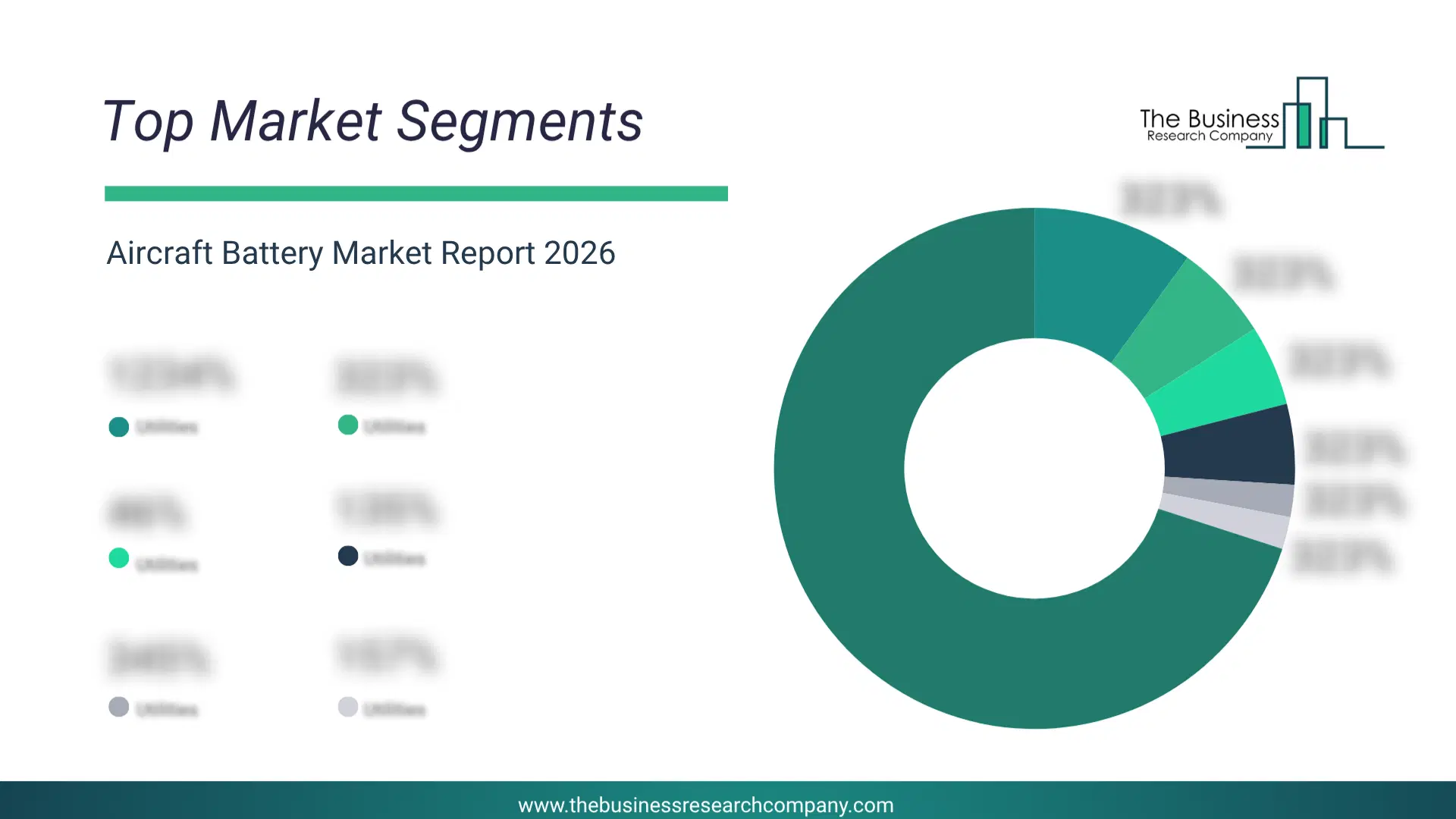
2) By Voltage Or Power Class: Low Voltage Systems (Below 48 Volts), Medium Voltage Systems (48–400 Volts), High Voltage Systems (Above 400 Volts) 3) By Application: Engine Starting, Auxiliary Power Unit, Emergency Backup Power, Avionics, Cabin Systems, Flight Control Systems, Other Applications 4) By End User: Commercial Aviation, Defense And Military, General Aviation, Business Aviation Subsegments: 1) By Lead Acid Battery: Flooded Lead Acid Battery, Valve Regulated Lead Acid Battery, Absorbent Glass Mat Battery, Gel Lead Acid Battery 2) By Nickel Cadmium Battery: Vented Nickel Cadmium Battery, Sealed Nickel Cadmium Battery, Pocket Plate Nickel Cadmium Battery, Sintered Plate Nickel Cadmium Battery 3) By Lithium Ion Battery: Lithium Iron Phosphate Battery, Lithium Nickel Manganese Cobalt Oxide Battery, Lithium Cobalt Oxide Battery, Lithium Manganese Oxide Battery, Lithium Titanate Battery 4) By Other Battery Types: Silver Zinc Battery, Nickel Metal Hydride Battery, Solid State Battery, Thermal BatteryWhat Is The Driver Of The Aircraft Battery Market?
The growing production and deliveries of commercial and military aircraft are expected to propel the growth of the aircraft battery market going forward. Production and deliveries of commercial and military aircraft refer to the complete process of manufacturing, certifying, and supplying civil and defense aircraft to operators, reflecting the aviation industry's capacity to meet operational, regulatory, and strategic transportation and security requirements. A key factor driving the growing production and deliveries of commercial and military aircraft is the increasing demand for fleet modernization, as airlines and defense organizations seek more efficient, technologically advanced, and reliable aircraft to improve operational performance, reduce lifecycle costs, comply with evolving safety and environmental standards, and strengthen transportation and defense capabilities, thereby encouraging manufacturers to expand production capacity and accelerate delivery schedules. Growing production and deliveries of commercial and military aircraft increase the installation of electrical systems that require dedicated batteries for engine starting, backup power, and onboard operations, thereby supporting the demand for aircraft batteries. For instance, in February 2026, according to ADS Group, a UK-based trade association, 2,175 commercial aircraft orders were placed in 2025, representing a 50% year-on-year increase, while 1,411 commercial aircraft were delivered, a 25% increase compared with 2024. Therefore, the growing production and deliveries of commercial and military aircraft are driving the growth of the aircraft battery industry.Key Players In The Global Aircraft Battery Market
Major companies operating in the aircraft battery market are Safran SA, Teledyne Technologies Incorporated, GS Yuasa Corporation, EnerSys, Inventus Power Inc, HBL Power Systems Limited, Ultralife Corporation, Mid-Continent Instrument Co Inc, Amprius Technologies Inc, Electric Power Systems Inc, Bren-Tronics Inc, MarathonNorco Aerospace Inc, CUSTOMCELLS Holding GmbH, Concorde Battery Corporation, H55 SA, EarthX Inc, Denchi Group Ltd, XING Mobility Inc, High Energy Batteries (India) Limited, MGM COMPRO sro, AeroAkku GmbH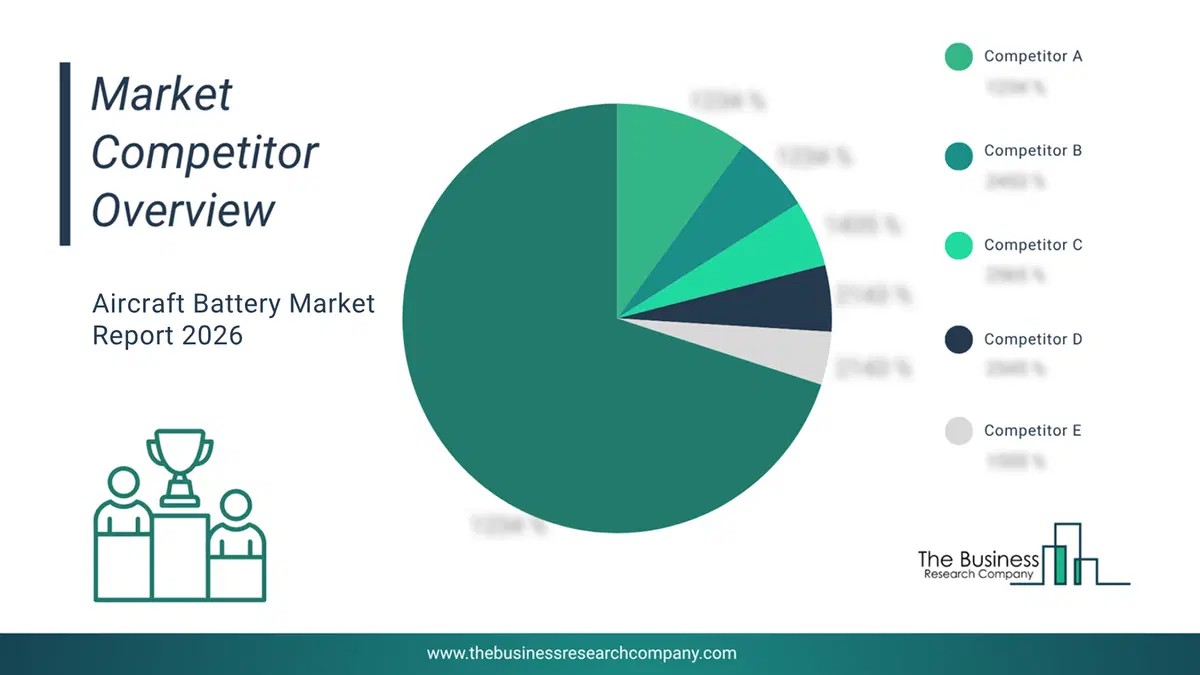
This chart is for illustrative purposes; the full report includes a detailed competitor analysis and comprehensive overview of the top 10 companies in the market.
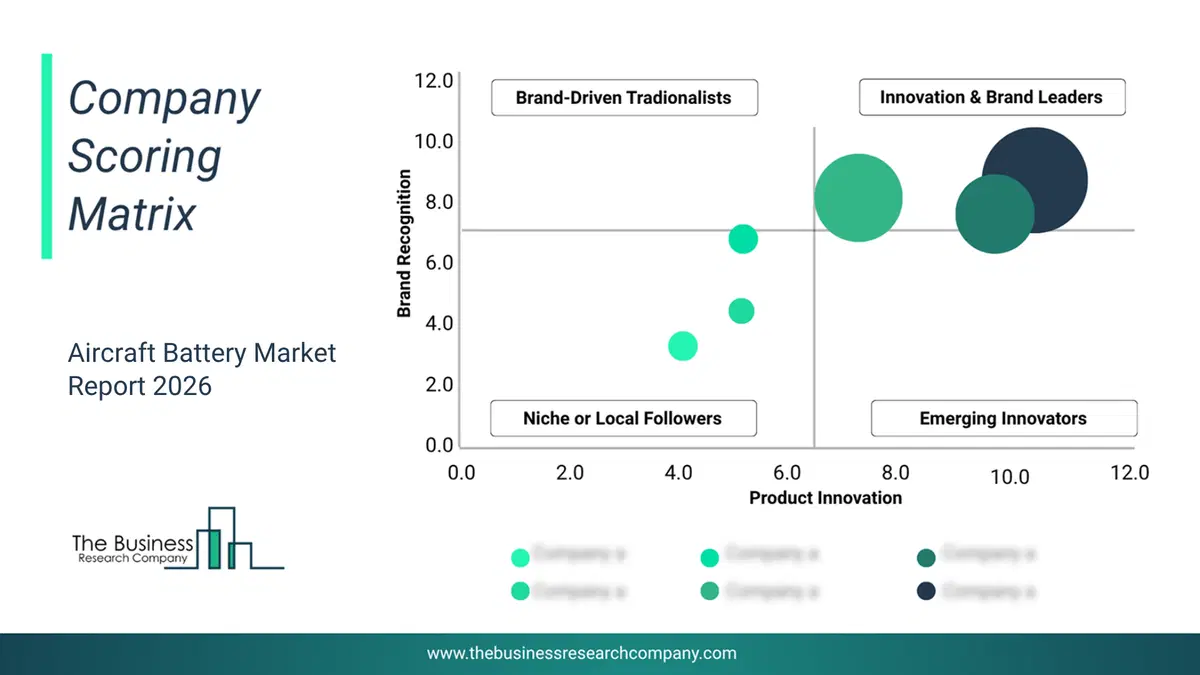
This chart maps companies by product innovation and brand strength, with bubble size indicating relative revenue, helping identify market leaders, challengers, and niche players. This is an illustrative chart; the full report provides a complete and accurate competitive analysis.
Global Aircraft Battery Market Trends and Insights
Major companies operating in the aircraft battery market are focusing on developing advanced battery solutions, such as certifiable battery modules, to improve energy storage safety, reliability, and integration into electric and hybrid-electric aircraft. Certifiable battery modules refer to aviation-grade battery units that have undergone regulatory testing to demonstrate their safety, reliability, and suitability for aircraft integration. For instance, in April 2026, H55, a Switzerland-based company specializing in certified electric propulsion and energy storage systems for aviation, delivered its first batch of Adagio battery modules to Smartflyer for integration into the SFX1 aircraft. The delivery supports the transition from component-level validation to full system integration and testing, including propulsion architecture and energy management. The Adagio battery system has completed regulator-required certification tests for integration across electric and hybrid-electric aircraft applications.What Are Latest Mergers And Acquisitions In The Aircraft Battery Market?
In October 2025, Archer Aviation Inc., a US-based aerospace and aviation technology company, acquired Lilium GmbH’s portfolio of approximately 300 advanced air mobility patent assets for €18 million ($20.84 million). Through this acquisition, Archer aims to strengthen its next-generation electric aviation capabilities by integrating Lilium’s patented technologies covering battery management, high-voltage systems, electric engines, flight controls, propellers, and ducted fans into its growing technology portfolio. Lilium GmbH is a Germany-based electric aircraft developer that provides high-performance aviation battery systems using silicon-anode lithium-ion technology.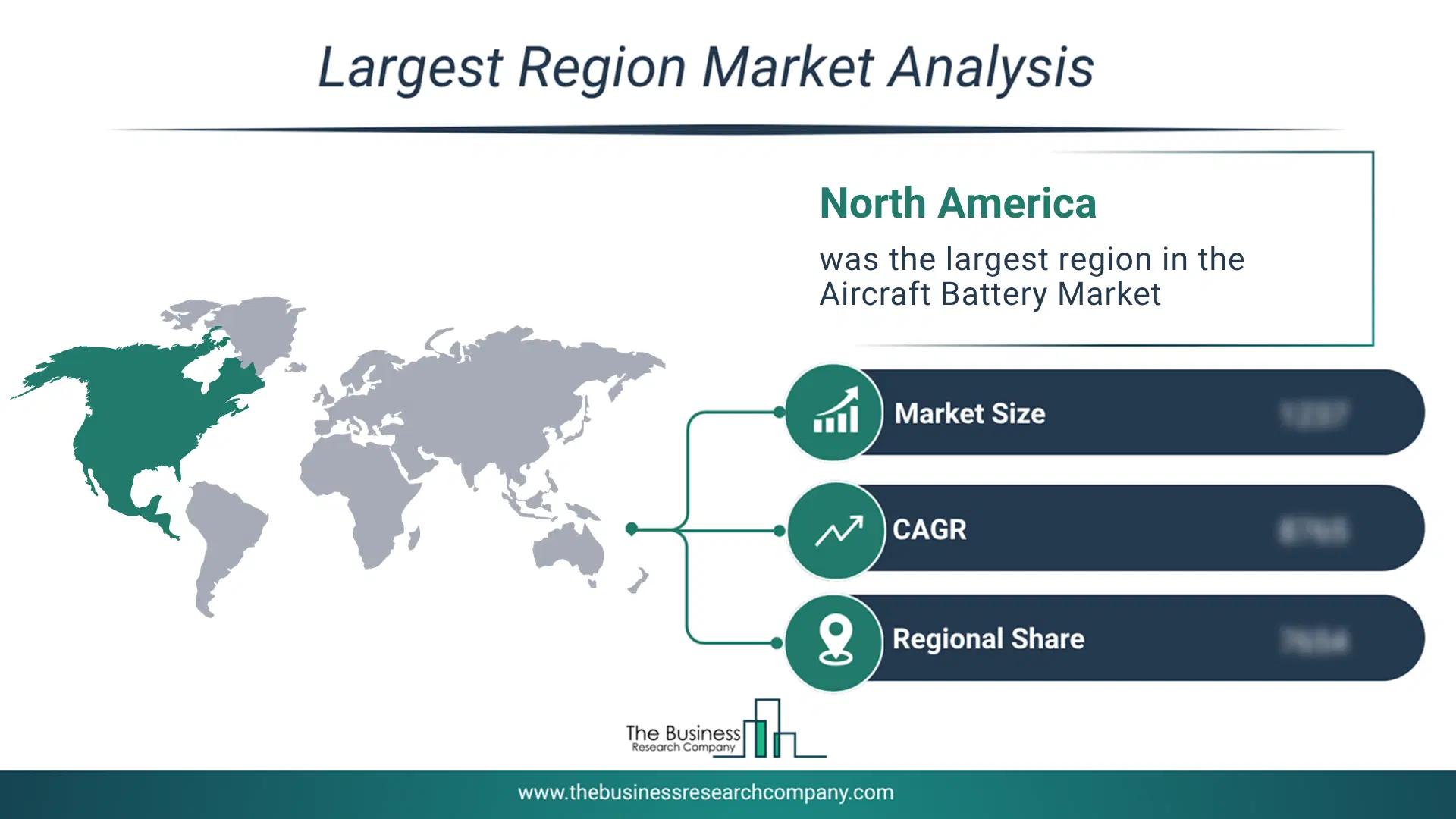
Regional Outlook/Insights
North America was the largest region in the aircraft battery market in 2025. Asia-Pacific is expected to be the fastest-growing region during the forecast period. The regions covered in this market report are Asia-Pacific, South East Asia, Western Europe, Eastern Europe, North America, South America, Middle East, Africa. The countries covered in this market report are Australia, Brazil, China, France, Germany, India, Indonesia, Japan, Taiwan, Russia, South Korea, UK, USA, Canada, Italy, Spain.What Defines the Aircraft Battery Market?
The aircraft battery market consists of sales of lead-acid aircraft batteries, nickel-cadmium aircraft batteries, lithium-ion aircraft batteries, lithium-polymer aircraft batteries, lithium-sulfur aircraft batteries, sodium-ion aircraft batteries, and advanced rechargeable aircraft battery systems. Values in this market are ‘factory gate’ values, that is, the value of goods sold by the manufacturers or creators of the goods, whether to other entities (including downstream manufacturers, wholesalers, distributors, and retailers) or directly to end customers. The value of goods in this market includes related services sold by the creators of the goods.How is Market Value Defined and Measured?
The market value is defined as the revenues that enterprises gain from the sale of goods and/or services within the specified market and geography through sales, grants, or donations in terms of the currency (in USD unless otherwise specified). The revenues for a specified geography are consumption values that are revenues generated by organizations in the specified geography within the market, irrespective of where they are produced. It does not include revenues from resales along the supply chain, either further along the supply chain or as part of other products.
This chart presents market attractiveness based on a quantitative evaluation of growth, competition, strategic alignment, and risk, offering a clear view of opportunity areas for decision-making. This chart is for illustrative purposes; the full report contains the complete analysis.

This chart highlights the Total Addressable Market (TAM) by estimating the maximum revenue opportunity using an assumption-driven approach, supporting strategic planning and opportunity sizing across markets. The chart is illustrative; the full report provides a more comprehensive analysis.
What Key Data and Analysis Are Included in the Aircraft Battery Market Report 2026?
The aircraft battery market research report is one of a series of new reports from The Business Research Company that provides market statistics, including industry global market size, regional shares, competitors with the market share, detailed market segments, market trends and opportunities, and any further data you may need to thrive in the aircraft battery industry. The market research report delivers a complete perspective of everything you need, with an in-depth analysis of the current and future state of the industry.Aircraft Battery Market Report Forecast Analysis
| Report Attribute | Details |
|---|---|
| Market Size Value In 2026 | $1.04 billion |
| Revenue Forecast In 2030 | $1.51 billion |
| Growth Rate | CAGR of 9.8% from 2026 to 2035 |
| Base Year For Estimation | 2025 |
| Actual Estimates/Historical Data | 2020-2025 |
| Forecast Period | 2026 - 2030 |
| Market Representation | Revenue in USD Billion and CAGR from 2026 to 2030 |
| Segments Covered | Battery Type, Voltage Or Power Class, Application, End User |
| Regional Scope | Asia-Pacific, Western Europe, Eastern Europe, North America, South America, Middle East, Africa |
| Country Scope | The countries covered in the report are Australia, Brazil, China, France, Germany, India, Indonesia, Japan, Taiwan, Russia, South Korea, UK, USA, Canada, Italy, Spain. |
| Customization Scope | Request for Customization |
| Pricing And Purchase Options | Explore Purchase Options |