
Aircraft Cabin Interior Market Report 2026
Global Outlook – By Type (Aircraft Seating, In-Flight Entertainment And Connectivity, Aircraft Cabin Lighting, Aircraft Galley, Aircraft Lavatory, Aircraft Windows And Windshields, Aircraft Stowage Bins, Aircraft Interior Panels), By Class (First Class, Business Class, Economy And Premium Economy Class), By Aircraft Type (Narrow Body Aircraft, Wide Body Aircraft, Business Jets, Regional Transport Aircraft), By Material (Alloys, Composites, Other Materials), By End User (OEM, Aftermarket) – Market Size, Trends, Strategies, and Forecast to 2030
Aircraft Cabin Interior Market Overview
• Aircraft Cabin Interior market size has reached to $27.46 billion in 2025 • Expected to grow to $41.86 billion in 2030 at a compound annual growth rate (CAGR) of 8.6% • Growth Driver: Rising Demand For New Aircraft Drives Growth In The Aircraft Cabin Interior Market • Market Trend: Enhancing Passenger Comfort Through Upgraded Cabin Interiors • North America was the largest region in 2025 and Asia-Pacific is the fastest growing region.Market Gains By 2030 – Top Opportunities By Segment
Market Gain identifies the most promising market opportunities by highlighting the segments or products expected to generate the highest incremental revenue growth over the next five years.
What Is Covered Under Aircraft Cabin Interior Market?
Aircraft cabin interior refers to the compartment in an aircraft that accommodates passengers and the aircraft systems needed for the passengers' comfortable and safe travel. The aircraft cabin's interior is ergonomically designed, has a pleasing appearance, proper space utilization, and user-friendly functionalities, and incorporated technical components. The main types of aircraft cabin interiors are aircraft seating, in-flight entertainment and connectivity, aircraft cabin lighting, aircraft galley, aircraft lavatory, aircraft windows and windshields, aircraft stowage bins, and aircraft interior panels. The aircraft cabin interiors are employed in first class, business class, and economy and premium economy class of narrow body aircraft, wide body aircraft, business jets, and regional transport aircraft. The material used are alloys, composites, and others by original equipment manufacturer (OEM) and aftermarket.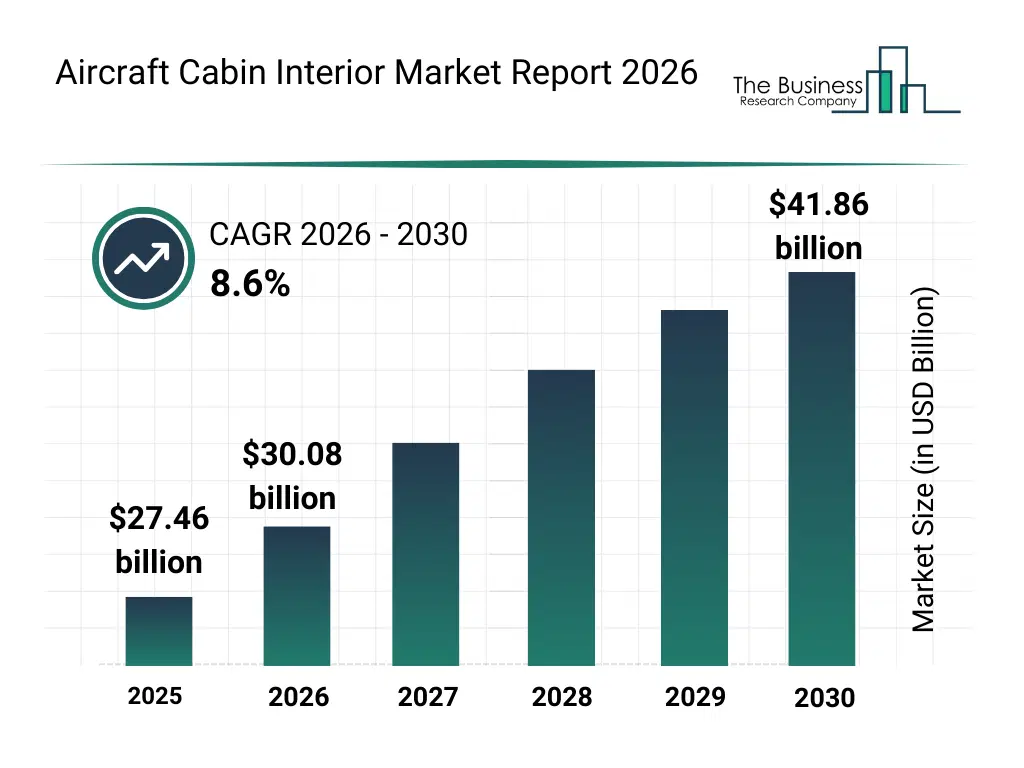
What Is The Aircraft Cabin Interior Market Size and Share 2026?
The aircraft cabin interior market size has grown strongly in recent years. It will grow from $27.46 billion in 2025 to $30.08 billion in 2026 at a compound annual growth rate (CAGR) of 9.5%. The growth in the historic period can be attributed to rising commercial air travel driving demand for upgraded passenger cabin components, increased adoption of advanced smoke detectors and air purifiers to enhance onboard safety, expansion of aircraft refurbishment programs replacing aging interior systems, growth in installation of efficient water and waste systems supporting long-haul operations, early integration of ergonomic and space-optimized cabin designs to improve passenger experience.What Is The Aircraft Cabin Interior Market Growth Forecast?
The aircraft cabin interior market size is expected to see strong growth in the next few years. It will grow to $41.86 billion in 2030 at a compound annual growth rate (CAGR) of 8.6%. The growth in the forecast period can be attributed to growing demand for lightweight and energy-efficient cabin interior solutions, increasing investment in smart cabin technologies enabling real-time monitoring and automation, rising adoption of modular interior systems to reduce airline maintenance downtime, expansion of premium cabin upgrades driven by competitive passenger experience strategies, development of next-generation air quality and sanitation systems to meet stricter safety and comfort standards. Major trends in the forecast period include passenger comfort optimization, cabin noise reduction technologies, smart air filtration and sanitation systems, lightweight and space-efficient interior designs, customizable and modular cabin layouts.
Global Aircraft Cabin Interior Market Segmentation
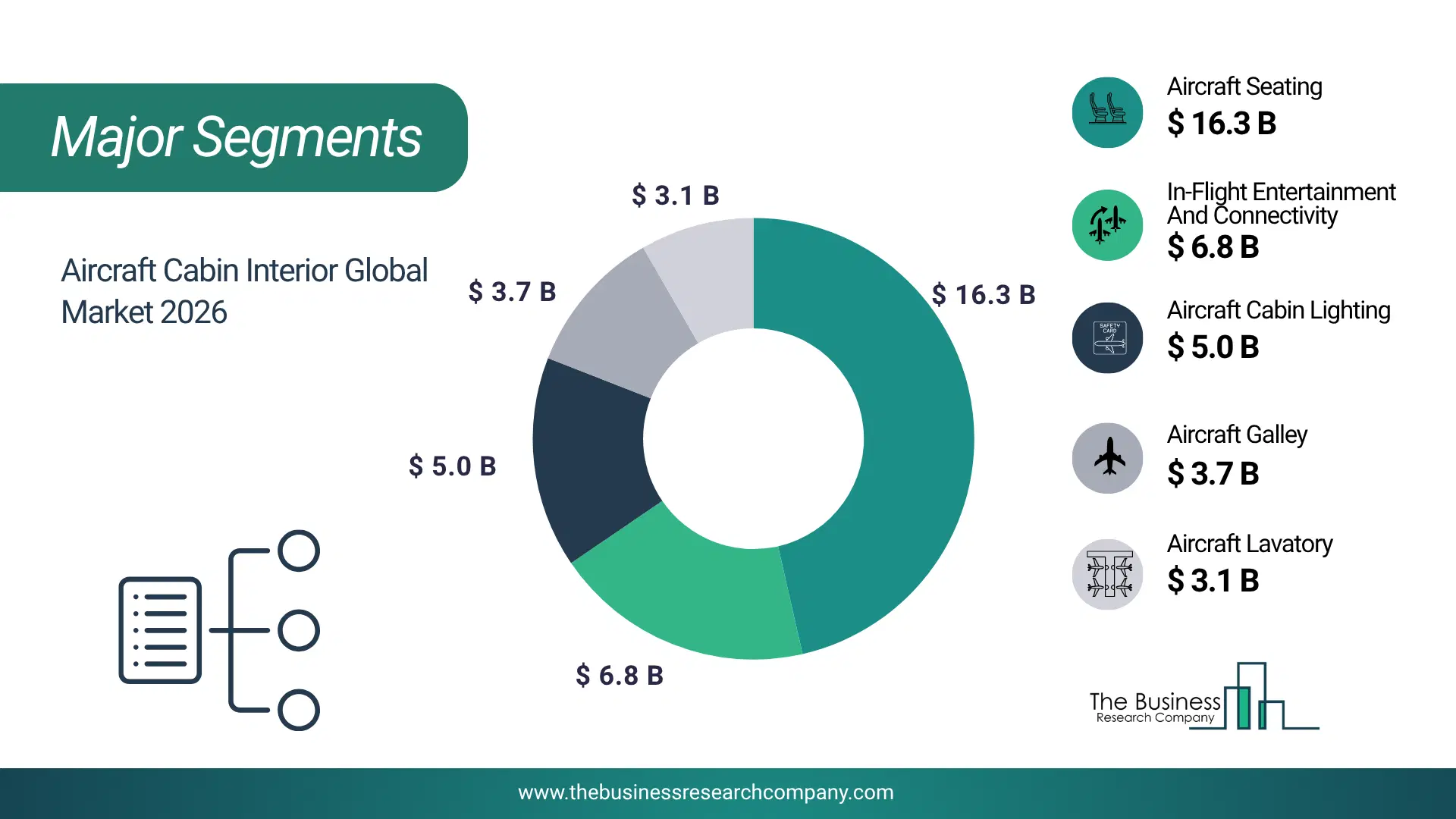
1) By Type: Aircraft Seating, In-Flight Entertainment And Connectivity, Aircraft Cabin Lighting, Aircraft Galley, Aircraft Lavatory, Aircraft Windows And Windshields, Aircraft Stowage Bins, Aircraft Interior Panels 2) By Class: First Class, Business Class, Economy And Premium Economy Class 3) By Aircraft Type: Narrow Body Aircraft, Wide Body Aircraft, Business Jets, Regional Transport Aircraft 4) By Material: Alloys, Composites, Other Materials 5) By End User: OEM, Aftermarket Subsegments: 1) By Aircraft Seating: Economy Class Seating, Business Class Seating, First Class Seating, Premium Economy Seating 2) By In-Flight Entertainment And Connectivity: IFE Systems, Connectivity Solutions 3) By Aircraft Cabin Lighting: Ambient Lighting, Reading Lights, Emergency Lighting Systems 4) By Aircraft Galley: Galley Equipment, Food Preparation Areas 5) By Aircraft Lavatory: Lavatory Fixtures, Sanitation Systems 6) By Aircraft Windows And Windshields: Cabin Windows, Cockpit Windshields 7) By Aircraft Stowage Bins: Overhead Bins, Crew Storage Compartments 8) By Aircraft Interior Panels: Sidewall Panels, Ceiling Panels, Floor Panels The top segments in the aircraft cabin interior market will be: • Aircraft Seating will reach $16.28 billion by 2030. • In-Flight Entertainment And Connectivity will reach $6.8 billion by 2030. • Aircraft Cabin Lighting will reach $5.05 billion by 2030. • Aircraft Galley will reach $3.71 billion by 2030. • Aircraft Lavatory will reach $3.06 billion by 2030.What Is Driver Of The Aircraft Cabin Interior Market?
An increase in demand for new aircraft is driving the growth of the aircraft cabin interior market. There is an increase in the demand for aircraft due to the increase in air passenger traffic and cargo volumes. Commercial airline operators across the globe are expanding their aircraft fleets to meet this increasing demand. Aircraft cabin interiors are used to make the flight experience comfortable and worthy enough. For instance, according to the International Civil Aviation Organization, a Canada-based specialized agency of the United Nations, demand for air transport will increase by an average of 4.3% per annum by 2040. Moreover, according to Airbus, a Netherlands-based aerospace company, demand for passenger traffic will grow annually by 3.6% over the next 20 years. Hence, an increase in demand for new aircraft will propel the aircraft cabin interior industry.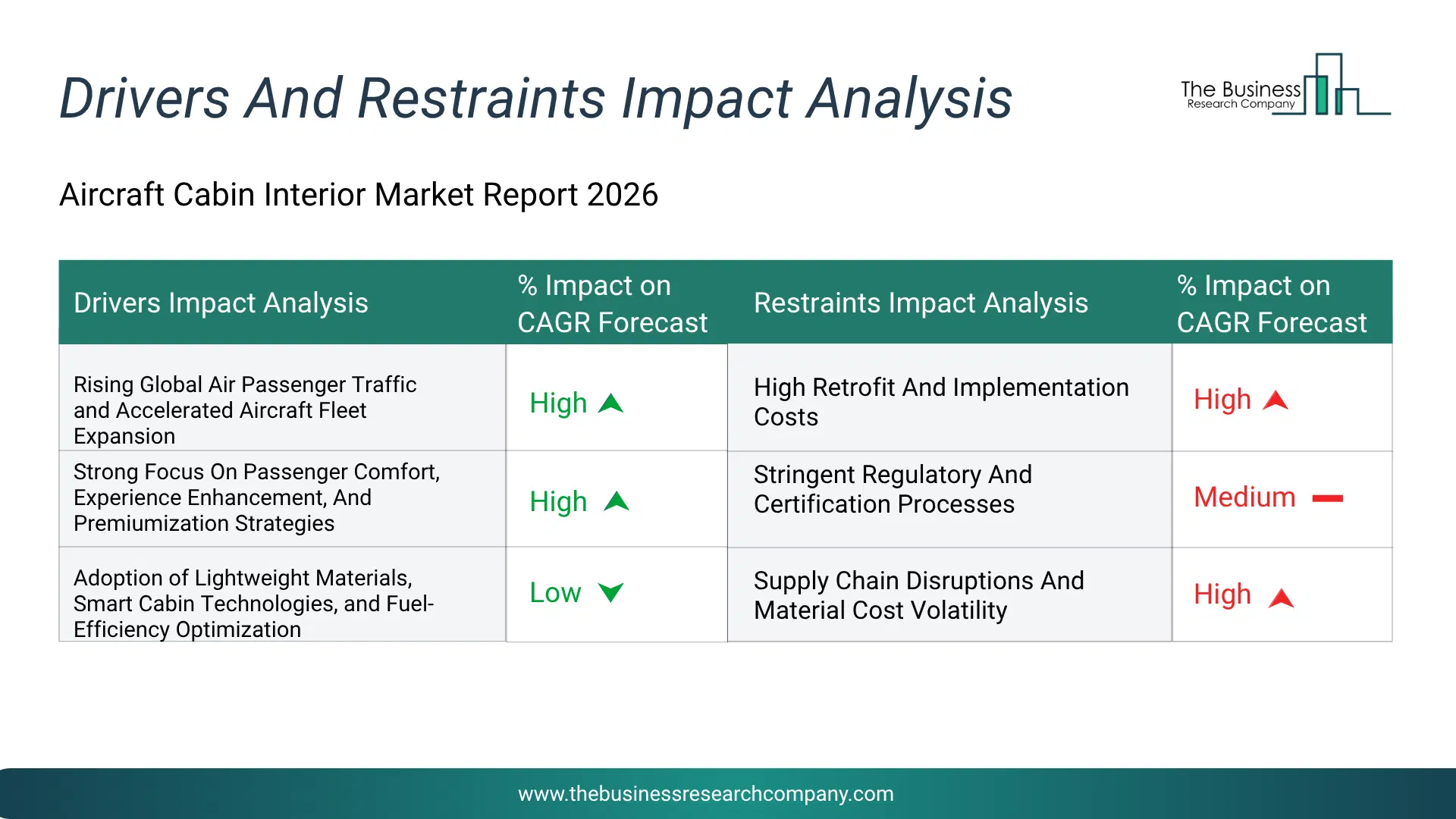
Infographic Chart Showing Key Market Drivers Analysis And Restraints For Aircraft Cabin Interior Market
The chart presents an impact analysis of key drivers and restraints, quantifying their relative influence on the market's growth rate and helping assess the balance between growth enablers and limiting factors. This chart offers a high-level perspective; the full report contains more detailed insights.
How Will The Drivers Impact Growth In The Global Aircraft Cabin Interior Market?
• Rising Global Air Passenger Traffic and Accelerated Aircraft Fleet Expansion (High) – During the forecast period, the rising global air passenger traffic and accelerated aircraft fleet expansion is expected to become a key growth driver for the aircraft cabin interior market by 2030. The steady rise in global air travel demand is driving airlines to expand and modernize their fleets, directly stimulating demand for advanced cabin interior systems. Increasing aircraft deliveries, particularly of narrow -body and wide -body jets, are generating strong oem demand for seating systems, cabin lighting, galleys, lavatories, and in -flight entertainment solutions. Additionally, expanding domestic and international routes, especially across asia -pacific and emerging markets, are further accelerating investments in cabin interior upgrades to enhance passenger capacity and service differentiation. • Strong Focus On Passenger Comfort, Experience Enhancement, And Premiumization Strategies (High) – During the forecast period, the strong focus on passenger comfort, experience enhancement, and premiumization strategies is expected to emerge as a major factor driving the expansion of the aircraft cabin interior market by 2030. Airlines are increasingly prioritizing passenger comfort, cabin aesthetics, digital connectivity, and premium seating configurations to strengthen brand positioning and customer retention. Rising competition among full-service and low-cost carriers is accelerating investments in ergonomic seating, mood lighting, high-definition inflight entertainment, wi-fi connectivity, and modular cabin layouts. This strategic shift toward experience-driven differentiation is significantly boosting retrofit programs and next-generation cabin design adoption, positioning passenger experience enhancement as a major structural growth driver. • Adoption of Lightweight Materials, Smart Cabin Technologies, and Fuel-Efficiency Optimization (Low) – During the forecast period, the adoption of lightweight materials, smart cabin technologies, and fuel-efficiency optimization is expected to act as a key growth catalyst for the aircraft cabin interior market by 2030. Airlines and aircraft oems are increasingly adopting lightweight composite materials, advanced alloys, smart lighting systems, and digitally integrated cabin solutions to reduce aircraft weight and enhance fuel efficiency. These innovations support lower operating costs, improved sustainability performance, and regulatory compliance, while enabling advanced cabin customization. The integration of ai-enabled cabin management, iot-based monitoring, and modular interior components is further accelerating technology-driven upgrades, making lightweight and smart cabin solutions a key long-term market growth catalyst.How Will The Restraints Impact Growth In The Global Aircraft Cabin Interior Market?
• High Retrofit And Implementation Costs (High) – During the forecast period, the substantial costs associated with procuring, installing, and certifying advanced cabin interior systems are a significant restraint, particularly for low?cost carriers and smaller operators. Premium seating, smart ifec solutions, and bespoke cabin layouts command price premiums that can delay investment decisions, especially when airlines must balance upgrade costs against operational budgets. • Stringent Regulatory And Certification Processes (Medium) – During the forecast period, the aircraft cabin interior components must comply with strict aviation safety standards, including fire resistance, crashworthiness, and material toxicity requirements. These certification procedures are both costly and time?consuming, often delaying product launches and adding complexity to design cycles, which can hinder rapid adoption of innovations in the cabin interiors market. • Supply Chain Disruptions And Material Cost Volatility (High) – During the forecast period, the disruptions in the supply of aerospace?grade materials, such as composites and alloys, coupled with price volatility in raw materials, create production bottlenecks and extended lead times for interior components. These issues not only inflate manufacturing costs but also impact timely delivery, particularly for aftermarket retrofits, limiting market responsiveness to changing airline demands.Key Players In The Global Aircraft Cabin Interior Market
Major companies operating in the aircraft cabin interior market are Safran S.A., Honeywell International Inc., Recaro Holding, Collins Aerospace, JAMCO Corporation, Astronics Corporation, Turkish Cabin Interior, Cobham Limited, Die Diehl Stiftung & Co. KG, Panasonic Avionics Corporation, HAECO Americas LLC, SCI Cabin Interiors, Geven S.p.A., Aviointeriors S.p.A., Bucher Leichtbau AG, Thales Group, Thompson Aero Seating, The Boeing Company, Gogo Inc., Global Aerospace Logistics (GAL), Hong Kong Aircraft Engineering Company Limited, Singapore Technologies Engineering Ltd., Acro Aircraft Seating, Boeing Encore Interiors LLC, AIM Altitude Limited, B/E Aerospace Inc., GKN Aerospace Limited, Greenpoint Technologies, United Technologies Corporation, Lacobucci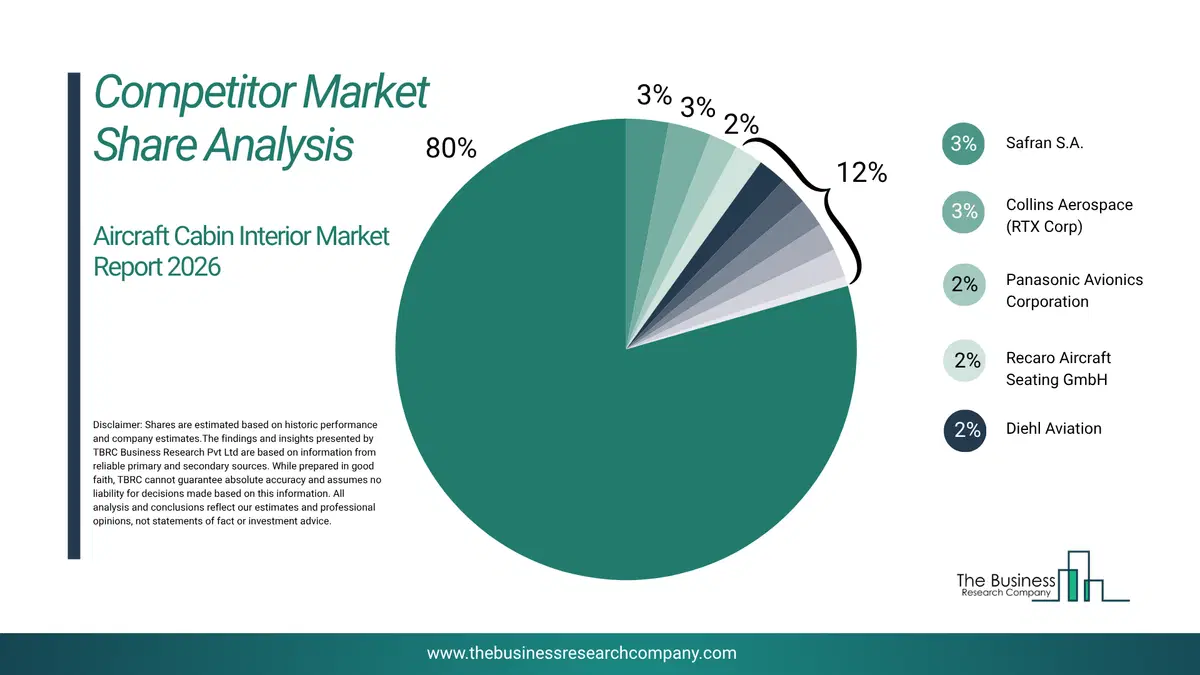
This chart is for illustrative purposes; the full report includes a detailed competitor analysis and comprehensive overview of the top 10 companies in the market.
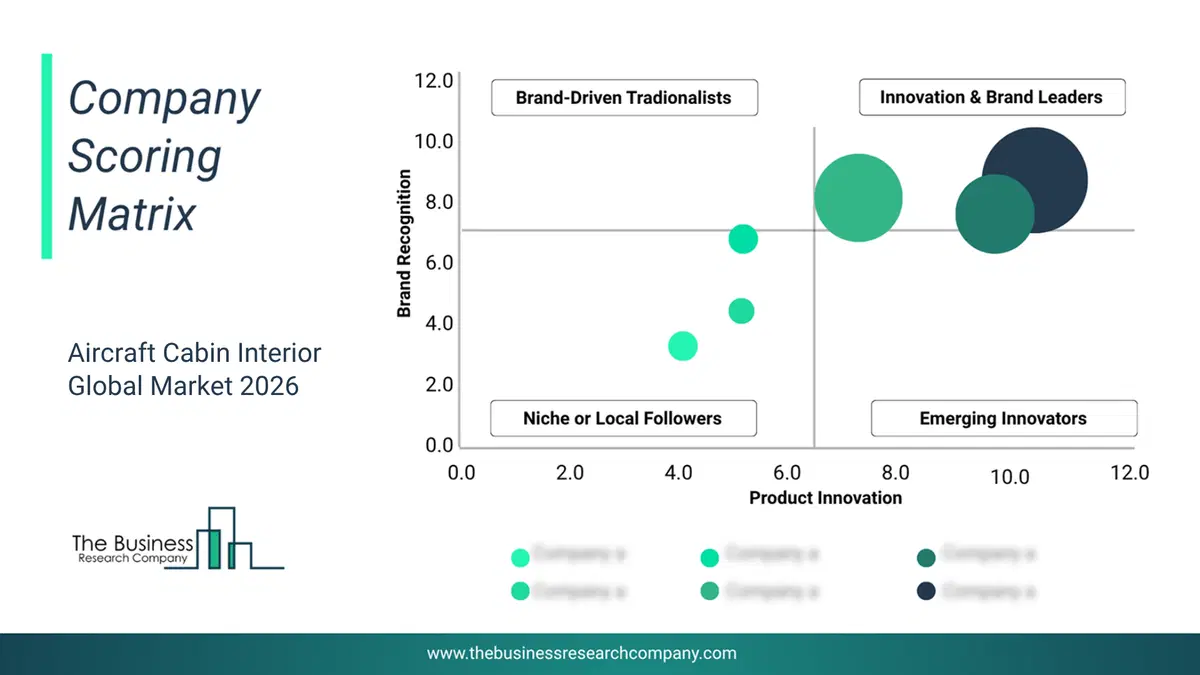
This chart maps companies by product innovation and brand strength, with bubble size indicating relative revenue, helping identify market leaders, challengers, and niche players. This is an illustrative chart; the full report provides a complete and accurate competitive analysis.
Global Aircraft Cabin Interior Market Trends and Insights
Major companies operating in the aircraft cabin interior market are focusing on enhancing cabin experience with upgraded interiors to improve passenger comfort and overall in-flight satisfaction across commercial and business aircraft segments. Cabin experience with upgraded interiors offers improved aircraft interiors that enhance passenger comfort, convenience, and visual appeal, featuring ergonomic seating, advanced lighting, and modern entertainment systems for a premium in-flight experience. For instance, in October 2025, Southwest Airlines, a US-based passenger airline that provides scheduled air transportation, unveiled its revamped Boeing 737 MAX 8 cabins, featuring extra legroom, spacious new Recaro R2 seats with multi-adjustable headrests, integrated device holders, and dual USB power ports at every seat. The redesign includes larger overhead bins, refreshed blue color schemes, modern lighting, and new premium seating sections with priority boarding and complimentary snacks. This major cabin transformation marks a significant milestone in Southwest's move towards assigned seating and a more upscale travel experience, with full rollout and boarding changes.What Are Latest Mergers And Acquisitions In The Aircraft Cabin Interior Market? DEMGY Group Acquired Tool-Gauge To Strengthen Aerospace Plastics Leadership And U.S. Presence
In March 2025, DEMGY Group, a France-based plastic fabrication company, acquired Tool-Gauge for an undisclosed amount. The acquisition aims to strengthen DEMGY's global leadership in high-value aerospace plastics, enhance its role as a Tier 1 supplier to Boeing and Airbus, and expand its presence in the U.S. market. It also leverages Tool-Gauge’s expertise in plastic injection molding and high-performance aircraft interior components to drive innovation and structural lightening in aerospace. Tool-Gauge is a US-based manufacturer of plastic aircraft cabin interior parts.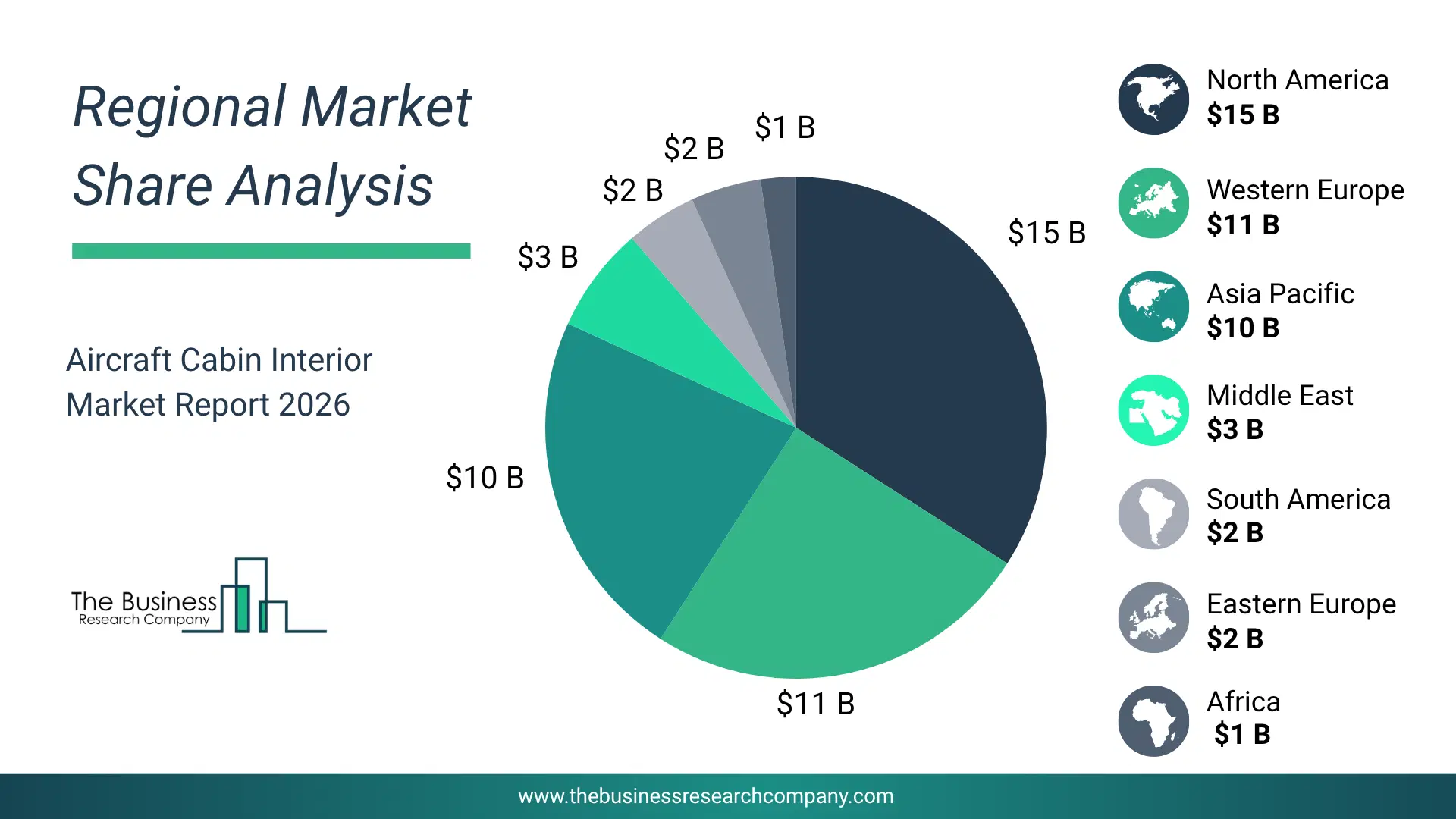
Regional Insights
North America was the largest region in the aircraft cabin Interior market in 2025. Asia-Pacific is expected to be the fastest-growing region in the forecast period. The regions covered in the aircraft cabin interior market report are Asia-Pacific, South East Asia, Western Europe, Eastern Europe, North America, South America, Middle East, Africa. The countries covered in the aircraft cabin interior market report are Australia, Brazil, China, France, Germany, India, Indonesia, Japan, Taiwan, Russia, South Korea, UK, USA, Canada, Italy, SpainWhat Defines the Aircraft Cabin Interior Market?
The aircraft cabin interior market consists of sales of smoke detectors, air purifiers, water and waste systems, and others that are used to provide passengers with an efficient and functional flight experience and ensure their well-being, safety, and comfort. Values in this market are ‘factory gate’ values, that is the value of goods sold by the manufacturers or creators of the goods, whether to other entities (including downstream manufacturers, wholesalers, distributors, and retailers) or directly to end customers. The value of goods in this market includes related services sold by the creators of the goods.How is Market Value Defined and Measured?
The market value is defined as the revenues that enterprises gain from the sale of goods and/or services within the specified market and geography through sales, grants, or donations in terms of the currency (in USD unless otherwise specified). The revenues for a specified geography are consumption values that are revenues generated by organizations in the specified geography within the market, irrespective of where they are produced. It does not include revenues from resales along the supply chain, either further along the supply chain or as part of other products.
This chart presents market attractiveness based on a quantitative evaluation of growth, competition, strategic alignment, and risk, offering a clear view of opportunity areas for decision-making. This chart is for illustrative purposes; the full report contains the complete analysis.

This chart highlights the Total Addressable Market (TAM) by estimating the maximum revenue opportunity using an assumption-driven approach, supporting strategic planning and opportunity sizing across markets. The chart is illustrative; the full report provides a more comprehensive analysis.
What Key Data and Analysis Are Included in the Aircraft Cabin Interior Market Report 2026?
The aircraft cabin interior market research report is one of a series of new reports from The Business Research Company that provides market statistics, including industry global market size, regional shares, competitors with the market share, detailed market segments, market trends and opportunities, and any further data you may need to thrive in the aircraft cabin interior industry. The market research report delivers a complete perspective of everything you need, with an in-depth analysis of the current and future state of the industry.Aircraft Cabin Interior Market Report Forecast Analysis
| Report Attribute | Details |
|---|---|
| Market Size Value In 2026 | $30.08 billion |
| Revenue Forecast In 2030 | $41.86 billion |
| Growth Rate | CAGR of 9.5% from 2026 to 2030 |
| Base Year For Estimation | 2025 |
| Actual Estimates/Historical Data | 2020-2025 |
| Forecast Period | 2026 - 2030 |
| Market Representation | Revenue in USD Billion and CAGR from 2026 to 2030 |
| Segments Covered | Type, Class, Aircraft Type, Material, End User |
| Regional Scope | Asia-Pacific, Western Europe, Eastern Europe, North America, South America, Middle East, Africa |
| Country Scope | The countries covered in the report are Australia, Brazil, China, France, Germany, India, Indonesia, Japan, Taiwan, Russia, South Korea, UK, USA, Canada, Italy, Spain. |
| Key Companies Profiled | Safran S.A., Honeywell International Inc., Recaro Holding, Collins Aerospace, JAMCO Corporation, Astronics Corporation, Turkish Cabin Interior, Cobham Limited, Die Diehl Stiftung & Co. KG, Panasonic Avionics Corporation, HAECO Americas LLC, SCI Cabin Interiors, Geven S.p.A., Aviointeriors S.p.A., Bucher Leichtbau AG, Thales Group, Thompson Aero Seating, The Boeing Company, Gogo Inc., Global Aerospace Logistics (GAL), Hong Kong Aircraft Engineering Company Limited, Singapore Technologies Engineering Ltd., Acro Aircraft Seating, Boeing Encore Interiors LLC, AIM Altitude Limited, B/E Aerospace Inc., GKN Aerospace Limited, Greenpoint Technologies, United Technologies Corporation, Lacobucci |
| Customization Scope | Request for Customization |
| Pricing And Purchase Options | Explore Purchase Options |