

Aircraft Electrical Connector Market Report 2026
Global Outlook – By Material Type (Plastic, Metal, Bimetallic, Ceramic, Composite Materials), By Connector Type (Circular Connectors, Rectangular Connectors, Push-Pull Connectors, Hybrid Connectors, Radio Frequency (RF) Connectors), By Application (Commercial Aviation, Military Aviation, General Aviation, Helicopters, Unmanned Aerial Vehicles (UAVs)), By End-User (Original Equipment Manufacturers (OEMs), Aftermarket Services, Repair And Maintenance Providers, Aerospace Defense Contractors, Aircraft Component Suppliers) – Market Size, Trends, Strategies, and Forecast to 2030
Aircraft Electrical Connector Market Overview
• Aircraft Electrical Connector market size has reached to $1.53 billion in 2025 • Expected to grow to $2.13 billion in 2030 at a compound annual growth rate (CAGR) of 6.8% • Growth Driver: Surge In Aircraft Production Driving The Growth Of The Market Due To Fleet Modernization And Rising Global Demand • Market Trend: Breakthrough In High-Power Harness Technology Enhances Efficiency And Supports Next-Gen Electric Aviation • North America was the largest region in 2025 and Asia-Pacific is the fastest growing region.What Is Covered Under Aircraft Electrical Connector Market?
Aircraft electrical connectors are specialized components designed to join electrical circuits within various aircraft systems, enabling the safe and efficient transmission of power and signals. They are engineered to withstand harsh environmental conditions such as extreme temperatures, vibrations, moisture, and pressure changes commonly encountered in aviation. These connectors play a critical role in ensuring the reliability and performance of avionics, lighting, communication, navigation, and control systems across different types of aircraft. The main material types of aircraft electrical connectors are plastic, metal, bimetallic, ceramic, and composite materials. Plastic connectors use insulating plastic materials for their housing and sometimes for internal parts, providing lightweight and corrosion-resistant solutions for electrical connections. These are used for various connector types, including circular connectors, rectangular connectors, push-pull connectors, hybrid connectors, and radio frequency (RF) connectors, with applications in commercial aviation, military aviation, general aviation, helicopters, and unmanned aerial vehicles (UAVs). These are also used by various end users such as original equipment manufacturers (OEMs), aftermarket services, repair and maintenance providers, aerospace defense contractors, and aircraft component suppliers.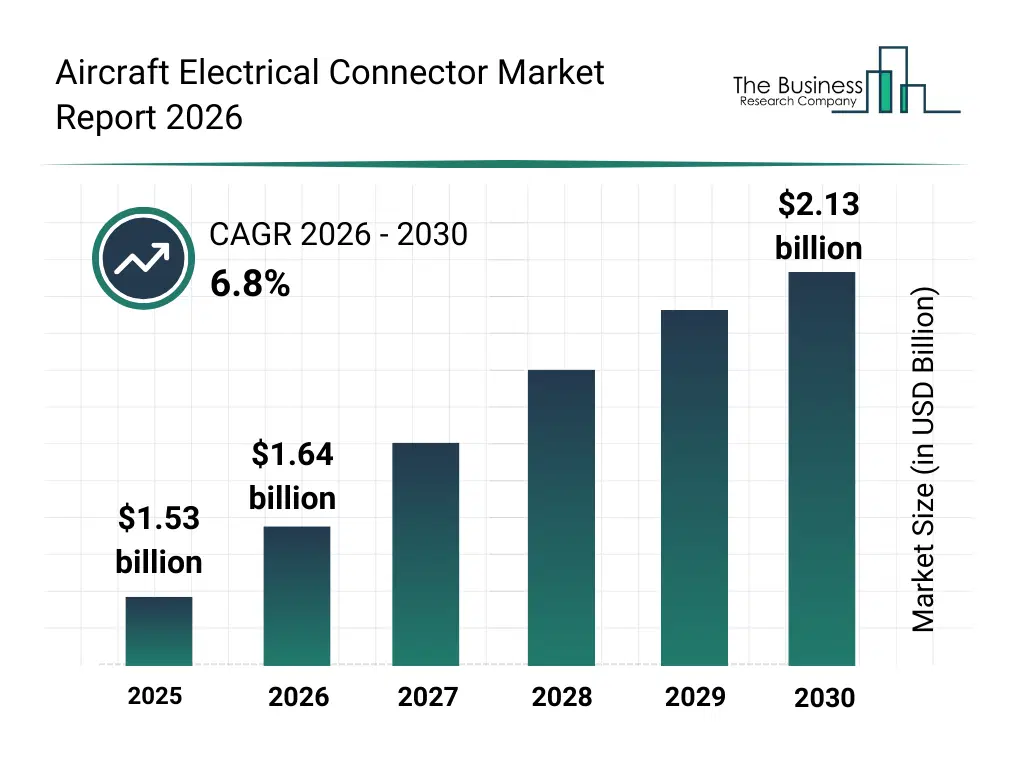
What Is The Aircraft Electrical Connector Market Size and Share 2026?
The aircraft electrical connector market size has grown strongly in recent years. It will grow from $1.53 billion in 2025 to $1.64 billion in 2026 at a compound annual growth rate (CAGR) of 7.2%. The growth in the historic period can be attributed to increasing adoption of circular and rectangular connectors in aircraft systems, development of fiber optic connectors for high-speed data transmission, rising demand for reliable power and signal connectors in avionics, implementation of modular connectors for versatile aircraft applications, growing focus on environmental resistance to vibration, temperature, and moisture.What Is The Aircraft Electrical Connector Market Growth Forecast?
The aircraft electrical connector market size is expected to see strong growth in the next few years. It will grow to $2.13 billion in 2030 at a compound annual growth rate (CAGR) of 6.8%. The growth in the forecast period can be attributed to expansion of high-speed and next-generation data connectors for modern avionics, rising adoption of lightweight and compact connector designs, integration of advanced materials for enhanced durability and corrosion resistance, increasing demand for modular and customizable connector solutions, growth in replacement and aftermarket services for aircraft electrical connectors. Major trends in the forecast period include high-speed data connectors, miniaturized connector adoption, high-temperature/vibration-resistant materials, fiber-optic expansion, modular multifunctional connectors.
Global Aircraft Electrical Connector Market Segmentation
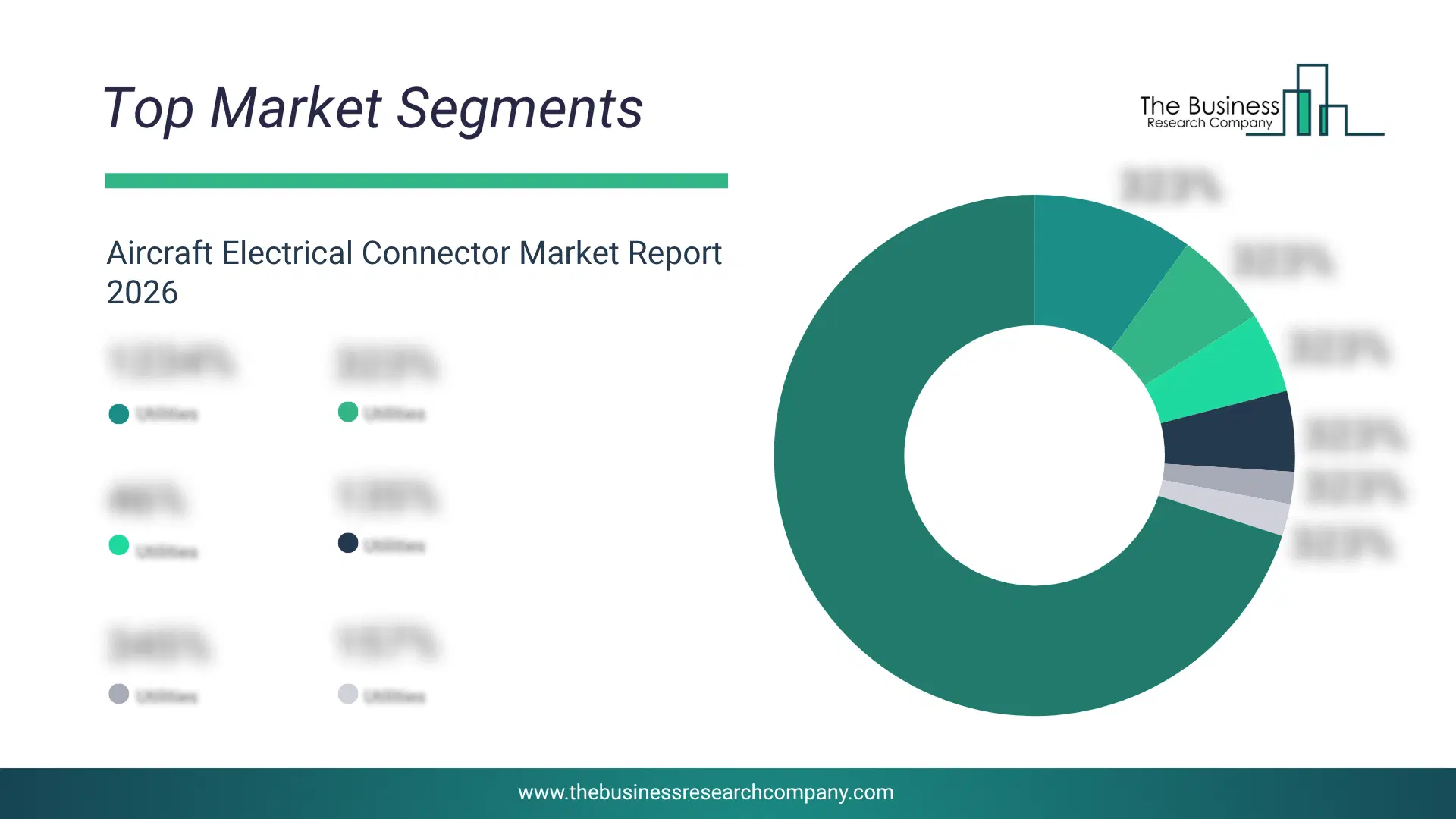
1) By Material Type: Plastic, Metal, Bimetallic, Ceramic, Composite Materials 2) By Connector Type: Circular Connectors, Rectangular Connectors, Push-Pull Connectors, Hybrid Connectors, Radio Frequency (RF) Connectors 3) By Application: Commercial Aviation, Military Aviation, General Aviation, Helicopters, Unmanned Aerial Vehicles (UAVs) 4) By End-User: Original Equipment Manufacturers (OEMs), Aftermarket Services, Repair And Maintenance Providers, Aerospace Defense Contractors, Aircraft Component Suppliers Subsegments: 1) By Plastic: Thermosetting Plastics, Thermoplastics, High-Performance Polymers, Glass-Fiber Reinforced Plastics 2) By Metal: Aluminum Alloys, Stainless Steel, Copper Alloys, Titanium Alloys, Nickel-Plated Metals 3) By Bimetallic: Copper-Aluminum Composites, Aluminum-Steel Combinations, Copper-Stainless Steel, Nickel-Coated Bimetals 4) By Ceramic: Alumina Ceramics, Zirconia Ceramics, Silicon Nitride Ceramics, Glass-Ceramic Composites 5) By Composite Materials: Carbon Fiber Reinforced Polymers, Glass Fiber Reinforced Polymers, Hybrid Composites, Nano-Composite MaterialsWhat Is Driver Of The Aircraft Electrical Connector Market?
The increasing aircraft production is expected to propel the growth of the aircraft electrical connector market going forward. Aircraft production refers to the process of designing, manufacturing, assembling, and testing aircraft, including both military and commercial airplanes, helicopters, and unmanned aerial vehicles (UAVs). Aircraft production is increasing due to fleet modernization, as airlines replace older, less efficient aircraft with newer models that offer improved fuel economy, lower emissions, and enhanced performance. Aircraft electrical connectors help aircraft production and fleet expansion by supporting reliable power and signal transmission, which ensures the safe and efficient operation of aircraft systems, making it easier to build and maintain more airplanes. For instance, in February 2024, according to a report published by Statistics Canada, a Canada-based government agency, aerospace products and parts production rose by 29.7% from 2022, reaching $24.9 billion in 2023, marking the second-highest total ever recorded. Therefore, increasing aircraft production is driving the growth of the aircraft electrical connector industry.Key Players In The Global Aircraft Electrical Connector Market
Major companies operating in the aircraft electrical connector market are Eaton Corporation plc, Safran S.A., TE Connectivity Ltd., Molex LLC, Nexans S.A., Phoenix Contact GmbH & Co. KG, Carlisle Companies Incorporated, Rosenberger Hochfrequenztechnik GmbH & Co. KG, ITT Corporation, Smiths Group plc, JAE Electronics Inc., HUBER+SUHNER AG, Glenair Inc., Samtec Inc., Bel Fuse Inc., Lemo S.A., Fischer Connectors SA, Trexon Inc., Conesys Inc., Esterline Technologies Corporation.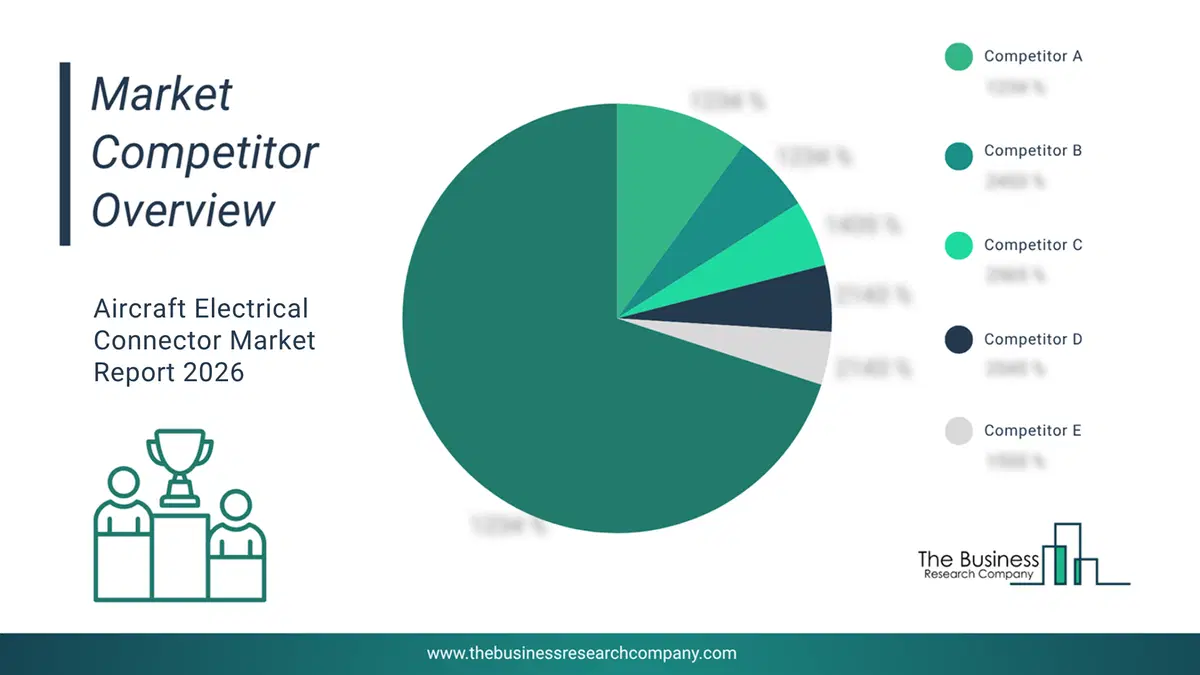
This chart is for illustrative purposes; the full report includes a detailed competitor analysis and comprehensive overview of the top 10 companies in the market.
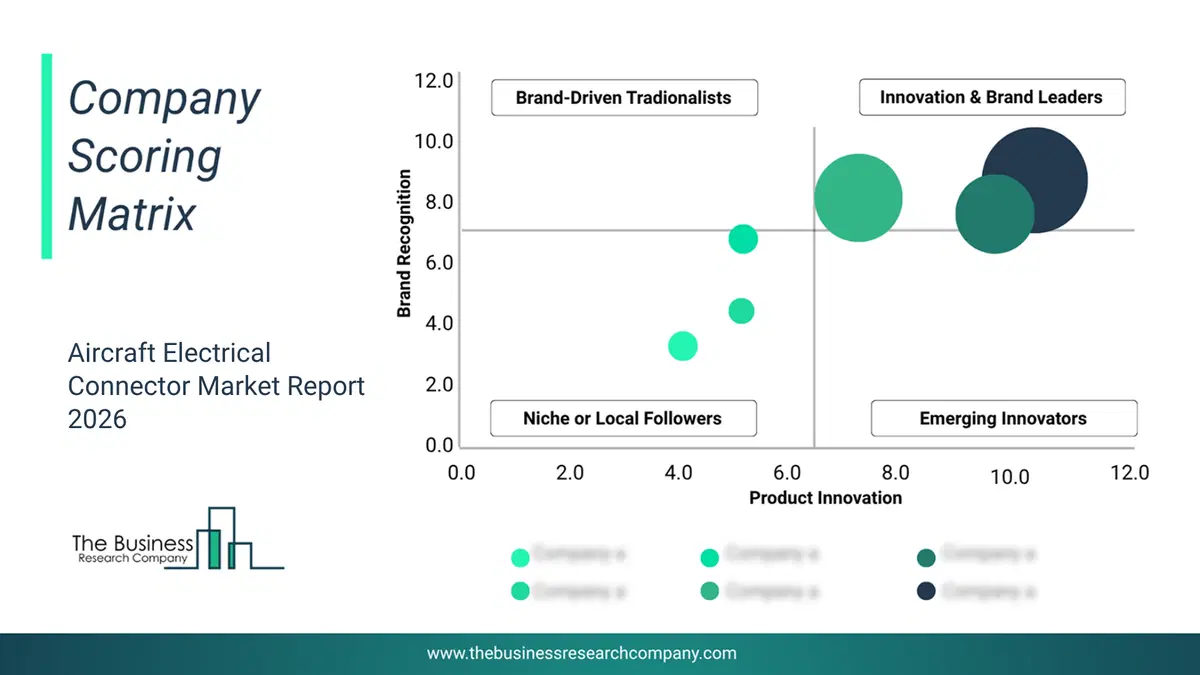
This chart maps companies by product innovation and brand strength, with bubble size indicating relative revenue, helping identify market leaders, challengers, and niche players. This is an illustrative chart; the full report provides a complete and accurate competitive analysis.
Global Aircraft Electrical Connector Market Trends and Insights
Major companies operating in the aircraft electrical connector market are focusing on technological advancements such as high-power electrical harnesses to enhance power transmission efficiency, reduce weight, and support the growing electrical demands of modern aircraft systems. High-power electrical harnesses are used to transmit large amounts of electrical energy efficiently across various aircraft systems, enabling the operation of power-intensive components such as electric propulsion, avionics, and environmental control systems while minimizing energy loss and optimizing overall aircraft performance. For instance, in April 2024, Safran, a France-based aerospace and defense company, launched GENeUSCONNECT, a cutting-edge range of high-power electrical harnesses specifically designed for all-electric and hybrid aircraft. The launch took place at the AERO Friedrichshafen trade show, showcasing Safran’s commitment to advancing electric propulsion technologies. GENeUSCONNECT harnesses are engineered to handle high voltages up to 800 volts DC and deliver double the power of conventional wiring systems, all while maintaining the same size footprint.What Are Latest Mergers And Acquisitions In The Aircraft Electrical Connector Market? Trexon Acquired AirBorn To Bolster High-Performance Interconnect Solutions For Aerospace And Defense
In December 2024, Molex, a US-based consumer electronics company, acquired AirBorn for an undisclosed amount. With this acquisition, it aims to strengthen Molex's capabilities in delivering advanced, reliable interconnect solutions for industries requiring high-performance technologies in extreme operating environments. AirBorn Inc. is a US-based manufacturer of rugged and highly reliable connectors and electronic components designed for mission-critical applications across aerospace and defense.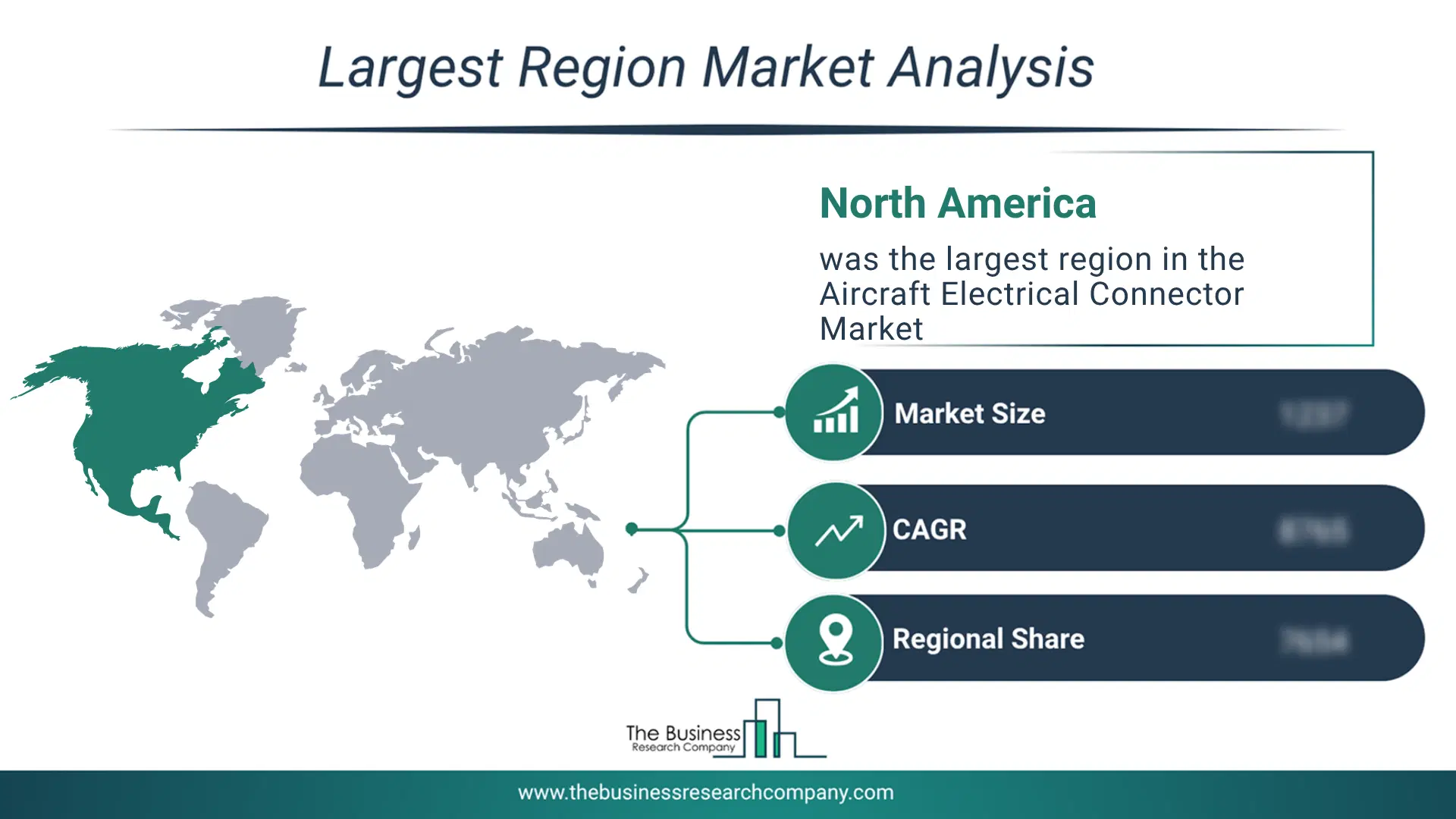
Regional Insights
North America was the largest region in the aircraft electrical connector market in 2025. Asia-Pacific is expected to be the fastest-growing region in the forecast period. The regions covered in this market report are Asia-Pacific, South East Asia, Western Europe, Eastern Europe, North America, South America, Middle East, Africa. The countries covered in this market report are Australia, Brazil, China, France, Germany, India, Indonesia, Japan, Taiwan, Russia, South Korea, UK, USA, Canada, Italy, SpainWhat Defines the Aircraft Electrical Connector Market?
The aircraft electrical connector market includes sales of circular connectors, rectangular connectors, fiber optic connectors, high-speed data connectors, power connectors, signal connectors, and modular connectors. Values in this market are ‘factory gate’ values, that is, the value of goods sold by the manufacturers or creators of the goods, whether to other entities (including downstream manufacturers, wholesalers, distributors, and retailers) or directly to end customers. The value of goods in this market includes related services sold by the creators of the goods.How is Market Value Defined and Measured?
The market value is defined as the revenues that enterprises gain from the sale of goods and/or services within the specified market and geography through sales, grants, or donations in terms of the currency (in USD unless otherwise specified). The revenues for a specified geography are consumption values that are revenues generated by organizations in the specified geography within the market, irrespective of where they are produced. It does not include revenues from resales along the supply chain, either further along the supply chain or as part of other products.
This chart presents market attractiveness based on a quantitative evaluation of growth, competition, strategic alignment, and risk, offering a clear view of opportunity areas for decision-making. This chart is for illustrative purposes; the full report contains the complete analysis.

This chart highlights the Total Addressable Market (TAM) by estimating the maximum revenue opportunity using an assumption-driven approach, supporting strategic planning and opportunity sizing across markets. The chart is illustrative; the full report provides a more comprehensive analysis.
What Key Data and Analysis Are Included in the Aircraft Electrical Connector Market Report 2026?
The aircraft electrical connector market research report is one of a series of new reports from The Business Research Company that provides market statistics, including industry global market size, regional shares, competitors with the market share, detailed market segments, market trends and opportunities, and any further data you may need to thrive in the aircraft electrical connector industry. The market research report delivers a complete perspective of everything you need, with an in-depth analysis of the current and future state of the industry.Aircraft Electrical Connector Market Report Forecast Analysis
| Report Attribute | Details |
|---|---|
| Market Size Value In 2026 | $1.64 billion |
| Revenue Forecast In 2030 | $2.13 billion |
| Growth Rate | CAGR of 6.8% from 2026 to 2030 |
| Base Year For Estimation | 2025 |
| Actual Estimates/Historical Data | 2020-2025 |
| Forecast Period | 2026 - 2030 |
| Market Representation | Revenue in USD Billion and CAGR from 2026 to 2030 |
| Segments Covered | Material Type, Connector Type, Application, End-User |
| Regional Scope | Asia-Pacific, Western Europe, Eastern Europe, North America, South America, Middle East, Africa |
| Country Scope | The countries covered in the aircraft electrical connector market report are Australia, Brazil, China, France, Germany, India, Indonesia, Japan, Taiwan, Russia, South Korea, UK, USA, Canada, Italy, Spain |
| Key Companies Profiled | Eaton Corporation plc, Safran S.A., TE Connectivity Ltd., Molex LLC, Nexans S.A., Phoenix Contact GmbH & Co. KG, Carlisle Companies Incorporated, Rosenberger Hochfrequenztechnik GmbH & Co. KG, ITT Corporation, Smiths Group plc, JAE Electronics Inc., HUBER+SUHNER AG, Glenair Inc., Samtec Inc., Bel Fuse Inc., Lemo S.A., Fischer Connectors SA, Trexon Inc., Conesys Inc., Esterline Technologies Corporation. |
| Customization Scope | Request for Customization |
| Pricing And Purchase Options | Explore Purchase Options |