
Aircraft Engine Blade Market Report 2026
Global Outlook – By Blade Type (Compressor Blades, Turbine Blades, Fan Blades), By Blade Size (0-20, 21-40, 41-60), By Material (Titanium, Nickle Alloy, Composites, Other Materials), By Aircraft Type (Commercial Aircraft, General Aviation, Regional Aircraft, Military Aircraft), By End User (Original Equipment Manufacturer (OEM), Aftermarket) – Market Size, Trends, Strategies, and Forecast to 2030
Aircraft Engine Blade Market Overview
• Aircraft Engine Blade market size has reached to $17.52 billion in 2025 • Expected to grow to $24.92 billion in 2030 at a compound annual growth rate (CAGR) of 7.2% • Growth Driver: Fuel-Efficient Aircraft Revolutionizing The Aircraft Engine Blade Market • Market Trend: Advancements in Heat-Resistant Alloys Enhance Aircraft Engine Performance and Durability • North America was the largest region in 2025 and Asia-Pacific is the fastest growing region.What Is Covered Under Aircraft Engine Blade Market?
Aircraft engine blades are one of the critical components of a jet engine. They are responsible for converting the energy of the hot, expanding gases into rotational energy that powers the engine's fan or compressor. The main types of aircraft engine blades are compressor blades, turbine blades, and fan blades. Compressor blades are located in the engine’s compressor section, which compresses the incoming air before it enters the combustion chamber. The various aircraft types include commercial aircraft, general aviation, regional aircraft, and military aircraft with various blade sizes such as 0-20, 21-40, and 41-60. The various materials include titanium, nickel alloy, composites, and others. These are used by various end-users such as original equipment manufacturers (OEM), and aftermarket.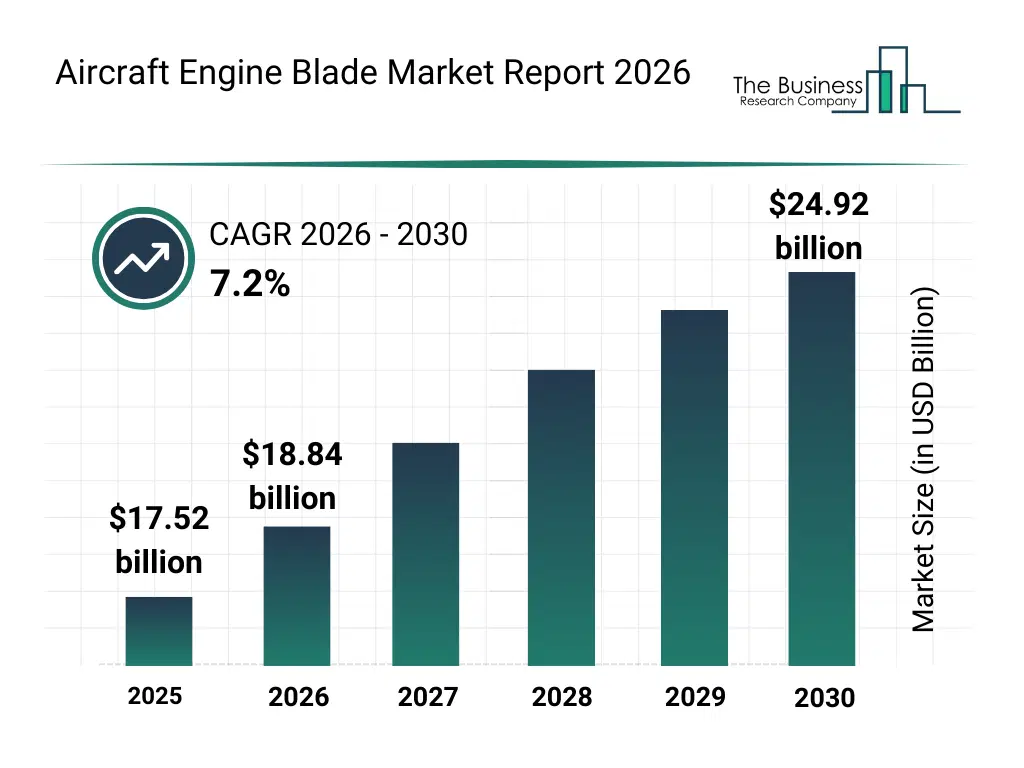
What Is The Aircraft Engine Blade Market Size and Share 2026?
The aircraft engine blade market size has grown strongly in recent years. It will grow from $17.52 billion in 2025 to $18.84 billion in 2026 at a compound annual growth rate (CAGR) of 7.5%. The growth in the historic period can be attributed to growing adoption of precision-engineered blade airfoils to improve engine efficiency, early development of shrouds and platforms to enhance structural integrity of turbine assemblies, rising demand for durable trailing edges to withstand extreme thermal and mechanical loads, expansion of commercial aviation driving the need for high-performance engine components, increasing use of advanced alloys and casting techniques in turbine blade manufacturing.What Is The Aircraft Engine Blade Market Growth Forecast?
The aircraft engine blade market size is expected to see strong growth in the next few years. It will grow to $24.92 billion in 2030 at a compound annual growth rate (CAGR) of 7.2%. The growth in the forecast period can be attributed to growing demand for lightweight, high-temperature-resistant materials to improve fuel efficiency and engine performance, increasing adoption of additive manufacturing for complex blade geometries, rising aircraft production and fleet modernization requiring next-generation turbine blades, technological advancements enabling improved cooling designs for higher engine operating temperatures, expansion of maintenance, repair and overhaul (MRO) activities driving replacement of worn or life-limited engine blades. Major trends in the forecast period include growing use of advanced airfoil designs, rising demand for high-temperature-resistant blade materials, increased adoption of multi-stage compressor and turbine blades, expansion in precision casting and forging technologies, greater emphasis on lightweight composite blade development.
Global Aircraft Engine Blade Market Segmentation
1) By Blade Type: Compressor Blades, Turbine Blades, Fan Blades 2) By Blade Size: 0-20, 21-40, 41-60 3) By Material: Titanium, Nickle Alloy, Composites, Other Materials 4) By Aircraft Type: Commercial Aircraft, General Aviation, Regional Aircraft, Military Aircraft 5) By End User: Original Equipment Manufacturer (OEM), Aftermarket Subsegments: 1) By Compressor Blades: Low-Pressure Compressor Blades, High-Pressure Compressor Blades 2) By Turbine Blades: High-Pressure Turbine Blades, Low-Pressure Turbine Blades 3) By Fan Blades: Front Fan Blades, Rear Fan BladesWhat Is Driver Of The Aircraft Engine Blade Market?
The surge in adopting cost-effective and fuel-efficient aircraft is expected to propel the growth of the aircraft engine blade market going forward. Cost-effective and fuel-efficient aircraft are designed to reduce operating costs and improve environmental sustainability, and they are equipped with advanced technologies to enhance fuel efficiency, reduce emissions, and lower maintenance costs. Aircraft engine blades are used in various cost-effective and fuel-efficient aircraft that increase their durability. For instance, in June 2023, according to the Boeing Company, a US-based aircraft industry company, boeing projects a global demand for 42,595 new commercial aircraft, worth US$8 trillion, by 2042. Airlines are expected to replace roughly half of their current fleets with newer, more fuel-efficient models. Therefore, the surge in adopting cost-effective and fuel-efficient aircraft drives the aircraft engine blade industry.Key Players In The Global Aircraft Engine Blade Market
Major companies operating in the aircraft engine blade market are CFM International, General Electric Company, Rolls-Royce Holdings plc, MTU Aero Engines AG, Albany International Corporation, Doncasters Group Limited, Safran S.A., Farinia S.A., RTX Corporation, AeroEdge Co. Ltd., GKN Aerospace Pvt. Ltd., Honeywell International Inc., Alcoa Corporation, Hi-Tek Manufacturing Pvt. Ltd., Aviadvigatel OJSC, PowerJet Engineering LLP, Textron Inc., Pratt & Whitney, Perm Engine Corporation, Omsk Engine Design Bureau, Aviastar-SP JSC, Howmet Aerospace Inc., Precision Castparts Corp., Avio Aero, Mitsubishi Heavy Industries Ltd., IHI Corporation, Kawasaki Heavy Industries Ltd., Siemens AG, Leonardo S.p.A., Liebherr Group
This chart is for illustrative purposes; the full report includes a detailed competitor analysis and comprehensive overview of the top 10 companies in the market.
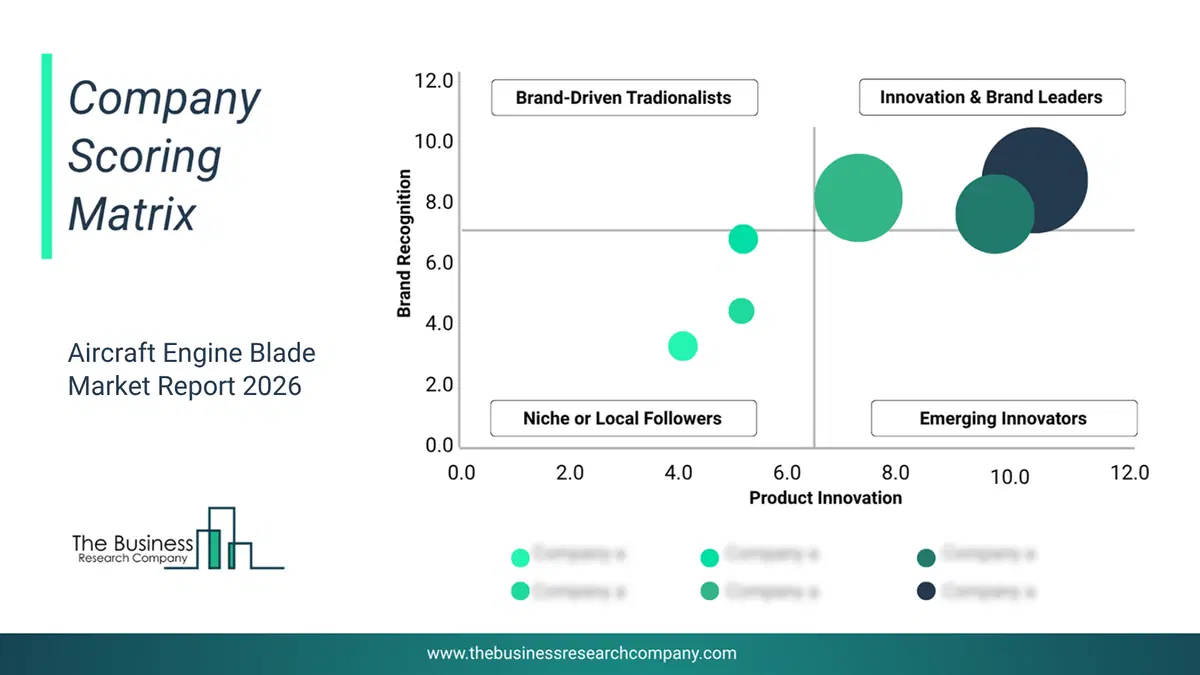
This chart maps companies by product innovation and brand strength, with bubble size indicating relative revenue, helping identify market leaders, challengers, and niche players. This is an illustrative chart; the full report provides a complete and accurate competitive analysis.
Global Aircraft Engine Blade Market Trends and Insights
Major companies operating in the aircraft engine blade market are focusing on leveraging innovative solutions such as advanced heat-resistant alloys to improve engine performance and durability. Advanced heat-resistant alloys are specialized metal mixtures that maintain strength and resist deformation even at extremely high temperatures, helping aircraft engines operate efficiently under intense thermal stress, improve fuel efficiency, reduce maintenance needs, and significantly increase overall durability and performance. For instance, in February 2024, Rostec State Corporation, a Russia-based aerospace and defense company, launched the PD-8 engine blades, an innovative product designed for the SJ-100 regional jet. The blades are manufactured from advanced heat-resistant alloys developed in collaboration with the National Research Center "Kurchatov Institute", VIAM, allowing them to withstand high mechanical and thermal loads. The new alloys meet international standards for chemical stability, impurity levels, and mechanical properties, enabling enhanced performance and durability without requiring changes to the existing production process. The development marks a significant step forward in Russia’s aircraft engine technology and could be applied in future gas turbine engines.What Are Latest Mergers And Acquisitions In The Aircraft Engine Blade Market? Safran S.A. Acquires Collins Aerospace’s Flight Control And Actuation Business
In July 2025, Safran S.A., a France-based aerospace company, acquired Collins Aerospace’s flight control and actuation business from RTX Corporation for $1.8 billion. With this acquisition, Safran aims to strengthen its position as a global leader in mission-critical flight control and actuation systems, enhancing its capabilities for next-generation aircraft platforms. Collins Aerospace is a U.S.-based manufacturing company that specializes in providing aircraft engine blades and advanced flight control technologies.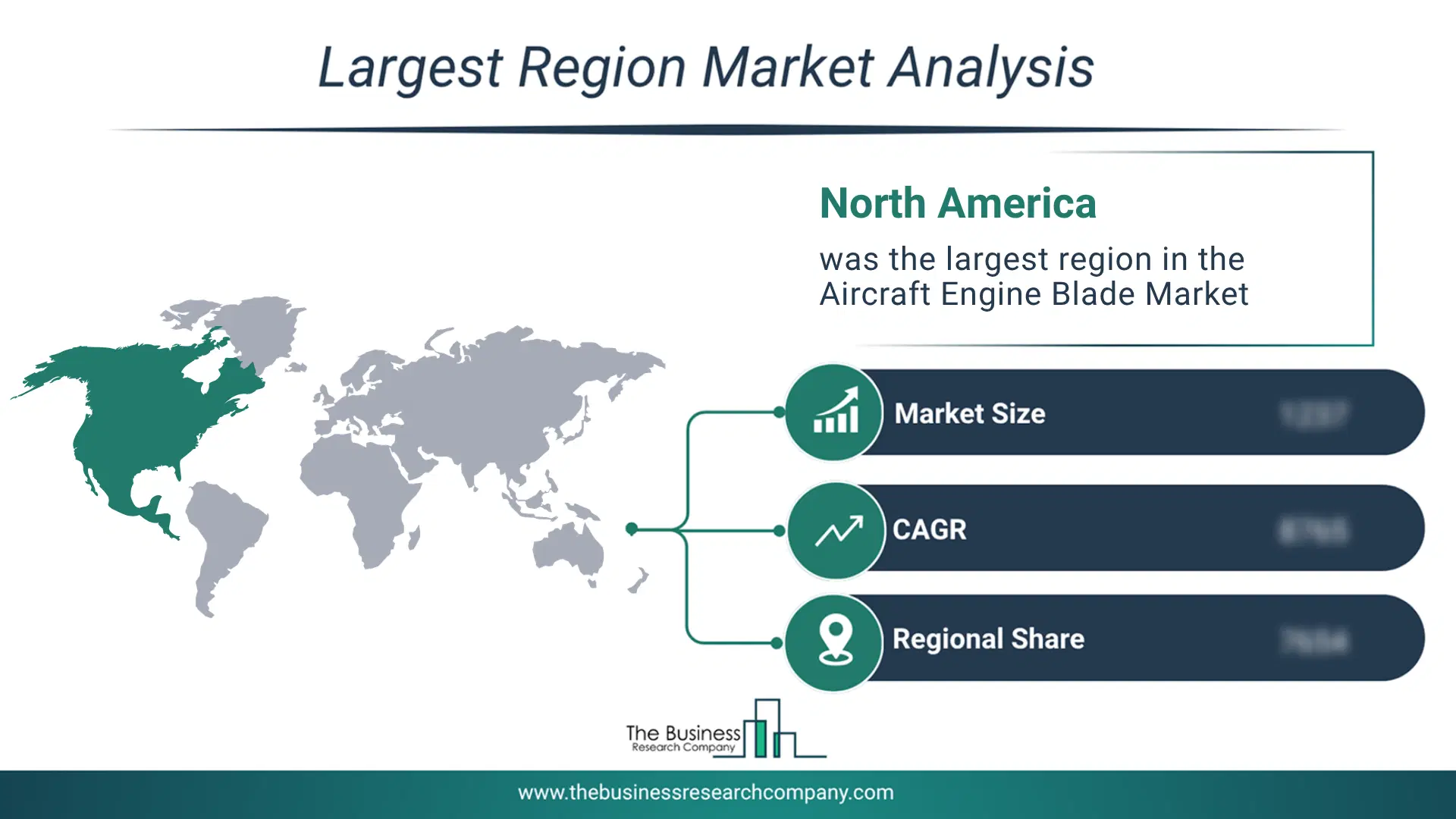
Regional Insights
North America was the largest region in the aircraft engine blade market in 2025. Asia-Pacific is expected to be the fastest-growing region in the global aircraft engine blade market during the forecast period. The regions covered in the aircraft engine blade market report are Asia-Pacific, South East Asia, Western Europe, Eastern Europe, North America, South America, Middle East, Africa. The countries covered in the aircraft engine blade market report are Australia, Brazil, China, France, Germany, India, Indonesia, Japan, Taiwan, Russia, South Korea, UK, USA, Canada, Italy, SpainWhat Defines the Aircraft Engine Blade Market?
The aircraft engine blade market consists of sales of blade airfoils, shrouds, trailing edges and platforms. Values in this market are ‘factory gate’ values, that is the value of goods sold by the manufacturers or creators of the goods, whether to other entities (including downstream manufacturers, wholesalers, distributors, and retailers) or directly to end customers. The value of goods in this market includes related services sold by the creators of the goods.How is Market Value Defined and Measured?
The market value is defined as the revenues that enterprises gain from the sale of goods and/or services within the specified market and geography through sales, grants, or donations in terms of the currency (in USD unless otherwise specified). The revenues for a specified geography are consumption values that are revenues generated by organizations in the specified geography within the market, irrespective of where they are produced. It does not include revenues from resales along the supply chain, either further along the supply chain or as part of other products.
This chart presents market attractiveness based on a quantitative evaluation of growth, competition, strategic alignment, and risk, offering a clear view of opportunity areas for decision-making. This chart is for illustrative purposes; the full report contains the complete analysis.

This chart highlights the Total Addressable Market (TAM) by estimating the maximum revenue opportunity using an assumption-driven approach, supporting strategic planning and opportunity sizing across markets. The chart is illustrative; the full report provides a more comprehensive analysis.
What Key Data and Analysis Are Included in the Aircraft Engine Blade Market Report 2026?
The aircraft engine blade market research report is one of a series of new reports from The Business Research Company that provides market statistics, including industry global market size, regional shares, competitors with the market share, detailed market segments, market trends and opportunities, and any further data you may need to thrive in the aircraft engine blade industry. The market research report delivers a complete perspective of everything you need, with an in-depth analysis of the current and future state of the industry.Aircraft Engine Blade Market Report Forecast Analysis
| Report Attribute | Details |
|---|---|
| Market Size Value In 2026 | $18.84 billion |
| Revenue Forecast In 2030 | $24.92 billion |
| Growth Rate | CAGR of 7.2% from 2026 to 2030 |
| Base Year For Estimation | 2025 |
| Actual Estimates/Historical Data | 2020-2025 |
| Forecast Period | 2026 - 2030 |
| Market Representation | Revenue in USD Billion and CAGR from 2026 to 2030 |
| Segments Covered | Blade Type, Blade Size, Material, Aircraft Type, End User |
| Regional Scope | Asia-Pacific, Western Europe, Eastern Europe, North America, South America, Middle East, Africa |
| Country Scope | The countries covered in the aircraft engine blade market report are Australia, Brazil, China, France, Germany, India, Indonesia, Japan, Taiwan, Russia, South Korea, UK, USA, Canada, Italy, Spain |
| Key Companies Profiled | CFM International, General Electric Company, Rolls-Royce Holdings plc, MTU Aero Engines AG, Albany International Corporation, Doncasters Group Limited, Safran S.A., Farinia S.A., RTX Corporation, AeroEdge Co. Ltd., GKN Aerospace Pvt. Ltd., Honeywell International Inc., Alcoa Corporation, Hi-Tek Manufacturing Pvt. Ltd., Aviadvigatel OJSC, PowerJet Engineering LLP, Textron Inc., Pratt & Whitney, Perm Engine Corporation, Omsk Engine Design Bureau, Aviastar-SP JSC, Howmet Aerospace Inc., Precision Castparts Corp., Avio Aero, Mitsubishi Heavy Industries Ltd., IHI Corporation, Kawasaki Heavy Industries Ltd., Siemens AG, Leonardo S.p.A., Liebherr Group |
| Customization Scope | Request for Customization |
| Pricing And Purchase Options | Explore Purchase Options |