

Aircraft Engine Components Market Report 2026
Global Outlook – By Component Type (Compressor, Turbine, Gearbox, Exhaust Nozzle, Fuel System, Other Component Types), By Engine Type (Turbofan, Turbojet, Turboshaft, Piston), By Fit Type (Line Fit, Retrofit), By Aircraft Type (Commercial Aircraft, Military Aircraft, Business Jets, General Aviation Aircraft, Helicopters), By End User (Original Equipment Manufacturers, Maintenance, Repair, And Overhaul Providers, Defense Organizations) – Market Size, Trends, Strategies, and Forecast to 2035
Aircraft Engine Components Market Overview
• Aircraft Engine Components market size has reached to $66.31 billion in 2025 • Expected to grow to $103.31 billion in 2030 at a compound annual growth rate (CAGR) of 9.2% • Growth Driver: Increasing Commercial Aircraft Production And Deliveries Drives The Market Growth Due To Rising Demand For New Aircraft Engines And Critical Engine Parts • Market Trend: Electric Aircraft Powertrain Systems Innovations Driving Sustainable Aviation Performance • North America was the largest region in 2025 and Asia-Pacific is the fastest growing region.What Is Covered Under Aircraft Engine Components Market?
Aircraft engine components are the precision-engineered mechanical, structural, and control elements that collectively enable an aircraft engine to generate power, regulate airflow, and maintain efficient operation under demanding conditions. These components are designed using advanced materials and manufacturing techniques to deliver high performance, durability, reliability, and compliance with stringent aerospace safety and quality standards. The main component types of aircraft engine components include compressors, turbines, gearboxes, exhaust nozzles, fuel systems, and other component types. Compressors refer to engine components that increase the pressure of incoming air before it enters the combustion section, supporting efficient engine operation and performance. These components are used in turbofan, turbojet, turboshaft, and piston engines and are available through line fit and retrofit configurations. They are installed across commercial aircraft, military aircraft, business jets, general aviation aircraft, and helicopters and are used by end users including original equipment manufacturers, maintenance, repair, and overhaul providers, and defense organizations.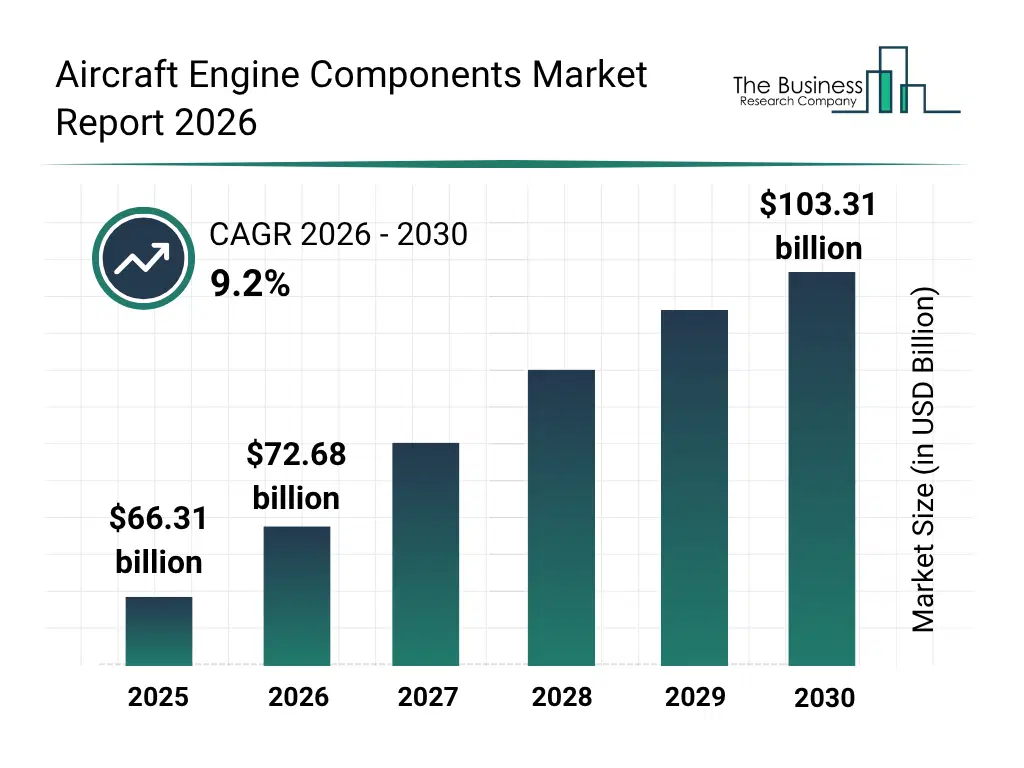
What Is The Aircraft Engine Components Market Size and Share 2026?
The aircraft engine components market size has grown strongly in recent years. It will grow from $66.31 billion in 2025 to $72.68 billion in 2026 at a compound annual growth rate (CAGR) of 9.6%. The growth in the historic period can be attributed to increasing aircraft fleet size, rising air passenger traffic, increasing aircraft engine production, growing aircraft maintenance requirements, rising demand for engine component replacement.What Is The Aircraft Engine Components Market Growth Forecast?
The aircraft engine components market size is expected to see strong growth in the next few years. It will grow to $103.31 billion in 2030 at a compound annual growth rate (CAGR) of 9.2%. The growth in the forecast period can be attributed to increasing demand for fuel-efficient aircraft engines, rising adoption of next-generation aircraft platforms, growing demand for high-performance engine components, increasing aircraft retirement and fleet renewal, expanding commercial and defense aviation operations. Major trends in the forecast period include increasing adoption of lightweight aircraft engine components, rising demand for high-temperature resistant engine components, growing use of corrosion-resistant engine components, increasing demand for modular and interchangeable engine components, expanding standardization of aircraft engine component designs.Tariff Impact On Aircraft Engine Components Market
Tariffs are impacting the aircraft engine components market by increasing the cost of imported metals, precision-engineered parts, semiconductor-based control components, and specialized manufacturing equipment required for aircraft engine component production and maintenance. This is increasing manufacturing and MRO costs and can delay engine component supply, particularly in regions dependent on international aerospace supply chains such as North America, Europe, and Asia-Pacific. Hardware-intensive segments like compressors, turbines, gearboxes, fuel systems, and exhaust nozzles are most affected due to their dependence on specialized materials and globally sourced components. However, tariffs are also encouraging local manufacturing, regional supplier diversification, domestic sourcing, and increased investment in aerospace component production ecosystems, creating long-term supply chain resilience in the Aircraft Engine Components market.
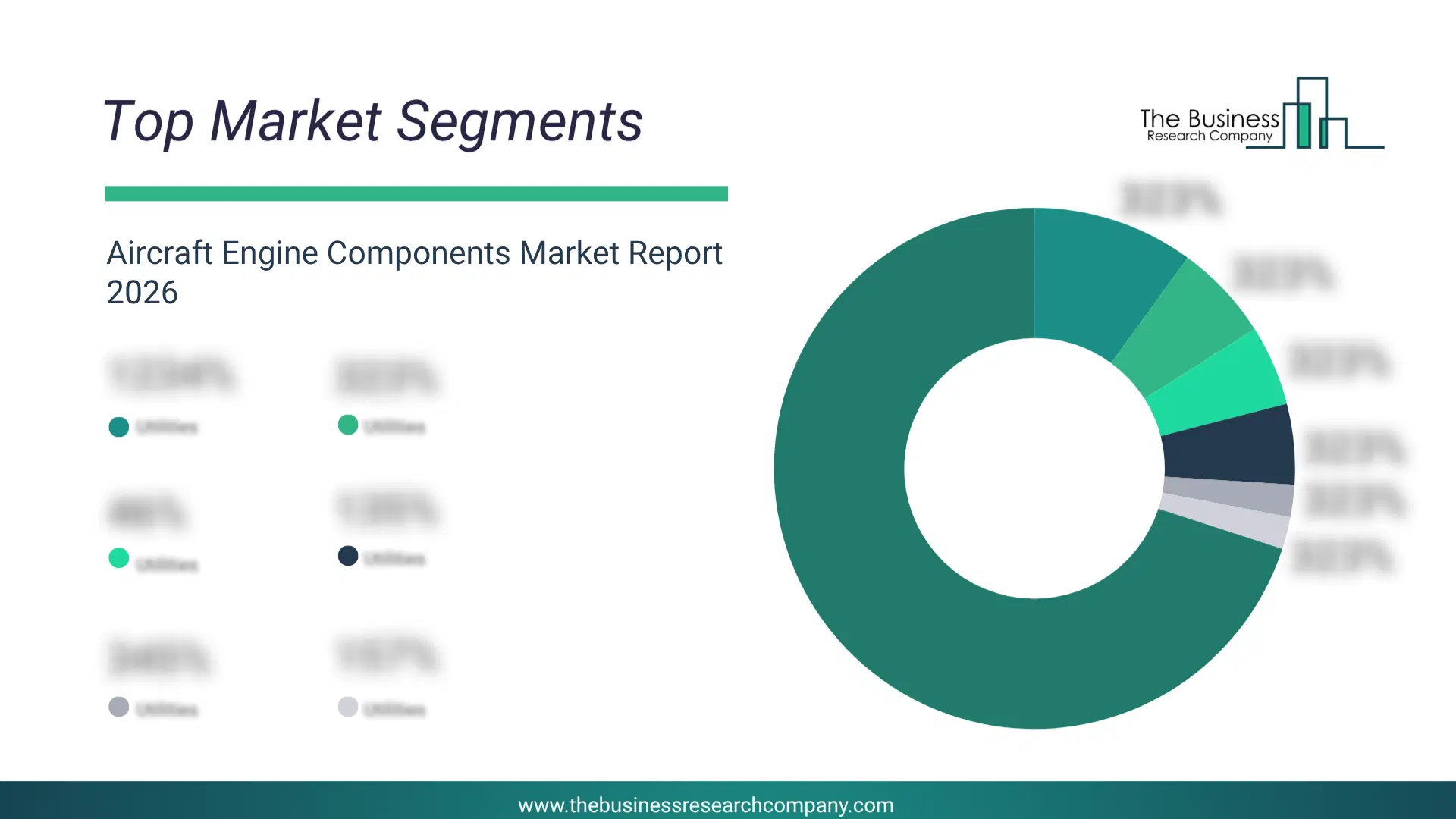
Global Aircraft Engine Components Market Segmentation
2) By Engine Type: Turbofan, Turbojet, Turboshaft, Piston 3) By Fit Type: Line Fit, Retrofit 4) By Aircraft Type: Commercial Aircraft, Military Aircraft, Business Jets, General Aviation Aircraft, Helicopters 5) By End User: Original Equipment Manufacturers, Maintenance, Repair, And Overhaul Providers, Defense Organizations Subsegments: 1) By Compressor: Axial Compressors, Centrifugal Compressors, Mixed-Flow Compressors, Multi-Stage Compressors, High-Pressure Compressors 2) By Turbine: High-Pressure Turbines, Power Turbines, Single-Stage Turbines, Multi-Stage Turbines, Cooled Turbines 3) By Gearbox: Main Reduction Gearboxes, Accessory Gearboxes, Intermediate Gearboxes, Tail Rotor Gearboxes, Planetary Gearboxes 4) By Exhaust Nozzle: Fixed Exhaust Nozzles, Variable Area Exhaust Nozzles, Infrared Suppression Exhaust Nozzles, Annular Exhaust Nozzles, Exhaust Diffuser Nozzles 5) By Fuel System: Fuel Injection Systems, Electronic Fuel Control Systems, Fuel Pumps, Fuel Filters, Fuel Metering Units 6) By Other Component Types: Combustors, Bearings, Shafts, Full Authority Digital Engine Control Systems, Lubrication SystemsWhat Is The Driver Of The Aircraft Engine Components Market?
The increasing commercial aircraft production and deliveries are expected to propel the growth of the aircraft engine components market going forward. Commercial aircraft production and deliveries refer to the manufacturing of commercial passenger and cargo aircraft and their handover to customers after completion, testing, and certification. Commercial aircraft production and deliveries are increasing due to the growing demand for air travel, as rising passenger traffic encourages airlines to expand and modernize their fleets to meet capacity requirements. Increasing commercial aircraft production and deliveries drive the growth of aircraft engine components by boosting demand for engines and the essential parts required for the assembly of newly manufactured aircraft. For instance, in September 2026, according to the Institution of Engineering and Technology (IET), a UK-based engineering and technology publication, airlines placed 242 aircraft orders in July 2026, more than five times the 38 orders recorded in July 2025. Therefore, the increasing commercial aircraft production and deliveries are driving the growth of the aircraft engine components industry.Key Players In The Global Aircraft Engine Components Market
Major companies operating in the aircraft engine components market are GE Aerospace, RTX Corporation, Rolls-Royce Holdings plc, Safran SA, Honeywell International Inc., Parker Hannifin Corporation, IHI Corporation, MTU Aero Engines AG, Kawasaki Heavy Industries Ltd., GKN Aerospace, ITP Aero, Woodward Inc., Precision Castparts Corp., CFM International, Williams International, Aero Engine Corporation of China, Hindustan Aeronautics Limited, Senior plc, TUSAŞ Engine Industries, Liebherr-Aerospace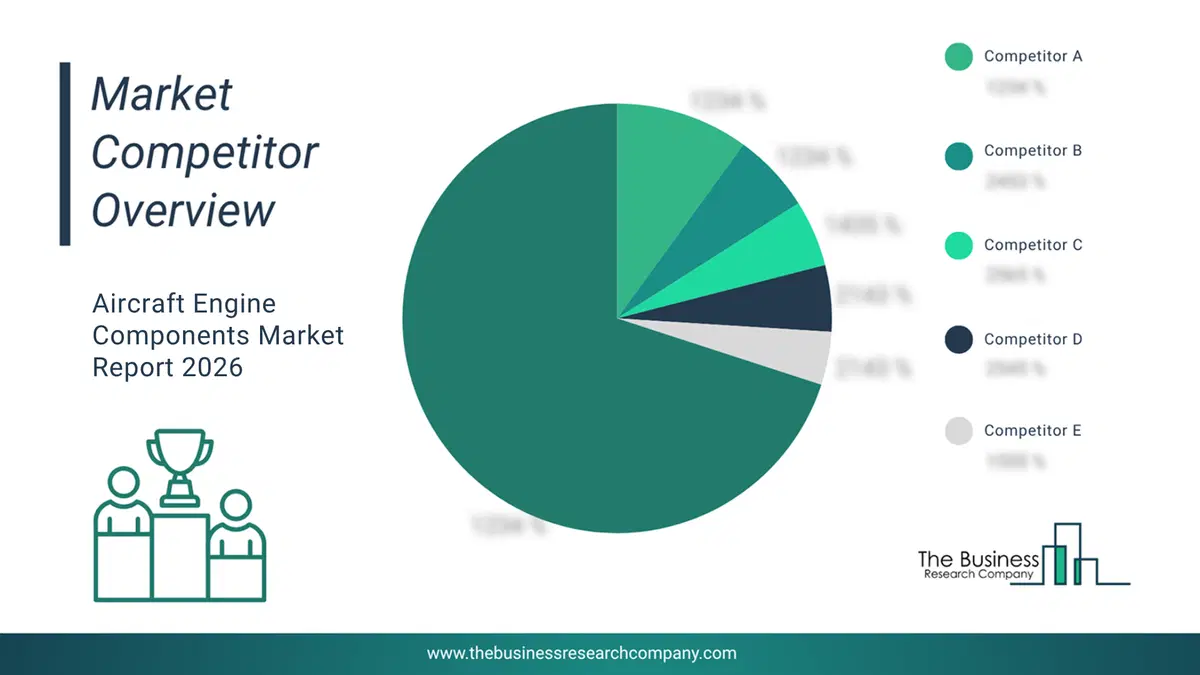
This chart is for illustrative purposes; the full report includes a detailed competitor analysis and comprehensive overview of the top 10 companies in the market.
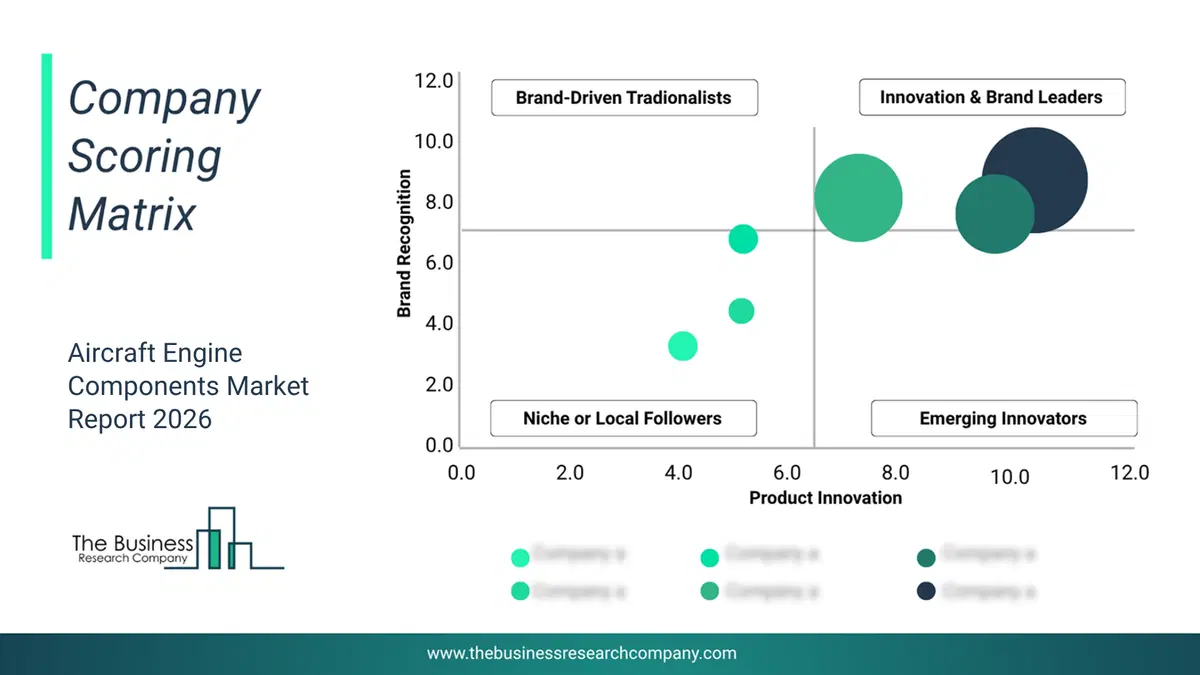
This chart maps companies by product innovation and brand strength, with bubble size indicating relative revenue, helping identify market leaders, challengers, and niche players. This is an illustrative chart; the full report provides a complete and accurate competitive analysis.
Global Aircraft Engine Components Market Trends and Insights
Major companies operating in the aircraft engine components market are focusing on developing innovative solutions such as hybrid-electric propulsion components to improve fuel efficiency, reduce emissions, and enhance aircraft performance. Hybrid-electric propulsion components refer to integrated engine and propulsion components, including electric motor-generators, power converters, inverters, controllers, gearboxes, heat exchangers, and engine harnesses, that work alongside conventional aircraft engines to provide additional electric power and propulsion. For instance, in July 2026, GE Aerospace, a US-based aerospace manufacturer, unveiled the world's first high-altitude flight assisted by hybrid-electric propulsion using a modified Saab 340B aircraft and a megawatt-class system developed with NASA. The hybrid-electric system incorporated GE Aerospace-developed motor-generators, power converters, inverters, controllers, and engine harnesses, along with gearboxes, propellers, heat exchangers, and a CT7 engine. The system is designed to supplement conventional engine power during different phases of flight, supporting improved high-altitude performance, fuel efficiency, and emissions reduction.What Are Latest Mergers And Acquisitions In The Aircraft Engine Components Market?
In June 2026, Pursuit Aerospace, a US-based aerospace manufacturing company, acquired Leesta Industries for an undisclosed amount. Through this acquisition, Pursuit Aerospace aims to strengthen its aerospace business by expanding its aero-engine machining and fabrication capabilities and broadening its component offerings across several Pratt & Whitney engine platforms. Leesta Industries is a US-based aerospace manufacturing company that specializes in machining flight-safety-critical aero-engine components.
Regional Outlook/Insights
North America was the largest region in the aircraft engine components market in 2025. Asia-Pacific is expected to be the fastest-growing region during the forecast period. The regions covered in this market report are Asia-Pacific, South East Asia, Western Europe, Eastern Europe, North America, South America, Middle East, Africa. The countries covered in this market report are Australia, Brazil, China, France, Germany, India, Indonesia, Japan, Taiwan, Russia, South Korea, UK, USA, Canada, Italy, Spain.What Defines the Aircraft Engine Components Market?
The aircraft engine components market consists of sales of fan blades and fan cases, engine casings and housings, bearings, and shafts. Values in this market are ‘factory gate’ values, that is, the value of goods sold by the manufacturers or creators of the goods, whether to other entities (including downstream manufacturers, wholesalers, distributors, and retailers) or directly to end customers. The value of goods in this market includes related services sold by the creators of the goods.How is Market Value Defined and Measured?
The market value is defined as the revenues that enterprises gain from the sale of goods and/or services within the specified market and geography through sales, grants, or donations in terms of the currency (in USD unless otherwise specified). The revenues for a specified geography are consumption values that are revenues generated by organizations in the specified geography within the market, irrespective of where they are produced. It does not include revenues from resales along the supply chain, either further along the supply chain or as part of other products.
This chart presents market attractiveness based on a quantitative evaluation of growth, competition, strategic alignment, and risk, offering a clear view of opportunity areas for decision-making. This chart is for illustrative purposes; the full report contains the complete analysis.

This chart highlights the Total Addressable Market (TAM) by estimating the maximum revenue opportunity using an assumption-driven approach, supporting strategic planning and opportunity sizing across markets. The chart is illustrative; the full report provides a more comprehensive analysis.
What Key Data and Analysis Are Included in the Aircraft Engine Components Market Report 2026?
The aircraft engine components market research report is one of a series of new reports from The Business Research Company that provides market statistics, including industry global market size, regional shares, competitors with the market share, detailed market segments, market trends and opportunities, and any further data you may need to thrive in the aircraft engine components industry. The market research report delivers a complete perspective of everything you need, with an in-depth analysis of the current and future state of the industry.Aircraft Engine Components Market Report Forecast Analysis
| Report Attribute | Details |
|---|---|
| Market Size Value In 2026 | $72.68 billion |
| Revenue Forecast In 2030 | $103.31 billion |
| Growth Rate | CAGR of 9.2% from 2026 to 2035 |
| Base Year For Estimation | 2025 |
| Actual Estimates/Historical Data | 2020-2025 |
| Forecast Period | 2026 - 2030 |
| Market Representation | Revenue in USD Billion and CAGR from 2026 to 2030 |
| Segments Covered | Component Type, Engine Type, Fit Type, Aircraft Type, End User |
| Regional Scope | Asia-Pacific, Western Europe, Eastern Europe, North America, South America, Middle East, Africa |
| Country Scope | The countries covered in the report are Australia, Brazil, China, France, Germany, India, Indonesia, Japan, Taiwan, Russia, South Korea, UK, USA, Canada, Italy, Spain. |
| Customization Scope | Request for Customization |
| Pricing And Purchase Options | Explore Purchase Options |