
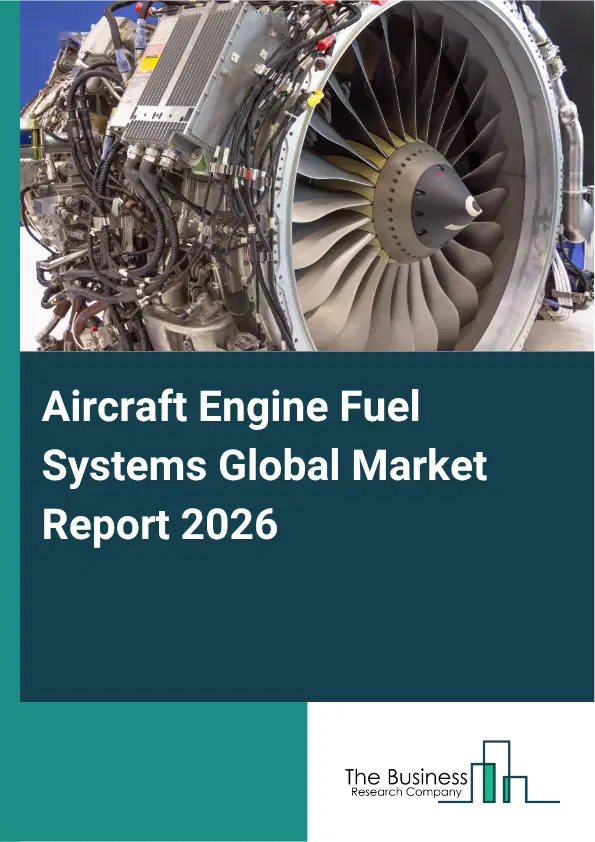
Aircraft Engine Fuel Systems Market Report 2026
Global Outlook – By Component (Pumps, Valves, Filters, Gauges, Other Components), By Engine Type (Turbofan, Turboprop, Turboshaft, Piston Engine), By Fuel Type (Aviation Turbine Fuel, Jet Fuel, Biofuels, Synthetic Fuels, Conventional Fuels), By Technology (Full Authority Digital Engine Control Based Systems, Hydromechanical Systems, Electronic Fuel Control Systems, Hybrid Fuel Management Systems), By End User (Original Equipment Manufacturers, Aftermarket, Defense Organizations, Commercial Airlines) – Market Size, Trends, Strategies, and Forecast to 2030
Aircraft Engine Fuel Systems Market Report 2026 Market Overview
• Aircraft Engine Fuel Systems Market Report 2026 market size has reached to $6.92 billion in 2025 • Expected to grow to $9.67 billion in 2030 at a compound annual growth rate (CAGR) of 6.8% • Growth Driver: The Rising Air Passenger Traffic Driving The Growth Of The Market Due To Higher Disposable Incomes • Market Trend: Advancements In Hydrogen-Based Propulsion Technologies For Sustainable Aviation • North America was the largest region in 2025 and Asia-Pacific is the fastest growing region.What Is Covered Under Aircraft Engine Fuel Systems Market?
Aircraft engine fuel systems refer to the integrated set of components and technologies that store, manage, regulate, and deliver fuel from the aircraft's fuel tanks to the engine for efficient combustion and power generation. These systems ensure a continuous, reliable, and precisely controlled fuel supply under varying flight conditions, contributing to engine performance, safety, and operational efficiency. The main components of aircraft engine fuel systems include pumps, valves, filters, gauges, and other components. Pumps refer to fuel delivery devices designed to transfer and regulate the flow of fuel from storage tanks to aircraft engines for efficient engine operation. These systems are designed for engine types including turbofan, turboprop, turboshaft, and piston engine and support fuel types such as aviation turbine fuel, jet fuel, biofuels, synthetic fuels, and conventional fuels. They also utilize technologies including full authority digital engine control based systems, hydromechanical systems, electronic fuel control systems, and hybrid fuel management systems, and they are used by several end users such as original equipment manufacturers, aftermarket, defense organizations, and commercial airlines.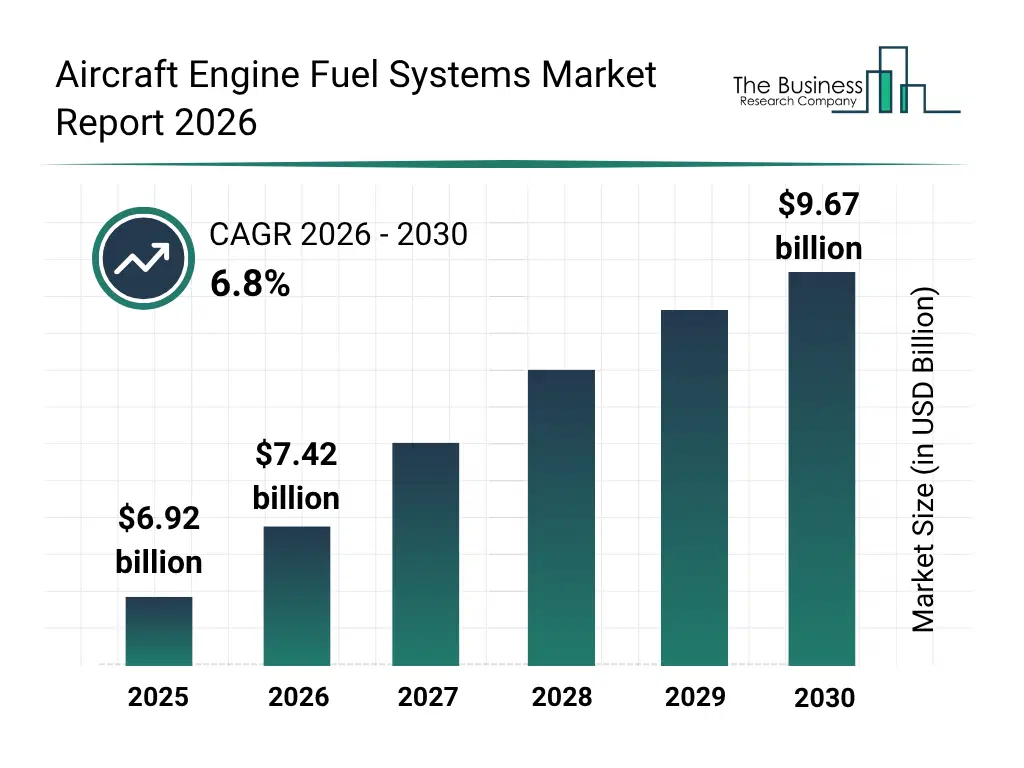
What Is The Aircraft Engine Fuel Systems Market Size and Share 2026?
The aircraft engine fuel systems market size has grown strongly in recent years. It will grow from $6.92 billion in 2025 to $7.42 billion in 2026 at a compound annual growth rate (CAGR) of 7.3%. The growth in the historic period can be attributed to growth in global aircraft production, increasing demand for fuel efficient engines, stringent aviation safety regulations, expansion of commercial aviation networks, rising investments in military aircraft modernization.What Is The Aircraft Engine Fuel Systems Market Growth Forecast?
The aircraft engine fuel systems market size is expected to see strong growth in the next few years. It will grow to $9.67 billion in 2030 at a compound annual growth rate (CAGR) of 6.8%. The growth in the forecast period can be attributed to growing adoption of sustainable aviation fuels, increasing deployment of next generation aircraft platforms, rising investments in electronic fuel control systems, expansion of aircraft fleet replacement programs, increasing demand for high performance engine systems. Major trends in the forecast period include increasing adoption of advanced fuel metering technologies, rising demand for lightweight fuel system components, growing integration of alternative fuel compatible systems, increasing focus on fuel efficiency optimization in aircraft engines, expansion of aftermarket fuel system maintenance and upgrades.
Global Aircraft Engine Fuel Systems Market Segmentation
1) By Component: Pumps, Valves, Filters, Gauges, Other Components 2) By Engine Type: Turbofan, Turboprop, Turboshaft, Piston Engine 3) By Fuel Type: Aviation Turbine Fuel, Jet Fuel, Biofuels, Synthetic Fuels, Conventional Fuels 4) By Technology: Full Authority Digital Engine Control Based Systems, Hydromechanical Systems, Electronic Fuel Control Systems, Hybrid Fuel Management Systems 5) By End User: Original Equipment Manufacturers, Aftermarket, Defense Organizations, Commercial Airlines Subsegments: 1) By Pumps: Fuel Boost Pumps, Fuel Transfer Pumps, Fuel Metering Pumps, Engine Driven Fuel Pumps 2) By Valves: Fuel Shutoff Valves, Fuel Control Valves, Pressure Relief Valves, Check Valves 3) By Filters: Fuel Inlet Filters, Fine Fuel Filters, Water Separator Filters, Cartridge Fuel Filters 4) By Gauges: Fuel Pressure Gauges, Fuel Flow Gauges, Fuel Quantity Gauges, Fuel Temperature Gauges 5) By Other Components: Fuel Nozzles, Fuel Manifolds, Fuel Lines, Fuel SensorsWhat Is The Driver Of The Aircraft Engine Fuel Systems Market?
The rising air passenger traffic is expected to propel the growth of the aircraft engine fuel systems market going forward. Air passenger traffic refers to the total number of passengers transported by airlines through domestic and international air services over a specific period and serves as a key indicator of air travel demand. Air passenger traffic is rising due to higher disposable incomes, as more people can afford air travel for business and leisure. Rising air passenger traffic is driving demand for new aircraft and increased flight operations, thereby boosting the need for advanced aircraft engine fuel systems that enhance fuel efficiency, reliability, and engine performance. For instance, in October 2024, according to the Department of Transportation, a US-based government department, in August 2024, 647,205 flights were operated, representing a 2.61% increase from the 630,761 flights in August 2023. Therefore, the rising air passenger traffic is driving the growth of the aircraft engine fuel systems industry.Key Players In The Global Aircraft Engine Fuel Systems Market
Major companies operating in the aircraft engine fuel systems market report are Allen Aircraft Products Inc, AMETEK Inc., Crane Company, Curtiss-Wright Corporation, Currawong Engineering Pty Ltd, Eaton Corporation plc, GE Aerospace, GKN Aerospace, Honeywell International Inc., ITT Inc., Liebherr Group, Moog Inc., Ontic Engineering & Manufacturing Ltd, Parker Hannifin Corp, Porvair plc, Robertson Fuel Systems LLC, Rolls-Royce Holdings plc, RTX Corporation, Safran S.A., Secondo Mona S.p.A., Weldon Pump LLC, Woodward Inc.
This chart is for illustrative purposes; the full report includes a detailed competitor analysis and comprehensive overview of the top 10 companies in the market.
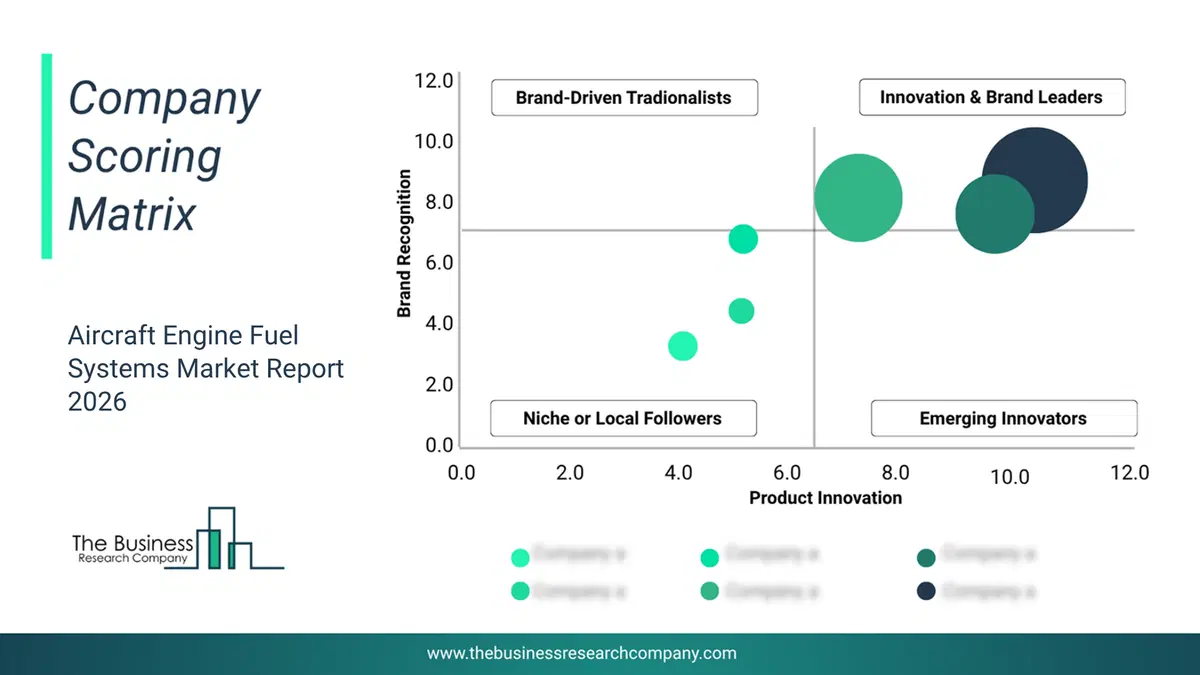
This chart maps companies by product innovation and brand strength, with bubble size indicating relative revenue, helping identify market leaders, challengers, and niche players. This is an illustrative chart; the full report provides a complete and accurate competitive analysis.
Global Aircraft Engine Fuel Systems Market Trends and Insights
Major companies operating in the aircraft engine fuel systems market are focusing on developing technologically advanced solutions, such as hydrogen-powered fuel cell propulsion systems, to reduce aviation emissions, improve fuel efficiency, and support the transition toward sustainable air transportation. A hydrogen-powered fuel cell propulsion system is a modern aircraft energy solution that changes liquid hydrogen into electricity using fuel cells to run electric motors, producing much lower emissions than traditional jet fuel engines. For instance, in June 2023, MTU Aero Engines AG, a Germany-based aircraft engine manufacturing company, launched the Flying Fuel Cell (FFC), an innovative aviation fuel cell technology designed for future zero-emission aircraft. The system utilizes liquid hydrogen stored in advanced fuel tanks and converts it into electrical energy through high-efficiency fuel cells, which then power an electric propulsion motor. The technology eliminates direct carbon dioxide, nitrogen oxide, and particulate emissions, producing only water vapor during operation. The solution integrates advanced hydrogen fuel storage, fuel management, control systems, and electric propulsion components to deliver enhanced energy efficiency and significantly reduce aviation's environmental impact.What Are Latest Mergers And Acquisitions In The Aircraft Engine Fuel Systems Market?
In February 2023, VSE Corporation, a US-based aerospace aftermarket services company, acquired Precision Fuel Components for an undisclosed amount. Through this acquisition, VSE Corporation aims to expand its maintenance, repair, and overhaul (MRO) capabilities by enhancing its engine accessory and fuel system repair services and strengthening its support for the business and general aviation (B&GA) and rotorcraft markets. Precision Fuel Components LLC is a US-based company that specializes in aircraft engine fuel systems.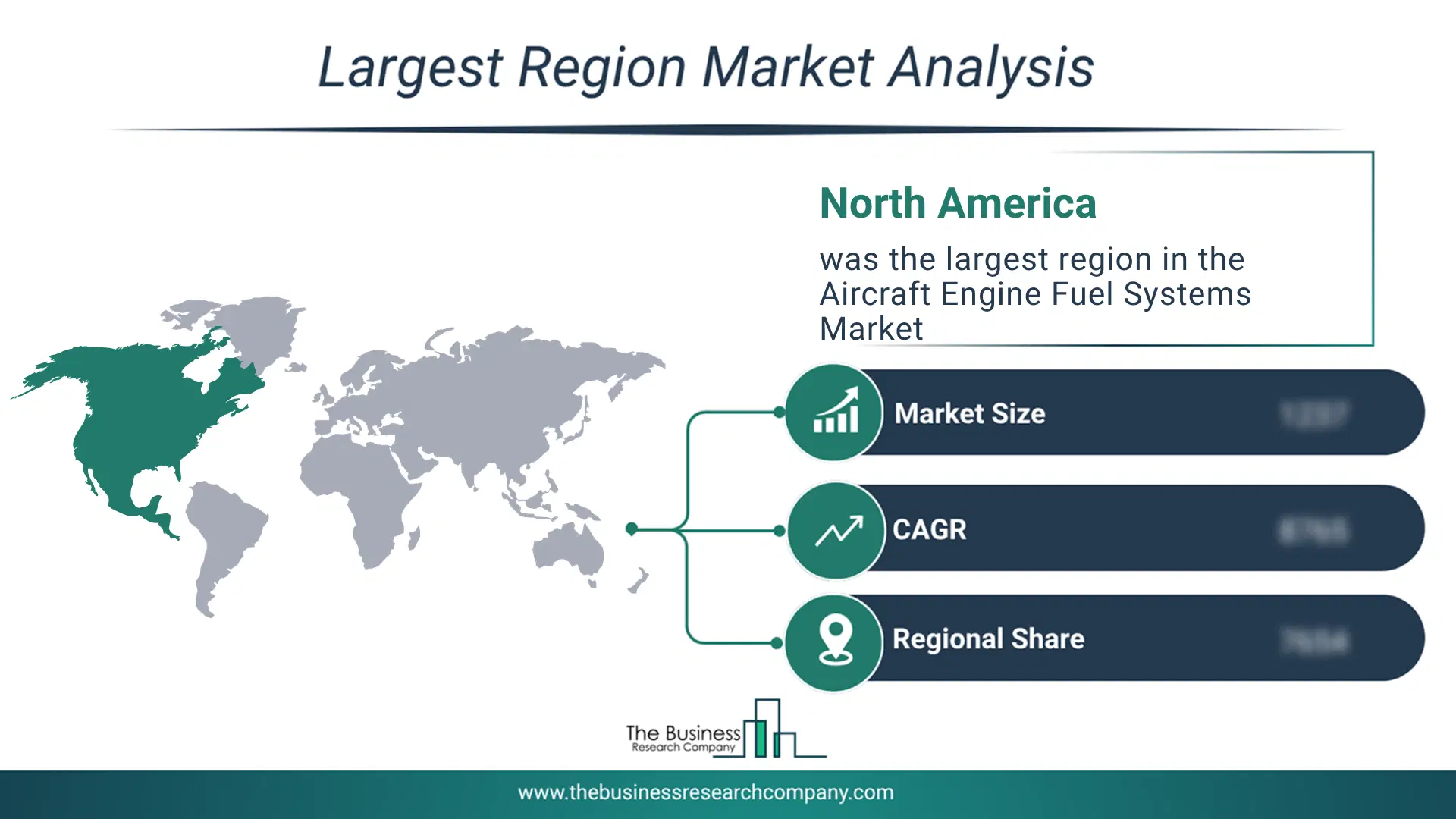
Regional Outlook
North America was the largest region in the aircraft engine fuel systems market in 2025. Asia-Pacific is expected to be the fastest-growing region in the forecast period. The regions covered in this market report are Asia-Pacific, South East Asia, Western Europe, Eastern Europe, North America, South America, Middle East, Africa. The countries covered in this market report are Australia, Brazil, China, France, Germany, India, Indonesia, Japan, Taiwan, Russia, South Korea, UK, USA, Canada, Italy, Spain.What Defines the Aircraft Engine Fuel Systems Market?
The aircraft engine fuel systems market consists of the sales of fuel metering valves, fuel nozzles and injectors, fuel manifolds, and fuel flow sensors. These products include integrated fuel delivery assemblies, fuel control units, fuel valves, fuel lines, fuel manifolds, and fuel management modules designed for efficient and safe engine operation. Values in this market are ‘factory gate’ values, that is the value of goods sold by the manufacturers or creators of the goods, whether to other entities (including downstream manufacturers, wholesalers, distributors and retailers) or directly to end customers. The value of goods in this market includes related services sold by the creators of the goods.How is Market Value Defined and Measured?
The market value is defined as the revenues that enterprises gain from the sale of goods and/or services within the specified market and geography through sales, grants, or donations in terms of the currency (in USD unless otherwise specified). The revenues for a specified geography are consumption values that are revenues generated by organizations in the specified geography within the market, irrespective of where they are produced. It does not include revenues from resales along the supply chain, either further along the supply chain or as part of other products.
This chart presents market attractiveness based on a quantitative evaluation of growth, competition, strategic alignment, and risk, offering a clear view of opportunity areas for decision-making. This chart is for illustrative purposes; the full report contains the complete analysis.

This chart highlights the Total Addressable Market (TAM) by estimating the maximum revenue opportunity using an assumption-driven approach, supporting strategic planning and opportunity sizing across markets. The chart is illustrative; the full report provides a more comprehensive analysis.
What Key Data and Analysis Are Included in the Aircraft Engine Fuel Systems Market Report 2026?
The aircraft engine fuel systems market research report is one of a series of new reports from The Business Research Company that provides market statistics, including industry global market size, regional shares, competitors with the market share, detailed market segments, market trends and opportunities, and any further data you may need to thrive in the aircraft engine fuel systems industry. The market research report delivers a complete perspective of everything you need, with an in-depth analysis of the current and future state of the industry.Aircraft Engine Fuel Systems Market Report Forecast Analysis
| Report Attribute | Details |
|---|---|
| Market Size Value In 2026 | $7.42 billion |
| Revenue Forecast In 2030 | $9.67 billion |
| Growth Rate | CAGR of 6.8% from 2026 to 2030 |
| Base Year For Estimation | 2025 |
| Actual Estimates/Historical Data | 2020-2025 |
| Forecast Period | 2026 - 2030 |
| Market Representation | Revenue in USD Billion and CAGR from 2026 to 2030 |
| Segments Covered | Component, Engine Type, Fuel Type, Technology, End User |
| Regional Scope | Asia-Pacific, Western Europe, Eastern Europe, North America, South America, Middle East, Africa |
| Country Scope | The countries covered in the report are Australia, Brazil, China, France, Germany, India, Indonesia, Japan, Taiwan, Russia, South Korea, UK, USA, Canada, Italy, Spain. |
| Key Companies Profiled | Allen Aircraft Products Inc, AMETEK Inc., Crane Company, Curtiss-Wright Corporation, Currawong Engineering Pty Ltd, Eaton Corporation plc, GE Aerospace, GKN Aerospace, Honeywell International Inc., ITT Inc., Liebherr Group, Moog Inc., Ontic Engineering & Manufacturing Ltd, Parker Hannifin Corp, Porvair plc, Robertson Fuel Systems LLC, Rolls-Royce Holdings plc, RTX Corporation, Safran S.A., Secondo Mona S.p.A., Weldon Pump LLC, Woodward Inc. |
| Customization Scope | Request for Customization |
| Pricing And Purchase Options | Explore Purchase Options |