
Aircraft Environmental Control Systems Market Report 2026
Global Outlook – By System Type (Air Supply And Management System, Thermal Management And Control System, Cabin Pressure And Control System, Humidity Control And Filtration System), By Aircraft Type (Fixed Wing, Rotary Wing), By Distribution Channel (Original Equipment Manufacturer, Aftermarket), By Application (Cabin Comfort And Air Quality, Avionics Cooling, Engine And Auxiliary Power Unit Thermal Regulation, Weapon Systems Cooling, Electronic Equipment Cooling), By End Use (Commercial Aviation, Military And Defense Aviation, General Aviation, Other End Uses) – Market Size, Trends, Strategies, and Forecast to 2030
Aircraft Environmental Control Systems Market Overview
• Aircraft Environmental Control Systems market size has reached to $3.75 billion in 2025 • Expected to grow to $4.87 billion in 2030 at a compound annual growth rate (CAGR) of 5.4% • Growth Driver: The Rising Air Passenger Traffic Driving The Growth Of The Market Due To Higher Disposable Incomes • Market Trend: Advancements In Integrated Thermal Management Systems For Next-Generation Electric Aircraft • North America was the largest region in 2025 and Asia-Pacific is the fastest growing region.What Is Covered Under Aircraft Environmental Control Systems Market?
Aircraft environmental control systems (ECS) are integrated systems in an aircraft that regulate and maintain cabin and cockpit environmental conditions, including temperature, air pressure, ventilation, humidity, and air quality, to ensure passenger and crew comfort and safety. These systems also provide conditioned air for cooling and pressurization of critical aircraft components and avionics, supporting efficient and reliable aircraft operations. The main system types of aircraft environmental control systems include air supply and management system, thermal management and control system, cabin pressure and control system, and humidity control and filtration system. Air supply and management system refers to the aircraft subsystem that regulates the supply, distribution, and conditioning of air to maintain a safe and comfortable cabin environment while supporting critical onboard systems. These systems are deployed in fixed wing and rotary wing aircraft and are supplied through original equipment manufacturer and aftermarket channels. The various applications involved are cabin comfort and air quality, avionics cooling, engine and auxiliary power unit thermal regulation, weapon systems cooling, and electronic equipment cooling, and they are used by several end uses such as commercial aviation, military and defense aviation, general aviation, and others.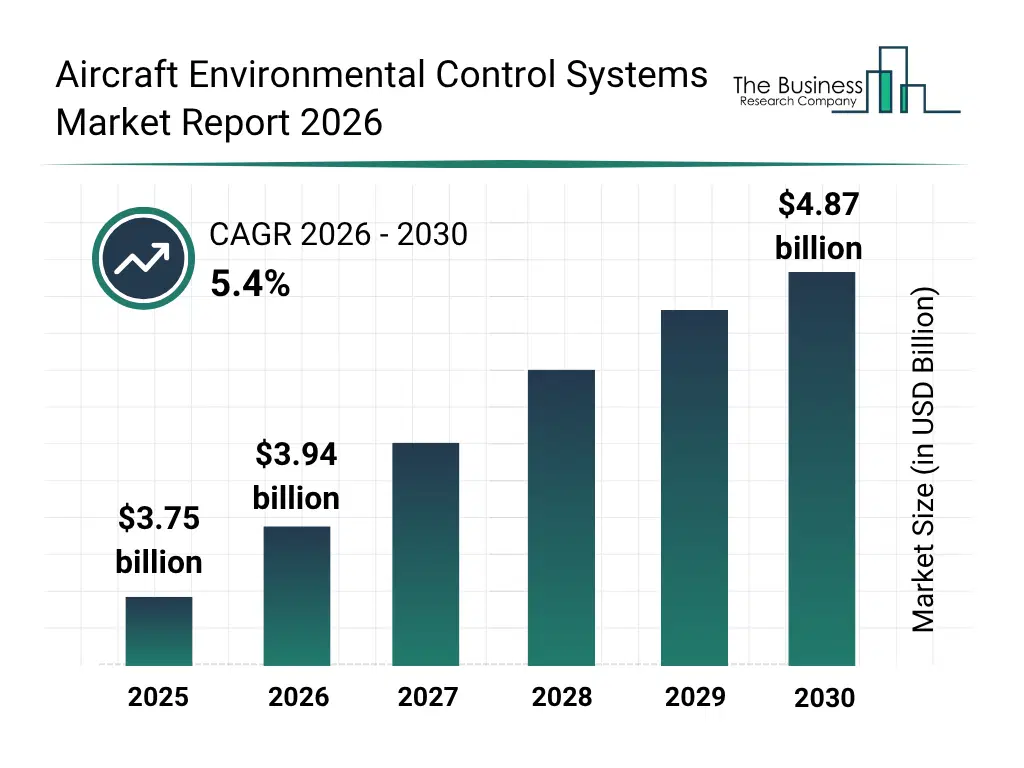
What Is The Aircraft Environmental Control Systems Market Size and Share 2026?
The aircraft environmental control systems market size has grown strongly in recent years. It will grow from $3.75 billion in 2025 to $3.94 billion in 2026 at a compound annual growth rate (CAGR) of 5.2%. The growth in the historic period can be attributed to growing demand for passenger comfort and safety, rising adoption of advanced avionics systems, expansion of commercial aviation fleet, increasing focus on aircraft operational efficiency.What Is The Aircraft Environmental Control Systems Market Growth Forecast?
The aircraft environmental control systems market size is expected to see strong growth in the next few years. It will grow to $4.87 billion in 2030 at a compound annual growth rate (CAGR) of 5.4%. The growth in the forecast period can be attributed to growing demand for next generation aircraft, increasing adoption of electric and hybrid aircraft systems, rising need for advanced thermal management solutions, expanding investments in aircraft modernization programs, increasing demand for efficient cabin environmental management. Major trends in the forecast period include rising adoption of advanced cabin air purification systems, increasing demand for lightweight environmental control system components, growing focus on improved aircraft thermal management solutions, rising integration of advanced humidity and pressure regulation systems, increasing development of energy efficient aircraft environmental control technologies.
Global Aircraft Environmental Control Systems Market Segmentation
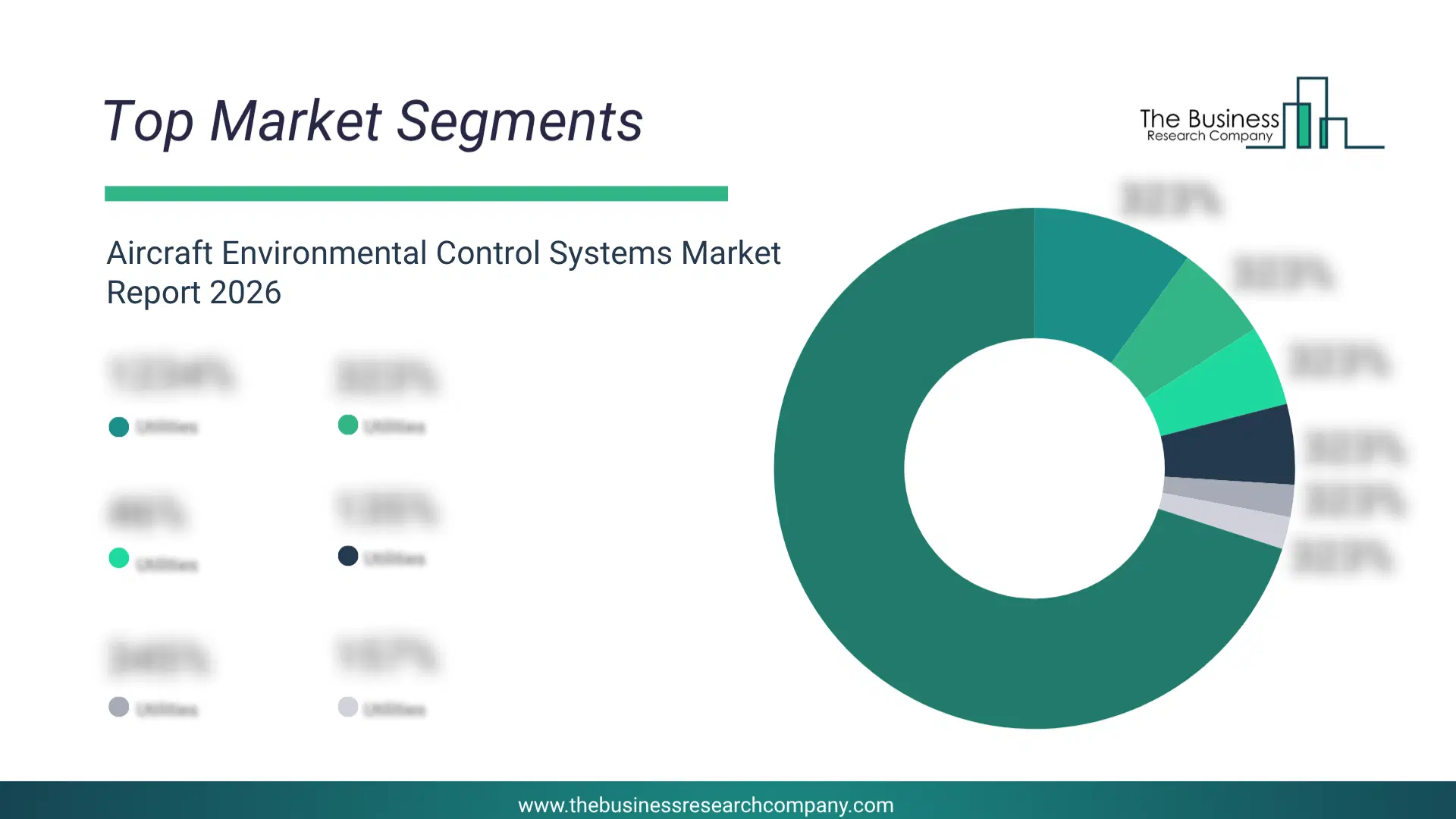
2) By Aircraft Type: Fixed Wing, Rotary Wing 3) By Distribution Channel: Original Equipment Manufacturer, Aftermarket 4) By Application: Cabin Comfort And Air Quality, Avionics Cooling, Engine And Auxiliary Power Unit Thermal Regulation, Weapon Systems Cooling, Electronic Equipment Cooling 5) By End Use: Commercial Aviation, Military And Defense Aviation, General Aviation, Other End Uses Subsegments: 1) By Air Supply And Management System: Engine Bleed Air Supply System, Auxiliary Power Air Supply System, Air Distribution Ducting System, Air Flow Regulation System, Air Mixing And Conditioning System, Ventilation Air Delivery System 2) By Thermal Management And Control System: Heat Exchanger System, Cooling Air Management System, Temperature Sensing And Monitoring System, Thermal Control Valve System, Equipment Cooling System, Refrigeration And Cooling Cycle System 3) By Cabin Pressure And Control System: Cabin Pressurization Control System, Pressure Relief Valve System, Outflow Valve Control System, Cabin Altitude Monitoring System, Differential Pressure Regulation System, Emergency Depressurization Protection System 4) By Humidity Control And Filtration System: Cabin Humidity Regulation System, Air Filtration System, Particulate Removal System, Contaminant Detection And Control System, Air Purification System, Moisture Separation And Management SystemWhat Are The Drivers Of The Aircraft Environmental Control Systems Market?
The rising air passenger traffic is expected to propel the growth of the aircraft environmental control systems market going forward. Air passenger traffic refers to the total number of passengers transported by airlines through domestic and international air services over a specific period and serves as a key indicator of air travel demand. Air passenger traffic is rising due to higher disposable incomes, as more people can afford air travel for business and leisure. Rising air passenger traffic is driving demand for new aircraft deliveries and fleet expansion, thereby increasing the need for advanced aircraft environmental control systems that ensure passenger comfort, cabin air quality, and efficient thermal management. For instance, in October 2024, according to the Department of Transportation, a US-based government department, in August 2024, 647,205 flights were operated, representing a 2.61% increase from the 630,761 flights in August 2023. Therefore, the rising air passenger traffic is driving the growth of the aircraft environmental control systems industry. The increasing military modernization programs is expected to propel the growth of the aircraft environmental control systems tanker market going forward. Military modernization programs are comprehensive initiatives by armed forces to upgrade and enhance their defense capabilities through advanced weapons systems and technologies. The rising military modernization programs is due to escalating geopolitical tensions and security threats to national sovereignty and regional stability, as nations seek to enhance their defense capabilities, deter potential adversaries, and safeguard their strategic interests. Increasing military modernization programs are driving demand for advanced aircraft environmental control systems by accelerating the procurement and upgrade of next-generation military aircraft that require sophisticated cabin pressurization, thermal management, and avionics cooling capabilities. For instance, in March 2023, according to the European Security and Defence College, a Belgium-based autonomous institution, In 2030, the ongoing US Army modernization program is set to field 35 new future force systems, forming the core of more than 500 development, acquisition, or upgrade initiatives underway. Therefore, the increasing military modernization programs is driving the growth of the aircraft environmental control systems industry.Key Players In The Global Aircraft Environmental Control Systems Market
Major companies operating in the aircraft environmental control systems market are Honeywell International Inc., RTX Corporation, Parker Hannifin Corporation, Liebherr-International AG, Safran S.A., Eaton Corporation plc, Diehl Aviation Holding GmbH, AMETEK Inc., Woodward Inc., ITT Inc., Curtiss-Wright Corporation, Astronics Corporation, GKN Aerospace Services Limited, CTT Systems AB, PBS Velka Bites a.s., FIMAC S.p.A., Omni Aerospace Inc.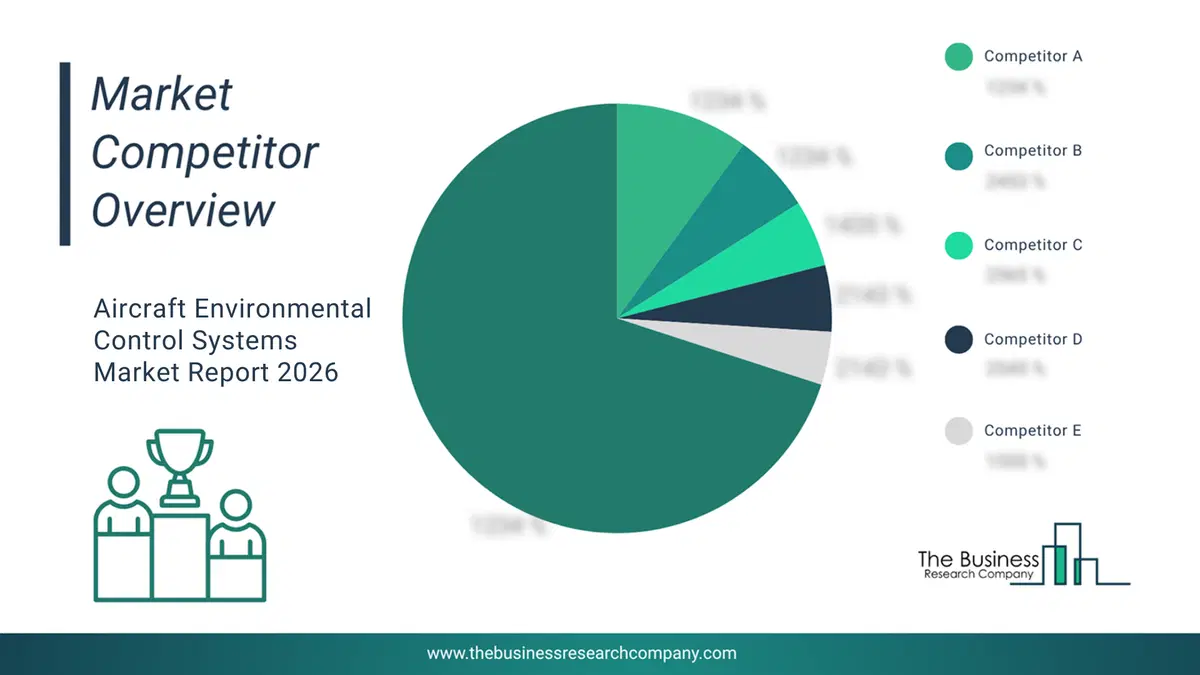
This chart is for illustrative purposes; the full report includes a detailed competitor analysis and comprehensive overview of the top 10 companies in the market.
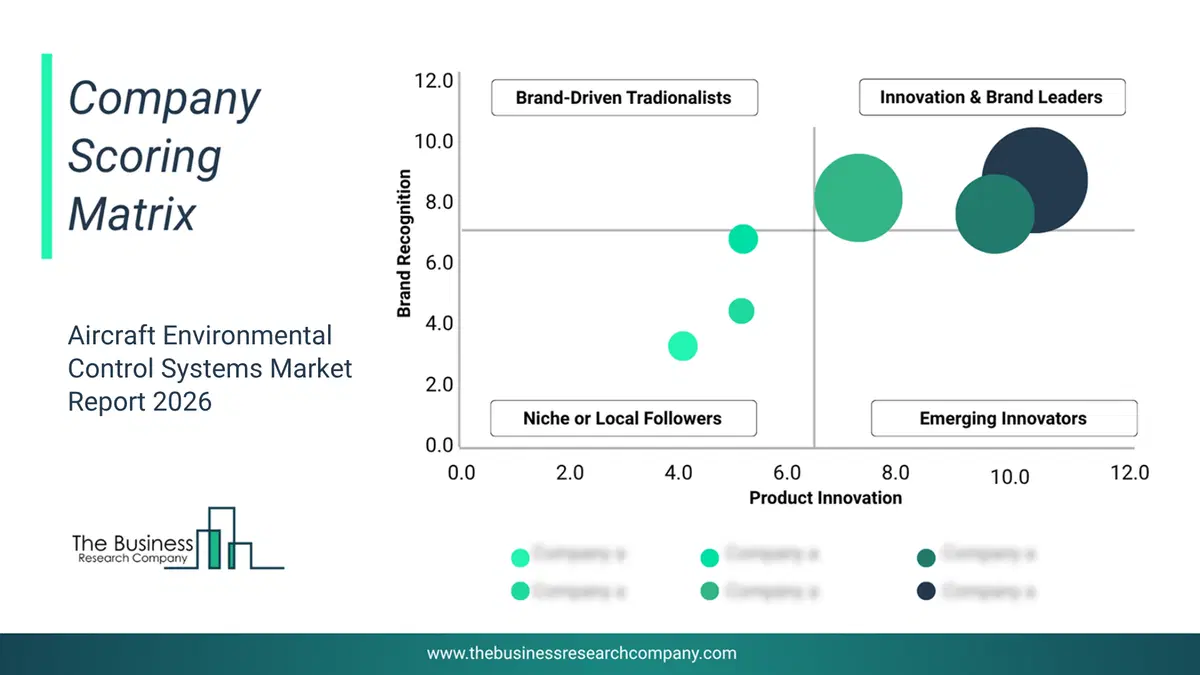
This chart maps companies by product innovation and brand strength, with bubble size indicating relative revenue, helping identify market leaders, challengers, and niche players. This is an illustrative chart; the full report provides a complete and accurate competitive analysis.
Global Aircraft Environmental Control Systems Market Trends and Insights
Major companies operating in the aircraft environmental control systems market are focusing on developing technological advancements, such as integrated thermal management systems, to enhance energy efficiency, optimize cabin and battery temperature control, and improve the performance and reliability of electric and next-generation aircraft. Integrated thermal management systems are advanced environmental control solutions that combine battery cooling, avionics cooling, cabin climate control, and heat management functions into a single system, providing improved efficiency, lower weight, and superior thermal performance compared to conventional standalone cooling and environmental control systems. For instance, in June 2023, Intergalactic, a US-based aerospace technology company, launched the GS1-EV Eagle5, an innovative fully integrated thermal management system designed for electric aircraft and electric vertical takeoff and landing applications. The system combines battery thermal management, cabin climate control, avionics cooling, and heat pump functionality within a compact architecture. It is engineered to optimize thermal performance while reducing system complexity, weight, and energy consumption. The GS1-EV Eagle5 supports efficient temperature regulation across critical aircraft subsystems, enhancing operational reliability and aircraft performance. The launch reflects the growing industry focus on integrated environmental control technologies for next-generation electric aviation platforms.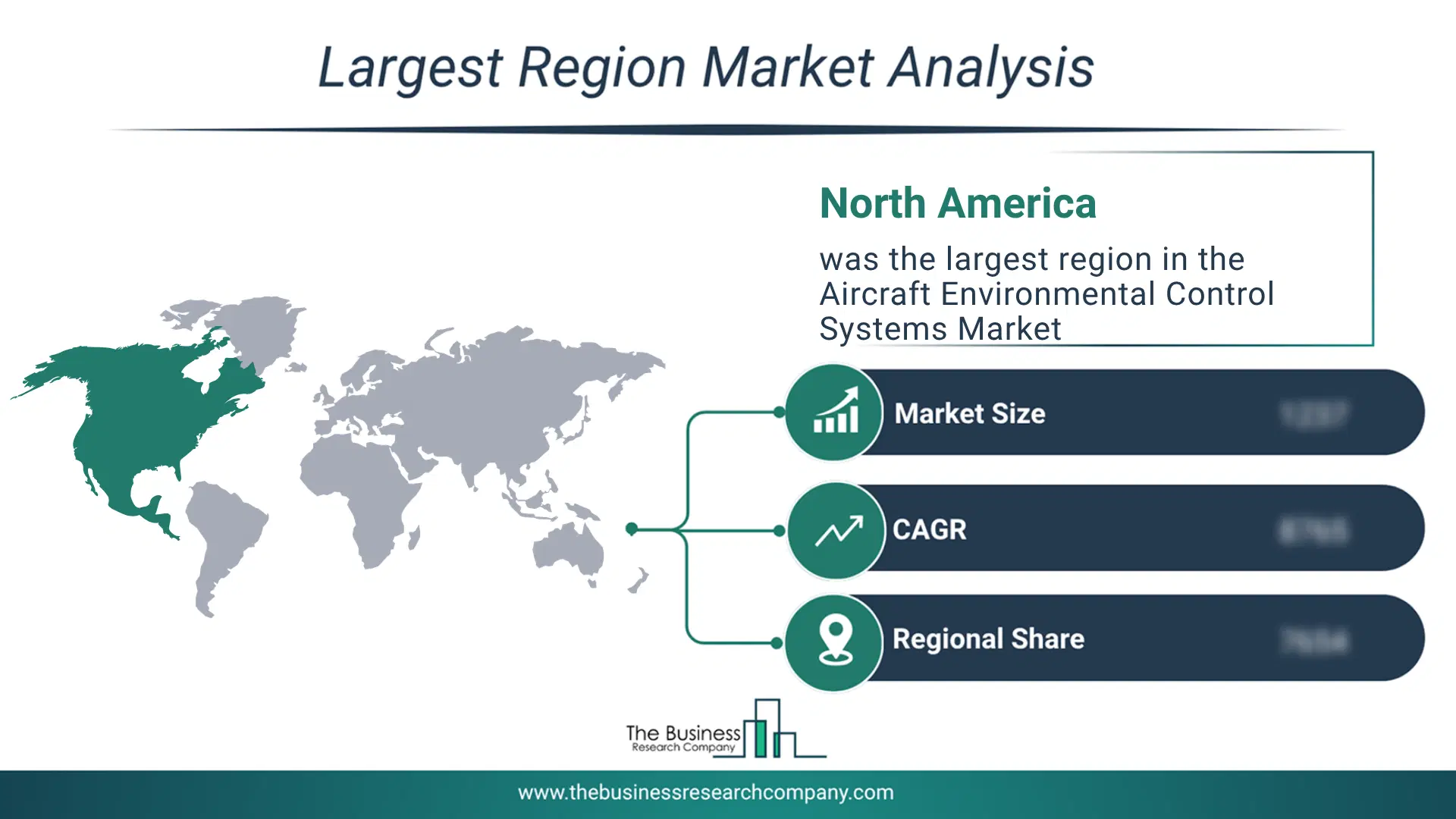
Regional Outlook/Insights
North America was the largest region in the aircraft environmental control systems market in 2025. Asia-Pacific is expected to be the fastest-growing region in the forecast period. The regions covered in this market report are Asia-Pacific, South East Asia, Western Europe, Eastern Europe, North America, South America, Middle East, Africa. The countries covered in this market report are Australia, Brazil, China, France, Germany, India, Indonesia, Japan, Taiwan, Russia, South Korea, UK, USA, Canada, Italy, Spain.What Defines the Aircraft Environmental Control Systems Market?
The aircraft environmental control systems market consists of sales of cabin temperature control units, air cycle machines, electronic environmental control system controllers, and bleed air management valves and ducting systems. Values in this market are ‘factory gate’ values, that is, the value of goods sold by the manufacturers or creators of the goods, whether to other entities (including downstream manufacturers, wholesalers, distributors, and retailers) or directly to end customers. The value of goods in this market includes related services sold by the creators of the goods.How is Market Value Defined and Measured?
The market value is defined as the revenues that enterprises gain from the sale of goods and/or services within the specified market and geography through sales, grants, or donations in terms of the currency (in USD unless otherwise specified). The revenues for a specified geography are consumption values that are revenues generated by organizations in the specified geography within the market, irrespective of where they are produced. It does not include revenues from resales along the supply chain, either further along the supply chain or as part of other products.
This chart presents market attractiveness based on a quantitative evaluation of growth, competition, strategic alignment, and risk, offering a clear view of opportunity areas for decision-making. This chart is for illustrative purposes; the full report contains the complete analysis.

This chart highlights the Total Addressable Market (TAM) by estimating the maximum revenue opportunity using an assumption-driven approach, supporting strategic planning and opportunity sizing across markets. The chart is illustrative; the full report provides a more comprehensive analysis.
What Key Data and Analysis Are Included in the Aircraft Environmental Control Systems Market Report 2026?
The aircraft environmental control systems market research report is one of a series of new reports from The Business Research Company that provides aircraft environmental control systems market statistics, including aircraft environmental control systems industry global market size, regional shares, competitors with a aircraft environmental control systems market share, detailed aircraft environmental control systems market segments, market trends and opportunities, and any further data you may need to thrive in the aircraft environmental control systems industry. This aircraft environmental control systems market research report delivers a complete perspective of everything you need, with an in-depth analysis of the current and future scenario of the industry.Aircraft Environmental Control Systems Market Report Forecast Analysis
| Report Attribute | Details |
|---|---|
| Market Size Value In 2026 | $3.94 billion |
| Revenue Forecast In 2030 | $4.87 billion |
| Growth Rate | CAGR of 5.4% from 2026 to 2030 |
| Base Year For Estimation | 2025 |
| Actual Estimates/Historical Data | 2020-2025 |
| Forecast Period | 2026 - 2030 |
| Market Representation | Revenue in USD Billion and CAGR from 2026 to 2030 |
| Segments Covered | System Type, Aircraft Type, Distribution Channel, Application, End Use |
| Regional Scope | Asia-Pacific, Western Europe, Eastern Europe, North America, South America, Middle East, Africa |
| Country Scope | The countries covered in the report are Australia, Brazil, China, France, Germany, India, Indonesia, Japan, Taiwan, Russia, South Korea, UK, USA, Canada, Italy, Spain. |
| Key Companies Profiled | Honeywell International Inc., RTX Corporation, Parker Hannifin Corporation, Liebherr-International AG, Safran S.A., Eaton Corporation plc, Diehl Aviation Holding GmbH, AMETEK Inc., Woodward Inc., ITT Inc., Curtiss-Wright Corporation, Astronics Corporation, GKN Aerospace Services Limited, CTT Systems AB, PBS Velka Bites a.s., FIMAC S.p.A., Omni Aerospace Inc. |
| Customization Scope | Request for Customization |
| Pricing And Purchase Options | Explore Purchase Options |