

Aircraft Flight Management System Market Report 2026
Global Outlook – By Component Type (Software, Hardware, Services), By Deployment (New Aircraft Installations, Retrofit And Upgrades, Onboard Systems, Ground Based Systems, Cloud Based Flight Management Solutions), By Application Type (Commercial Aircraft, Military Aircraft, Business Jets, Unmanned Aerial Vehicles, Helicopters) – Market Size, Trends, Strategies, and Forecast to 2030
Aircraft Flight Management System Market Report 2026 Market Overview
• Aircraft Flight Management System Market Report 2026 market size has reached to $26.4 billion in 2025 • Expected to grow to $42.94 billion in 2030 at a compound annual growth rate (CAGR) of 10.1% • Growth Driver: Increasing Air Traffic Volume Fueling The Growth Of The Market Due To Rising Demand For Optimized Flight Operations, Enhanced Navigation Accuracy, And Efficient Airspace Management Solutions • Market Trend: Artificial Intelligence-Driven Flight Management Platforms Enhance Operational Efficiency And Predictive Decision-Making • North America was the largest region in 2025 and Asia-Pacific is the fastest growing region.What Is Covered Under Aircraft Flight Management System Market?
Aircraft flight management system (FMS) is an integrated avionics system that automates flight planning, performance management, and aircraft guidance during all phases of flight. It combines aircraft performance, and flight route databases to optimize flight operations. It is used to improve flight efficiency, accuracy, and safety by assisting pilots in route planning, fuel management, and automated flight execution. The main component types of aircraft flight management system include software, hardware, and services. Software refers to digital systems used for flight planning, navigation, guidance, and performance optimization to support efficient aircraft operations. These systems are deployed through new aircraft installations, retrofit and upgrades, onboard systems, ground based systems, and cloud based flight management solutions and the various applications involved are commercial aircraft, military aircraft, business jets, unmanned aerial vehicles, and helicopters.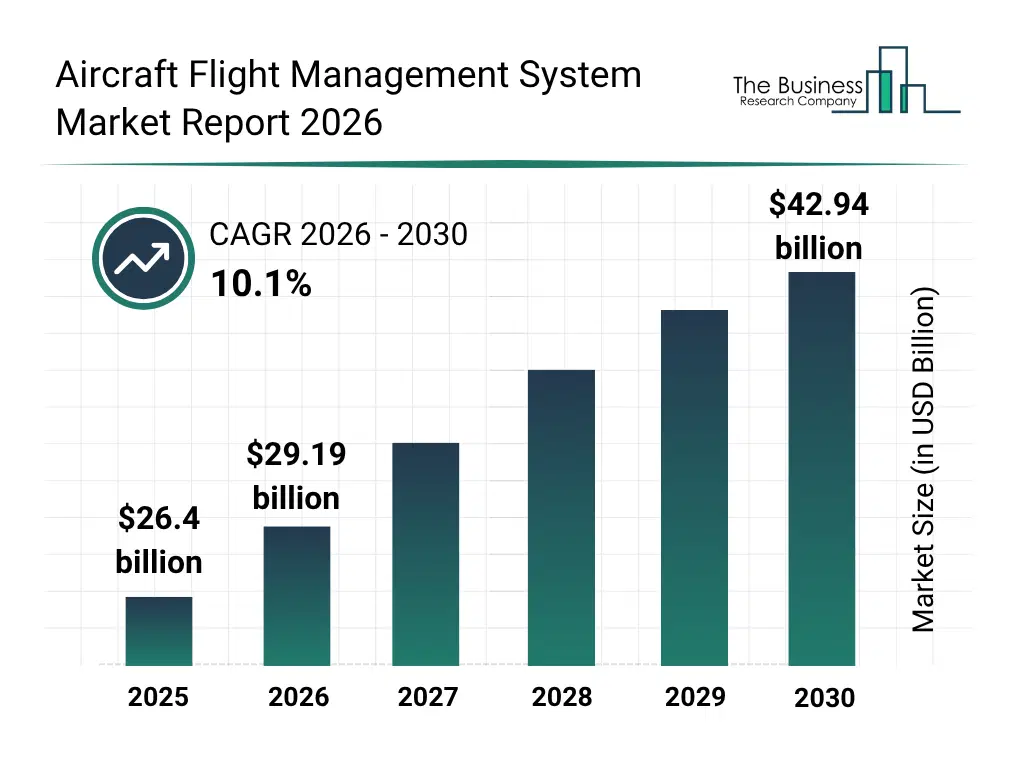
What Is The Aircraft Flight Management System Market Size and Share 2026?
The aircraft flight management system market size has grown rapidly in recent years. It will grow from $26.4 billion in 2025 to $29.19 billion in 2026 at a compound annual growth rate (CAGR) of 10.6%. The growth in the historic period can be attributed to growth in commercial aviation traffic, increasing aircraft fleet expansion, stringent aviation safety regulations, rising demand for fuel efficiency improvements, expansion of advanced avionics integration in aircraft.What Is The Aircraft Flight Management System Market Growth Forecast?
The aircraft flight management system market size is expected to see rapid growth in the next few years. It will grow to $42.94 billion in 2030 at a compound annual growth rate (CAGR) of 10.1%. The growth in the forecast period can be attributed to growing adoption of next generation connected aircraft systems, increasing investments in autonomous flight technologies, rising demand for cloud based flight management platforms, expansion of military aircraft modernization programs, increasing deployment of unmanned aerial vehicle systems. Major trends in the forecast period include increasing adoption of advanced route optimization capabilities, growing demand for fuel management and efficiency solutions, rising integration of multi-source navigation systems, increasing retrofit and upgrade activities for legacy aircraft systems, expansion of integrated flight performance monitoring solutions.
Global Aircraft Flight Management System Market Segmentation
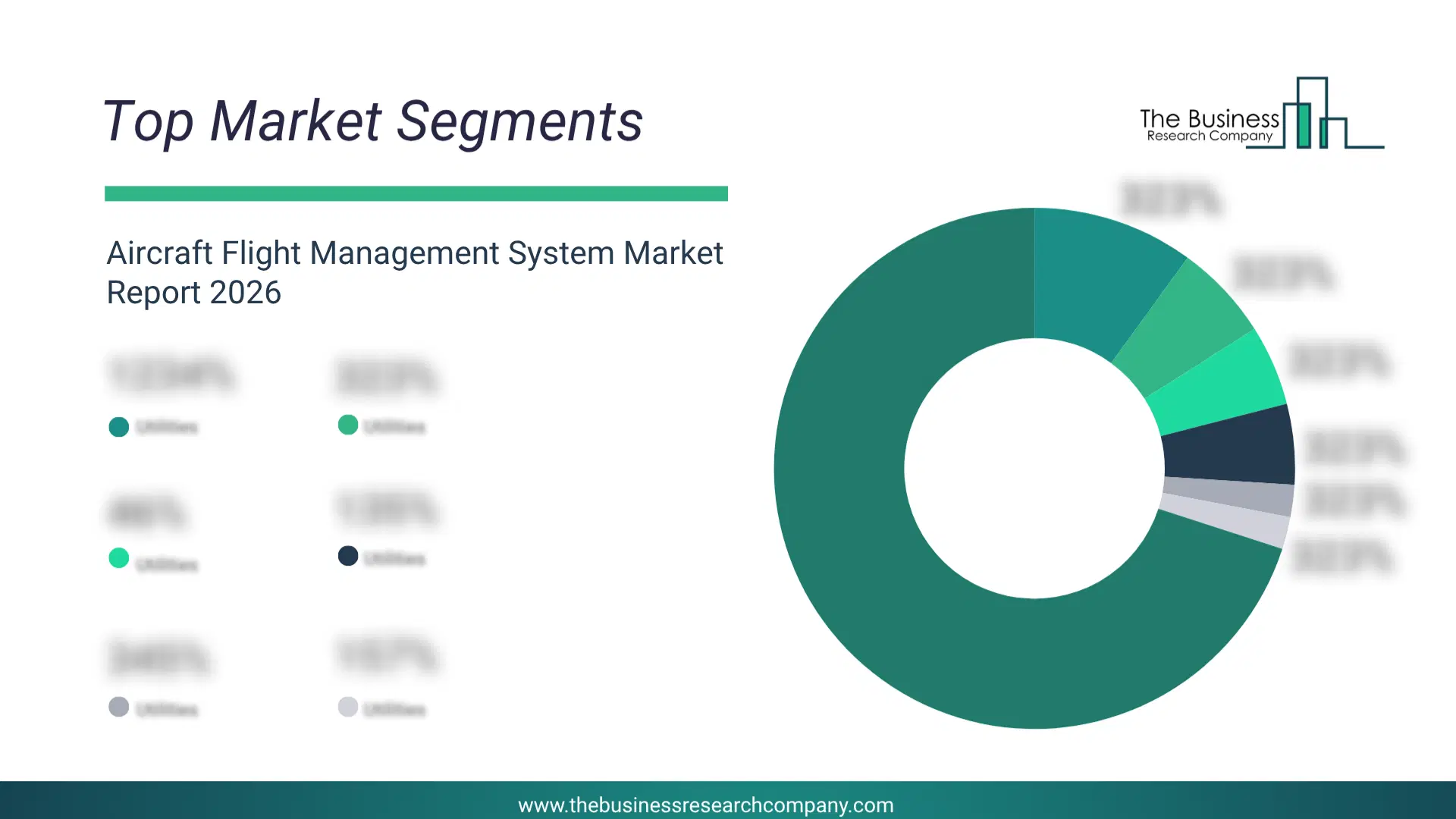
1) By Component Type: Software, Hardware, Services 2) By Deployment: New Aircraft Installations, Retrofit And Upgrades, Onboard Systems, Ground Based Systems, Cloud Based Flight Management Solutions 3) By Application Type: Commercial Aircraft, Military Aircraft, Business Jets, Unmanned Aerial Vehicles, Helicopters Subsegments: 1) By Software: Flight Management Software, Navigation And Flight Planning Software, Performance Optimization Software, Flight Data Management Software, Air Traffic Integration Software 2) By Hardware: Flight Management Computer, Control Display Unit, Multipurpose Control And Display Unit, Navigation Sensors, Avionics Processing Units 3) By Services: System Integration Services, Maintenance And Repair Services, Software Update And Upgrade Services, Training And Simulation Services, Consulting And Technical Support ServicesWhat Is The Driver Of The Aircraft Flight Management System Market?
The increasing air traffic volume is expected to propel the growth of the aircraft flight management system market going forward. Air traffic volume refers to the total number of aircraft movements and passengers transported through air transportation networks over a specific period. Air traffic volume is increasing due to the continued growth in global passenger travel demand. Aircraft flight management system supports increasing air traffic volume by optimizing flight routes, improving airspace utilization, enhancing navigation accuracy, and reducing pilot workload through automated flight planning and guidance functions. For instance, in October 2024, according to the International Air Transport Association, a Canada-based aviation trade association, total air traffic measured in revenue passenger kilometers increased by 8.6% in August 2024 compared to 2023, while international traffic rose by 10.6% year-over-year. Therefore, the increasing air traffic volume is expected to propel the growth of the aircraft flight management system industry.Key Players In The Global Aircraft Flight Management System Market
Major companies operating in the aircraft flight management system market report are The Boeing Company, RTX Corporation, Northrop Grumman Corporation, BAE Systems plc, Honeywell International Inc., GE Aerospace, Safran S.A., Thales S.A., Leonardo S.p.A., Textron Inc., Elbit Systems Ltd., Garmin Ltd., Saab AB, Diehl Aerospace GmbH, Curtiss-Wright Corporation, Moog Inc., Avidyne Corporation, L3Harris Technologies, TransDigm Group Incorporated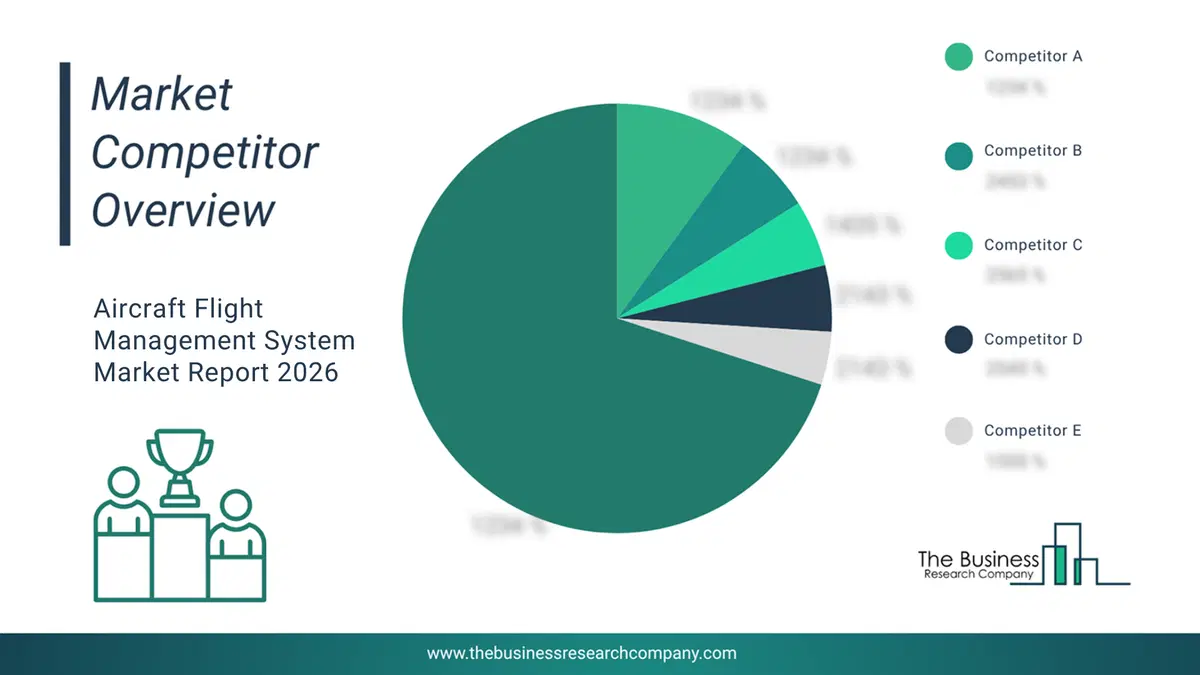
This chart is for illustrative purposes; the full report includes a detailed competitor analysis and comprehensive overview of the top 10 companies in the market.
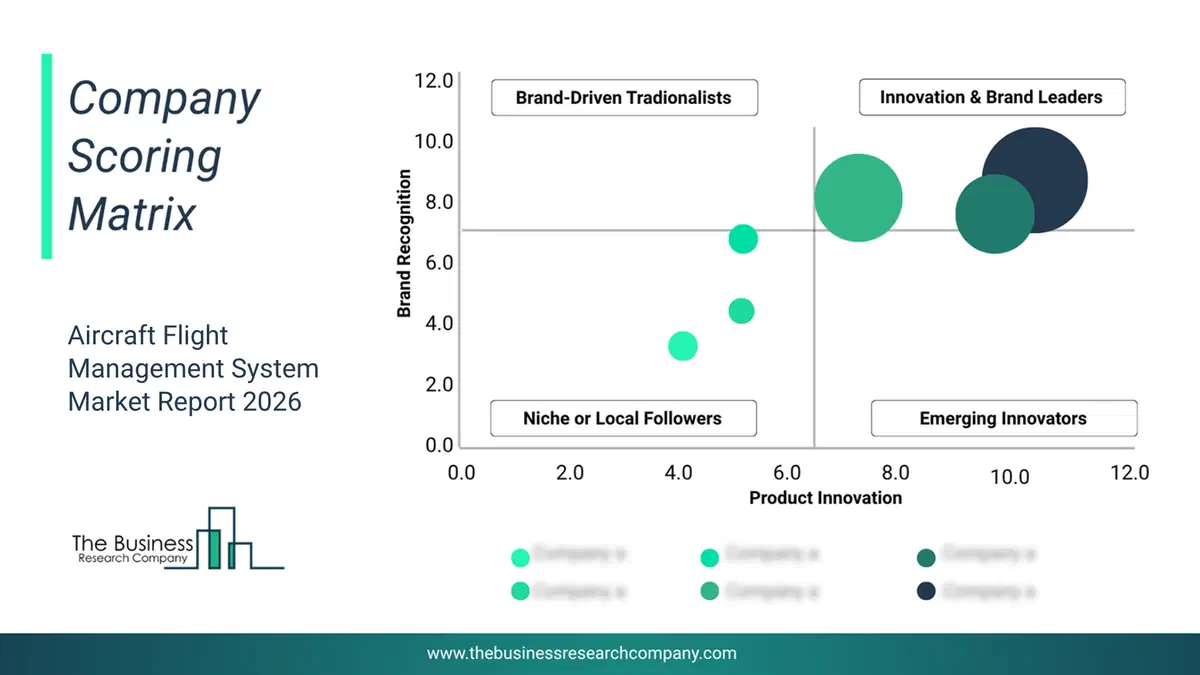
This chart maps companies by product innovation and brand strength, with bubble size indicating relative revenue, helping identify market leaders, challengers, and niche players. This is an illustrative chart; the full report provides a complete and accurate competitive analysis.
Global Aircraft Flight Management System Market Trends and Insights
Major companies operating in the aircraft flight management system market are focusing on developing advanced solutions, such as predictive trajectory optimization algorithms that use real-time aircraft performance data, weather inputs, and air traffic constraints to dynamically compute the most fuel-efficient and time-optimized flight paths during all phases of flight. These systems enable continuous recalculation of routes and performance parameters using machine learning models that improve decision accuracy, reduce pilot workload, and enhance operational efficiency in complex airspace environments. For instance, in September 2024, Ramco Systems Limited a Indian-based enterprise software company launched Aviation Software 6.0, an Artificial Intelligence-enabled aviation operations platform supporting maintenance, engineering, and operational flight management workflows. The system integrates predictive analytics, automated compliance management, and digital aviation lifecycle optimization tools. The launch also introduced a specialized Engine MRO module designed to improve the management of aviation engine maintenance, repair, and overhaul activities. It included a Maintenance Control Centre (MCC) Hub that enables personnel to assess aircraft readiness and support operational coordination. Additionally, the platform features an Aviation Material Requirements Planning (MRP) module to optimize resource allocation and scheduling processes.What Are Latest Mergers And Acquisitions In The Aircraft Flight Management System Market?
In July 2025, Safran, a France-based provider of aircraft engines, landing gear, brakes, cabin interiors, and avionics systems, acquired Collins Aerospace's flight control and actuation business for $1.8 billion. With this acquisition, Safran establishes itself as the unparalleled global leader in actuation and flight control systems, strengthening its strategic position on next-generation commercial and military aircraft programs. Collins Aerospace is a US-based provider of mission-critical flight control and actuation systems for commercial and military aircraft and helicopters.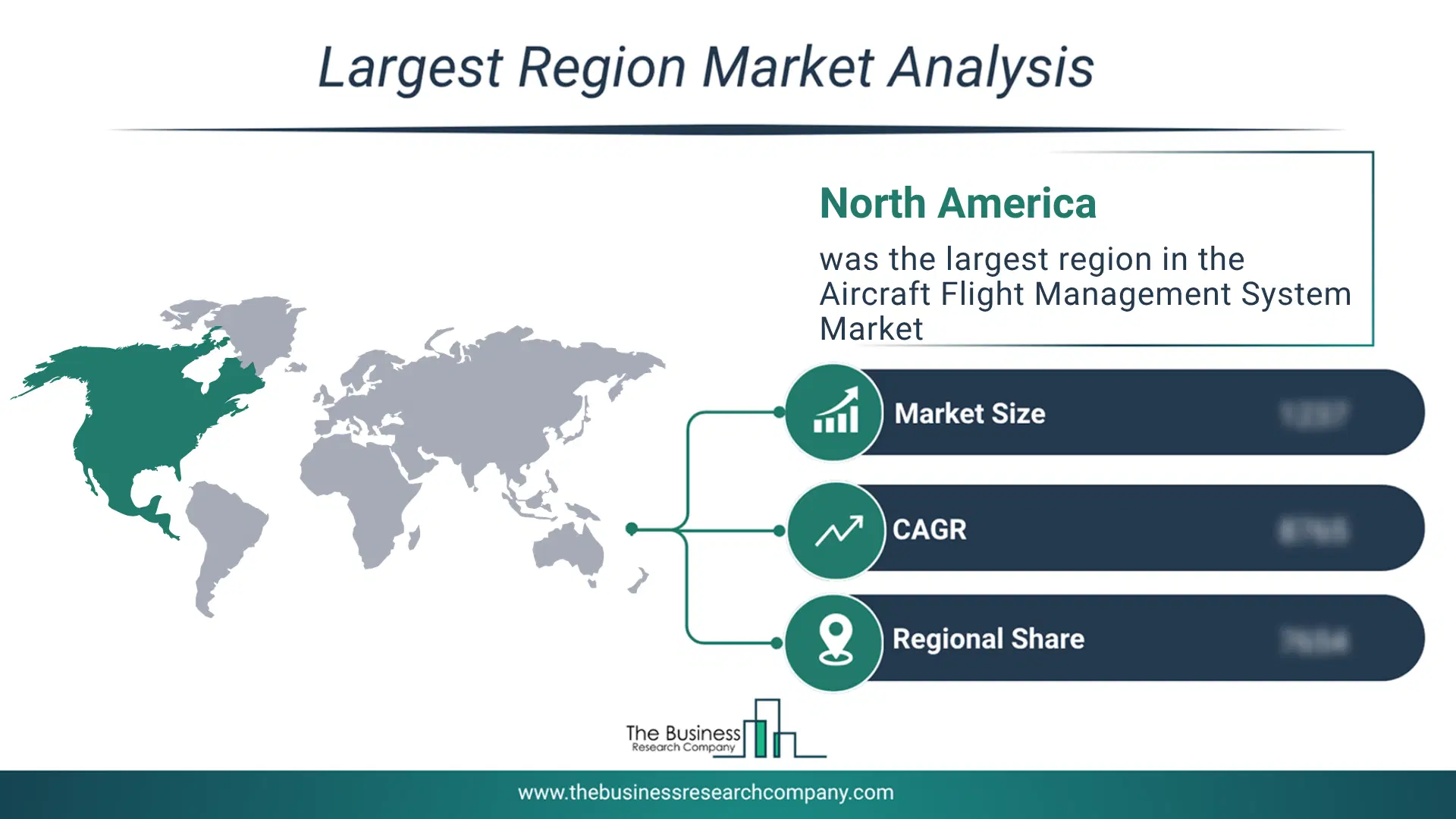
Regional Outlook
North America was the largest region in the aircraft flight management system market in 2025. Asia-Pacific is expected to be the fastest-growing region in the forecast period. The regions covered in this market report are Asia-Pacific, South East Asia, Western Europe, Eastern Europe, North America, South America, Middle East, Africa. The countries covered in this market report are Australia, Brazil, China, France, Germany, India, Indonesia, Japan, Taiwan, Russia, South Korea, UK, USA, Canada, Italy, Spain.What Defines the Aircraft Flight Management System Market?
The aircraft flight management system market consists of revenues earned by entities by providing services such as performance optimization, flight guidance, predictive maintenance support, avionics integration, technical support, and flight operations management services. The market value includes the value of related goods sold by the service provider or included within the service offering. The aircraft flight management system market also includes sales of performance management systems, communication interfaces, and sensors. Values in this market are ‘factory gate’ values, that is the value of goods sold by the manufacturers or creators of the goods, whether to other entities (including downstream manufacturers, wholesalers, distributors and retailers) or directly to end customers. The value of goods in this market includes related services sold by the creators of the goods.How is Market Value Defined and Measured?
The market value is defined as the revenues that enterprises gain from the sale of goods and/or services within the specified market and geography through sales, grants, or donations in terms of the currency (in USD unless otherwise specified). The revenues for a specified geography are consumption values that are revenues generated by organizations in the specified geography within the market, irrespective of where they are produced. It does not include revenues from resales along the supply chain, either further along the supply chain or as part of other products.
This chart presents market attractiveness based on a quantitative evaluation of growth, competition, strategic alignment, and risk, offering a clear view of opportunity areas for decision-making. This chart is for illustrative purposes; the full report contains the complete analysis.

This chart highlights the Total Addressable Market (TAM) by estimating the maximum revenue opportunity using an assumption-driven approach, supporting strategic planning and opportunity sizing across markets. The chart is illustrative; the full report provides a more comprehensive analysis.
What Key Data and Analysis Are Included in the Aircraft Flight Management System Market Report 2026?
The aircraft flight management system market research report is one of a series of new reports from The Business Research Company that provides market statistics, including industry global market size, regional shares, competitors with the market share, detailed market segments, market trends and opportunities, and any further data you may need to thrive in the aircraft flight management system industry. The market research report delivers a complete perspective of everything you need, with an in-depth analysis of the current and future state of the industry.Aircraft Flight Management System Market Report Forecast Analysis
| Report Attribute | Details |
|---|---|
| Market Size Value In 2026 | $29.19 billion |
| Revenue Forecast In 2030 | $42.94 billion |
| Growth Rate | CAGR of 10.1% from 2026 to 2030 |
| Base Year For Estimation | 2025 |
| Actual Estimates/Historical Data | 2020-2025 |
| Forecast Period | 2026 - 2030 |
| Market Representation | Revenue in USD Billion and CAGR from 2026 to 2030 |
| Segments Covered | Component Type, Deployment, Application Type |
| Regional Scope | Asia-Pacific, Western Europe, Eastern Europe, North America, South America, Middle East, Africa |
| Country Scope | The countries covered in the report are Australia, Brazil, China, France, Germany, India, Indonesia, Japan, Taiwan, Russia, South Korea, UK, USA, Canada, Italy, Spain. |
| Key Companies Profiled | The Boeing Company, RTX Corporation, Northrop Grumman Corporation, BAE Systems plc, Honeywell International Inc., GE Aerospace, Safran S.A., Thales S.A., Leonardo S.p.A., Textron Inc., Elbit Systems Ltd., Garmin Ltd., Saab AB, Diehl Aerospace GmbH, Curtiss-Wright Corporation, Moog Inc., Avidyne Corporation, L3Harris Technologies, TransDigm Group Incorporated |
| Customization Scope | Request for Customization |
| Pricing And Purchase Options | Explore Purchase Options |