
Aircraft Fuel Systems Market Report 2026
Global Outlook – By Component (Piping, Inerting Systems, Pumps, Valves, Gauges, Filters, Other Components), By Technology (Gravity Feed Fuel System, Fuel Injection System, Pump Feed System), By Fuel Type (Jet Fuel, Aviation Gasoline, Biofuel, Other Fuel Types), By End User (Civil Aviation, Military Aviation, Other End Users) – Market Size, Trends, Strategies, and Forecast to 2030
Aircraft Fuel Systems Market Report 2026 Market Overview
• Aircraft Fuel Systems Market Report 2026 market size has reached to $6.3 billion in 2025 • Expected to grow to $8.9 billion in 2030 at a compound annual growth rate (CAGR) of 7.1% • Growth Driver: The Rising Air Passenger Traffic Driving The Growth Of The Market Due To Higher Disposable Incomes • Market Trend: Hydrogen Fuel Cell Propulsion Technologies Advancing Clean Aviation Through Zero-Emission Aircraft Power Solutions • North America was the largest region in 2025 and Asia-Pacific is the fastest growing region.What Is Covered Under Aircraft Fuel Systems Market?
Aircraft fuel systems refer to the integrated arrangement within an aircraft that stores, manages, and delivers fuel to the engines in a safe and controlled manner. These systems ensure that fuel is supplied efficiently and reliably throughout all phases of flight, maintaining proper engine performance and aircraft operation without interruption. The main components of aircraft fuel systems include piping, inerting systems, pumps, valves, gauges, filters, and other components. Piping refers to the network of tubes and conduits that safely transport aviation fuel between storage tanks, pumps, engines, and other fuel system components within an aircraft. These systems utilize gravity feed fuel system, fuel injection system, and pump feed system technologies. They are designed to handle jet fuel, aviation gasoline, biofuel, and others, while serving end users such as civil aviation, military aviation, and others.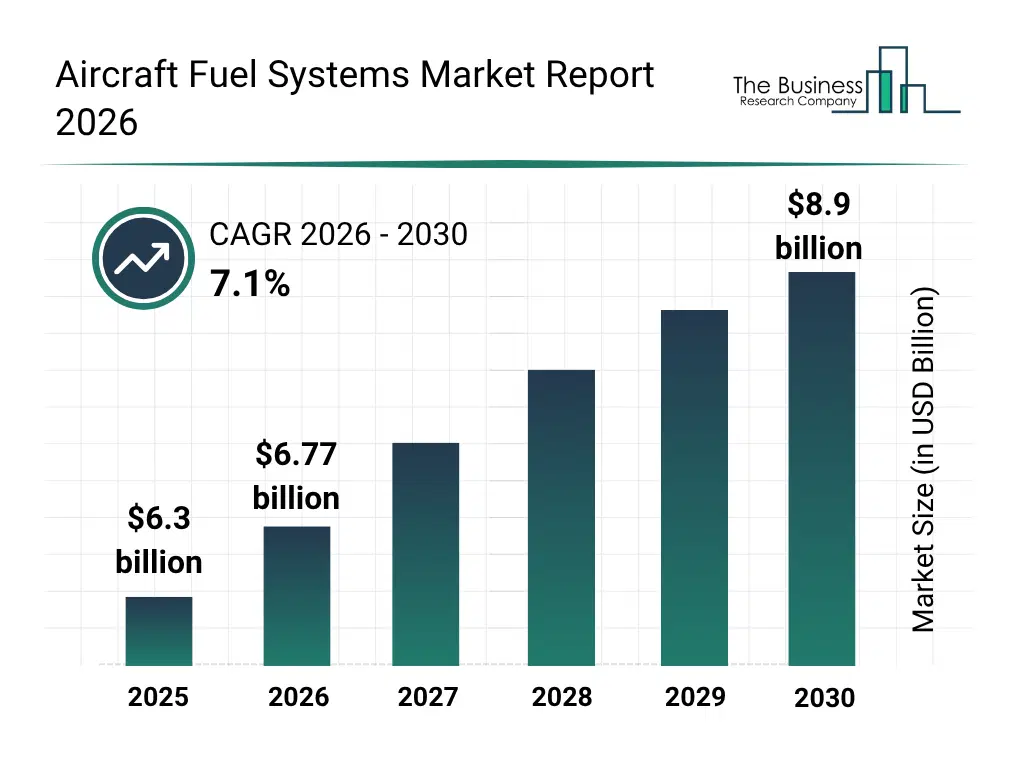
What Is The Aircraft Fuel Systems Market Size and Share 2026?
The aircraft fuel systems market size has grown strongly in recent years. It will grow from $6.3 billion in 2025 to $6.77 billion in 2026 at a compound annual growth rate (CAGR) of 7.5%. The growth in the historic period can be attributed to aircraft fleet expansion, rising commercial air passenger traffic, increasing military aircraft procurement, growth in long-haul aviation operations, stringent aviation fuel safety regulations.What Is The Aircraft Fuel Systems Market Growth Forecast?
The aircraft fuel systems market size is expected to see strong growth in the next few years. It will grow to $8.9 billion in 2030 at a compound annual growth rate (CAGR) of 7.1%. The growth in the forecast period can be attributed to growing adoption of sustainable aviation fuel, increasing next-generation aircraft production, rising investment in advanced fuel management systems, expansion of unmanned aerial vehicle fleets, increasing demand for lightweight aircraft components. Major trends in the forecast period include increasing adoption of lightweight fuel system components, growing demand for advanced fuel tank safety systems, rising integration of modular fuel management architectures, expansion of biofuel-compatible fuel system designs, increasing focus on fuel delivery efficiency optimization.
Global Aircraft Fuel Systems Market Segmentation
1) By Component: Piping, Inerting Systems, Pumps, Valves, Gauges, Filters, Other Components 2) By Technology: Gravity Feed Fuel System, Fuel Injection System, Pump Feed System 3) By Fuel Type: Jet Fuel, Aviation Gasoline, Biofuel, Other Fuel Types 4) By End User: Civil Aviation, Military Aviation, Other End Users Subsegments: 1) By Piping: Rigid Fuel Pipes, Flexible Fuel Hoses, Metallic Fuel Lines, Composite Fuel Lines, Fuel Transfer Lines 2) By Inerting Systems: Nitrogen Generation Systems, Onboard Inert Gas Generation Systems, Hollow Fiber Membrane Systems, Fuel Tank Inerting Systems, Center Wing Tank Inerting Systems 3) By Pumps: Electric Fuel Pumps, Engine Driven Fuel Pumps, Booster Fuel Pumps, Transfer Fuel Pumps, Auxiliary Fuel Pumps 4) By Valves: Fuel Shutoff Valves, Fuel Transfer Valves, Check Valves, Pressure Relief Valves, Crossfeed Valves 5) By Gauges: Fuel Quantity Gauges, Fuel Pressure Gauges, Fuel Flow Gauges, Fuel Level Indicators, Digital Fuel Monitoring Gauges 6) By Filters: Fuel Strainer Filters, Cartridge Fuel Filters, Inline Fuel Filters, Water Separator Filters, Fine Particle Fuel Filters 7) By Other Components: Fuel Tanks, Fuel Sensors, Fuel Meters, Fuel Vent Systems, Fuel Management Control UnitsWhat Is The Driver Of The Aircraft Fuel Systems Market?
The rising air passenger traffic is expected to propel the growth of the aircraft fuel systems market going forward. Air passenger traffic refers to the total number of passengers transported by airlines through domestic and international air services over a specific period and serves as a key indicator of air travel demand. Air passenger traffic is rising due to higher disposable incomes, as more people can afford air travel for business and leisure. Rising air passenger traffic drives fleet expansion and higher aircraft utilization, thereby increasing demand for advanced and efficient aircraft fuel systems to ensure reliable fuel management, safety, and improved fuel efficiency across commercial and military aviation operations. For instance, in October 2024, according to the Department of Transportation, a US-based government department, in August 2024, 647,205 flights were operated, representing a 2.61% increase from the 630,761 flights in August 2023. Therefore, the rising air passenger traffic is driving the growth of the aircraft fuel systems industry.Key Players In The Global Aircraft Fuel Systems Market
Major companies operating in the aircraft fuel systems market report are RTX Corporation, Honeywell International Inc., Safran S.A., Eaton Corporation plc, Thales Group, Parker-Hannifin Corporation, Liebherr-International AG, TransDigm Group Incorporated, GKN Aerospace Services Limited, AMETEK Inc., Curtiss-Wright Corporation, HEICO Corporation, ITT Inc., Moog Inc., Woodward Inc., Crane Company, Triumph Group Inc., Senior plc, Astronics Corporation, Marotta Controls Inc., Metalcraft Technologies Inc., Hartwig Aircraft Fuel Cell Repair Inc.
This chart is for illustrative purposes; the full report includes a detailed competitor analysis and comprehensive overview of the top 10 companies in the market.
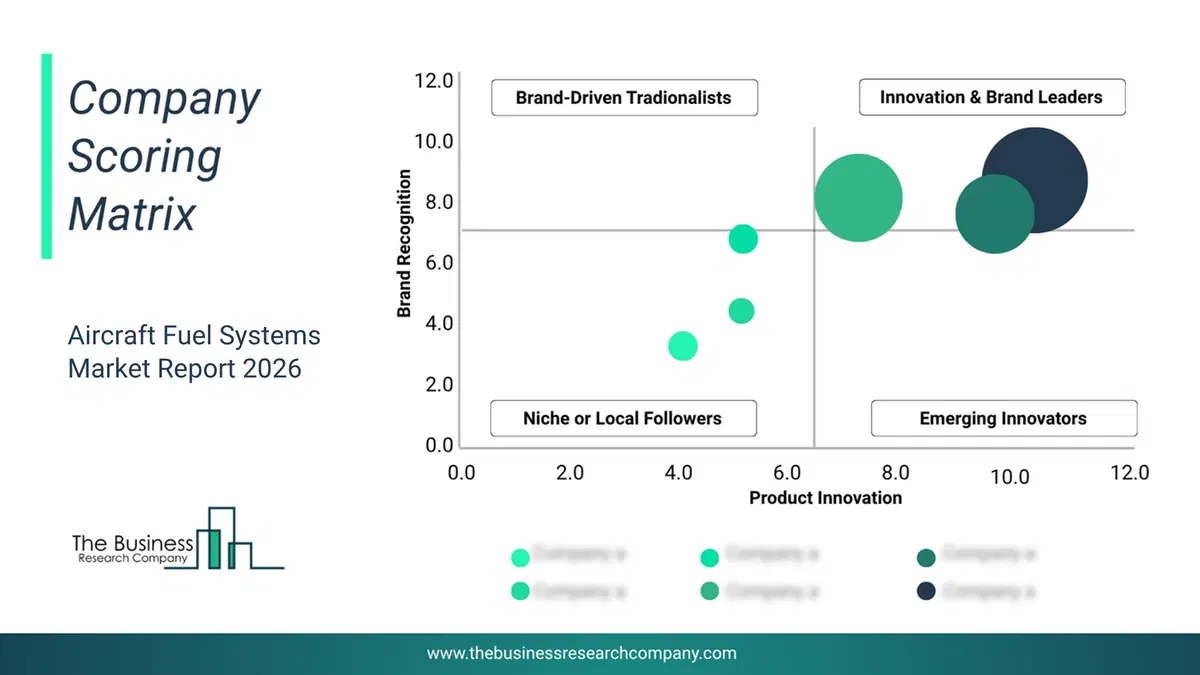
This chart maps companies by product innovation and brand strength, with bubble size indicating relative revenue, helping identify market leaders, challengers, and niche players. This is an illustrative chart; the full report provides a complete and accurate competitive analysis.
Global Aircraft Fuel Systems Market Trends and Insights
Major companies operating in the aircraft fuel systems market are focusing on developing innovative solutions, such as hydrogen-based fuel cell propulsion systems, to enhance fuel efficiency, reduce emissions, and support the aviation industry’s transition toward zero-emission flight. Hydrogen fuel cell-based propulsion systems are advanced aircraft power solutions that convert liquid hydrogen into electrical energy through electrochemical reactions, which then power electric motors for aircraft propulsion, offering a cleaner alternative to conventional jet fuel-based fuel systems that rely on combustion and produce CO₂, NOx, and particulate emissions. For instance, in June 2023, MTU Aero Engines AG, a Germany-based aerospace propulsion company, developed the Flying Fuel Cell (FFC) concept, an aviation fuel cell technology designed to convert liquid hydrogen into electricity for powering aircraft propulsion systems. The system uses fuel cells to generate electrical energy that drives high-efficiency electric motors connected to propellers, enabling near-zero emissions flight with only water as a byproduct. Additionally, the concept targets an initial application in short-haul and regional aircraft, with plans for broader deployment in short- and medium-haul aviation in the coming decades, supporting long-term decarbonization goals in the aviation industry.What Are Latest Mergers And Acquisitions In The Aircraft Fuel Systems Market?
In June 2025, TransDigm Group Inc., a US-based manufacturing company, acquired Simmonds Precision Products Inc. for $765 million. With this acquisition, TransDigm aims to strengthen its position in the aerospace fuel measurement and sensing systems segment while expanding its portfolio of highly engineered, aftermarket-focused aircraft components with strong proprietary content and recurring revenue potential. Simmonds Precision Products Inc. is a US-based company that provides aircraft fuel systems, specifically fuel quantity measurement and fuel management systems.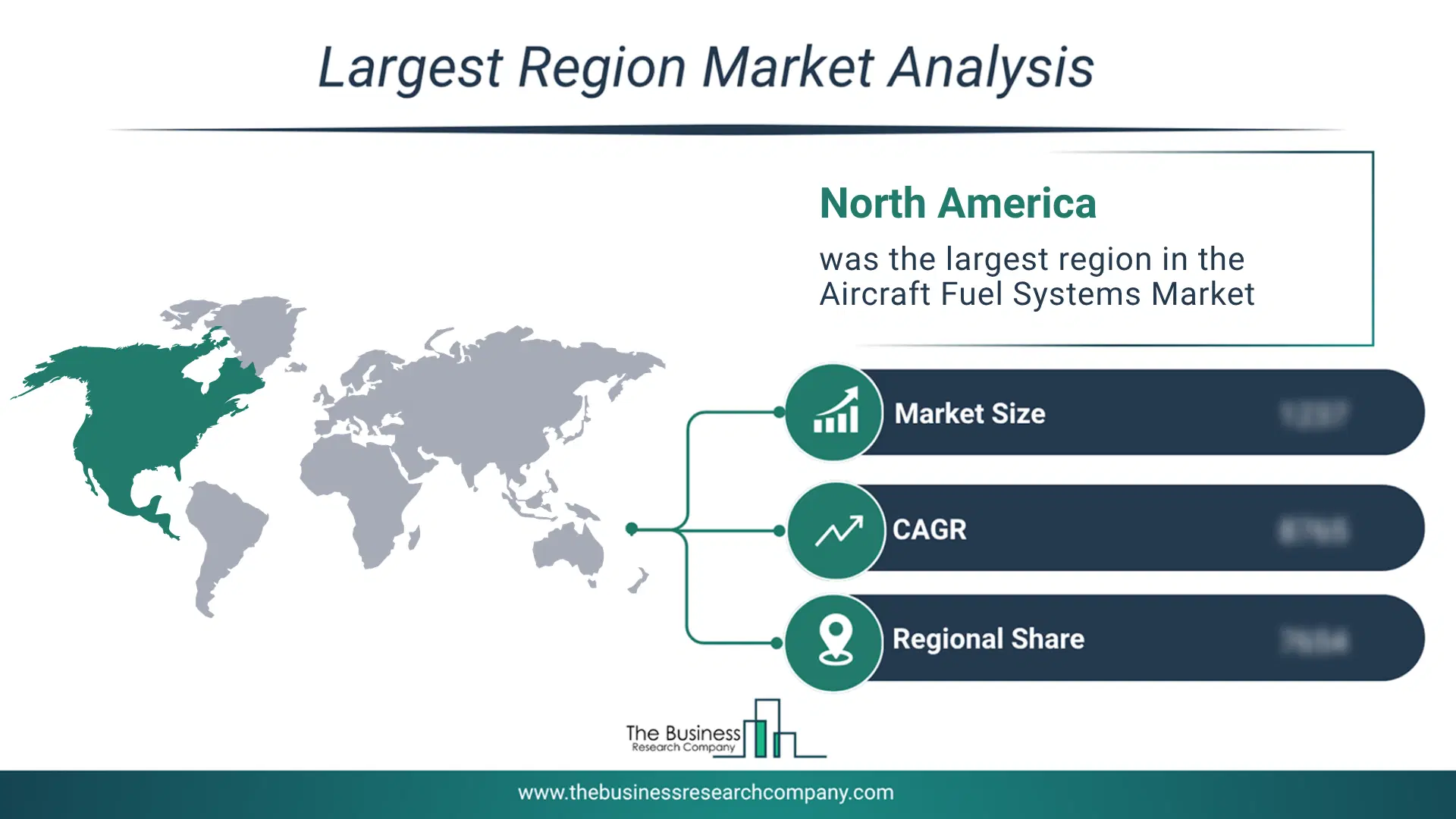
Regional Outlook
North America was the largest region in the aircraft fuel systems market in 2025. Asia-Pacific is expected to be the fastest-growing region in the forecast period. The regions covered in this market report are Asia-Pacific, South East Asia, Western Europe, Eastern Europe, North America, South America, Middle East, Africa. The countries covered in this market report are Australia, Brazil, China, France, Germany, India, Indonesia, Japan, Taiwan, Russia, South Korea, UK, USA, Canada, Italy, Spain.What Defines the Aircraft Fuel Systems Market?
The aircraft fuel systems market consists of sales of fuel storage units, fuel control and monitoring systems, fuel distribution components, fuel safety and protection systems. Values in this market are ‘factory gate’ values, that is, the value of goods sold by the manufacturers or creators of the goods, whether to other entities (including downstream manufacturers, wholesalers, distributors, and retailers) or directly to end customers. The value of goods in this market includes related services sold by the creators of the goods.How is Market Value Defined and Measured?
The market value is defined as the revenues that enterprises gain from the sale of goods and/or services within the specified market and geography through sales, grants, or donations in terms of the currency (in USD unless otherwise specified). The revenues for a specified geography are consumption values that are revenues generated by organizations in the specified geography within the market, irrespective of where they are produced. It does not include revenues from resales along the supply chain, either further along the supply chain or as part of other products.
This chart presents market attractiveness based on a quantitative evaluation of growth, competition, strategic alignment, and risk, offering a clear view of opportunity areas for decision-making. This chart is for illustrative purposes; the full report contains the complete analysis.

This chart highlights the Total Addressable Market (TAM) by estimating the maximum revenue opportunity using an assumption-driven approach, supporting strategic planning and opportunity sizing across markets. The chart is illustrative; the full report provides a more comprehensive analysis.
What Key Data and Analysis Are Included in the Aircraft Fuel Systems Market Report 2026?
The aircraft fuel systems market research report is one of a series of new reports from The Business Research Company that provides market statistics, including industry global market size, regional shares, competitors with the market share, detailed market segments, market trends and opportunities, and any further data you may need to thrive in the aircraft fuel systems industry. The market research report delivers a complete perspective of everything you need, with an in-depth analysis of the current and future state of the industry.Aircraft Fuel Systems Market Report Forecast Analysis
| Report Attribute | Details |
|---|---|
| Market Size Value In 2026 | $6.77 billion |
| Revenue Forecast In 2030 | $8.9 billion |
| Growth Rate | CAGR of 7.1% from 2026 to 2030 |
| Base Year For Estimation | 2025 |
| Actual Estimates/Historical Data | 2020-2025 |
| Forecast Period | 2026 - 2030 |
| Market Representation | Revenue in USD Billion and CAGR from 2026 to 2030 |
| Segments Covered | Component, Technology, Fuel Type, End User |
| Regional Scope | Asia-Pacific, Western Europe, Eastern Europe, North America, South America, Middle East, Africa |
| Country Scope | The countries covered in the report are Australia, Brazil, China, France, Germany, India, Indonesia, Japan, Taiwan, Russia, South Korea, UK, USA, Canada, Italy, Spain. |
| Key Companies Profiled | RTX Corporation, Honeywell International Inc., Safran S.A., Eaton Corporation plc, Thales Group, Parker-Hannifin Corporation, Liebherr-International AG, TransDigm Group Incorporated, GKN Aerospace Services Limited, AMETEK Inc., Curtiss-Wright Corporation, HEICO Corporation, ITT Inc., Moog Inc., Woodward Inc., Crane Company, Triumph Group Inc., Senior plc, Astronics Corporation, Marotta Controls Inc., Metalcraft Technologies Inc., Hartwig Aircraft Fuel Cell Repair Inc. |
| Customization Scope | Request for Customization |
| Pricing And Purchase Options | Explore Purchase Options |