
Aircraft Insulation Market Report 2026
Global Outlook – By Type (Thermal Insulation, Acoustic And Vibration Insulation, Electric Insulation ), By Platform (Fixed Wing, Rotary Wing, Unmanned Aerial Vehicles ), By Material (Foamed Plastics, Fiberglass, Mineral Wool, Ceramic-Based Materials, Other Materials ), By Application (Airframe, Propulsion System ) – Market Size, Trends, Strategies, and Forecast to 2030
Aircraft Insulation Market Overview
• Aircraft Insulation market size has reached to $9.37 billion in 2025 • Expected to grow to $14.03 billion in 2030 at a compound annual growth rate (CAGR) of 8.4% • Growth Driver: Rising Demand For Helicopters Fueling The Growth Of The Market Due To Increasing Need For Cabin Comfort And Operational Efficiency • Market Trend: Sensata Launches Next-Gen SIM200 Insulation Monitoring Device For Enhanced Aircraft Electrical System Safety • North America was the largest region in 2025 and Asia-Pacific is the fastest growing region.Market Gains By 2030 – Top Opportunities By Segment
Market Gain identifies the most promising market opportunities by highlighting the segments or products expected to generate the highest incremental revenue growth over the next five years.
What Is Covered Under Aircraft Insulation Market?
Aircraft insulation is installed in aircraft to enhance the safety and comfort level. Insulation plays an important role in protecting the crew and passengers from frigid temperatures at higher altitudes. It also provides safety against engine noise. The aircraft insulation is used to enhance acoustic, anti-vibration, thermal, fire-resistant, and electrical insulation properties. The main types of aircraft insulation are thermal insulation, acoustic and vibration insulation, and electric insulation. Thermal insulation refers to the process of insulating material by transferring heat between the materials that are in thermal contact. The different platforms include fixed wing, rotary wing, and unmanned aerial vehicles and involve several materials such as foamed plastics, fiberglass, mineral wool, ceramic-based materials, and others. The applications involved are airframe and propulsion systems.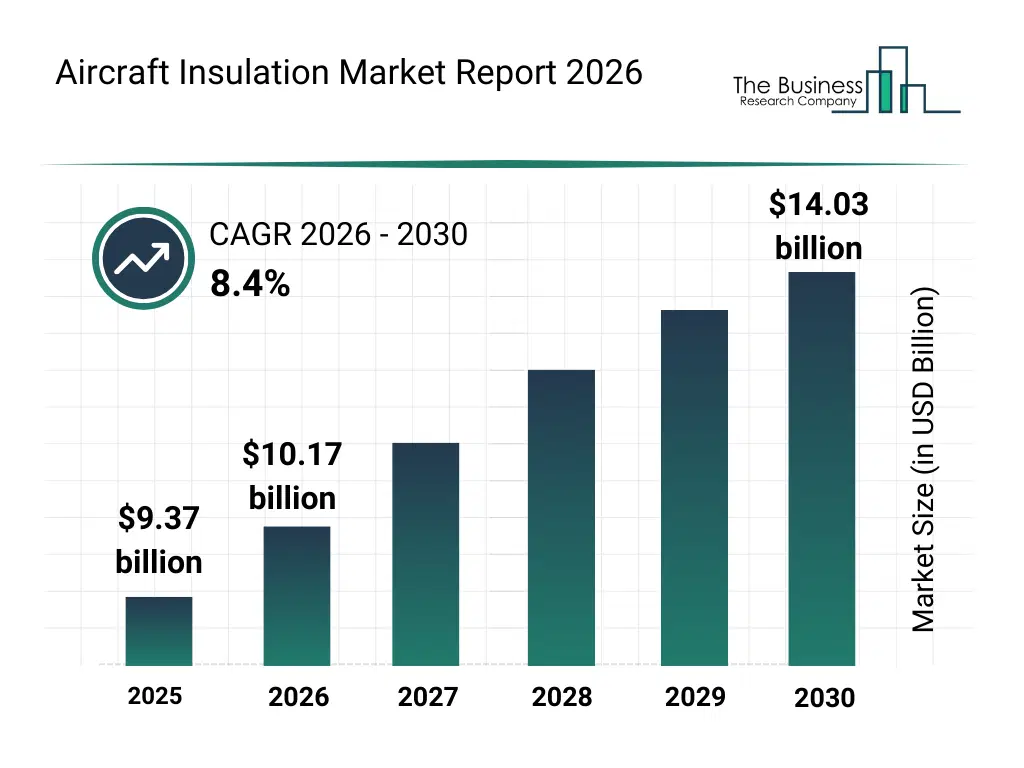
What Is The Aircraft Insulation Market Size and Share 2026?
The aircraft insulation market size has grown strongly in recent years. It will grow from $9.37 billion in 2025 to $10.17 billion in 2026 at a compound annual growth rate (CAGR) of 8.4%. The growth in the historic period can be attributed to growing use of thermal insulation to protect passengers and crew from extreme altitude temperatures, rising demand for acoustic and anti-vibration insulation to improve cabin comfort, increased regulatory focus on fire-resistant insulation materials enhancing aircraft safety, expansion of aircraft production driving consumption of foam- and composite-based insulation, adoption of lightweight insulation materials such as cellulose and natural fibers to reduce aircraft weight.What Is The Aircraft Insulation Market Growth Forecast?
The aircraft insulation market size is expected to see strong growth in the next few years. It will grow to $14.03 billion in 2030 at a compound annual growth rate (CAGR) of 8.4%. The growth in the forecast period can be attributed to anticipated rise in next-generation aircraft requiring advanced multi-functional insulation solutions, increasing adoption of eco-efficient and recyclable insulation materials in aviation, growing demand for high-performance ceramic and metal composite insulation for improved durability, expansion of global fleet modernization boosting replacement and retrofit insulation needs, technological advancements enabling insulation materials with enhanced thermal, acoustic, and fire-resistant properties. Major trends in the forecast period include growing use of lightweight composite insulation, increasing adoption of multi-functional insulation materials, rising demand for advanced fire-resistant insulation solutions, expanding use of thermal-acoustic hybrid insulation, development of next-generation vibration-damping materials.
Global Aircraft Insulation Market Segmentation
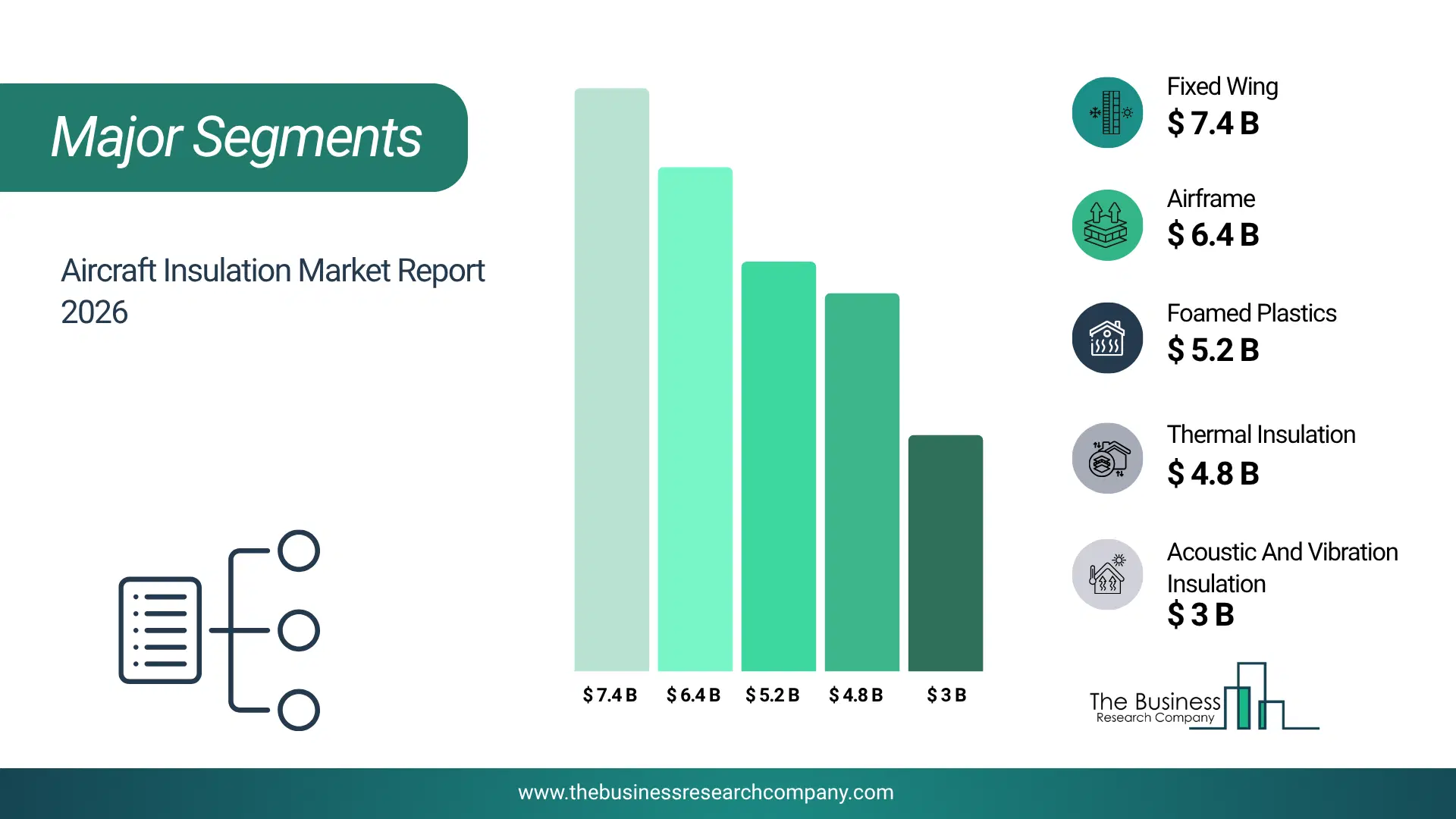
1) By Type: Thermal Insulation, Acoustic And Vibration Insulation, Electric Insulation 2) By Platform: Fixed Wing, Rotary Wing, Unmanned Aerial Vehicles 3) By Material: Foamed Plastics, Fiberglass, Mineral Wool, Ceramic-Based Materials, Other Materials 4) By Application: Airframe, Propulsion System Subsegments: 1) By Thermal Insulation: Reflective Thermal Insulation, Fiberglass Thermal Insulation, Foam Thermal Insulation, Aerogel Thermal Insulation 2) By Acoustic and Vibration Insulation: Soundproofing Materials, Acoustic Foam Panels, Vibration Damping Materials, Composite Acoustic Insulation 3) By Electric Insulation: Insulating Materials for Wiring, Electrical Insulation Coatings, Heat Shrink Tubing, Insulating Gaskets and Seals The top segments in the aircraft insulation market will be: • Fixed Wing will reach $7405.15 Million by 2025. • Airframe will reach $6481.76 Million by 2025. • Foamed Plastics will reach $5227.02 Million by 2025. • Thermal Insulation will reach $4892.41 Million by 2025. • Acoustic And Vibration Insulation will reach $3030.17 Million by 2025.What Is Driver Of The Aircraft Insulation Market?
The increase in demand for helicopters is expected to propel the growth of the aircraft insulation market going forward. A helicopter is an aircraft with large blades on top that spin very quickly, allowing it to hover in the air and travel straight upward or downward. Helicopters are increasing due to growing demand for versatile aerial transportation and specialized services, prompting manufacturers and operators to expand fleets for commercial, medical, and defense applications. Aircraft insulation supports the demand for helicopters by enhancing cabin comfort, noise reduction, and thermal efficiency, making helicopters more reliable and appealing for commercial, medical, and defense operations. For instance, in January 2025, according to Airbus, a France-based aircraft manufacturer, in 2024, Airbus Helicopters recorded an order intake with unit growth approaching 10%, marking the second consecutive year of near-double-digit expansion. Therefore, the increase in demand for helicopters is driving the growth of the aircraft insulation industry.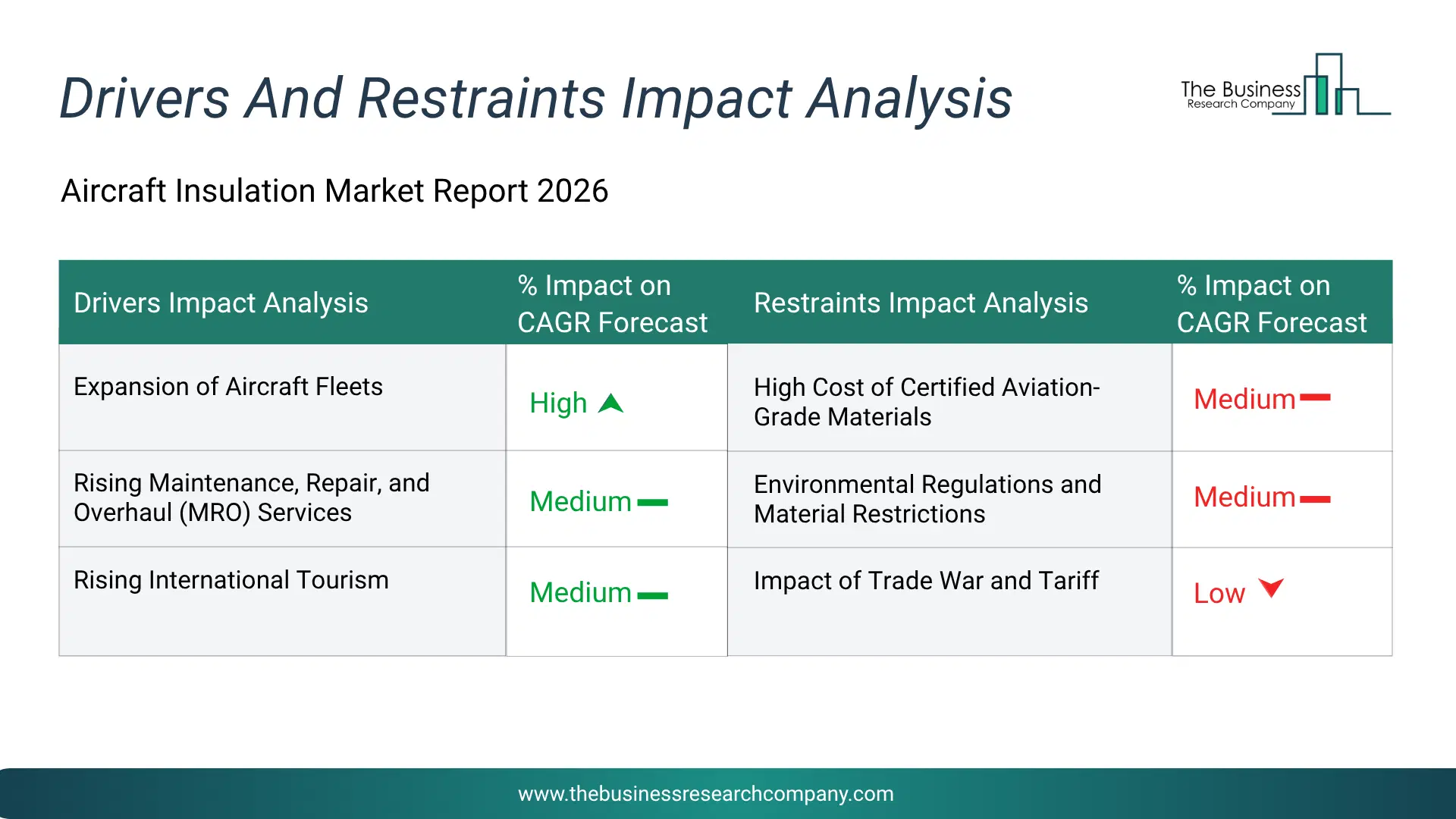
Infographic Chart Showing Key Market Drivers Analysis And Restraints For Aircraft Insulation Market
The chart presents an impact analysis of key drivers and restraints, quantifying their relative influence on the market's growth rate and helping assess the balance between growth enablers and limiting factors. This chart offers a high-level perspective; the full report contains more detailed insights.
How Will The Drivers Impact Growth In The Global Aircraft Insulation Market?
• Expansion of Aircraft Fleets (High) – The expansion of aircraft fleets will become a key driver of growth in the aircraft insulation market by 2030. Fleet expansion refers to the increase in the number of aircraft operated by airlines, driven by rising passenger demand and the need to replace older, less efficient aircraft. This trend is fueled by factors such as economic recovery, increased air travel and the introduction of new aircraft models. Airlines are investing in fleet expansion to meet growing demand and improve operational efficiency. The expansion of aircraft fleets directly increases the demand for aircraft insulation materials, as new and existing aircraft require insulation solutions for temperature control, noise reduction and safety compliance. This strategic move aims to modernize Air India's fleet, strengthen its international routes and replace older planes. As a result, the expansion of aircraft fleets is anticipated to contributing to a 2.0% annual growth in the market. • Rising Maintenance, Repair, and Overhaul (MRO) Services (Medium) – The rising demand for maintenance, repair and overhaul (MRO) services will emerge as a major factor driving the expansion of the market by 2030. MRO services encompass the upkeep, repair and upgrading of aircraft to ensure safety, compliance and performance. The increasing fleet size and the aging of existing aircraft fleets contribute to a higher demand for MRO services. Airlines and operators are investing in MRO to maintain fleet reliability and meet regulatory requirements. The rising demand for MRO services directly influences the aircraft insulation materials market, as insulation components require regular maintenance, replacement and upgrades during MRO activities. Consequently, a rising demand for maintenance, repair and overhaul (MRO) services is projected to contributing to a 1.5% annual growth in the market. • Rising International Tourism (Medium) – The rising international tourism will serve as a key growth catalyst for the market by 2030. International tourism refers to the movement of people across borders for leisure, business, or other purposes, leading to increased demand for air travel. Factors such as economic growth, improved connectivity and increased disposable income contribute to the rise in international tourism. Airlines are expanding their networks and increasing flight frequencies to cater to the growing number of international travelers. The rising international tourism directly impacts the aircraft insulation materials market, as airlines require more aircraft to meet the increased demand, necessitating the use of insulation materials for new and existing aircraft. This growth in passenger traffic reflects the resurgence of international tourism and the corresponding need for expanded air travel capacity. Therefore, this rising international tourism is projected to supporting to a 1.25% annual growth in the market. • Stringent Emission and Noise Regulations (Medium) – The stringent emission and noise regulations will become a significant driver contributing to the growth of the market by 2030. Emission and noise regulations are environmental standards set by governments and international bodies to limit the environmental impact of aviation activities. These regulations aim to reduce greenhouse gas emissions and minimize noise pollution around airports. Airlines are investing in technologies and modifications to comply with these regulations, including the use of advanced insulation materials that contribute to noise reduction and improved fuel efficiency. The implementation of stringent emission and noise regulations directly influences the aircraft insulation materials market, as compliance requires the adoption of materials that meet these environmental standards. This growth in passenger demand underscores the need for airlines to adopt more efficient and environmentally friendly technologies, including advanced insulation materials. Consequently, the stringent emission and noise regulations is projected to contributing to a 1.0% annual growth in the market.How Will The Restraints Impact Growth In The Global Aircraft Insulation Market?
• High Cost of Certified Aviation-Grade Materials (High) – High Cost of Certified Aviation-Grade Materials will restrict the growth of the Aircraft Insulation market during the forecast period. Aircraft insulation materials must meet stringent aviation safety standards, including fire resistance, low smoke emission, and weight specifications. These certified materials are significantly more expensive than standard commercial insulation, often costing several times more. The high material costs contribute to increased aircraft manufacturing and maintenance expenses, potentially limiting demand for replacement insulation and new installations. • Environmental Regulations and Material Restrictions (Medium) – Environmental Regulations and Material Restrictions will restrict the growth of the Aircraft Insulation market during the forecast period. Increasingly stringent environmental regulations governing the use of certain chemicals, including flame retardants and insulation materials, challenge the aircraft insulation market. Compliance with regulations such as REACH and the phase-out of materials like fiberglass and certain foams requires manufacturers to reformulate products and invest in research and development, increasing costs and limiting material options. • Impact of Trade War and Tariff (Medium) – Impact of Trade War and Tariff will restrict the growth of the Aircraft Insulation market during the forecast period. Aircraft insulation materials often involve complex global supply chains with components sourced from multiple countries. Trade tariffs and geopolitical tensions disrupt these supply chains, increasing material costs and manufacturing lead times. Higher aircraft production costs are ultimately passed on to airlines, potentially reducing fleet expansion and replacement plans, thereby limiting market demand.Key Players In The Global Aircraft Insulation Market
Major companies operating in the aircraft insulation market are BASF SE, AVS Industries Limited Liability Company, Minnesota Mining and Manufacturing Company, Duracote Corporation, Boyd Corporation, DuPont de Nemours Inc., Rogers Corporation, Elmelin Ltd., Evonik Industries AG, Johns Manville, Hutchinson SA, Polymer Technologies Inc., Lamart Corporation, Safran S.A, Triumph Group Inc., Transdigm Group Inc., Zotefoams plc, Esterline Technologies Corporation, Zodiac Aerospace, Armacell International S.A., Unifrax I LLC, Cabot Corporation, Knauf Insulation, Owens Corning, Saint-Gobain S.A., Aeroflex Industries Limited, Autex Industries Ltd., Cellofoam North America Inc., Insul-Therm International Inc., Pacor Inc., Thermal Control Products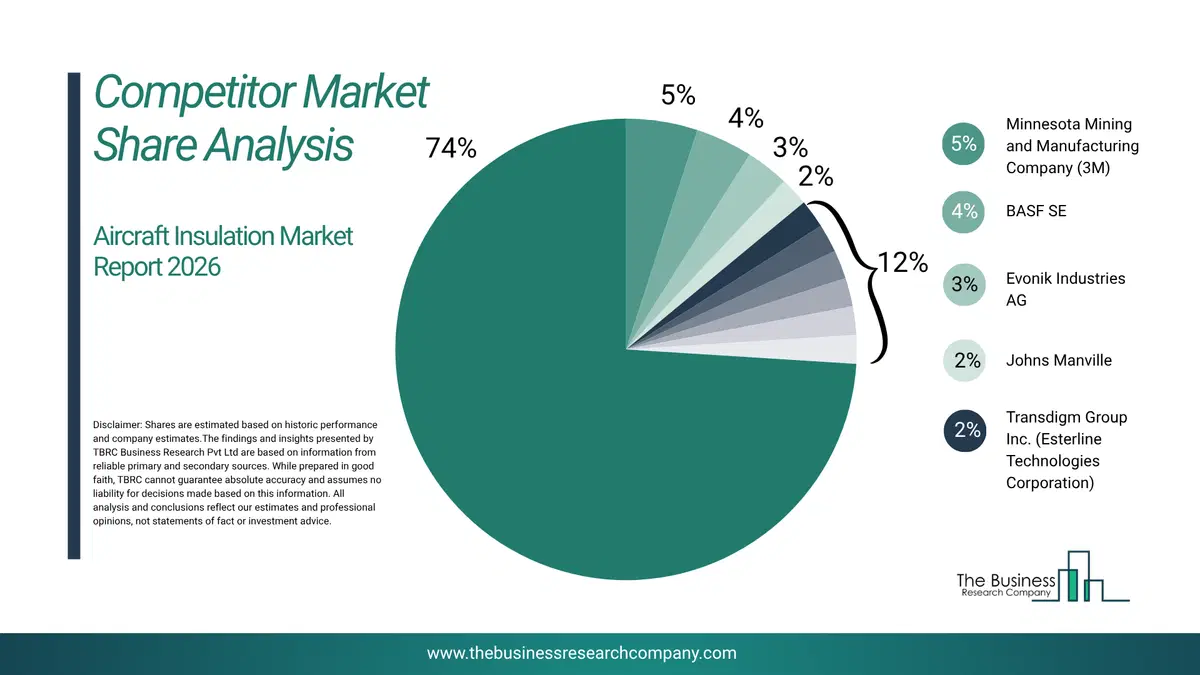
This chart is for illustrative purposes; the full report includes a detailed competitor analysis and comprehensive overview of the top 10 companies in the market.
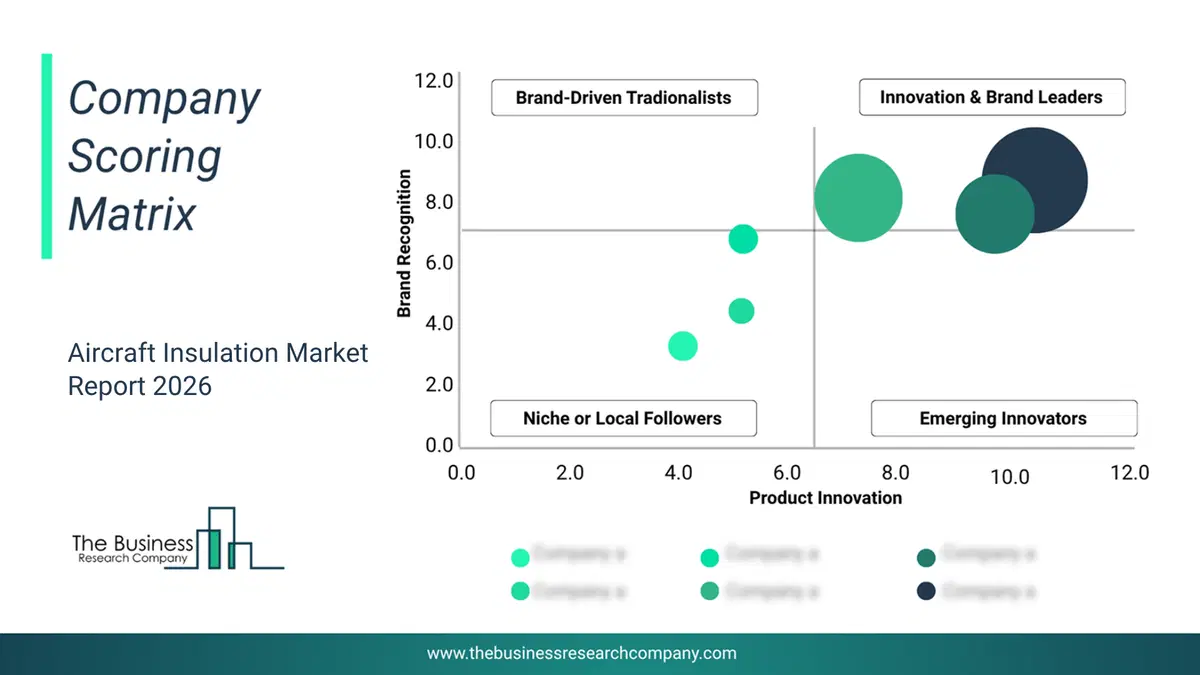
This chart maps companies by product innovation and brand strength, with bubble size indicating relative revenue, helping identify market leaders, challengers, and niche players. This is an illustrative chart; the full report provides a complete and accurate competitive analysis.
Global Aircraft Insulation Market Trends and Insights
Major companies operating in the aircraft electrical systems market are focusing on leveraging innovative monitoring technologies, such as next-generation insulation monitoring devices, to enhance safety, reliability, and operational efficiency in high-voltage systems. Next-generation insulation monitoring devices, which use advanced sensors and diagnostic algorithms, help detect insulation faults, prevent electrical failures, and extend the lifespan of high-voltage components, ensuring safer and more efficient aircraft operations. For instance, in March 2025, Sensata Technologies Holding plc, a US-based electronics and sensor company, launched the next-gen SIM200 insulation monitoring device designed for advanced safety monitoring in high-voltage aircraft systems. Developed to meet the growing demand for reliable and intelligent electrical system management in modern aerospace applications, the device is designed to provide early fault detection and continuous monitoring while minimizing system downtime and maintenance costs. The technology leverages Sensata’s expertise in sensor development and high-precision electronics, enabling aircraft electrical systems that are safer, more reliable, and technologically advanced than conventional alternatives.What Are Latest Mergers And Acquisitions In The Aircraft Insulation Market? ALTANA AG Acquires Von Roll Holding AG To Strengthen Innovation In Electromobility And Renewable Energy
In November 2023, ALTANA AG, a Germany-based chemicals company, acquired Von Roll Holding AG for an undisclosed amount. With this acquisition, ALTANA AG aims to strengthen its innovation capabilities and drive growth in the electromobility and renewable energy sectors by utilizing Von Roll's advanced insulation and high-voltage technologies. Von Roll Holding AG is a Switzerland-based company that provides aircraft insulation.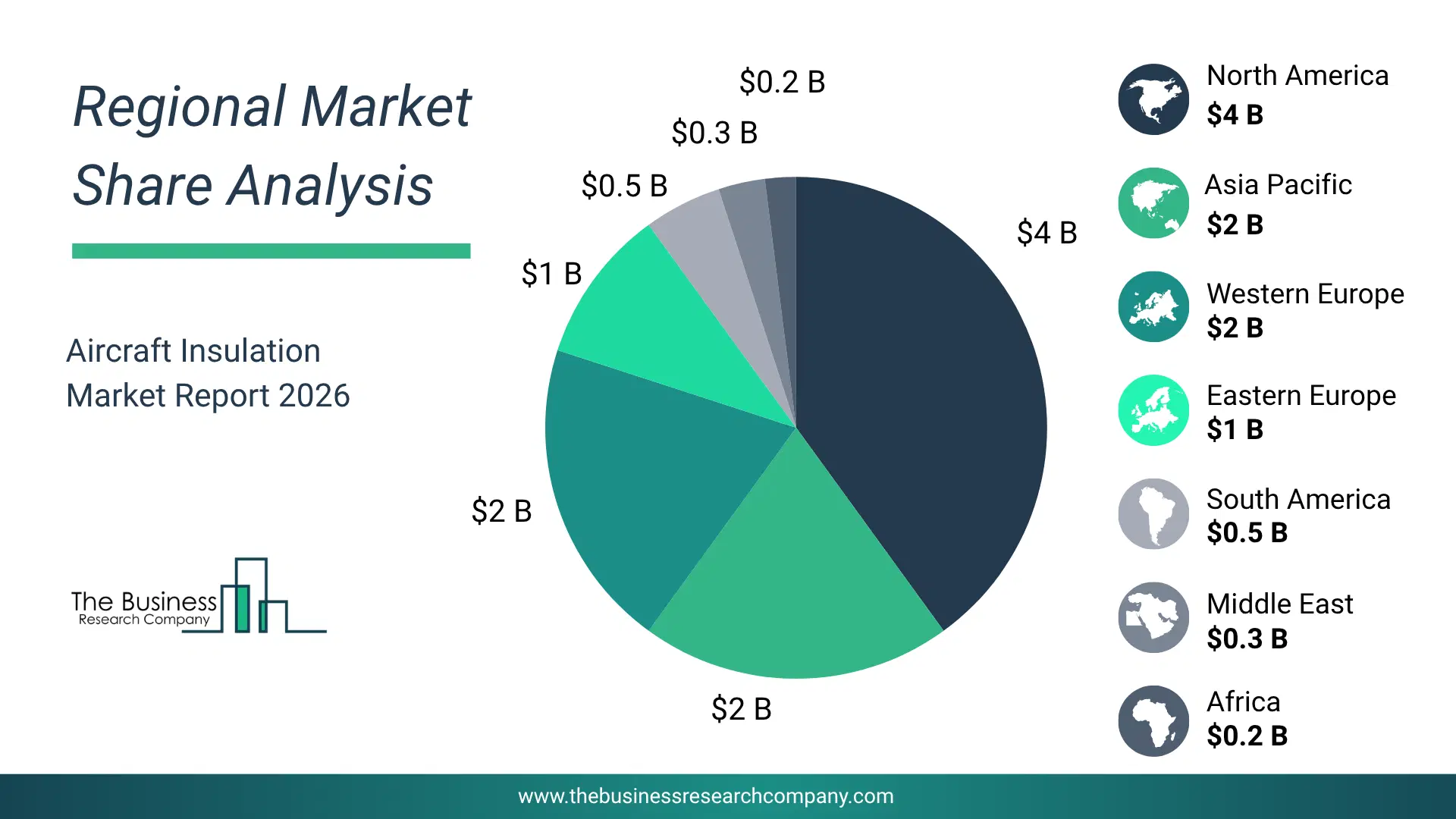
Regional Insights
North America was the largest region in the aircraft insulation market in 2025. Asia-Pacific is expected to be the fastest-growing region in the forecast period. The regions covered in this market report are Asia-Pacific, South East Asia, Western Europe, Eastern Europe, North America, South America, Middle East, Africa. The countries covered in this market report are Australia, Brazil, China, France, Germany, India, Indonesia, Japan, Taiwan, Russia, South Korea, UK, USA, Canada, Italy, SpainWhat Defines the Aircraft Insulation Market?
The aircraft insulation market consists of sales of cellulose, natural fibers, polystyrene, melamine foams, metal composites, and ceramic composites. Values in this market are ‘factory gate’ values, that is the value of goods sold by the manufacturers or creators of the goods, whether to other entities (including downstream manufacturers, wholesalers, distributors and retailers) or directly to end customers. The value of goods in this market includes related services sold by the creators of the goods.How is Market Value Defined and Measured?
The market value is defined as the revenues that enterprises gain from the sale of goods and/or services within the specified market and geography through sales, grants, or donations in terms of the currency (in USD unless otherwise specified). The revenues for a specified geography are consumption values that are revenues generated by organizations in the specified geography within the market, irrespective of where they are produced. It does not include revenues from resales along the supply chain, either further along the supply chain or as part of other products.
This chart presents market attractiveness based on a quantitative evaluation of growth, competition, strategic alignment, and risk, offering a clear view of opportunity areas for decision-making. This chart is for illustrative purposes; the full report contains the complete analysis.

This chart highlights the Total Addressable Market (TAM) by estimating the maximum revenue opportunity using an assumption-driven approach, supporting strategic planning and opportunity sizing across markets. The chart is illustrative; the full report provides a more comprehensive analysis.
What Key Data and Analysis Are Included in the Aircraft Insulation Market Report 2026?
The aircraft insulation market research report is one of a series of new reports from The Business Research Company that provides market statistics, including industry global market size, regional shares, competitors with the market share, detailed market segments, market trends and opportunities, and any further data you may need to thrive in the aircraft insulation industry. The market research report delivers a complete perspective of everything you need, with an in-depth analysis of the current and future state of the industry.Aircraft Insulation Market Report Forecast Analysis
| Report Attribute | Details |
|---|---|
| Market Size Value In 2026 | $10.17 billion |
| Revenue Forecast In 2030 | $14.03 billion |
| Growth Rate | CAGR of 8.4% from 2026 to 2030 |
| Base Year For Estimation | 2025 |
| Actual Estimates/Historical Data | 2020-2025 |
| Forecast Period | 2026 - 2030 |
| Market Representation | Revenue in USD Billion and CAGR from 2026 to 2030 |
| Segments Covered | Type, Platform, Material, Application |
| Regional Scope | Asia-Pacific, Western Europe, Eastern Europe, North America, South America, Middle East, Africa |
| Country Scope | The countries covered in the report are Australia, Brazil, China, France, Germany, India, Indonesia, Japan, Taiwan, Russia, South Korea, UK, USA, Canada, Italy, Spain. |
| Key Companies Profiled | BASF SE, AVS Industries Limited Liability Company, Minnesota Mining and Manufacturing Company, Duracote Corporation, Boyd Corporation, DuPont de Nemours Inc., Rogers Corporation, Elmelin Ltd., Evonik Industries AG, Johns Manville, Hutchinson SA, Polymer Technologies Inc., Lamart Corporation, Safran S.A, Triumph Group Inc., Transdigm Group Inc., Zotefoams plc, Esterline Technologies Corporation, Zodiac Aerospace, Armacell International S.A., Unifrax I LLC, Cabot Corporation, Knauf Insulation, Owens Corning, Saint-Gobain S.A., Aeroflex Industries Limited, Autex Industries Ltd., Cellofoam North America Inc., Insul-Therm International Inc., Pacor Inc., Thermal Control Products |
| Customization Scope | Request for Customization |
| Pricing And Purchase Options | Explore Purchase Options |