
Aircraft Level Sensors Market Report 2026
Global Outlook – By Type (Capacitive Level Sensors, Ultrasonic Level Sensors, Radar Level Sensors, Optical Level Sensors, Float Level Sensors, Magnetostrictive Level Sensors, Conductive Level Sensors, Other Types), By Platform (Fixed Wing Commercial Aircraft, Fixed Wing Military Aircraft, Rotary Wing Aircraft, Unmanned Aerial Vehicles, Advanced Or Special Mission Platforms), By Application (Fuel Level Monitoring, Hydraulic Fluid Level Monitoring, Engine Oil Level Monitoring, Coolant And Water Level Monitoring, Waste Water And Service Tank Monitoring), By End User (Original Equipment Manufacturers, Tier 1 Avionics And System Integrators, Airlines And Commercial Operators, Military And Government Operators, Maintenance, Repair, And Overhaul Service Providers And Aftermarket Distributors) – Market Size, Trends, Strategies, and Forecast to 2035
Aircraft Level Sensors Market Overview
• Aircraft Level Sensors market size has reached to $1.72 billion in 2025 • Expected to grow to $2.38 billion in 2030 at a compound annual growth rate (CAGR) of 6.7% • Growth Driver: Growing Commercial Aircraft Deliveries Driving The Market Growth Due To Increasing Demand For Reliable Fluid Level Monitoring Systems Across Modern Aircraft • Market Trend: Innovations In Smart Fuel Quantity Monitoring Systems Enhance Aircraft Fluid Measurement Accuracy And Operational Efficiency • North America was the largest region in 2025 and Asia-Pacific is the fastest growing region.What Is Covered Under Aircraft Level Sensors Market?
Aircraft level sensors refer to sensing devices designed to measure and monitor the level of fluids, materials, or other substances within aircraft systems. These sensors provide accurate and reliable measurements to support aircraft operation, system monitoring, safety, and performance management. They are engineered to function under demanding aviation conditions while enabling efficient control, maintenance, and optimization of aircraft systems. The main types of aircraft level sensors include capacitive level sensors, ultrasonic level sensors, radar level sensors, optical level sensors, float level sensors, magnetostrictive level sensors, conductive level sensors, and other types. Capacitive level sensors refer to sensing devices that detect fluid levels by measuring changes in electrical capacitance caused by variations in the amount of fluid surrounding the sensing element. These sensors are used across fixed wing commercial aircraft, fixed wing military aircraft, rotary wing aircraft, unmanned aerial vehicles, and advanced or special mission platforms. The various applications involved are fuel level monitoring, hydraulic fluid level monitoring, engine oil level monitoring, coolant and water level monitoring, and waste water and service tank monitoring and they are utilized by end users including original equipment manufacturers, tier 1 avionics and system integrators, airlines and commercial operators, military and government operators, and maintenance, repair, and overhaul service providers and aftermarket distributors.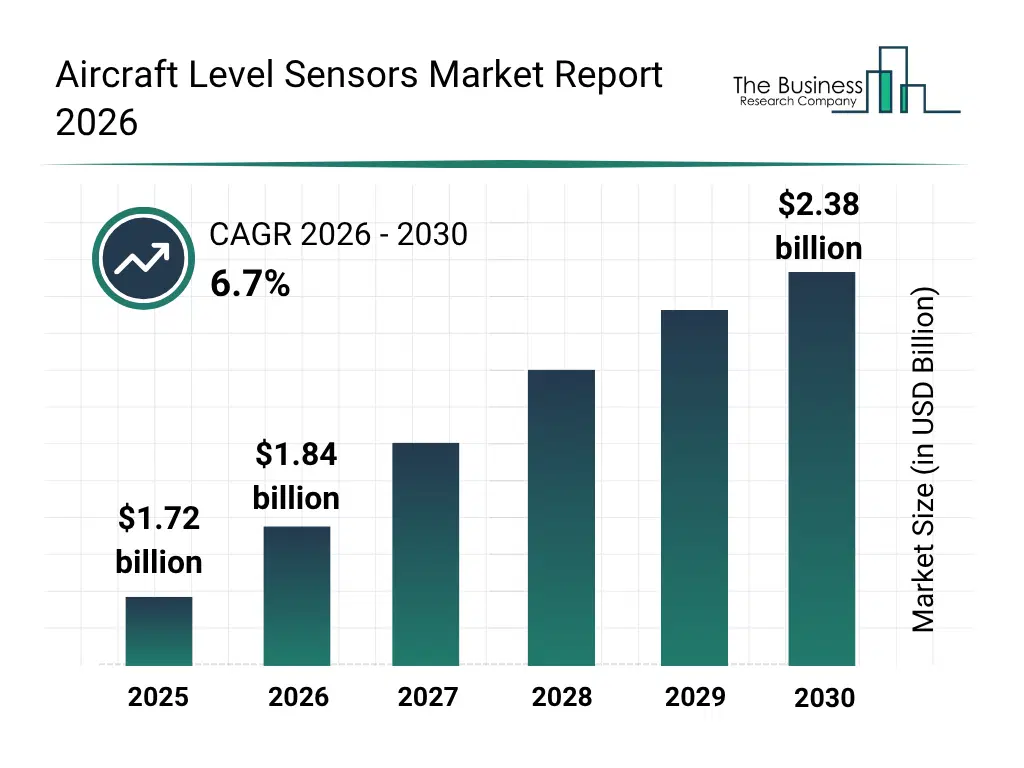
What Is The Aircraft Level Sensors Market Size and Share 2026?
The aircraft level sensors market size has grown strongly in recent years. It will grow from $1.72 billion in 2025 to $1.84 billion in 2026 at a compound annual growth rate (CAGR) of 7.1%. The growth in the historic period can be attributed to increasing aircraft production and fleet expansion, rising demand for accurate fuel level monitoring, growing adoption of advanced avionics systems, increasing aircraft safety and reliability requirements, expansion of aircraft maintenance and aftermarket activities.What Is The Aircraft Level Sensors Market Growth Forecast?
The aircraft level sensors market size is expected to see strong growth in the next few years. It will grow to $2.38 billion in 2030 at a compound annual growth rate (CAGR) of 6.7%. The growth in the forecast period can be attributed to increasing deployment of unmanned aerial vehicles, rising demand for lightweight aircraft sensing components, growing adoption of advanced special mission aircraft, increasing demand for predictive aircraft maintenance, expansion of next-generation commercial and military aircraft programs. Major trends in the forecast period include increasing adoption of non-contact level sensing, miniaturization of aircraft level sensors, improved sensor accuracy under extreme conditions, integration of multi-fluid level monitoring, development of high-reliability aviation sensors.Tariff Impact On Aircraft Level Sensors Market
Tariffs are impacting the aircraft level sensors market by increasing the cost of imported sensing components, electronic parts, precision materials, and manufacturing equipment used in aircraft sensor production. OEMs, Tier 1 avionics and system integrators, and MRO providers may experience higher procurement and production costs, particularly in North America, Europe, and Asia-Pacific due to globally interconnected aerospace supply chains. However, tariffs can encourage regional sourcing, domestic sensor manufacturing, and supply-chain diversification, potentially strengthening local aerospace component capabilities and improving long-term supply resilience.
Global Aircraft Level Sensors Market Segmentation
2) By Platform: Fixed Wing Commercial Aircraft, Fixed Wing Military Aircraft, Rotary Wing Aircraft, Unmanned Aerial Vehicles, Advanced Or Special Mission Platforms 3) By Application: Fuel Level Monitoring, Hydraulic Fluid Level Monitoring, Engine Oil Level Monitoring, Coolant And Water Level Monitoring, Waste Water And Service Tank Monitoring 4) By End User: Original Equipment Manufacturers, Tier 1 Avionics And System Integrators, Airlines And Commercial Operators, Military And Government Operators, Maintenance, Repair, And Overhaul Service Providers And Aftermarket Distributors Subsegments: 1) By Capacitive Level Sensors: Point Level Sensors, Contact Level Sensors, Non Contact Level Sensors 2) By Ultrasonic Level Sensors: Short Range Level Sensors, Long Range Level Sensors, High Precision Level Sensors 3) By Radar Level Sensors: Pulse Radar Level Sensors, Frequency Modulated Continuous Wave Level Sensors, Guided Wave Radar Level Sensors, Non Contact Radar Level Sensors 4) By Optical Level Sensors: Infrared Optical Level Sensors, Photoelectric Level Sensors, Point Optical Level Sensors 5) By Float Level Sensors: Magnetic Float Level Sensors, Mechanical Float Level Sensors, Vertical Float Level Sensors, Horizontal Float Level Sensors 6) By Magnetostrictive Level Sensors: Continuous Position Level Sensors, High Accuracy Level Sensors, Liquid Interface Level Sensors 7) By Conductive Level Sensors: Single Point Level Sensors, Multi Point Level Sensors, Conductivity Based Level Sensors, Electrode Level Sensors 8) By Other Types: Vibrating Fork Level Sensors, Thermal Dispersion Level Sensors, Pressure Based Level Sensors, Pneumatic Level SensorsWhat Is The Driver Of The Aircraft Level Sensors Market?
The growing commercial aircraft deliveries are expected to propel the growth of the aircraft level sensors market going forward. Commercial aircraft are airplanes designed to transport passengers and cargo for business purposes through scheduled or charter airline services. Commercial aircraft deliveries are increasing due to rising global air passenger traffic, as airlines procure new aircraft to accommodate increasing passenger demand. Rising commercial aircraft deliveries drive demand for aircraft level sensors by increasing the need for accurate and reliable fluid monitoring solutions that support critical aircraft systems, including fuel management, hydraulic systems, lubrication systems, and other onboard fluid applications. For instance, in July 2026, according to Airbus, a Netherlands-based aerospace manufacturer, the company delivered 351 commercial aircraft in the first half of 2026, up from 306 aircraft in the first half of 2025, representing a 14.7% year-over-year increase. Therefore, the growing commercial aircraft deliveries are driving the growth of the aircraft level sensors industry.Key Players In The Global Aircraft Level Sensors Market
Major companies operating in the aircraft level sensors market are RTX Corporation, Safran S.A., Eaton Corporation plc, Amphenol Corporation, Parker-Hannifin Corporation, TE Connectivity plc., AMETEK Inc., Sensata Technologies Holding plc, Curtiss-Wright Corporation, Crane Company, VEGA Grieshaber KG, TT Electronics plc, Gems Sensors Inc., Gill Sensors & Controls Limited, Liquid Measurement Systems Inc., Reventec Limited, Liebherr-Aerospace & Transportation SAS, CiES Inc., J.P. Instruments Inc.
This chart is for illustrative purposes; the full report includes a detailed competitor analysis and comprehensive overview of the top 10 companies in the market.
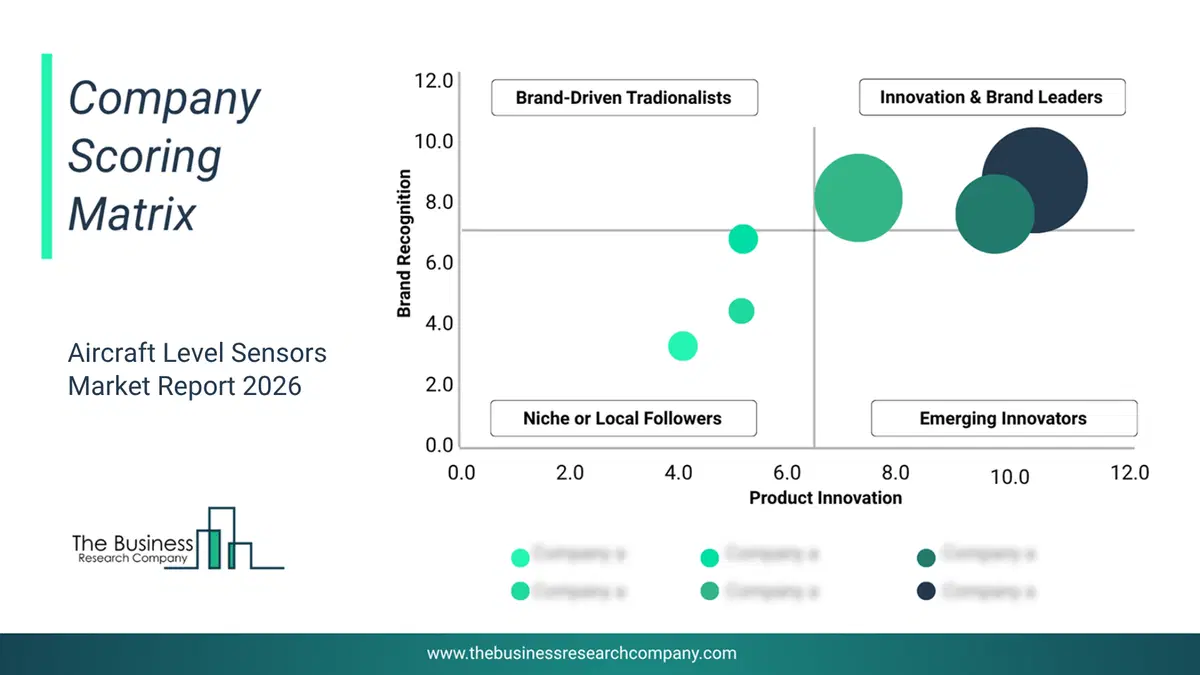
This chart maps companies by product innovation and brand strength, with bubble size indicating relative revenue, helping identify market leaders, challengers, and niche players. This is an illustrative chart; the full report provides a complete and accurate competitive analysis.
Global Aircraft Level Sensors Market Trends and Insights
Major companies operating in the aircraft level sensors market are focusing on developing advanced aircraft sensing solutions, such as smart fuel quantity monitoring systems, to improve fluid measurement accuracy, enhance operational reliability, and support predictive maintenance. Smart fuel quantity monitoring systems are advanced sensing technologies that use capacitive liquid level sensors and digital communication protocols to provide real-time, high-accuracy fuel level measurements, enabling aircraft operators to optimize fuel usage, extend flight duration, and improve overall system performance compared with traditional fuel monitoring methods. For instance, in June 2025, Reventec Limited, a UK-based custom electronic sensor manufacturer, launched a DroneCAN protocol feature for its capacitive liquid level sensor range, enabling next-generation unmanned aerial vehicles (UAVs) to benefit from enhanced fuel level monitoring and seamless integration with flight control systems. The technology allows Reventec’s sensors to communicate directly with UAV flight controllers through the DroneCAN protocol, reducing installation complexity and eliminating the need for manual device programming compared with conventional CAN-based systems. The capacitive liquid level sensors deliver real-time fuel measurement with accuracy of up to ±0.5% of reading and are designed with lightweight, robust construction suitable for demanding aerospace environments.What Are Latest Mergers And Acquisitions In The Aircraft Level Sensors Market?
In October 2025, Amphenol Corporation, a US-based manufacturer of high-technology interconnect, sensor and antenna solutions, acquired Rochester Sensors LLC for an undisclosed amount. Through this acquisition, Amphenol Corporation aims to expand its sensing portfolio and strengthen its capabilities in mission-critical fluid and fuel level measurement, supporting applications including personal aircraft and other demanding transportation systems. Rochester Sensors is a US-based manufacturer of liquid-level gauges, sensors and tank-monitoring systems that provides liquid level sensors, fuel sensors, and engine instrumentation designed for general aviation and personal aircraft applications.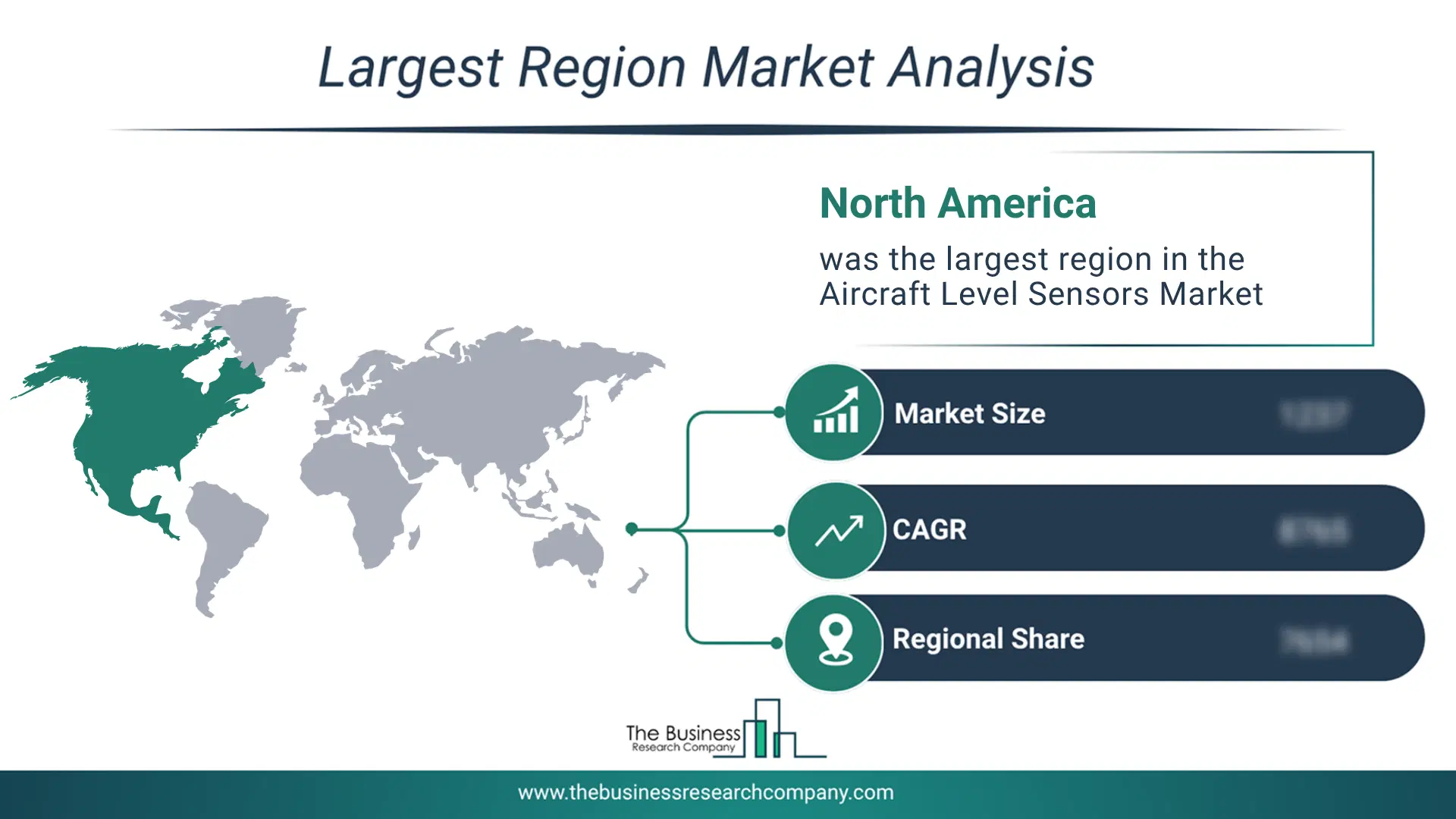
Regional Outlook/Insights
North America was the largest region in the aircraft level sensors market in 2025. Asia-Pacific is expected to be the fastest-growing region in the forecast period. The regions covered in this market report are Asia-Pacific, South East Asia, Western Europe, Eastern Europe, North America, South America, Middle East, Africa. The countries covered in this market report are Australia, Brazil, China, France, Germany, India, Indonesia, Japan, Taiwan, Russia, South Korea, UK, USA, Canada, Italy, Spain.What Defines the Aircraft Level Sensors Market?
The aircraft level sensors market consists of sales of fuel level sensors, oil level sensors, hydraulic fluid level sensors, coolant level sensors, water level sensors, tank monitoring sensors, and fluid measurement sensors. Values in this market are ‘factory gate’ values, that is, the value of goods sold by the manufacturers or creators of the goods, whether to other entities (including downstream manufacturers, wholesalers, distributors, and retailers) or directly to end customers. The value of goods in this market includes related services sold by the creators of the goods.How is Market Value Defined and Measured?
The market value is defined as the revenues that enterprises gain from the sale of goods and/or services within the specified market and geography through sales, grants, or donations in terms of the currency (in USD unless otherwise specified). The revenues for a specified geography are consumption values that are revenues generated by organizations in the specified geography within the market, irrespective of where they are produced. It does not include revenues from resales along the supply chain, either further along the supply chain or as part of other products.
This chart presents market attractiveness based on a quantitative evaluation of growth, competition, strategic alignment, and risk, offering a clear view of opportunity areas for decision-making. This chart is for illustrative purposes; the full report contains the complete analysis.

This chart highlights the Total Addressable Market (TAM) by estimating the maximum revenue opportunity using an assumption-driven approach, supporting strategic planning and opportunity sizing across markets. The chart is illustrative; the full report provides a more comprehensive analysis.
What Key Data and Analysis Are Included in the Aircraft Level Sensors Market Report 2026?
The aircraft level sensors market research report is one of a series of new reports from The Business Research Company that provides market statistics, including industry global market size, regional shares, competitors with the market share, detailed market segments, market trends and opportunities, and any further data you may need to thrive in the aircraft level sensors industry. The market research report delivers a complete perspective of everything you need, with an in-depth analysis of the current and future state of the industry.Aircraft Level Sensors Market Report Forecast Analysis
| Report Attribute | Details |
|---|---|
| Market Size Value In 2026 | $1.84 billion |
| Revenue Forecast In 2030 | $2.38 billion |
| Growth Rate | CAGR of 6.7% from 2026 to 2035 |
| Base Year For Estimation | 2025 |
| Actual Estimates/Historical Data | 2020-2025 |
| Forecast Period | 2026 - 2030 |
| Market Representation | Revenue in USD Billion and CAGR from 2026 to 2030 |
| Segments Covered | Type, Platform, Application, End User |
| Regional Scope | Asia-Pacific, Western Europe, Eastern Europe, North America, South America, Middle East, Africa |
| Country Scope | The countries covered in the report are Australia, Brazil, China, France, Germany, India, Indonesia, Japan, Taiwan, Russia, South Korea, UK, USA, Canada, Italy, Spain. |
| Customization Scope | Request for Customization |
| Pricing And Purchase Options | Explore Purchase Options |