

Aircraft Micro Turbine Engines Market Report 2026
Global Outlook – By Engine Type (Turbojet Micro Turbine Engines, Turboshaft Micro Turbine Engines, Turboprop Micro Turbine Engines), By Platform (General Aviation, Commercial Aviation, Military Aviation), By Fuel Type (Jet Fuel, Biofuel, Synthetic Fuel), By Power Output (Below 100 Kilowatts, 100 Kilowatts To 500 Kilowatts, Above 500 Kilowatts), By End Use (Civil Aviation, Defense, Research And Development, Training And Simulation) – Market Size, Trends, Strategies, and Forecast to 2035
Aircraft Micro Turbine Engines Market Overview
• Aircraft Micro Turbine Engines market size has reached to $2.81 billion in 2025 • Expected to grow to $5.07 billion in 2030 at a compound annual growth rate (CAGR) of 12.4% • Growth Driver: Defense Modernization Programs Driving The Market Growth Due To Increasing Demand For Advanced Unmanned Aerial Vehicles (UAVs) • Market Trend: Advancements In Advanced Propulsion Systems Enhance Performance And Efficiency In Aircraft Micro Turbine Engines • North America was the largest region in 2025 and Asia-Pacific is the fastest growing region.What Is Covered Under Aircraft Micro Turbine Engines Market?
Aircraft microturbine engines are compact gas turbine engines designed for propulsion or onboard power applications in small aircraft, unmanned aerial vehicles, and other specialized aviation platforms. They convert fuel energy into mechanical power through air compression, combustion, and exhaust expansion and are designed to provide a high power-to-weight ratio, compact dimensions, and reliable performance. The main engine types of aircraft micro turbine engines include turbojet micro turbine engines, turboshaft micro turbine engines, and turboprop micro turbine engines. Turbojet micro turbine engines refer to compact turbine engines that generate thrust primarily by accelerating exhaust gases and are designed for applications requiring lightweight and high-speed propulsion. These engines are used across general aviation, commercial aviation, and military aviation platforms and operate on jet fuel, biofuel, and synthetic fuel. They are available with power outputs below 100 kilowatts, 100 kilowatts to 500 kilowatts, and above 500 kilowatts, and are used end use for civil aviation, defense, research and development, and training and simulation.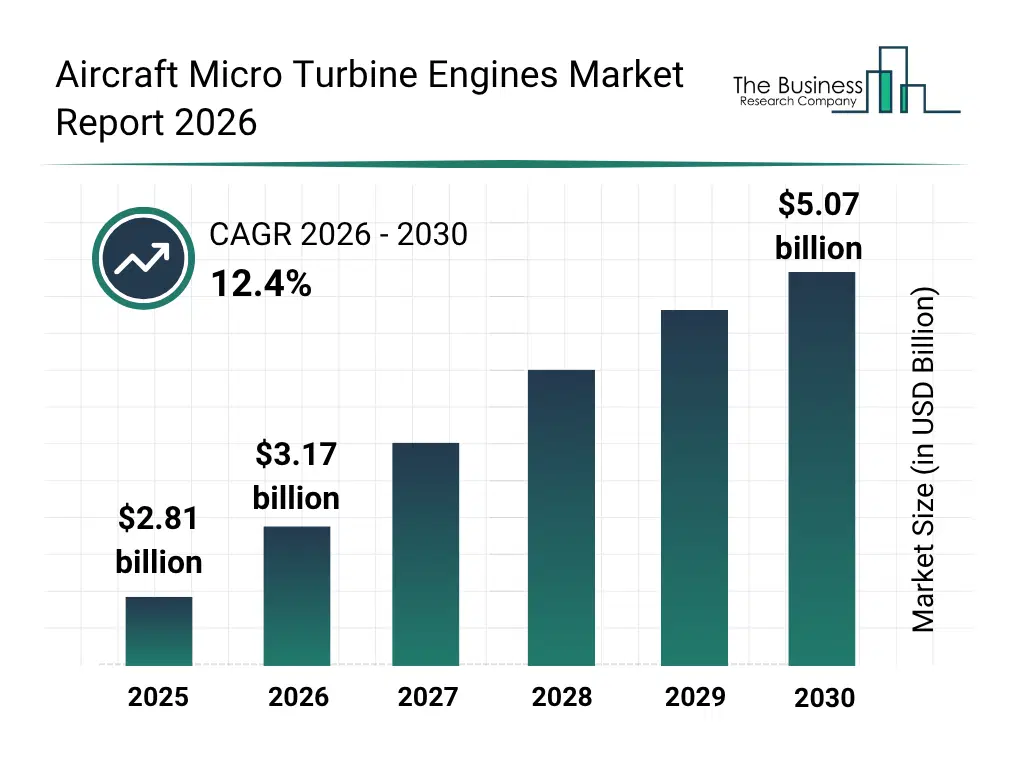
What Is The Aircraft Micro Turbine Engines Market Size and Share 2026?
The aircraft micro turbine engines market size has grown rapidly in recent years. It will grow from $2.81 billion in 2025 to $3.17 billion in 2026 at a compound annual growth rate (CAGR) of 12.9%. The growth in the historic period can be attributed to increasing demand for lightweight propulsion systems, rising adoption of compact aircraft, growing general aviation activities, increasing military aviation requirements, rising demand for efficient small-scale engines.What Is The Aircraft Micro Turbine Engines Market Growth Forecast?
The aircraft micro turbine engines market size is expected to see rapid growth in the next few years. It will grow to $5.07 billion in 2030 at a compound annual growth rate (CAGR) of 12.4%. The growth in the forecast period can be attributed to increasing demand for distributed propulsion systems, rising adoption of unmanned aircraft platforms, growing demand for alternative aviation fuels, increasing deployment of compact propulsion for defense applications, expanding research into advanced aviation propulsion. Major trends in the forecast period include increasing adoption of compact and lightweight microturbine engines, rising demand for high power-to-weight ratio microturbine engines, growing use of multi-fuel compatible microturbine engines, increasing demand for high-speed rotating microturbine components, expanding adoption of small-scale turbine propulsion systems.Tariff Impact On Aircraft Micro Turbine Engines Market
Tariffs are impacting the aircraft micro turbine engines market by increasing the cost of imported high-temperature alloys, precision-machined components, bearings, fuel system components, and specialized manufacturing equipment required for microturbine engine production. This is raising manufacturing costs and creating supply chain pressures across turbojet, turboshaft, and turboprop microturbine engines, particularly in regions dependent on international aerospace supply chains such as North America, Europe, and Asia-Pacific. Component-intensive segments such as high-speed rotating assemblies, combustion systems, turbine components, and fuel systems are most affected due to their reliance on specialized aerospace-grade materials and globally sourced parts. However, tariffs are also encouraging domestic component production, regional supplier diversification, local sourcing, and increased investment in aerospace propulsion manufacturing ecosystems, creating greater long-term supply chain resilience in the Aircraft Microturbine Engines market.
Global Aircraft Micro Turbine Engines Market Segmentation
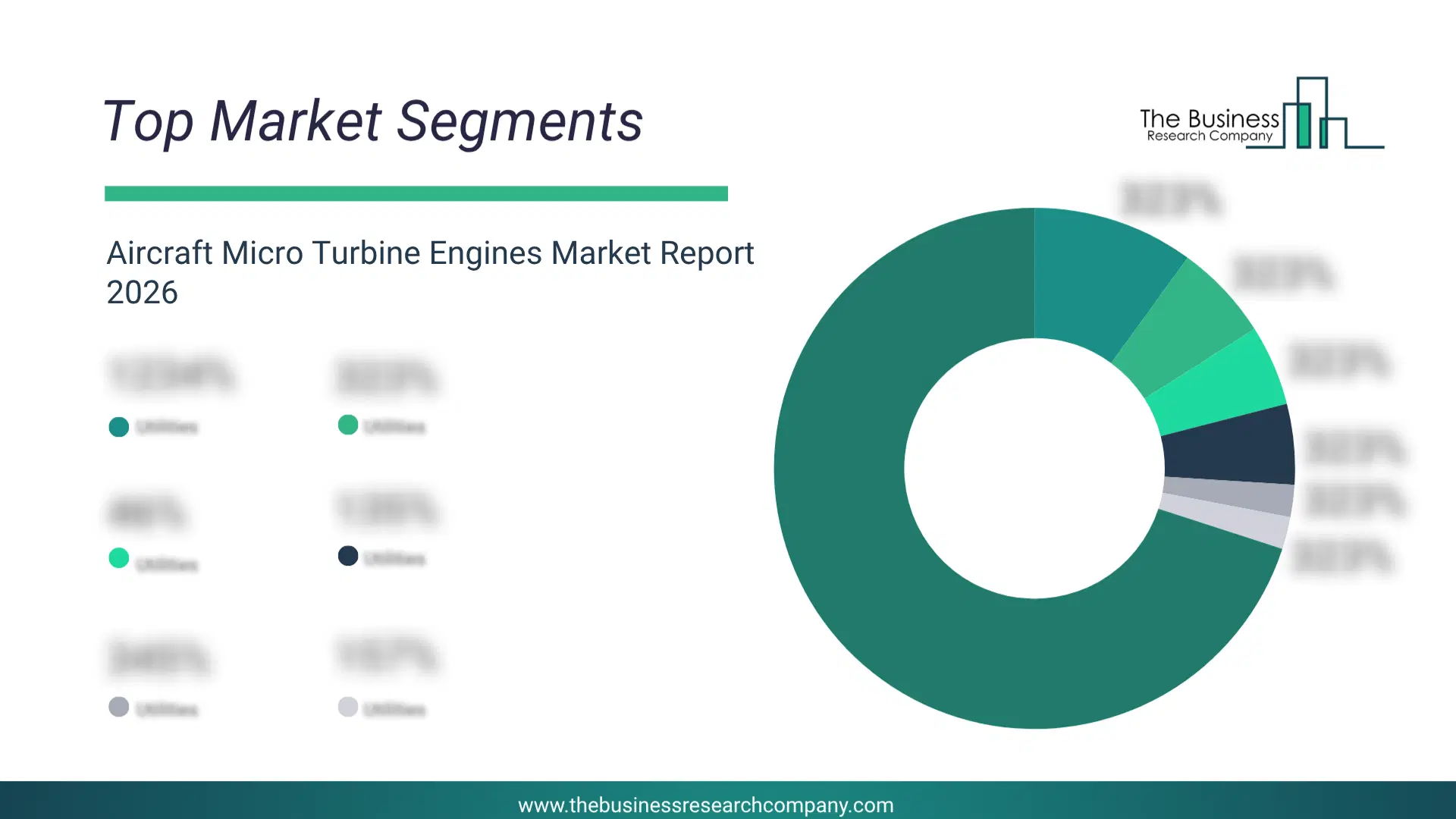
2) By Platform: General Aviation, Commercial Aviation, Military Aviation 3) By Fuel Type: Jet Fuel, Biofuel, Synthetic Fuel 4) By Power Output: Below 100 Kilowatts, 100 Kilowatts To 500 Kilowatts, Above 500 Kilowatts 5) By End Use: Civil Aviation, Defense, Research And Development, Training And Simulation Subsegments: 1) By Turbojet Micro Turbine Engines: Single-Spool Turbojet Engines, Twin-Spool Turbojet Engines, Afterburning Turbojet Engines, Non-Afterburning Turbojet Engines, Compact Turbojet Engines 2) By Turboshaft Micro Turbine Engines: Free-Turbine Turboshaft Engines, Direct-Drive Turboshaft Engines, Reverse-Flow Turboshaft Engines, Axial-Flow Turboshaft Engines, Centrifugal-Flow Turboshaft Engines 3) By Turboprop Micro Turbine Engines: Fixed-Pitch Turboprop Engines, Variable-Pitch Turboprop Engines, Constant-Speed Turboprop Engines, Reduction-Gear Turboprop Engines, Direct-Drive Turboprop EnginesWhat Is The Driver Of The Aircraft Micro Turbine Engines Market?
The rising defense modernization programs are expected to propel the growth of the aircraft micro turbine engines market going forward. Defense modernization programs are government initiatives aimed at upgrading military capabilities through the adoption of advanced technologies, replacement of aging equipment, and improvement of defense infrastructure. Defense modernization programs are increasing due to rising geopolitical tensions, as countries are investing in advanced military capabilities to strengthen national security and improve preparedness against evolving threats. Defense modernization programs drive aircraft micro turbine engines by increasing demand for advanced unmanned aerial vehicles (UAVs), lightweight aircraft systems, and compact propulsion solutions that enhance military operational capabilities. For instance, in July 2025, according to the U.S. Department of Defense (DoD), a US-based federal executive department responsible for coordinating and supervising, the U.S. FY2026 defense budget request allocates $11.6 billion to land-power modernization, $10.4 billion to long-range weapons, $34.0 billion to space capabilities, and $15.1 billion to cyberspace activities, highlighting increased investment in military modernization and advanced defense capabilities. Therefore, the rising defense modernization programs are propelling the growth of the aircraft micro turbine engines industry.Key Players In The Global Aircraft Micro Turbine Engines Market
Major companies operating in the aircraft micro turbine engines market are Honeywell International Inc., Safran S.A., Rolls-Royce plc, MTU Aero Engines AG, Aero Engine Corporation of China, Hindustan Aeronautics Limited, Williams International Co. LLC, Kratos Defense & Security Solutions Inc., PBS Group a.s., JetCat GmbH, Turbotech SAS, Raghu Vamsi Aerospace Group, KingTech Turbines Co. Ltd., Jet Central S.A., JetsMunt S.L., Frank Turbine Co. Ltd., UAV Turbines Inc., Cape Aerospace Technologies, AMT Netherlands B.V., Swiwin Turbojet Equipment Co. Ltd.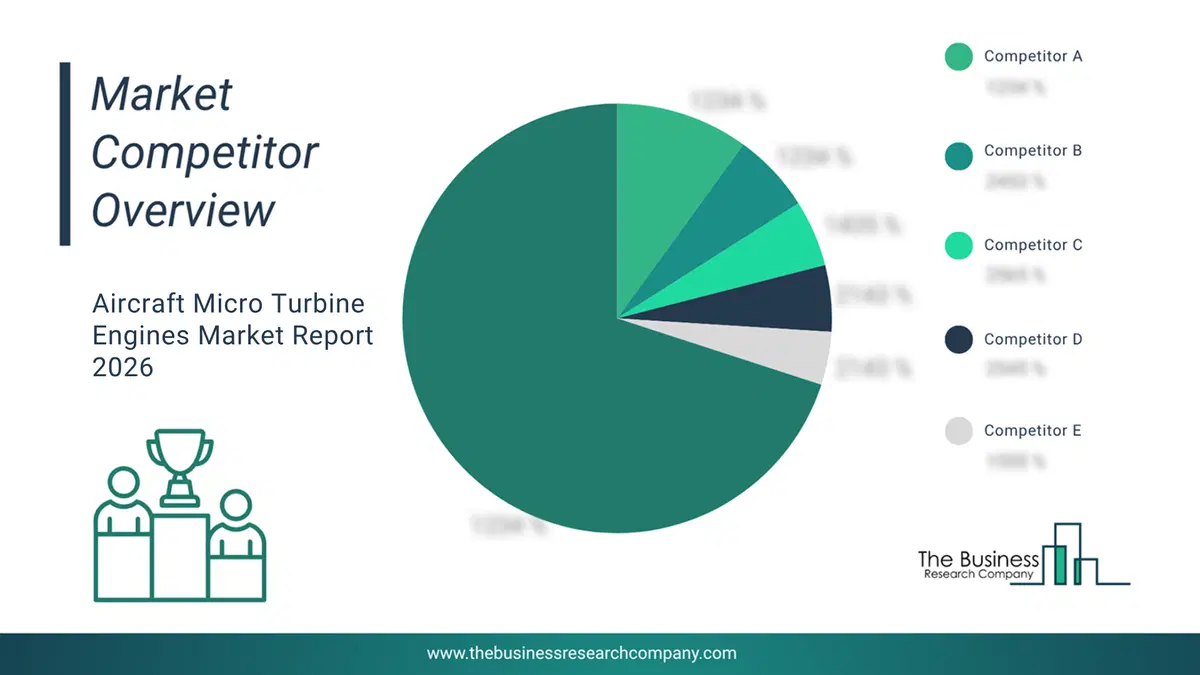
This chart is for illustrative purposes; the full report includes a detailed competitor analysis and comprehensive overview of the top 10 companies in the market.
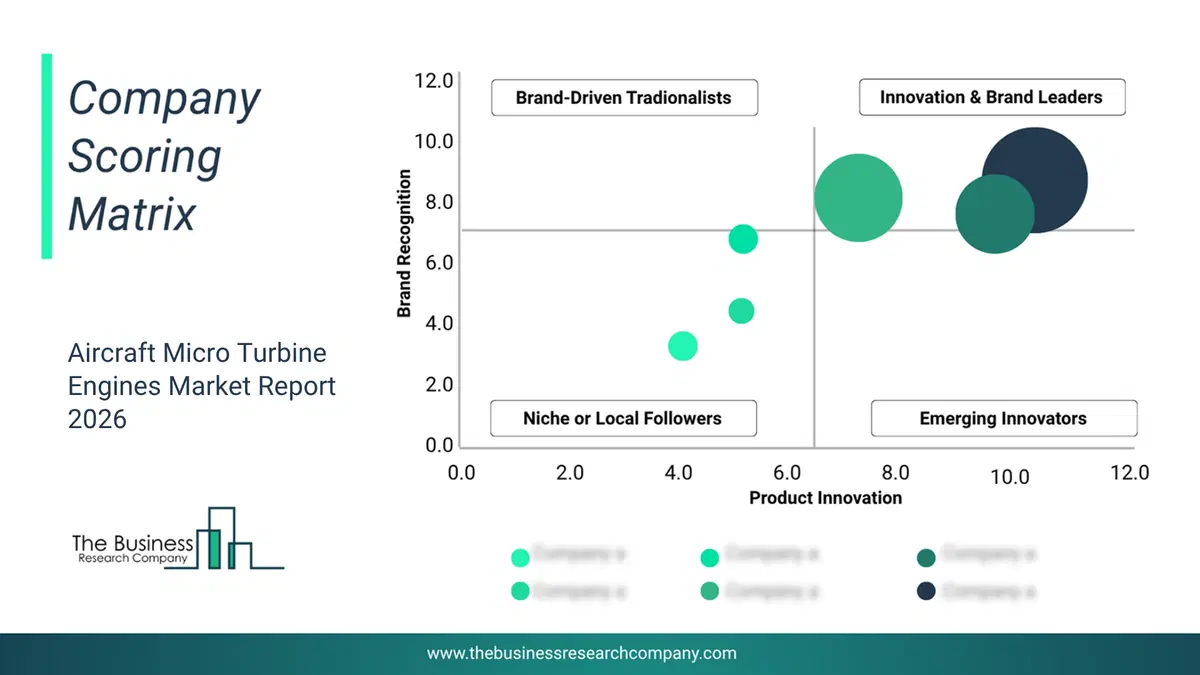
This chart maps companies by product innovation and brand strength, with bubble size indicating relative revenue, helping identify market leaders, challengers, and niche players. This is an illustrative chart; the full report provides a complete and accurate competitive analysis.
Global Aircraft Micro Turbine Engines Market Trends and Insights
Major companies operating in the aircraft micro turbine engines market are focusing on developing innovative solutions such as advanced propulsion systems to improve engine performance, enhance operational efficiency, and support the growing demand for compact propulsion technologies in defense and aerospace applications. Advanced propulsion systems refer to integrated technologies that combine innovative engine designs, components, and control systems to deliver improved thrust, efficiency, reliability, and performance for aircraft and unmanned platforms. For instance, in June 2026, EDGE Group, a UAE-based defense technology company, launched PJ120, a small turbojet engine, through its subsidiary Powertech. The product is designed to provide compact and efficient propulsion for missiles and unmanned aerial vehicles (UAVs). It offers benefits such as a high thrust-to-weight ratio, lower fuel consumption, and simplified integration due to its compact design. The launch aims to help customers achieve reliable propulsion performance while supporting the advancement of indigenous aerospace manufacturing capabilities and next-generation autonomous defense systems.What Are Latest Mergers And Acquisitions In The Aircraft Micro Turbine Engines Market?
In August 2025, GE Aerospace, a US-based aerospace propulsion and systems company, partnered with Kratos Defense & Security Solutions Inc. to advance the development, manufacturing, testing, and deployment of small, cost-effective propulsion systems for unmanned aerial systems and Collaborative Combat Aircraft (CCA)-type aircraft. Through this partnership, the companies aim to deliver affordable, high-performance, and scalable small engines that support next-generation defense platforms and meet evolving military propulsion requirements. Kratos Defense & Security Solutions Inc. is a US-based manufacturer of small turbine engines for defense aerospace applications.
Regional Outlook/Insights
North America was the largest region in the aircraft micro turbine engines market in 2025. Asia-Pacific is expected to be the fastest-growing region in the forecast period. The regions covered in this market report are Asia-Pacific, South East Asia, Western Europe, Eastern Europe, North America, South America, Middle East, Africa. The countries covered in this market report are Australia, Brazil, China, France, Germany, India, Indonesia, Japan, Taiwan, Russia, South Korea, UK, USA, Canada, Italy, Spain.What Defines the Aircraft Micro Turbine Engines Market?
The aircraft micro turbine engine market consists of sales of micro turbine engine cores, micro gas turbine power units, and micro turbine auxiliary power units. Values in this market are 'factory gate' values, that is, the value of goods sold by the manufacturers or creators of the goods, whether to other entities (including downstream aircraft manufacturers, UAV manufacturers, system integrators, wholesalers, distributors, and retailers) or directly to end customers. The value of goods in this market includes related services sold by the creators of the goods.How is Market Value Defined and Measured?
The market value is defined as the revenues that enterprises gain from the sale of goods and/or services within the specified market and geography through sales, grants, or donations in terms of the currency (in USD unless otherwise specified). The revenues for a specified geography are consumption values that are revenues generated by organizations in the specified geography within the market, irrespective of where they are produced. It does not include revenues from resales along the supply chain, either further along the supply chain or as part of other products.
This chart presents market attractiveness based on a quantitative evaluation of growth, competition, strategic alignment, and risk, offering a clear view of opportunity areas for decision-making. This chart is for illustrative purposes; the full report contains the complete analysis.

This chart highlights the Total Addressable Market (TAM) by estimating the maximum revenue opportunity using an assumption-driven approach, supporting strategic planning and opportunity sizing across markets. The chart is illustrative; the full report provides a more comprehensive analysis.
What Key Data and Analysis Are Included in the Aircraft Micro Turbine Engines Market Report 2026?
The aircraft micro turbine engines market research report is one of a series of new reports from The Business Research Company that provides market statistics, including industry global market size, regional shares, competitors with the market share, detailed market segments, market trends and opportunities, and any further data you may need to thrive in the aircraft micro turbine engines industry. The market research report delivers a complete perspective of everything you need, with an in-depth analysis of the current and future state of the industry.Aircraft Micro Turbine Engines Market Report Forecast Analysis
| Report Attribute | Details |
|---|---|
| Market Size Value In 2026 | $3.17 billion |
| Revenue Forecast In 2030 | $5.07 billion |
| Growth Rate | CAGR of 12.4% from 2026 to 2035 |
| Base Year For Estimation | 2025 |
| Actual Estimates/Historical Data | 2020-2025 |
| Forecast Period | 2026 - 2030 |
| Market Representation | Revenue in USD Billion and CAGR from 2026 to 2030 |
| Segments Covered | Engine Type, Platform, Fuel Type, Power Output, End Use |
| Regional Scope | Asia-Pacific, Western Europe, Eastern Europe, North America, South America, Middle East, Africa |
| Country Scope | The countries covered in the report are Australia, Brazil, China, France, Germany, India, Indonesia, Japan, Taiwan, Russia, South Korea, UK, USA, Canada, Italy, Spain. |
| Customization Scope | Request for Customization |
| Pricing And Purchase Options | Explore Purchase Options |