
Aircraft Noise Reduction Components Market Report 2026
Global Outlook – By Component (Acoustic Liners, Engine Nacelle Components, Vibration Dampers And Isolators, Soundproofing Insulation Materials, Exhaust Noise Reduction Systems, Propeller Noise Reduction Components, Cabin Noise Insulation Components, Other Components), By Material (Composite Materials, Metallic Materials, Polymer And Foam Materials, Ceramic Materials, Other Materials), By Technology Type (Passive Noise Reduction, Active Noise Reduction), By Aircraft Type (Commercial Transport Aircraft, Business And General Aviation Aircraft, Military Fixed Wing Aircraft, Helicopters Or Rotorcraft, Electric Vertical Take Off And Landing Or Advanced Air Mobility Aircraft), By End User (Original Equipment Manufacturers, Maintenance, Repair, And Overhaul Providers, Airlines, Defense Organizations) – Market Size, Trends, Strategies, and Forecast to 2035
Aircraft Noise Reduction Components Market Overview
• Aircraft Noise Reduction Components market size has reached to $2.73 billion in 2025 • Expected to grow to $4.2 billion in 2030 at a compound annual growth rate (CAGR) of 8.9% • Growth Driver: Expansion Of Aircraft Deliveries Is Driving The Market Growth Due To Rising Demand For Compliant, Advanced Aircraft Noise Reduction Components • Market Trend: Advanced Acoustic Technologies Enhance Noise Reduction And Passenger Comfort In Aircraft • North America was the largest region in 2025 and Asia-Pacific is the fastest growing region.What Is Covered Under Aircraft Noise Reduction Components Market?
Aircraft noise reduction components are engineered structural, acoustic, and mechanical elements designed to minimize sound generation and transmission throughout an aircraft by controlling vibration, airflow interactions, and other noise-producing mechanisms while supporting acoustic performance, operational efficiency, environmental compliance, passenger comfort, and adherence to stringent aviation certification requirements. Their integration contributes to improved acoustic management throughout the aircraft lifecycle, helping organizations meet evolving regulatory expectations, reduce environmental impact, enhance operational acceptance, and support long-term performance, safety, and sustainability objectives without compromising functional integrity. The main components of aircraft noise reduction components include acoustic liners, engine nacelle components, vibration dampers and isolators, soundproofing insulation materials, exhaust noise reduction systems, propeller noise reduction components, cabin noise insulation components, and other components. Acoustic liners refer to sound-absorbing materials installed within aircraft structures, particularly engine nacelles, to reduce noise generated by engines and other aerodynamic sources. These components are made from composite materials, metallic materials, polymer and foam materials, ceramic materials, and other materials, and use passive noise reduction and active noise reduction technologies. They are used across commercial transport aircraft, business and general aviation aircraft, military fixed wing aircraft, helicopters or rotorcraft, and electric vertical take off and landing or advanced air mobility aircraft, serving end users including original equipment manufacturers, maintenance, repair, and overhaul providers, airlines, and defense organizations.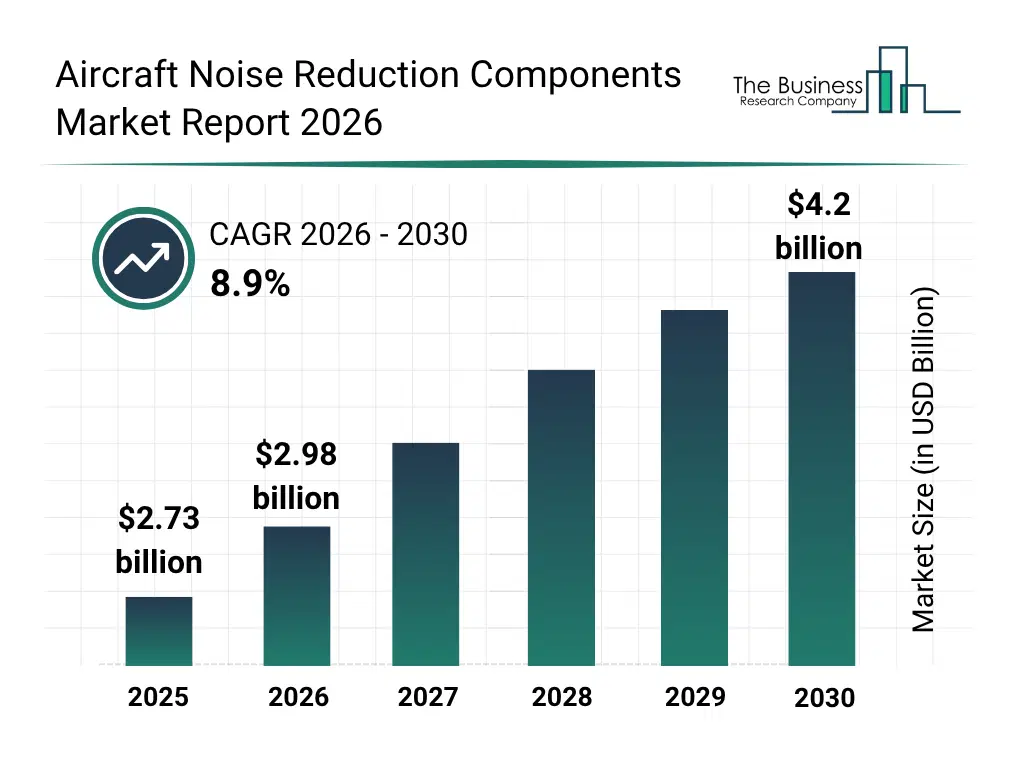
What Is The Aircraft Noise Reduction Components Market Size and Share 2026?
The aircraft noise reduction components market size has grown strongly in recent years. It will grow from $2.73 billion in 2025 to $2.98 billion in 2026 at a compound annual growth rate (CAGR) of 9.4%. The growth in the historic period can be attributed to tightening aircraft noise regulations, increasing aircraft fleet modernization, rising demand for passenger cabin comfort, growing adoption of acoustic insulation materials, increasing aircraft MRO activities.What Is The Aircraft Noise Reduction Components Market Growth Forecast?
The aircraft noise reduction components market size is expected to see strong growth in the next few years. It will grow to $4.2 billion in 2030 at a compound annual growth rate (CAGR) of 8.9%. The growth in the forecast period can be attributed to increasing demand for quieter aircraft operations, growing adoption of electric vertical take off and landing or advanced air mobility aircraft, rising aircraft production and deliveries, increasing investment in sustainable aviation technologies, growing demand for advanced active noise reduction systems. Major trends in the forecast period include advanced composite acoustic materials, lightweight noise reduction components, next-generation acoustic liner designs, integrated aircraft vibration and noise control, low-noise propulsion system components.Tariff Impact On Aircraft Noise Reduction Components Market
Tariffs are impacting the aircraft noise reduction components market by increasing the cost of imported composite materials, metallic components, polymers, foams, acoustic insulation products, and specialized manufacturing equipment. OEMs and MRO providers are likely to face the greatest cost pressures, particularly in North America, Europe, and Asia-Pacific due to globally interconnected aerospace supply chains. Higher component costs may increase aircraft production and maintenance expenses and create procurement delays, while tariffs can also encourage regional sourcing, domestic manufacturing, supplier diversification, and investment in cost-efficient noise reduction technologies.
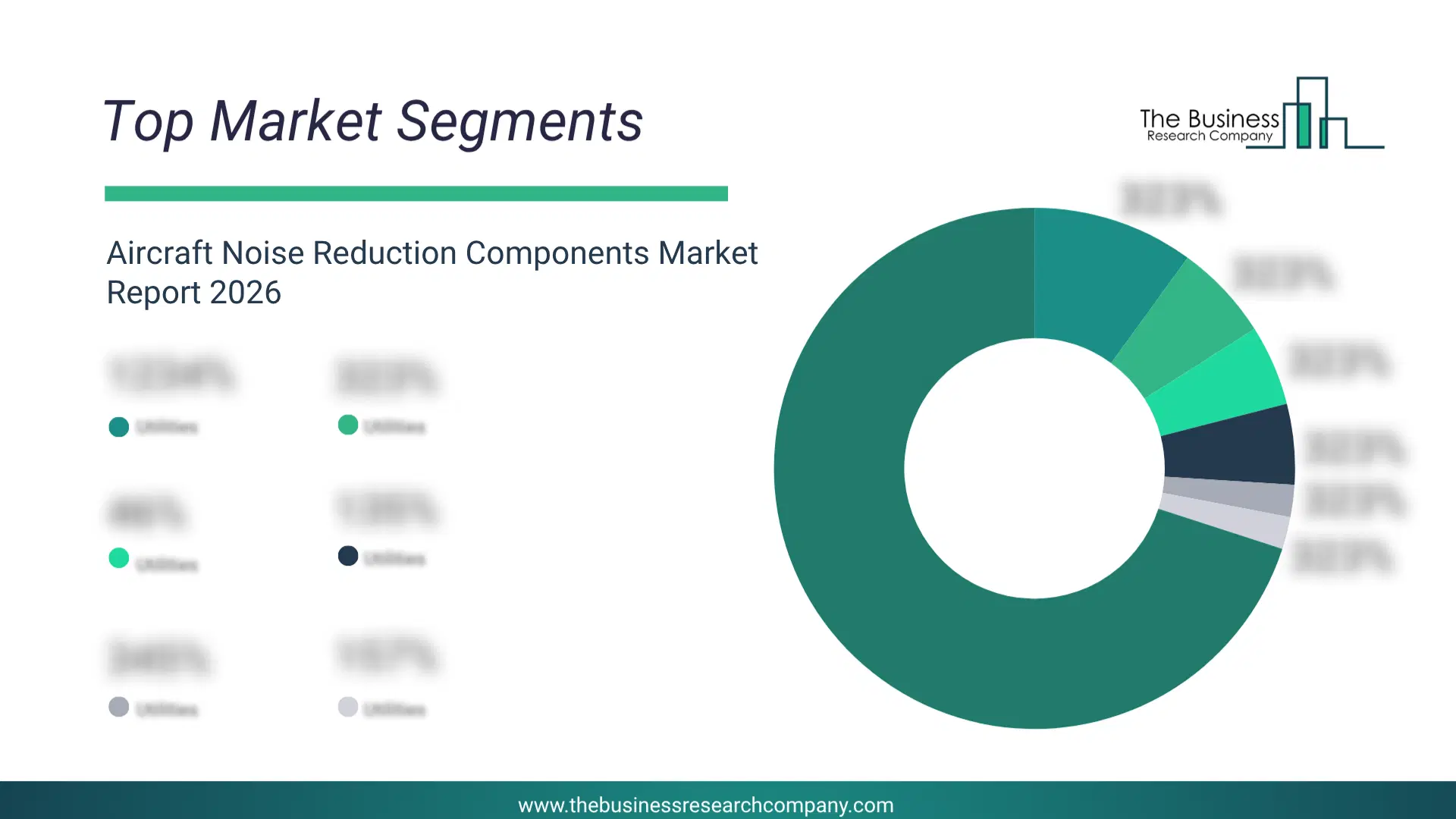
Global Aircraft Noise Reduction Components Market Segmentation
2) By Material: Composite Materials, Metallic Materials, Polymer And Foam Materials, Ceramic Materials, Other Materials 3) By Technology Type: Passive Noise Reduction, Active Noise Reduction 4) By Aircraft Type: Commercial Transport Aircraft, Business And General Aviation Aircraft, Military Fixed Wing Aircraft, Helicopters Or Rotorcraft, Electric Vertical Take Off And Landing Or Advanced Air Mobility Aircraft 5) By End User: Original Equipment Manufacturers, Maintenance, Repair, And Overhaul Providers, Airlines, Defense Organizations Subsegments: 1) By Acoustic Liners: Single Layer Acoustic Liners, Double Layer Acoustic Liners, Multi Layer Acoustic Liners, Perforated Acoustic Liners, Honeycomb Acoustic Liners 2) By Engine Nacelle Components: Inlet Acoustic Panels, Fan Cowl Acoustic Panels, Thrust Reverser Acoustic Panels, Exhaust Duct Acoustic Panels, Engine Fairing Components 3) By Vibration Dampers And Isolators: Elastomeric Dampers, Hydraulic Dampers, Spring Isolators, Viscoelastic Dampers, Tuned Mass Dampers 4) By Soundproofing Insulation Materials: Fiberglass Insulation, Mineral Wool Insulation, Foam Insulation, Composite Insulation, Thermal Acoustic Blankets 5) By Exhaust Noise Reduction Systems: Exhaust Mixers, Exhaust Diffusers, Acoustic Exhaust Liners, Noise Suppression Nozzles, Exhaust Flow Conditioners 6) By Propeller Noise Reduction Components: Low Noise Propeller Blades, Blade Tip Devices, Blade Surface Treatments, Propeller Hub Dampers, Blade Root Dampers 7) By Cabin Noise Insulation Components: Floor Insulation Panels, Sidewall Insulation Panels, Ceiling Insulation Panels, Door Insulation Systems, Window Acoustic Insulation 8) By Other Components: Acoustic Seals, Noise Barrier Panels, Vibration Absorbing Mounts, Acoustic Enclosures, Structural Damping MaterialsWhat Is The Driver Of The Aircraft Noise Reduction Components Market?
The expansion of aircraft deliveries is expected to propel the growth of the aircraft noise reduction components market going forward. Aircraft deliveries refer to the formal transfer of completed aircraft from manufacturers to customers following final assembly, testing, certification, and contractual acceptance, signifying that the aircraft is ready for operational deployment and entry into service. Increasing demand for fleet modernization is a key factor driving the expansion of aircraft deliveries, as airlines, cargo operators, and government organizations continuously replace aging aircraft with newer platforms that offer improved operational efficiency, regulatory compliance, lower lifecycle costs, and enhanced performance, thereby encouraging manufacturers to increase production and fulfill a growing volume of orders. Expansion of aircraft deliveries increases the demand for aircraft noise reduction components, as manufacturers incorporate advanced acoustic solutions to meet stringent certification requirements, improve environmental performance, and enhance passenger comfort while ensuring newly delivered aircraft achieve broader operational acceptance. For instance, in February 2026, according to the ADS Group, a UK-based trade organization, aircraft orders reached 2,175 in 2025, increasing by 50% year on year, while 1,411 aircraft were delivered, representing a 25% increase compared to 2024. Therefore, the expansion of aircraft deliveries is driving the growth of the aircraft noise reduction components industry.Key Players In The Global Aircraft Noise Reduction Components Market
Major companies operating in the aircraft noise reduction components market are The Boeing Company, RTX Corporation, GE Aerospace, Safran S.A., Honeywell Aerospace Technologies, Rolls-Royce Holdings plc, 3M Company, Parker-Hannifin Corporation, Hutchinson S.A., GKN Aerospace, Hexcel Corporation, Triumph Group Inc., FACC AG, Armacell International S.A., The NORDAM Group LLC, SMAC SAS, Duracote Corporation, The Aeroacoustic Corporation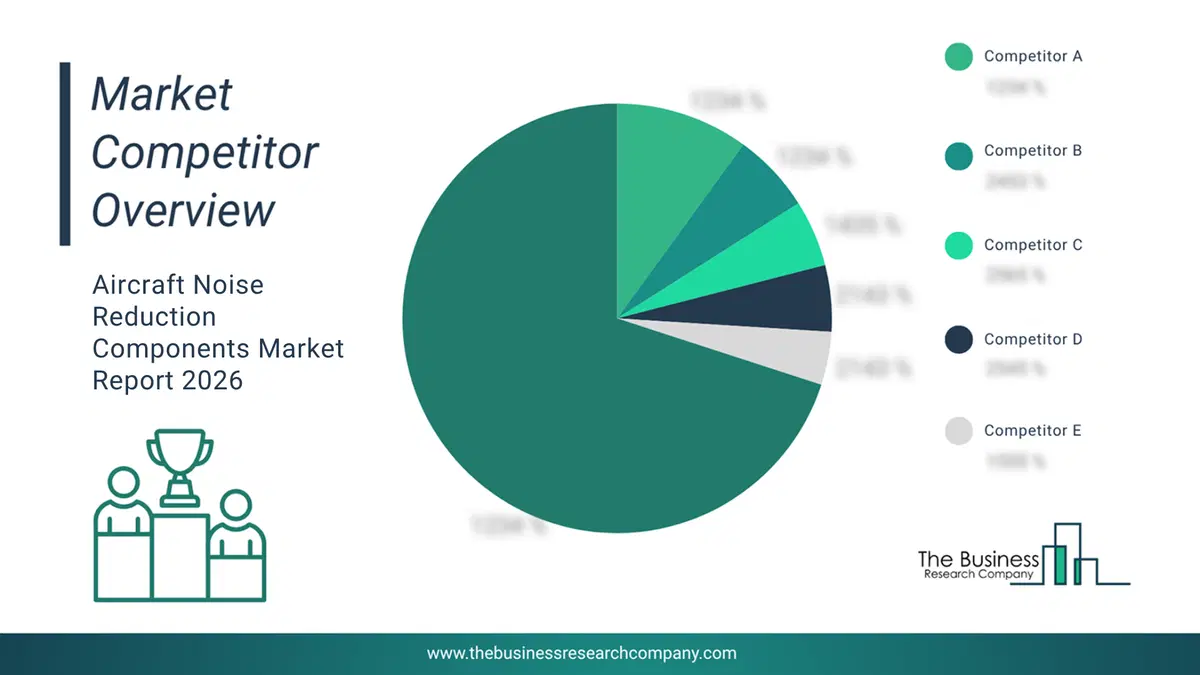
This chart is for illustrative purposes; the full report includes a detailed competitor analysis and comprehensive overview of the top 10 companies in the market.
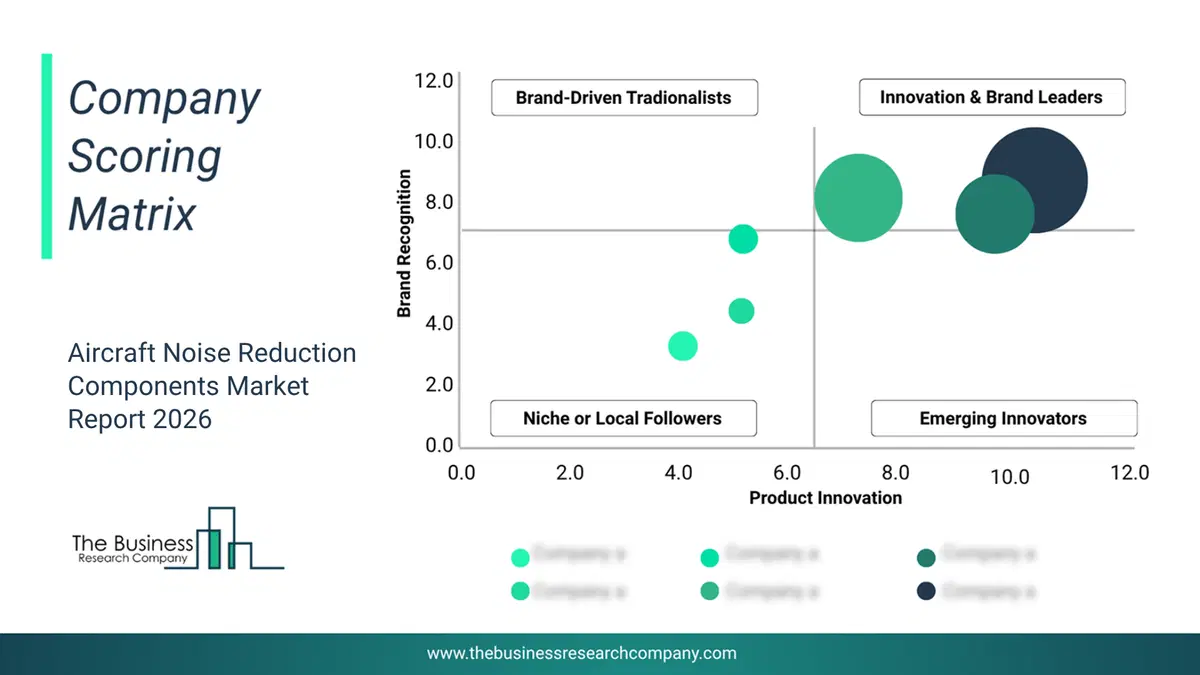
This chart maps companies by product innovation and brand strength, with bubble size indicating relative revenue, helping identify market leaders, challengers, and niche players. This is an illustrative chart; the full report provides a complete and accurate competitive analysis.
Global Aircraft Noise Reduction Components Market Trends and Insights
Major companies operating in the aircraft noise reduction components market are focusing on developing advanced acoustic technologies, such as integrated aircraft-frame acoustic solutions, to minimize engine noise, reduce aircraft noise footprints, and enhance passenger comfort during flight. Integrated aircraft-frame acoustic solutions are noise-reduction technologies incorporated into an aircraft’s structural frame to absorb and dampen engine and vibration-related noise, reducing noise transmission into the cabin and improving passenger comfort. For instance, in July 2026, Airbus SE, a France-based aerospace company, highlighted the integration of advanced acoustic technologies throughout the aircraft frame of its A321XLR aircraft to minimize engine noise and improve the long-haul passenger experience. The technologies contribute to a 50% reduction in the aircraft’s noise footprint compared with previous-generation single-aisle aircraft, supporting a quieter cabin environment and enhancing passenger comfort on long-haul flights.What Are Latest Mergers And Acquisitions In The Aircraft Noise Reduction Components Market?
In November 2025, IAE International Aero Engines (IAE), a US-based multinational aircraft engine consortium, partnered with Japanese Aero Engines Corporation (JAEC), MTU Aero Engines AG, and Pratt & Whitney to advance next-generation Geared Turbofan (GTF) engine technologies for future commercial aircraft with improved fuel efficiency and reduced noise. Through this partnership, the consortium aims to strengthen its technological capabilities by jointly developing advanced propulsion technologies, including hybrid-electric propulsion, advanced materials, and high-performance aerodynamics, to support next-generation single-aisle aircraft. Japanese Aero Engines Corporation (JAEC) is a Japan-based provider of aircraft engine program management and collaborative aero engine development services, while MTU Aero Engines AG is a Germany-based provider of aircraft engine development, manufacturing, maintenance, repair, and overhaul services, and Pratt & Whitney is a US-based provider of commercial and military aircraft engines, auxiliary power units, and global engine support services.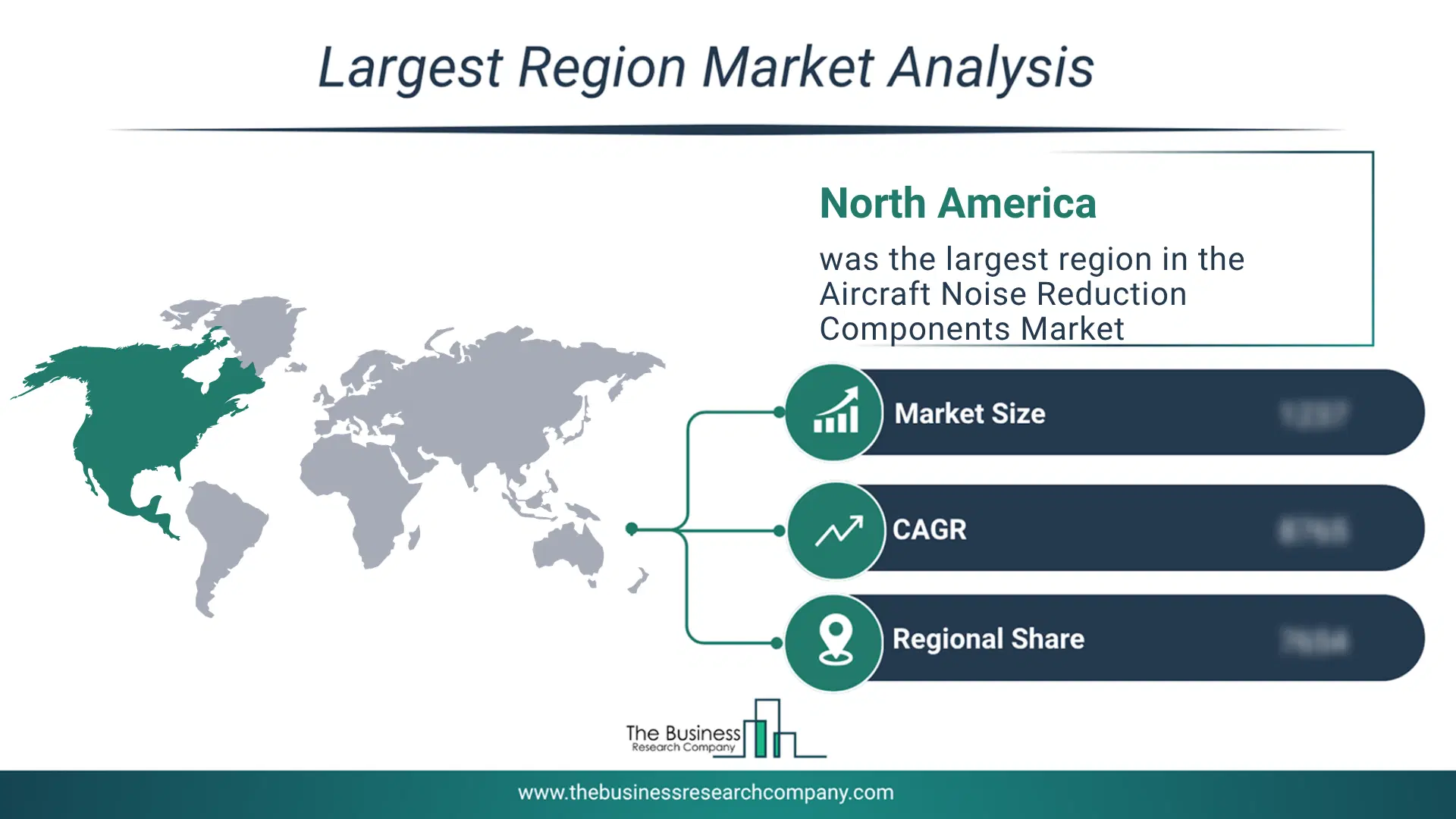
Regional Outlook/Insights
North America was the largest region in the aircraft noise reduction components market in 2025. Asia-Pacific is expected to be the fastest-growing region during the forecast period. The regions covered in this market report are Asia-Pacific, South East Asia, Western Europe, Eastern Europe, North America, South America, Middle East, Africa. The countries covered in this market report are Australia, Brazil, China, France, Germany, India, Indonesia, Japan, Taiwan, Russia, South Korea, UK, USA, Canada, Italy, Spain.What Defines the Aircraft Noise Reduction Components Market?
The aircraft noise reduction components market consists of sales of airframe fairings, wing edge noise reduction devices, landing gear noise shields, landing gear fairings, wheel hub fairings, airframe gap seals, trailing edge noise control devices, airframe vibration control panels, structural acoustic barriers, acoustic composite panels, and aerodynamic noise control surfaces. Values in this market are ‘factory gate’ values, that is, the value of goods sold by the manufacturers or creators of the goods, whether to other entities (including downstream manufacturers, wholesalers, distributors, and retailers) or directly to end customers. The value of goods in this market includes related services sold by the creators of the goods.How is Market Value Defined and Measured?
The market value is defined as the revenues that enterprises gain from the sale of goods and/or services within the specified market and geography through sales, grants, or donations in terms of the currency (in USD unless otherwise specified). The revenues for a specified geography are consumption values that are revenues generated by organizations in the specified geography within the market, irrespective of where they are produced. It does not include revenues from resales along the supply chain, either further along the supply chain or as part of other products.
This chart presents market attractiveness based on a quantitative evaluation of growth, competition, strategic alignment, and risk, offering a clear view of opportunity areas for decision-making. This chart is for illustrative purposes; the full report contains the complete analysis.

This chart highlights the Total Addressable Market (TAM) by estimating the maximum revenue opportunity using an assumption-driven approach, supporting strategic planning and opportunity sizing across markets. The chart is illustrative; the full report provides a more comprehensive analysis.
What Key Data and Analysis Are Included in the Aircraft Noise Reduction Components Market Report 2026?
The aircraft noise reduction components market research report is one of a series of new reports from The Business Research Company that provides market statistics, including industry global market size, regional shares, competitors with the market share, detailed market segments, market trends and opportunities, and any further data you may need to thrive in the aircraft noise reduction components industry. The market research report delivers a complete perspective of everything you need, with an in-depth analysis of the current and future state of the industry.Aircraft Noise Reduction Components Market Report Forecast Analysis
| Report Attribute | Details |
|---|---|
| Market Size Value In 2026 | $2.98 billion |
| Revenue Forecast In 2030 | $4.2 billion |
| Growth Rate | CAGR of 8.9% from 2026 to 2035 |
| Base Year For Estimation | 2025 |
| Actual Estimates/Historical Data | 2020-2025 |
| Forecast Period | 2026 - 2030 |
| Market Representation | Revenue in USD Billion and CAGR from 2026 to 2030 |
| Segments Covered | Component, Material, Technology Type, Aircraft Type, End User |
| Regional Scope | Asia-Pacific, Western Europe, Eastern Europe, North America, South America, Middle East, Africa |
| Country Scope | The countries covered in the report are Australia, Brazil, China, France, Germany, India, Indonesia, Japan, Taiwan, Russia, South Korea, UK, USA, Canada, Italy, Spain. |
| Customization Scope | Request for Customization |
| Pricing And Purchase Options | Explore Purchase Options |