
Aircraft Turbofan Engine Market Report 2026
Global Outlook – By Engine Type (PW4000, GEnx, Trent 1000, F414, GP7000, Other Engines, By Aircraft Type (Narrow Body Aircraft, Wide Body Aircraft), By Platform (Fixed Wing, Rotary Wing), By Application (Military Aviation, Commercial Air Transport, Other Applications) – Market Size, Trends, Strategies, and Forecast to 2030
Aircraft Turbofan Engine Market Overview
• Aircraft Turbofan Engine market size has reached to $3.35 billion in 2025 • Expected to grow to $4.66 billion in 2030 at a compound annual growth rate (CAGR) of 6.8% • Growth Driver: Rising Defense Budgets Fueling Growth In The Aircraft Turbofan Engines Market • Market Trend: Global Aircraft Turbofan Engine Market Trend: New Standards For Efficiency And Sustainability In The Aircraft Turbofan Engine Market • North America was the largest region in 2025 and Asia-Pacific is the fastest growing region.Market Gains By 2030 – Top Opportunities By Segment
Market Gain identifies the most promising market opportunities by highlighting the segments or products expected to generate the highest incremental revenue growth over the next five years.
What Is Covered Under Aircraft Turbofan Engine Market?
An aircraft turbofan engine is a jet engine that powers modern commercial and military aircraft. The turbofan engine is designed to provide high efficiency and low noise compared to earlier jet engine designs. The main types of aircraft turbofan engine are PW4000, GEnx, Trent 1000, F414, GP7000, and others. PW4000 refers to the first model of high-thrust engines that consists of a 94-inch fan engine. This aircraft turbofan engine offers thrust in the range between 74,000 and 98,000 pound-force. The main types of aircraft are narrow body aircraft and wide body aircraft, which has fixed wing or rotary wing, and used in military aviation, commercial air transport, and other applications.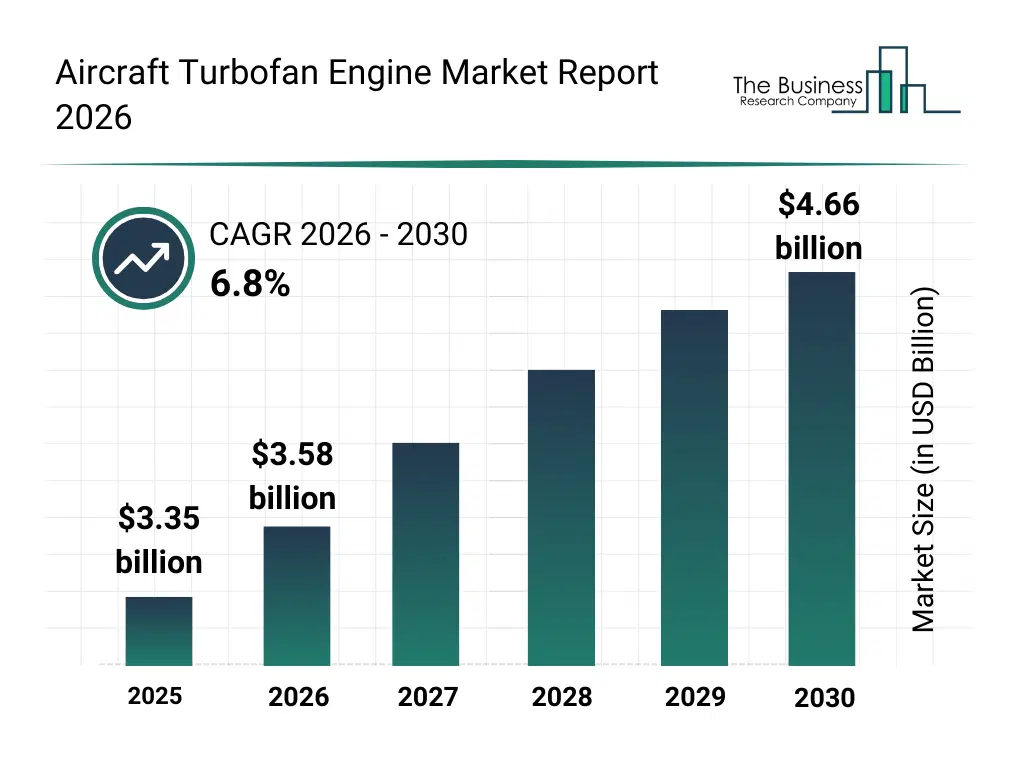
What Is The Aircraft Turbofan Engine Market Size and Share 2026?
The aircraft turbofan engine market size has grown strongly in recent years. It will grow from $3.35 billion in 2025 to $3.58 billion in 2026 at a compound annual growth rate (CAGR) of 6.8%. The growth in the historic period can be attributed to growing adoption of turbofan engines to achieve higher fuel efficiency and lower noise levels, early deployment of low and medium bypass ratio engines in commercial and military platforms, rising demand for high bypass ratio turbofans to support wide-body and long-haul aircraft, development of geared turbofan technologies to improve propulsion efficiency, expansion of global air travel driving large-scale production of turbofan engines.What Is The Aircraft Turbofan Engine Market Growth Forecast?
The aircraft turbofan engine market size is expected to see strong growth in the next few years. It will grow to $4.66 billion in 2030 at a compound annual growth rate (CAGR) of 6.8%. The growth in the forecast period can be attributed to growing demand for next-generation turbofan engines with reduced emissions and improved efficiency, increasing adoption of advanced materials and cooling technologies to support higher operating temperatures, rising investment in geared turbofan platforms for enhanced performance and lower operating costs, expansion of aircraft fleet modernization programs requiring new propulsion systems, technological advancements enabling hybrid-electric integration and further noise reduction in turbofan engines. Major trends in the forecast period include demand for high-efficiency, low-noise turbofan engines, growth in commercial air transport driving engine sales, adoption of geared turbofan technology for fuel efficiency, expansion of military aviation programs and upgrades, increasing maintenance, repair, and overhaul (mro) services.
Global Aircraft Turbofan Engine Market Segmentation
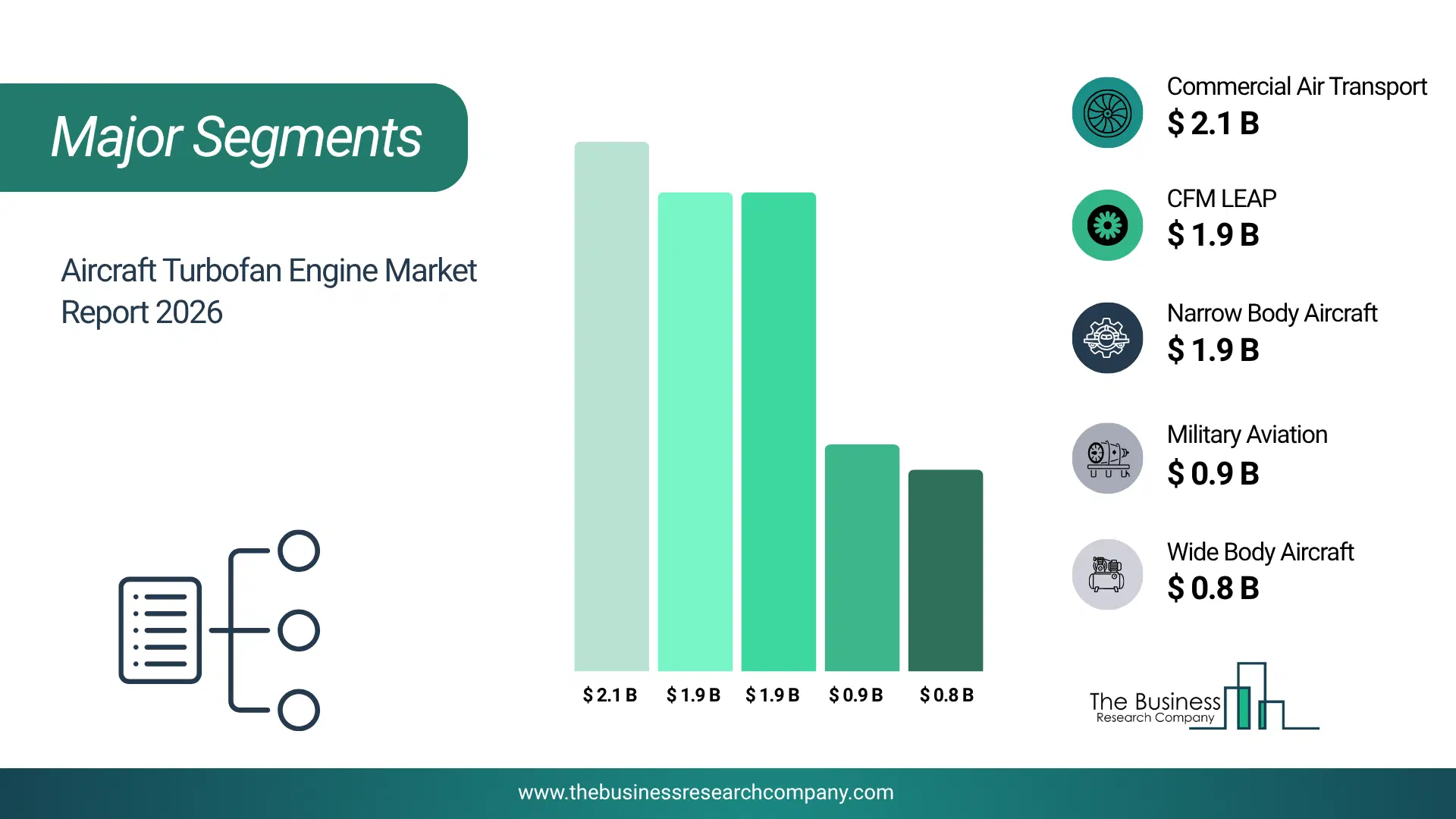
1) By Engine Type: PW4000, GEnx, Trent 1000, F414, GP7000, Other Engines 2) By Aircraft Type: Narrow Body Aircraft, Wide Body Aircraft 3) By Platform: Fixed Wing, Rotary Wing 4) By Application: Military Aviation, Commercial Air Transport, Other Applications Subsegments: 1) By PW4000: PW4000-94, PW4000-100, PW4000-112 2) By GEnx: GEnx-1B, GEnx-2B 3) By Trent 1000: Trent 1000-A, Trent 1000-C, Trent 1000-TEN 4) By F414: F414-GE-400, F414-GE-400 Enhanced 5) By GP7000: GP7000-PW6100, GP7000-PW6100D 6) By Other Engines: CF6 Series, LEAP Engine, RB211 Series The top segments in the aircraft turbofan engine market will be: • Commercial Air Transport will reach $2125.51 Million by 2025. • CFM LEAP will reach $1978.07 Million by 2025. • Narrow Body Aircraft will reach $1974.49 Million by 2025. • Military Aviation will reach $906.96 Million by 2025. • Wide Body Aircraft will reach $804.63 Million by 2025.What Is Driver Of The Aircraft Turbofan Engine Market?
The increase in the number of air passengers is expected to propel the aircraft turbofan engine market. An air passenger refers to a person or business involved primarily in the transportation of people by aircraft in interstate commerce. As air travel becomes more accessible and affordable, more people are choosing to fly, leading to an increase in demand for air transportation. This, in turn, has created a growing demand for more efficient and reliable aircraft engines, and turbofan engines are among the most popular choices for commercial airliners. For instance, in December 2024, according to the Eurostat, a Luxembourg-based government agency, in 2023, a total of 973 million passengers traveled by air within the EU, a 19.3% increase from 2022, when 816 million passengers were recorded. The data show that all EU member states saw a rise in air passenger numbers compared with the previous year. Therefore, the rise in the number of air passengers is driving the growth of the aircraft turbofan engine industry.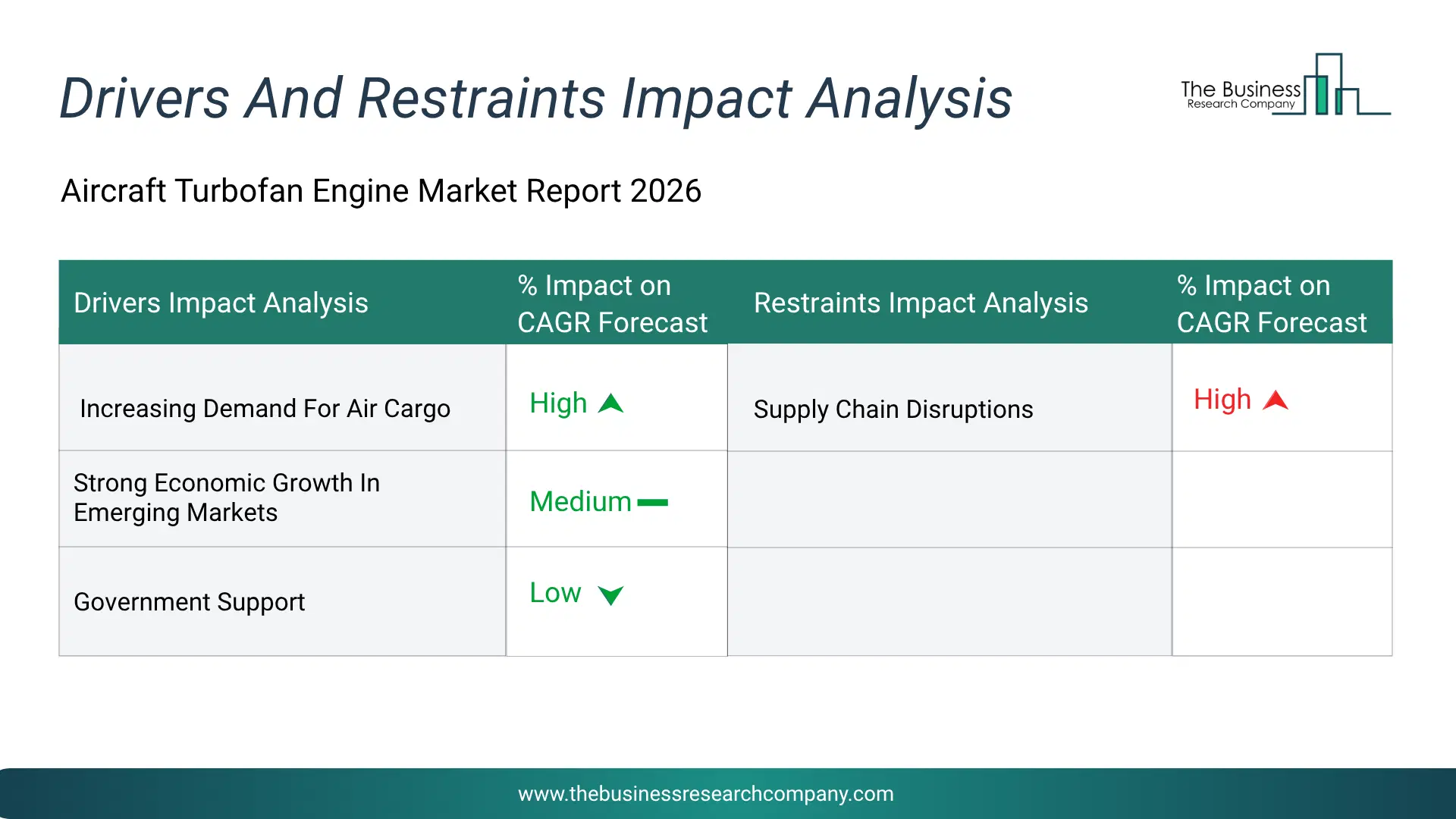
Infographic Chart Showing Key Market Drivers Analysis And Restraints For Aircraft Turbofan Engine Market
The chart presents an impact analysis of key drivers and restraints, quantifying their relative influence on the market's growth rate and helping assess the balance between growth enablers and limiting factors. This chart offers a high-level perspective; the full report contains more detailed insights.
How Will The Drivers Impact Growth In The Global Aircraft Turbofan Engine Market?
• Increasing Demand For Air Cargo (High) – The increasing demand for air cargo will become a key driver of growth in the aircraft turbofan engine market by 2030. As global air cargo demand rises, driven by the growth of e-commerce, increasing expectations for faster delivery and evolving supply chain requirements, cargo airlines are expanding their fleets. This expansion typically involves acquiring new, more efficient aircraft equipped with advanced turbofan engines. As a result, the increasing demand for air cargo is anticipated to contributing to annual growth in the market. • Strong Economic Growth In Emerging Markets (Medium) – The strong economic growth in emerging markets will emerge as a major factor driving the expansion of the market by 2030. As emerging markets experience economic expansion, disposable incomes increase, resulting in a heightened demand for air travel. This enables a larger segment of the population to afford flights for business and leisure purposes, prompting airlines to expand their fleets. Consequently, this growth in fleet size drives the demand for new aircraft and their associated components, including aircraft turbofan engine. As a result, the strong economic growth is anticipated to contributing to annual growth in the market. • Government Support (Low) – The government support will serve as a key growth catalyst for the market by 2030. As these governments invest in modernizing their military fleets, the demand for advanced turbofan engines grows to meet the operational needs of contemporary fighter jets, transport planes and surveillance aircraft. As a result, the government support is anticipated to contributing to annual growth in the market.How Will The Restraints Impact Growth In The Global Aircraft Turbofan Engine Market?
• Supply Chain Disruptions (High) – Supply Chain Disruptions will restrict the growth of the Aircraft Turbofan Engine market during the forecast period. Turbofan engine production depends on complex global supply chains for materials, components, and precision manufacturing. Disruptions from geopolitical tensions, supplier failures, or logistics challenges can delay production and increase costs. Supply chain vulnerabilities affect the ability of manufacturers to meet demand and may limit market growth.Key Players In The Global Aircraft Turbofan Engine Market
Major companies operating in the aircraft turbofan engine market are Pratt & Whitney Canada Corp., Rolls-Royce Holdings plc, CFM International SA, Safran SA, GE Aviation, Honeywell International Inc., MTU Aero Engines AG, Eurojet Turbo GmbH, United Engine Corporation, International Aero Engines AG, Engine Alliance GP, Aero Engine Corporation of China, Aviation Industry Corporation of China, Raytheon Technologies Corporation, Snecma, Ishikawajima-Harima Heavy Industries Co. Ltd., JSC Aviadvigatel, NPO Saturn, Williams International, Ivchenko-Progress Design Bureau, Klimov JSC, Motor Sich JSC, Hindustan Aeronautics Limited, Shenyang Liming Aero-Engine (Group) Co. Ltd., Kuznetsov Design Bureau, IHI Corporation, Avio Aero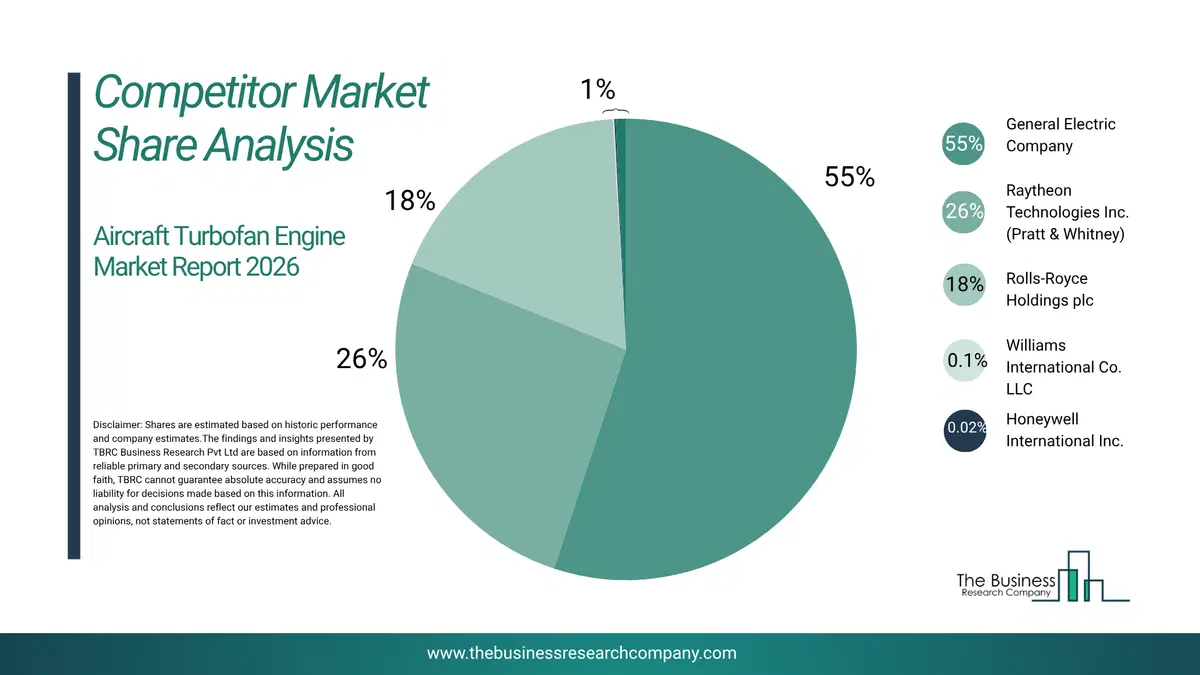
This chart is for illustrative purposes; the full report includes a detailed competitor analysis and comprehensive overview of the top 10 companies in the market.
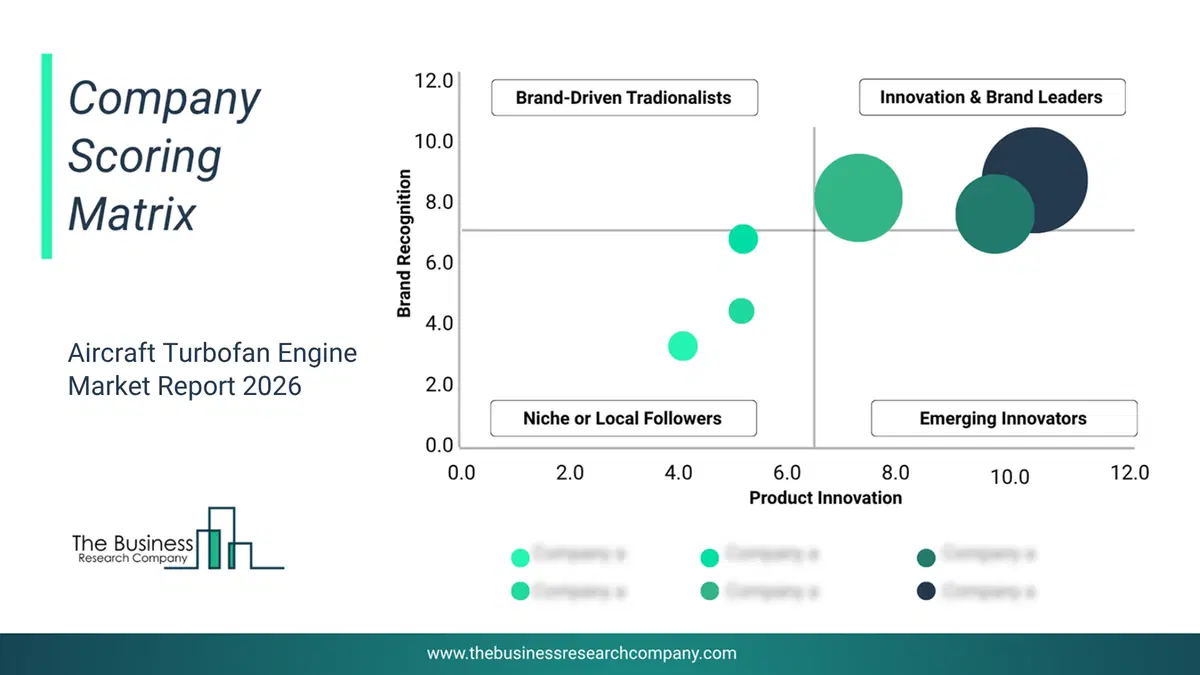
This chart maps companies by product innovation and brand strength, with bubble size indicating relative revenue, helping identify market leaders, challengers, and niche players. This is an illustrative chart; the full report provides a complete and accurate competitive analysis.
Global Aircraft Turbofan Engine Market Trends and Insights
Major companies operating in the aircraft turbofan engine market are focused on developing innovations, such as demonstrator aero engines, to gain a competitive edge in the market. A demonstrator aero engine is a non-production engine built to test new technologies and concepts before they are incorporated into production engines. For instance, in May 2023, Rolls-Royce PLC, a UK-based aerospace and defense company, launched UltraFan, the world's largest turbofan engine. It is the world's largest aero engine, with a 140-inch fan diameter, and is designed to deliver a 25% fuel burn improvement compared to the first generation of Trent engines. The engine has been successfully run to full power, producing over 85,000 lbs of thrust. The engine is designed to be ready to run on 100% Sustainable Aviation Fuel (SAF) from day one of service.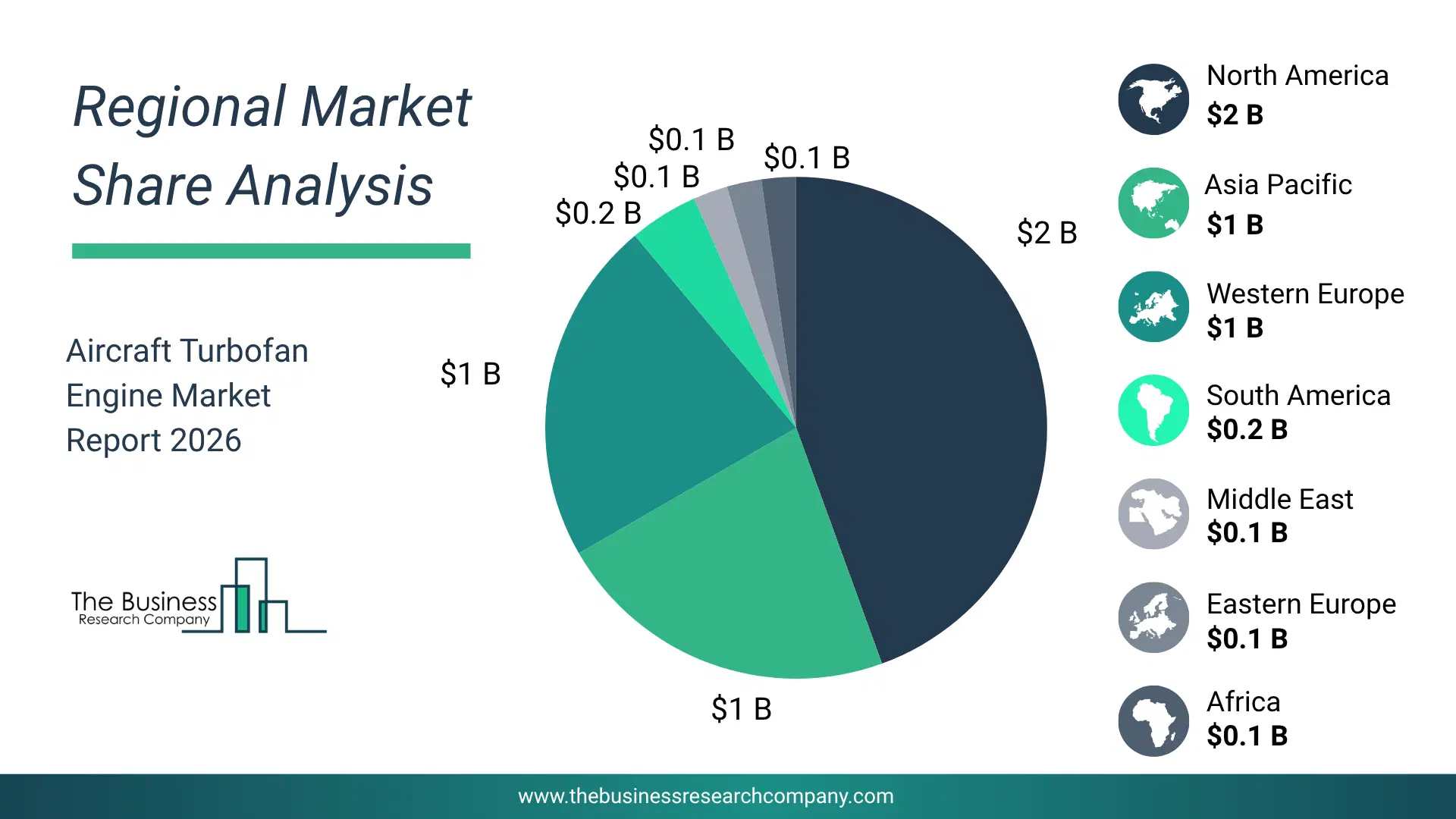
Regional Insights
North America was the largest region in the aircraft turbofan engine market in 20254. Asia-Pacific is expected to be the fastest-growing region in the global aircraft turbofan engine market report during the forecast period. The regions covered in this market report are Asia-Pacific, South East Asia, Western Europe, Eastern Europe, North America, South America, Middle East, Africa. The countries covered in this market report are Australia, Brazil, China, France, Germany, India, Indonesia, Japan, Taiwan, Russia, South Korea, UK, USA, Canada, Italy, SpainWhat Defines the Aircraft Turbofan Engine Market?
The aircraft turbofan engine marker consists of the sale of low bypass ratio turbofan engines, medium bypass ratio turbofan engines, high bypass ratio turbofan engines, and geared turbofan engines. Values in this market are ‘factory gate’ values, that is the value of goods sold by the manufacturers or creators of the goods, whether to other entities (including downstream manufacturers, wholesalers, distributors and retailers) or directly to end customers. The value of goods in this market includes related services sold by the creators of the goods.How is Market Value Defined and Measured?
The market value is defined as the revenues that enterprises gain from the sale of goods and/or services within the specified market and geography through sales, grants, or donations in terms of the currency (in USD unless otherwise specified). The revenues for a specified geography are consumption values that are revenues generated by organizations in the specified geography within the market, irrespective of where they are produced. It does not include revenues from resales along the supply chain, either further along the supply chain or as part of other products.
This chart presents market attractiveness based on a quantitative evaluation of growth, competition, strategic alignment, and risk, offering a clear view of opportunity areas for decision-making. This chart is for illustrative purposes; the full report contains the complete analysis.

This chart highlights the Total Addressable Market (TAM) by estimating the maximum revenue opportunity using an assumption-driven approach, supporting strategic planning and opportunity sizing across markets. The chart is illustrative; the full report provides a more comprehensive analysis.
What Key Data and Analysis Are Included in the Aircraft Turbofan Engine Market Report 2026?
The aircraft turbofan engine market research report is one of a series of new reports from The Business Research Company that provides market statistics, including industry global market size, regional shares, competitors with the market share, detailed market segments, market trends and opportunities, and any further data you may need to thrive in the aircraft turbofan engine industry. The market research report delivers a complete perspective of everything you need, with an in-depth analysis of the current and future state of the industry.Aircraft Turbofan Engine Market Report Forecast Analysis
| Report Attribute | Details |
|---|---|
| Market Size Value In 2026 | $3.58 billion |
| Revenue Forecast In 2030 | $4.66 billion |
| Growth Rate | CAGR of 6.8% from 2026 to 2030 |
| Base Year For Estimation | 2025 |
| Actual Estimates/Historical Data | 2020-2025 |
| Forecast Period | 2026 - 2030 |
| Market Representation | Revenue in USD Billion and CAGR from 2026 to 2030 |
| Segments Covered | Engine Type, Aircraft Type, Platform, Application |
| Regional Scope | Asia-Pacific, Western Europe, Eastern Europe, North America, South America, Middle East, Africa |
| Country Scope | The countries covered in the report are Australia, Brazil, China, France, Germany, India, Indonesia, Japan, Taiwan, Russia, South Korea, UK, USA, Canada, Italy, Spain. |
| Key Companies Profiled | Pratt & Whitney Canada Corp., Rolls-Royce Holdings plc, CFM International SA, Safran SA, GE Aviation, Honeywell International Inc., MTU Aero Engines AG, Eurojet Turbo GmbH, United Engine Corporation, International Aero Engines AG, Engine Alliance GP, Aero Engine Corporation of China, Aviation Industry Corporation of China, Raytheon Technologies Corporation, Snecma, Ishikawajima-Harima Heavy Industries Co. Ltd., JSC Aviadvigatel, NPO Saturn, Williams International, Ivchenko-Progress Design Bureau, Klimov JSC, Motor Sich JSC, Hindustan Aeronautics Limited, Shenyang Liming Aero-Engine (Group) Co. Ltd., Kuznetsov Design Bureau, IHI Corporation, Avio Aero |
| Customization Scope | Request for Customization |
| Pricing And Purchase Options | Explore Purchase Options |