
Aircraft Wheels And Braking Systems Market Report 2026
Global Outlook – By Component (Wheels, Tires, Brake Discs, Brake Actuators, Brake Control Units, Anti Skid Systems, Wheel Speed Sensors), By Fit Type (Line Fit Or Original Equipment Manufacturer, Retrofit Or Aftermarket), By Type Of Aircraft (Commercial Aircraft, General Aviation Aircraft, Military Aircraft, Helicopters), By Application (Taxiing Operations, Takeoff Operations, Landing Operations, Emergency Braking Operations) – Market Size, Trends, Strategies, and Forecast to 2030
Aircraft Wheels And Braking Systems Market Overview
• Aircraft Wheels And Braking Systems market size has reached to $5.32 billion in 2025 • Expected to grow to $7.32 billion in 2030 at a compound annual growth rate (CAGR) of 6.5% • Growth Driver: Surge In Air Passenger Traffic Volumes Fueling The Growth Of The Market Due To Increasing Demand For Air Travel • Market Trend: Innovations In Carbon Brake And Wheel Technology Enhance Aircraft Braking Performance And Operational Efficiency • North America was the largest region in 2025 and Asia-Pacific is the fastest growing region.What Is Covered Under Aircraft Wheels And Braking Systems Market?
Aircraft wheels and braking systems are critical components of an aircraft that support ground operations by enabling safe taxiing, takeoff, landing, and parking while bearing the aircraft's weight. These systems are designed to provide reliable motion control, deceleration, and stopping performance under varying operating conditions. Aircraft wheels and braking systems enhance aircraft safety, operational efficiency, and durability by ensuring stable ground handling, effective braking performance, and dependable operation across diverse environmental and runway conditions. The main components of aircraft wheels and braking systems include wheels, tires, brake discs, brake actuators, brake control units, anti skid systems, and wheel speed sensors. Wheels refer to structural assemblies that support aircraft tires, bear operational loads, and enable safe taxiing, takeoff, landing, and ground maneuvering while integrating with braking systems. These components are supplied as line fit or original equipment manufacturer and retrofit or aftermarket solutions. They are various types of aircrafts such as commercial aircraft, general aviation aircraft, military aircraft, and helicopters and find application in taxiing operations, takeoff operations, landing operations, and emergency braking operations.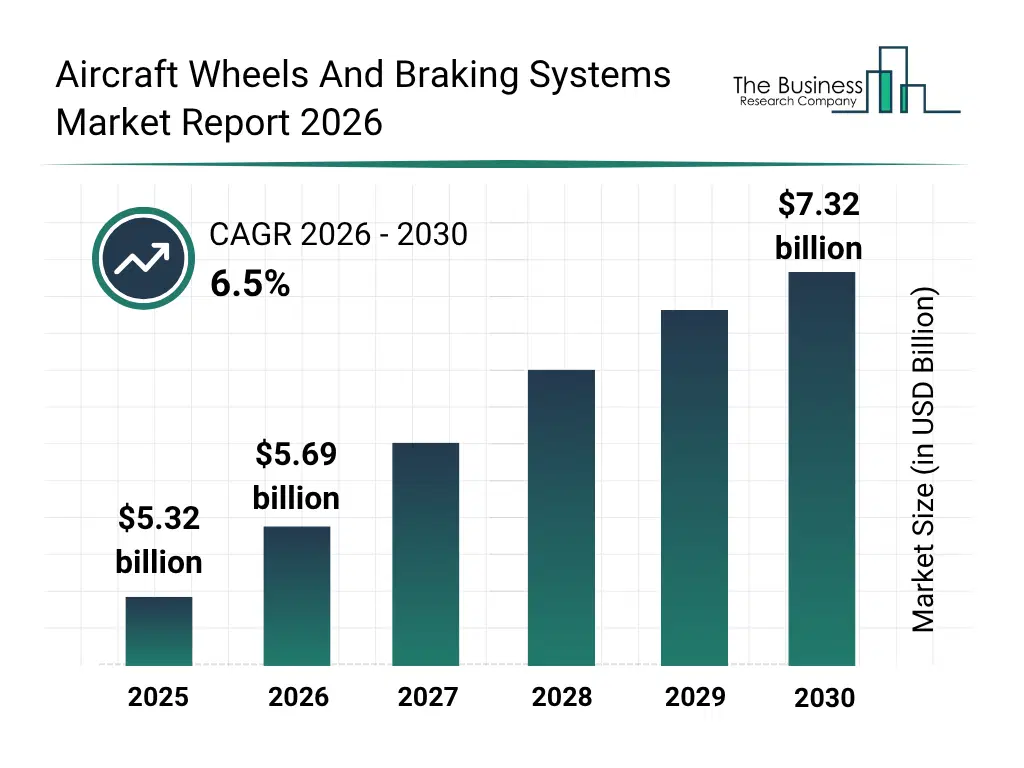
What Is The Aircraft Wheels And Braking Systems Market Size and Share 2026?
The aircraft wheels and braking systems market size has grown strongly in recent years. It will grow from $5.32 billion in 2025 to $5.69 billion in 2026 at a compound annual growth rate (CAGR) of 6.9%. The growth in the historic period can be attributed to growing commercial aircraft deliveries, rising global air passenger traffic, increasing aircraft fleet expansion, growing military aircraft procurement, increasing demand for reliable aircraft safety systems.What Is The Aircraft Wheels And Braking Systems Market Growth Forecast?
The aircraft wheels and braking systems market size is expected to see strong growth in the next few years. It will grow to $7.32 billion in 2030 at a compound annual growth rate (CAGR) of 6.5%. The growth in the forecast period can be attributed to increasing aircraft fleet modernization, growing demand for fuel efficient aircraft components, rising replacement demand for aging landing gear systems, expanding aircraft MRO activities, increasing production of next generation aircraft. Major trends in the forecast period include increasing adoption of lightweight carbon brake discs, growing demand for high durability aircraft wheels, rising integration of advanced anti skid systems, expansion of electromechanical braking technologies, increasing focus on longer component service life.
Global Aircraft Wheels And Braking Systems Market Segmentation
1) By Component: Wheels, Tires, Brake Discs, Brake Actuators, Brake Control Units, Anti Skid Systems, Wheel Speed Sensors 2) By Fit Type: Line Fit Or Original Equipment Manufacturer, Retrofit Or Aftermarket 3) By Type Of Aircraft: Commercial Aircraft, General Aviation Aircraft, Military Aircraft, Helicopters 4) By Application: Taxiing Operations, Takeoff Operations, Landing Operations, Emergency Braking Operations Subsegments: 1) By Wheels: Main Wheels, Nose Wheels, Tail Wheels 2) By Tires: Bias Ply Tires, Radial Tires 3) By Brake Discs: Steel Brake Discs, Carbon Brake Discs 4) By Brake Actuators: Hydraulic Brake Actuators, Electromechanical Brake Actuators 5) By Brake Control Units: Analog Brake Control Units, Digital Brake Control Units 6) By Anti Skid Systems: On Off Anti Skid Systems, Proportional Anti Skid Systems, Adaptive Anti Skid Systems 7) By Wheel Speed Sensors: Passive Wheel Speed Sensors, Active Wheel Speed SensorsWhat Is The Driver Of The Aircraft Wheels And Braking Systems Market?
The rising air passenger traffic volumes are expected to propel the growth of the aircraft wheels and braking systems market going forward. Air passenger traffic volumes refer to the total number of passengers traveling by air on domestic and international flights within a specified period. The rise in air passenger traffic is driven by increasing demand for air travel, as growing tourism and business travel have led to a higher number of domestic and international passengers. Aircraft wheels and braking systems support air passenger traffic volumes by ensuring safe, reliable, and efficient aircraft takeoff, landing, and ground operations, enabling airlines to accommodate increasing flight frequencies and passenger demand. For instance, in March 2025, according to the United States Department of Transportation, a U.S.-based government department, U.S. airlines carried a record 83.3 million scheduled domestic and international passengers in December 2024, including 72.1 million domestic and 11.2 million international travelers, with seasonally adjusted enplanements increasing 0.2% from November. Therefore, the rising global air passenger traffic volumes are driving the growth of the aircraft wheels and braking systems industry.Key Players In The Global Aircraft Wheels And Braking Systems Market
Major companies operating in the aircraft wheels and braking systems market are AAR CORP., Alaska Gear Company, Arkwin Industries Inc., Beijing Beimo Gaoke Friction Material Co. Ltd., BERINGER AERO SAS, Bridgestone Aircraft Tire Co., Crane Co., Grove Aircraft Landing Gear Systems Inc., Honeywell International Inc., Lufthansa Technik AG, Magellan Aerospace Corporation, Michelin Aircraft Tire, Moog Inc., NMG Aerospace Ltd., Parker-Hannifin Corporation, RAPCO Fleet Services Inc., Revima SAS, RTX Corporation, Safran S.A., The Goodyear Tire & Rubber Company, Tost GmbH Flugzeuggerätebau, TP Aerospace Solutions ApS, Trelleborg Sealing Solutions
This chart is for illustrative purposes; the full report includes a detailed competitor analysis and comprehensive overview of the top 10 companies in the market.
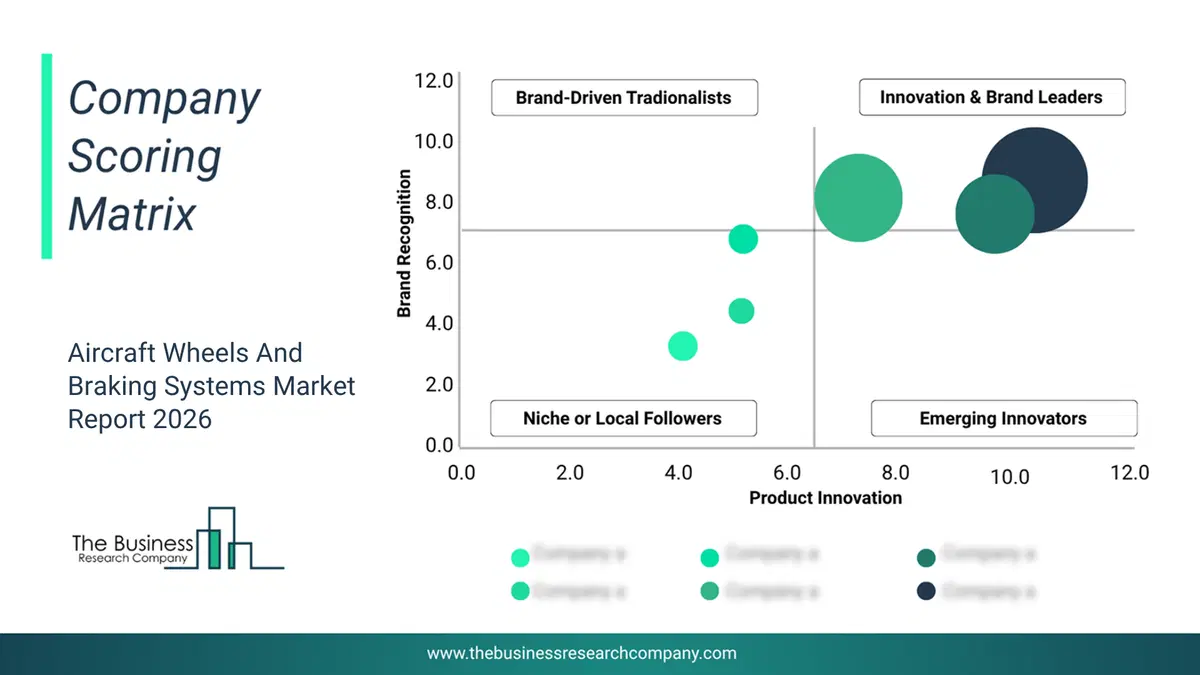
This chart maps companies by product innovation and brand strength, with bubble size indicating relative revenue, helping identify market leaders, challengers, and niche players. This is an illustrative chart; the full report provides a complete and accurate competitive analysis.
Global Aircraft Wheels And Braking Systems Market Trends and Insights
Major companies operating in the aircraft wheels and braking systems market are focusing on developing advanced braking solutions, such as carbon brake and wheel systems, to improve braking performance, reduce maintenance requirements, and enhance operational efficiency. Carbon brake and wheel systems refer to lightweight aircraft braking assemblies that utilize advanced carbon materials to deliver superior durability, lower lifecycle costs, and improved heat dissipation compared to conventional braking systems. For instance, in October 2024, Parker Aerospace, a US-based aerospace systems manufacturer, unveiled the Advanced NuCarb carbon brake and wheel for the Airbus A321neo. The solution is designed to provide operators with a reliable, safe, and cost-effective braking option, certified for the aircraft's highest maximum takeoff weight, while supporting both new production aircraft from 2026 and retrofit installations for in-service fleets.What Are Latest Mergers And Acquisitions In The Aircraft Wheels And Braking Systems Market?
In November 2025, Safran Landing Systems, a France-based manufacturer of aircraft landing gear, wheels, and braking systems, entered into a long-term partnership with Riyadh Air to supply wheels and advanced electric carbon brakes for more than 70 Boeing 787-9 aircraft. Through this agreement, Safran aims to strengthen its position in the aircraft wheels and braking systems market by delivering lightweight braking solutions that improve aircraft performance, reduce fuel consumption, and enhance maintenance efficiency while also supporting Riyadh Air with brake testing equipment, repair capability development, and engineer training. Riyadh Air is a Saudi Arabia-based provider of commercial passenger air services.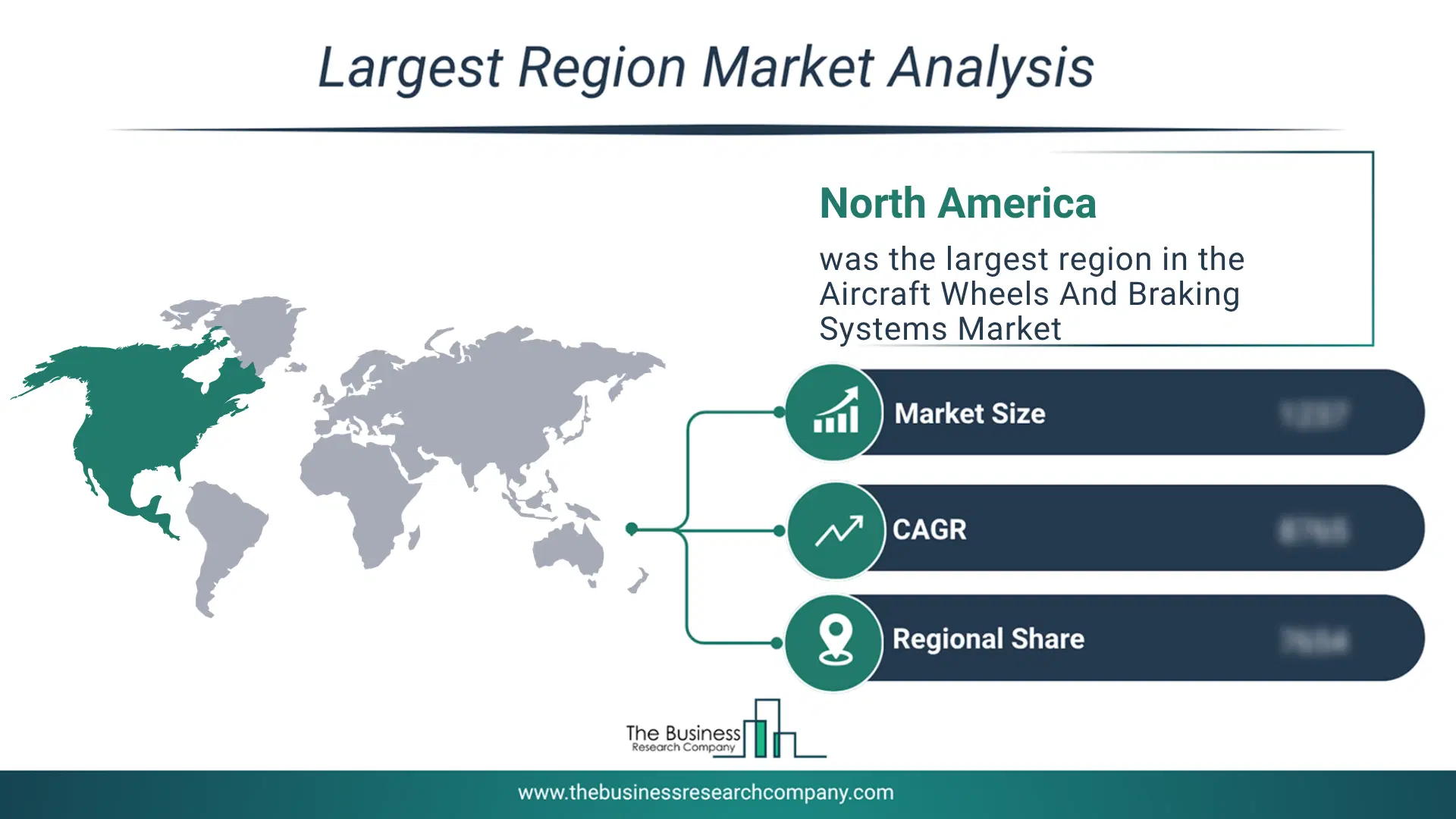
Regional Insights
North America was the largest region in the aircraft wheels and braking systems market in 2025. Asia-Pacific is expected to be the fastest-growing region in the forecast period. The regions covered in this market report are Asia-Pacific, South East Asia, Western Europe, Eastern Europe, North America, South America, Middle East, Africa. The countries covered in this market report are Australia, Brazil, China, France, Germany, India, Indonesia, Japan, Taiwan, Russia, South Korea, UK, USA, Canada, Italy, Spain.What Defines the Aircraft Wheels And Braking Systems Market?
The aircraft wheels and braking systems market consists of sales of brake heat shields, wheel valves, brake wear indicators, wheel chocks, and wheel fasteners. Values in this market are ‘factory gate’ values, that is, the value of goods sold by the manufacturers or creators of the goods, whether to other entities (including downstream manufacturers, wholesalers, distributors, and retailers) or directly to end customers. The value of goods in this market includes related services sold by the creators of the goods.How is Market Value Defined and Measured?
The market value is defined as the revenues that enterprises gain from the sale of goods and/or services within the specified market and geography through sales, grants, or donations in terms of the currency (in USD unless otherwise specified). The revenues for a specified geography are consumption values that are revenues generated by organizations in the specified geography within the market, irrespective of where they are produced. It does not include revenues from resales along the supply chain, either further along the supply chain or as part of other products.
This chart presents market attractiveness based on a quantitative evaluation of growth, competition, strategic alignment, and risk, offering a clear view of opportunity areas for decision-making. This chart is for illustrative purposes; the full report contains the complete analysis.

This chart highlights the Total Addressable Market (TAM) by estimating the maximum revenue opportunity using an assumption-driven approach, supporting strategic planning and opportunity sizing across markets. The chart is illustrative; the full report provides a more comprehensive analysis.
What Key Data and Analysis Are Included in the Aircraft Wheels And Braking Systems Market Report 2026?
The aircraft wheels and braking systems market research report is one of a series of new reports from The Business Research Company that provides market statistics, including industry global market size, regional shares, competitors with the market share, detailed market segments, market trends and opportunities, and any further data you may need to thrive in the aircraft wheels and braking systems industry. The market research report delivers a complete perspective of everything you need, with an in-depth analysis of the current and future state of the industry.Aircraft Wheels And Braking Systems Market Report Forecast Analysis
| Report Attribute | Details |
|---|---|
| Market Size Value In 2026 | $5.69 billion |
| Revenue Forecast In 2030 | $7.32 billion |
| Growth Rate | CAGR of 6.5% from 2026 to 2030 |
| Base Year For Estimation | 2025 |
| Actual Estimates/Historical Data | 2020-2025 |
| Forecast Period | 2026 - 2030 |
| Market Representation | Revenue in USD Billion and CAGR from 2026 to 2030 |
| Segments Covered | Component, Fit Type, Type Of Aircraft, Application |
| Regional Scope | Asia-Pacific, Western Europe, Eastern Europe, North America, South America, Middle East, Africa |
| Country Scope | The countries covered in the report are Australia, Brazil, China, France, Germany, India, Indonesia, Japan, Taiwan, Russia, South Korea, UK, USA, Canada, Italy, Spain. |
| Key Companies Profiled | AAR CORP., Alaska Gear Company, Arkwin Industries Inc., Beijing Beimo Gaoke Friction Material Co. Ltd., BERINGER AERO SAS, Bridgestone Aircraft Tire Co., Crane Co., Grove Aircraft Landing Gear Systems Inc., Honeywell International Inc., Lufthansa Technik AG, Magellan Aerospace Corporation, Michelin Aircraft Tire, Moog Inc., NMG Aerospace Ltd., Parker-Hannifin Corporation, RAPCO Fleet Services Inc., Revima SAS, RTX Corporation, Safran S.A., The Goodyear Tire & Rubber Company, Tost GmbH Flugzeuggerätebau, TP Aerospace Solutions ApS, Trelleborg Sealing Solutions |
| Customization Scope | Request for Customization |
| Pricing And Purchase Options | Explore Purchase Options |