
Airfield Drainage Systems Market Report 2026
Global Outlook – By Product Type (Surface Drainage Systems, Subsurface Drainage Systems, Slot Drains, Channel Drains, Other Product Types), By Installation Type (New Installation, Retrofit), By Material Type (Concrete Systems, Polymer Concrete Systems, High Density Polyethylene Systems, Polyvinyl Chloride Systems, Metal Based Systems, Composite Material Systems), By Component (Drains, Pipes, Grates, Catch Basins, Geotextiles, Other Components), By Application (Commercial Airports, Military Airbases, Private Airfields, Other Applications) – Market Size, Trends, Strategies, and Forecast to 2030
Airfield Drainage Systems Market Overview
• Airfield Drainage Systems market size has reached to $1.6 billion in 2025 • Expected to grow to $2.24 billion in 2030 at a compound annual growth rate (CAGR) of 6.9% • Growth Driver: Surge In Expansion Of Airport Infrastructure Fueling The Growth Of The Market Due To Rising Air Travel Demand • Market Trend: Advancements In Stormwater Drainage Infrastructure Strengthen Airport Operational Resilience • Asia-Pacific was the largest region in 2025 and North America is the fastest growing region.What Is Covered Under Airfield Drainage Systems Market?
Airfield drainage systems refer to engineered networks designed to efficiently manage and remove excess water from airport runways, taxiways, and aprons. These systems prevent water accumulation, reduce the risk of surface damage, and ensure safe aircraft operations under various weather conditions. The main product types of airfield drainage systems include surface drainage systems, subsurface drainage systems, slot drains, channel drains, and other product types. Surface drainage systems refer to engineered solutions designed to remove surface water efficiently from runways, taxiways, and aprons to ensure safe aircraft operations. These systems are installed as new installations or retrofits and are made from materials such as concrete systems, polymer concrete systems, high-density polyethylene systems, polyvinyl chloride systems, metal-based systems, and Composite material systems. The various components include drains, pipes, grates, catch basins, geotextiles, and others that are used in commercial airports, military airbases, private airfields, and other applications.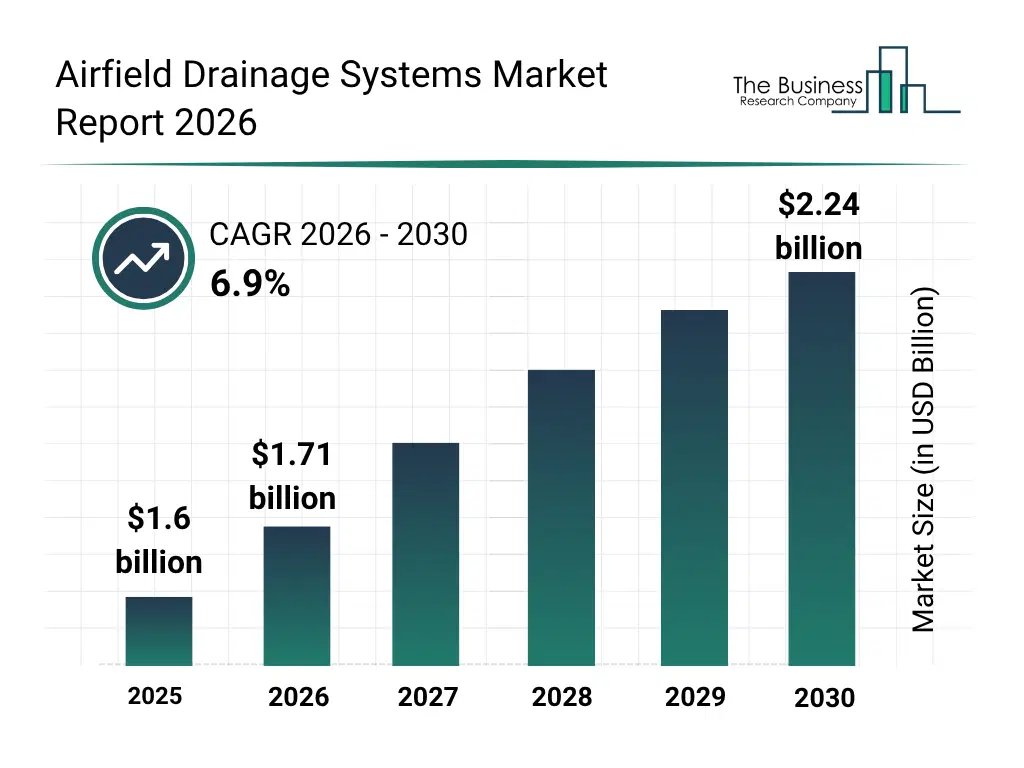
What Is The Airfield Drainage Systems Market Size and Share 2026?
The airfield drainage systems market size has grown strongly in recent years. It will grow from $1.6 billion in 2025 to $1.71 billion in 2026 at a compound annual growth rate (CAGR) of 6.7%. The growth in the historic period can be attributed to increasing air traffic and airport expansions, rising incidence of runway flooding and waterlogging, adoption of surface drainage systems, growing airport safety regulations, expansion of commercial and military airfields.What Is The Airfield Drainage Systems Market Growth Forecast?
The airfield drainage systems market size is expected to see strong growth in the next few years. It will grow to $2.24 billion in 2030 at a compound annual growth rate (CAGR) of 6.9%. The growth in the forecast period can be attributed to growing demand for sustainable and eco-friendly drainage solutions, increasing adoption of smart drainage monitoring systems, rising investments in airport modernization projects, expansion of private and regional airfields, increasing focus on high-capacity stormwater management systems. Major trends in the forecast period include increasing adoption of subsurface drainage systems, rising demand for polymer and composite material systems, growing integration of modular and prefabricated drainage solutions, expansion of retrofit installation projects, rising focus on military and high-security airfield applications.
Global Airfield Drainage Systems Market Segmentation
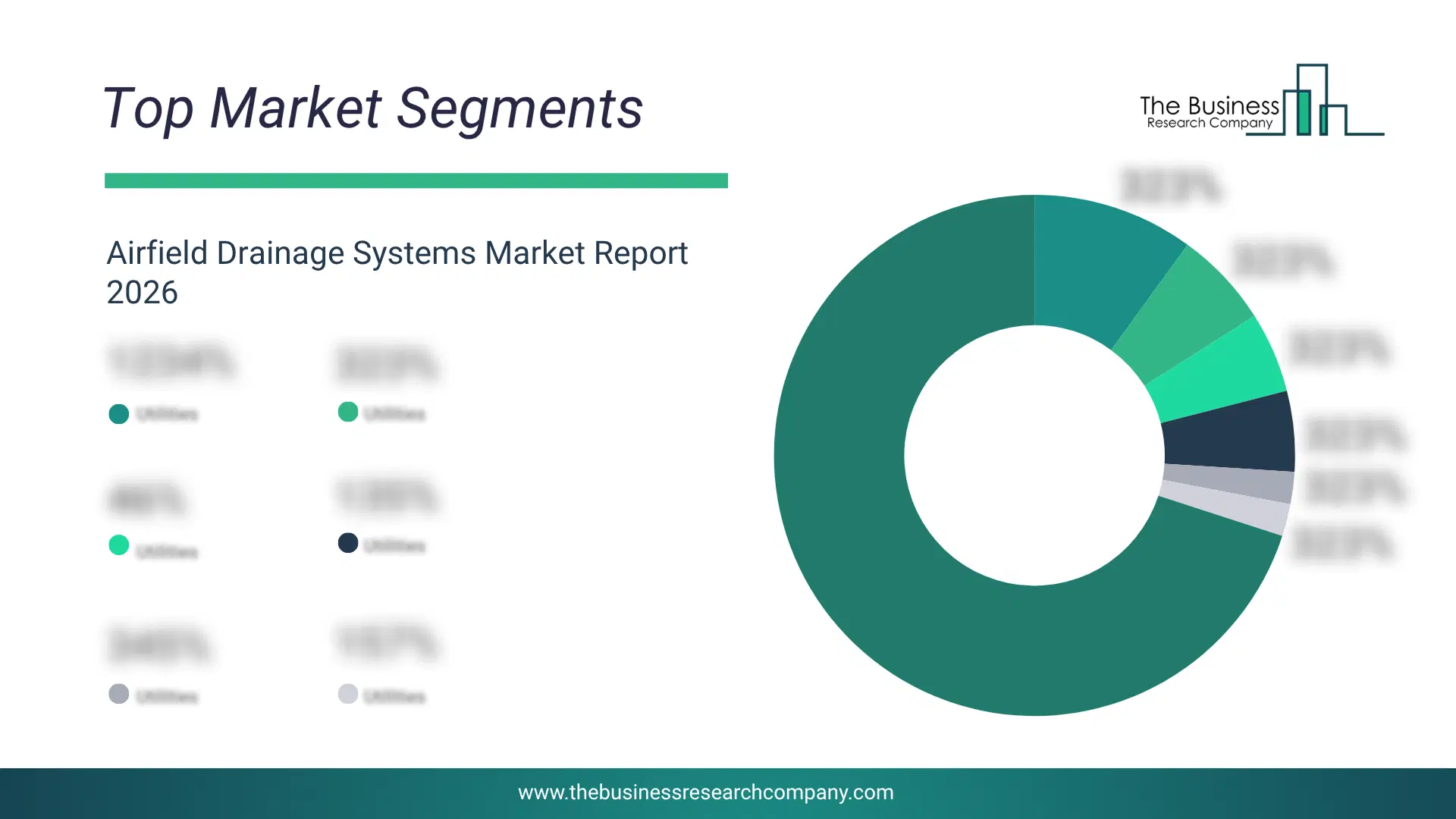
1) By Product Type: Surface Drainage Systems, Subsurface Drainage Systems, Slot Drains, Channel Drains, Other Product Types 2) By Installation Type: New Installation, Retrofit 3) By Material Type: Concrete Systems, Polymer Concrete Systems, High Density Polyethylene Systems, Polyvinyl Chloride Systems, Metal Based Systems, Composite Material Systems 4) By Component: Drains, Pipes, Grates, Catch Basins, Geotextiles, Other Components 5) By Application: Commercial Airports, Military Airbases, Private Airfields, Other Applications Subsegments: 1) By Surface Drainage Systems: Trench Drain Systems, Grated Drain Systems, Catch Basin Systems, Open Channel Drains 2) By Subsurface Drainage Systems: Perforated Pipe Drains, French Drain Systems, Underdrain Pipe Networks, Geocomposite Drain Systems 3) By Slot Drains: Precast Concrete Slot Drains, Polymer Concrete Slot Drains, Stainless Steel Slot Drains, Modular Slot Drains 4) By Channel Drains: Polymer Concrete Channel Drains, Fiberglass Channel Drains, Steel Channel Drains, Plastic Channel Drains 5) By Other Product Types: Oil Water Separator Drains, Sump Pump Drainage Systems, Retention And Detention Systems, Custom Engineered Drainage SolutionsWhat Are The Drivers Of The Airfield Drainage Systems Market?
The increasing expansion of airport infrastructure is expected to propel the growth of the airfield drainage systems market going forward. Airport infrastructure refers to the physical facilities and systems that support the operation, safety, and efficiency of an airport, including runways, terminals, navigation aids, and support services. The expansion of airport infrastructure is driven by growing air travel demand, as it enables airports to handle more passengers and cargo efficiently while supporting economic growth. Airfield drainage systems help the expansion of airport infrastructure by efficiently managing stormwater, preventing runway flooding, and ensuring safe, uninterrupted operations for increased aircraft traffic. For instance, in September 2025, according to Airports Council International (ACI) World, a Canada-based airport authority organization, total global airport passenger traffic reached approximately 9.4 billion, representing an 8.3% increase compared to 2023. Therefore, the increasing airport infrastructure expansion is driving the growth of the airfield drainage systems industry. The increasing extreme rainfall events are expected to propel the growth of the airfield drainage systems market going forward. Extreme rainfall events refer to unusually heavy or intense precipitation that often leads to flooding and significant societal or economic impacts. The increase in extreme rainfall events is driven by climate change, as rising global temperatures intensify the water cycle, leading to heavier and more frequent precipitation. Extreme rainfall events support the growth of airfield drainage systems as they efficiently channel excess water away from runways and taxiways, reducing flooding risks and ensuring safe aircraft operations. For instance, in April 2024, according to Deutsche Welle (DW), a Germany-based international public broadcaster, Europe experienced 7% above-average rainfall, leading to floods that affected 1.6 million people, killed over 40, and caused €13.4 billion ($14.3 billion) in weather-related damages. Therefore, the increasing extreme rainfall eventsis driving the growth of the airfield drainage systems industry.Key Players In The Global Airfield Drainage Systems Market
Major companies operating in the airfield drainage systems market are Contech Engineered Solutions LLC, East Jordan Iron Works Inc, HAURATON GmbH & Co KG, ULMA Architectural Solutions S Coop, ABT Inc, Clark Companies, American Wick Drain Corp, MERT DOKUM ANONIM SIRKETI, Cultec Inc, MEA Water Management GmbH, Fields Inc, SubAir Systems LLC, Alpine Services Inc, ACO Group, BIRCO GmbH, AirField Systems LLC, Flli Moro Srl, R B Agarwalla & Co, Hancor Inc, and Lanco Amenagement Inc.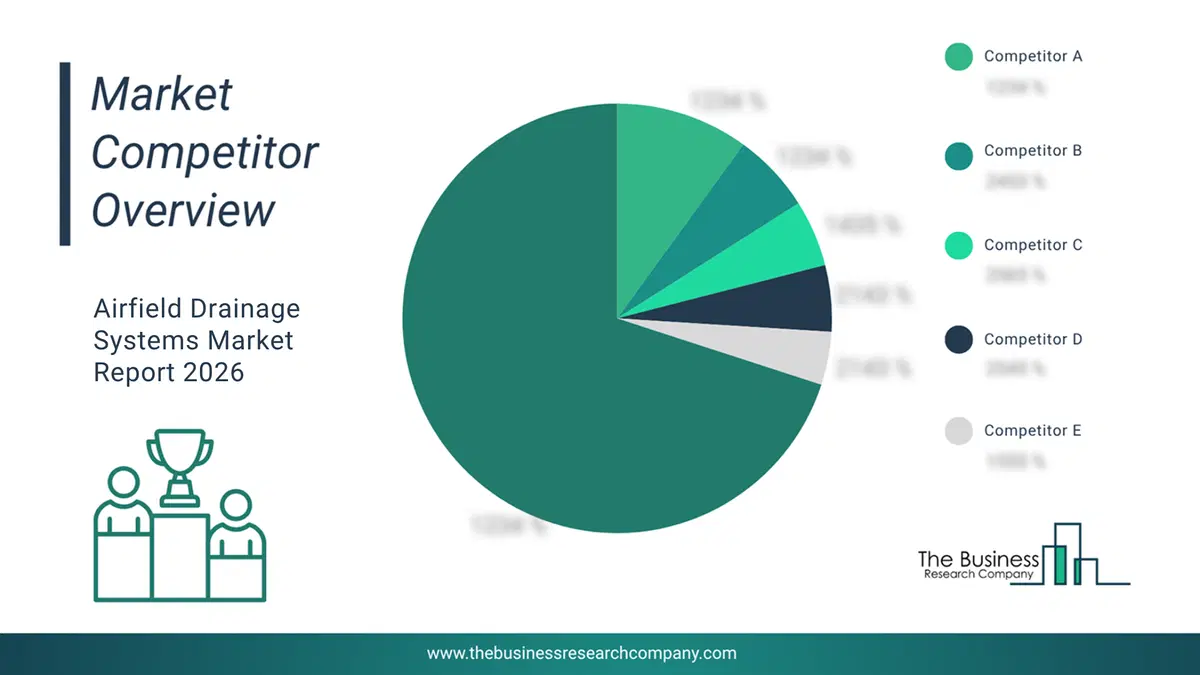
This chart is for illustrative purposes; the full report includes a detailed competitor analysis and comprehensive overview of the top 10 companies in the market.
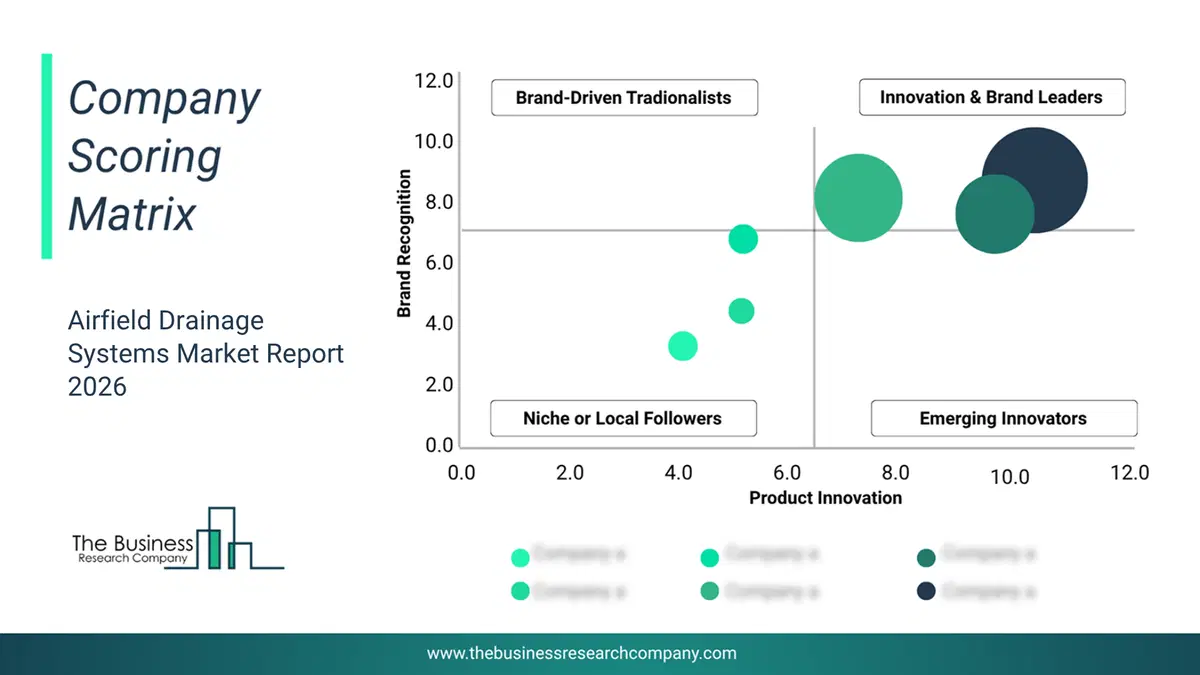
This chart maps companies by product innovation and brand strength, with bubble size indicating relative revenue, helping identify market leaders, challengers, and niche players. This is an illustrative chart; the full report provides a complete and accurate competitive analysis.
Global Airfield Drainage Systems Market Trends and Insights
Major companies operating in the airfield drainage systems market are focusing on developing advanced stormwater management solutions to enhance airport safety, operational efficiency, and resilience against extreme weather events. Stormwater management solutions refer to technologies and approaches used to capture, regulate, filter, and properly release rainwater runoff from cities and industrial zones, which help to minimize flood risks, lower contamination levels, safeguard infrastructure, and support sustainable practices. For instance, in December 2025, the Airports Authority of India, an India-based Ministry of Civil Aviation, approved an ₹11 crore ($1.21 million) stormwater drainage upgrade at Trichy Airport. It is a project designed to improve water discharge, reduce waterlogging risks, and enhance airfield safety during monsoon and heavy rainfall conditions. It is leveraging advanced hydraulic engineering, high-capacity drainage channels, and automated control mechanisms to enable consistent water management, operational continuity, and minimized disruption to airport activities. It is engineered to support demanding airport environments, ensuring scalable and reliable performance for runways, taxiways, and passenger safety while facilitating long-term infrastructure resilience and operational efficiency.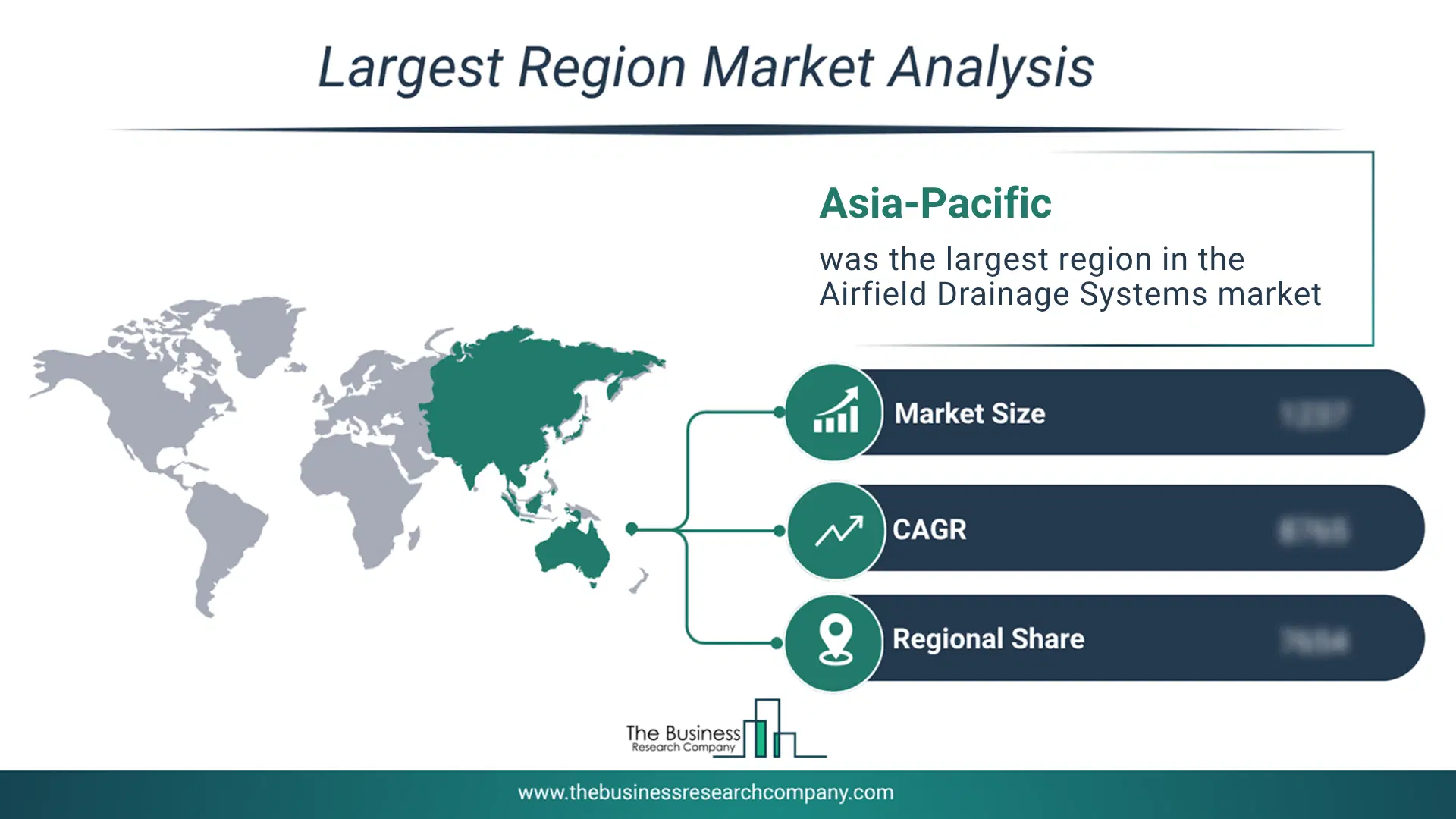
Regional Insights
Asia-Pacific was the largest region in the airfield drainage systems market in 2025. North America is expected to be the fastest-growing region in the forecast period. The regions covered in this market report are Asia-Pacific, South East Asia, Western Europe, Eastern Europe, North America, South America, Middle East, Africa. The countries covered in this market report are Australia, Brazil, China, France, Germany, India, Indonesia, Japan, Taiwan, Russia, South Korea, UK, USA, Canada, Italy, Spain.What Defines the Airfield Drainage Systems Market?
The airfield drainage systems market consists of sales of trench drains, soakaways, detention tanks, and manhole covers. Values in this market are ‘factory gate’ values, that is, the value of goods sold by the manufacturers or creators of the goods, whether to other entities (including downstream manufacturers, wholesalers, distributors, and retailers) or directly to end customers. The value of goods in this market includes related services sold by the creators of the goods.How is Market Value Defined and Measured?
The market value is defined as the revenues that enterprises gain from the sale of goods and/or services within the specified market and geography through sales, grants, or donations in terms of the currency (in USD unless otherwise specified). The revenues for a specified geography are consumption values that are revenues generated by organizations in the specified geography within the market, irrespective of where they are produced. It does not include revenues from resales along the supply chain, either further along the supply chain or as part of other products.
This chart presents market attractiveness based on a quantitative evaluation of growth, competition, strategic alignment, and risk, offering a clear view of opportunity areas for decision-making. This chart is for illustrative purposes; the full report contains the complete analysis.

This chart highlights the Total Addressable Market (TAM) by estimating the maximum revenue opportunity using an assumption-driven approach, supporting strategic planning and opportunity sizing across markets. The chart is illustrative; the full report provides a more comprehensive analysis.
What Key Data And Analysis Are Included In The Airfield Drainage Systems Market Report 2026?
The airfield drainage systems market research report is one of a series of new reports from The Business Research Company that provides market statistics, including industry global market size, regional shares, competitors with the market share, detailed market segments, market trends and opportunities, and any further data you may need to thrive in the airfield drainage systems industry. The market research report delivers a complete perspective of everything you need, with an in-depth analysis of the current and future state of the industry.Airfield Drainage Systems Market Report Forecast Analysis
| Report Attribute | Details |
|---|---|
| Market Size Value In 2026 | $1.71 billion |
| Revenue Forecast In 2030 | $2.24 billion |
| Growth Rate | CAGR of 6.7% from 2026 to 2030 |
| Base Year For Estimation | 2025 |
| Actual Estimates/Historical Data | 2020-2025 |
| Forecast Period | 2026 - 2030 - 2030 |
| Market Representation | Revenue in USD Billion and CAGR from 2026 to 2030 |
| Segments Covered | Product Type, Installation Type, Material Type, Component, Application |
| Regional Scope | Asia-Pacific, Western Europe, Eastern Europe, North America, South America, Middle East, Africa |
| Country Scope | The countries covered in the report are Australia, Brazil, China, France, Germany, India, Indonesia, Japan, Taiwan, Russia, South Korea, UK, USA, Canada, Italy, Spain. |
| Key Companies Profiled | Contech Engineered Solutions LLC, East Jordan Iron Works Inc, HAURATON GmbH & Co KG, ULMA Architectural Solutions S Coop, ABT Inc, Clark Companies, American Wick Drain Corp, MERT DOKUM ANONIM SIRKETI, Cultec Inc, MEA Water Management GmbH, Fields Inc, SubAir Systems LLC, Alpine Services Inc, ACO Group, BIRCO GmbH, AirField Systems LLC, Flli Moro Srl, R B Agarwalla & Co, Hancor Inc, and Lanco Amenagement Inc. |
| Customization Scope | Request for Customization |
| Pricing And Purchase Options | Explore Purchase Options |