
Airflow And Zone Control Equipment Market Report 2026
Global Outlook – By Products (Variable Air Volume (VAV) Systems, Constant Air Volume (CAV) Systems, Dampers, Actuators, Controllers, Thermostats, Valves, Other Products), By Operation (Manual, Automatic), By Distribution Channel (Online, Retail Stores, Wholesale Stores, Other Distribution Channels), By Application (Commercial, Residential, Industrial), By End Users (Heating, Ventilation, And Air Conditioning (HVAC) Contractors, Building Owners, Facility Managers, System Integrators) – Market Size, Trends, Strategies, and Forecast to 2030
Airflow And Zone Control Equipment Market Overview
• Airflow And Zone Control Equipment market size has reached to $6.11 billion in 2025 • Expected to grow to $9.36 billion in 2030 at a compound annual growth rate (CAGR) of 8.8% • Growth Driver: Rising Demand For Smart Building Solutions Fueling The Growth Of The Market Due To Increasing Need For Energy Efficiency And Automated Building Management • Market Trend: Innovative Plug-And-Play Systems Enhance Indoor Comfort And Efficiency • Asia-Pacific was the largest region in 2025 and North America is the fastest growing region.What Is Covered Under Airflow And Zone Control Equipment Market?
Airflow and zone control equipment refers to devices and systems used to regulate, direct, and balance the flow of air within heating, ventilation, and air conditioning (HVAC) systems across different zones or areas of a building. This equipment improves indoor air quality and comfort by maintaining desired temperature, humidity, and ventilation levels in specific zones while enhancing energy efficiency by preventing over-conditioning of unoccupied spaces. The main product types of airflow and zone control equipment are variable air volume (VAV) systems, constant air volume (CAV) systems, dampers, actuators, controllers, thermostats, valves, and others. VAV systems are HVAC systems that deliver conditioned air at variable flow rates to maintain comfort and energy efficiency across multiple zones. This product can operate manually or automatically and is distributed through various channels, including online, retail stores, wholesale stores, and other distribution channels. It is used in various applications, such as commercial, residential, and industrial settings, and caters to end users such as heating, ventilation, and air conditioning (HVAC) contractors, building owners, facility managers, and system integrators.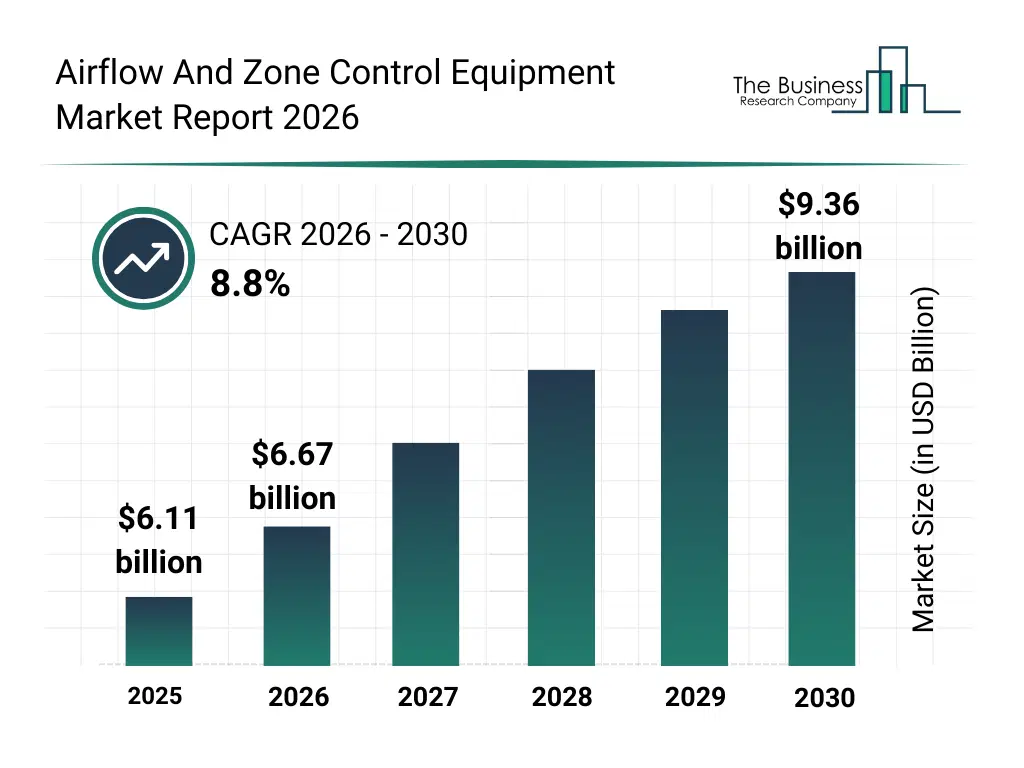
What Is The Airflow And Zone Control Equipment Market Size and Share 2026?
The airflow and zone control equipment market size has grown strongly in recent years. It will grow from $6.11 billion in 2025 to $6.67 billion in 2026 at a compound annual growth rate (CAGR) of 9.2%. The growth in the historic period can be attributed to commercial building expansion, hvac modernization, energy efficiency regulations, growth of urban housing, adoption of centralized air systems.What Is The Airflow And Zone Control Equipment Market Growth Forecast?
The airflow and zone control equipment market size is expected to see strong growth in the next few years. It will grow to $9.36 billion in 2030 at a compound annual growth rate (CAGR) of 8.8%. The growth in the forecast period can be attributed to smart building investments, net zero energy targets, demand for occupant comfort control, growth of green buildings, digital hvac monitoring adoption. Major trends in the forecast period include adoption of smart zoning systems, energy efficient air distribution solutions, demand for indoor air quality control, integration with building automation systems, retrofitting of hvac infrastructure.Tariff Impact On Airflow And Zone Control Equipment Market
Tariffs have impacted the airflow and zone control equipment market by increasing prices of actuators, controllers, and electronic sensors. North America and Asia Pacific are most affected. Installation costs have risen. At the same time, tariffs are promoting regional manufacturing of hvac components.
Global Airflow And Zone Control Equipment Market Segmentation
1) By Products: Variable Air Volume (VAV) Systems, Constant Air Volume (CAV) Systems, Dampers, Actuators, Controllers, Thermostats, Valves, Other Products 2) By Operation: Manual, Automatic 3) By Distribution Channel: Online, Retail Stores, Wholesale Stores, Other Distribution Channels 4) By Application: Commercial, Residential, Industrial 5) By End Users: Heating, Ventilation, And Air Conditioning (HVAC) Contractors, Building Owners, Facility Managers, System Integrators Subsegments: 1) By Variable Air Volume Systems: Single Duct, Dual Duct, Fan Powered, Pressure Independent, Pressure Dependent 2) By Constant Air Volume Systems: Single Duct, Dual Duct, Fan Powered, Zoned 3) By Dampers, Volume Control: Fire, Smoke, Combination, Backdraft, Pressure Relief 4) By Actuators: Electric, Pneumatic, Hydraulic, Electro Pneumatic 5) By Controllers: Programmable Logic, Digital, Analog, Remote 6) By Thermostats: Programmable, Non Programmable, Smart, Wireless 7) By Valves: Globe, Ball, Butterfly, Pressure Independent, Control 8) By Other Products: Sensors, Switches, Humidifiers, Dehumidifiers, Air CleanersWhat Is The Driver Of The Airflow And Zone Control Equipment Market?
The rising demand for smart building solutions is expected to propel the growth of the airflow and zone control equipment market going forward. Smart building solutions refer to technology-driven systems that integrate sensors, automation, and data analytics to optimize building operations such as energy use, airflow, lighting, and security. The rising demand for smart building solutions is largely driven by the growing need for energy efficiency, as these technologies help reduce energy consumption, lower costs, and support sustainable operations. Airflow and zone control equipment enhances smart building solutions by providing precise temperature and ventilation management, making them ideal for multi-zone residential and commercial spaces. They optimize energy usage by automatically adjusting airflow based on occupancy and environmental conditions, improving comfort and reducing operational costs. For instance, in July 2023, according to the Central Statistics Office, an Ireland-based government agency, 30% of internet users adopted smart solutions in households in 2024, up from 17% in 2022. Therefore, the rising demand for smart building solutions is driving the growth of the airflow and zone control equipment industry.Key Players In The Global Airflow And Zone Control Equipment Market
Major companies operating in the airflow and zone control equipment market are Siemens AG, Hitachi Ltd., Panasonic Holdings Corporation, Mitsubishi Electric Corporation, Daikin Industries Ltd., Carrier Global Corporation, Trane Technologies plc, Danfoss A/S, Greenheck Fan Corporation, Blue Star Limited, Zehnder Group International AG, Broan-NuTone LLC, CAREL Industries S.p.A, Aldes Groupe, KMC Controls Inc., EBTRON Inc., Zonefirst, Zonex Systems, Arzel Zoning Technology Inc., ACD Machine Control Company Private Limited
This chart is for illustrative purposes; the full report includes a detailed competitor analysis and comprehensive overview of the top 10 companies in the market.
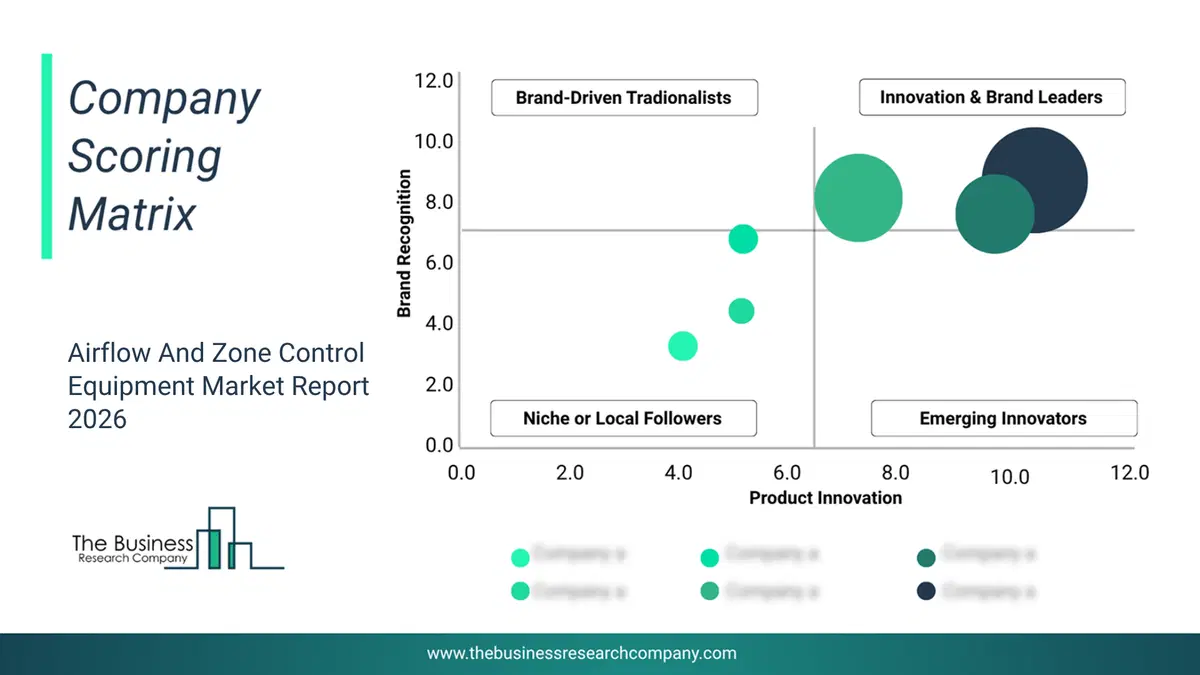
This chart maps companies by product innovation and brand strength, with bubble size indicating relative revenue, helping identify market leaders, challengers, and niche players. This is an illustrative chart; the full report provides a complete and accurate competitive analysis.
Global Airflow And Zone Control Equipment Market Trends and Insights
Major companies operating in the airflow and zone control equipment market are focusing on developing innovative solutions, such as plug-and-play zoning systems, to simplify installation and enhance energy efficiency, comfort, and easy heating, ventilation, and air conditioning (HVAC) integration. Plug-and-play zoning systems are pre-assembled HVAC solutions that can be quickly installed to provide precise temperature control in multiple zones while improving energy efficiency and reducing operational costs. For instance, in February 2023, Airzone, a Spain-based provider of HVAC control systems, launched the Easyzone, a customizable plug-and-play zoning solution designed to optimize airflow control and improve indoor air quality across various heating, ventilation, and air conditioning (HVAC) systems in residential and commercial buildings. This innovative airflow and zone control equipment features precision zoning capability and customizable control interfaces, enabling it to optimize environmental conditions, enhance energy efficiency, and support improved comfort and air quality. The Easyzone is highly versatile, enabling seamless integration with diverse heating, ventilation, and air conditioning (HVAC) systems to deliver precise zoning control and optimized airflow management, enhancing indoor comfort, energy efficiency, and air quality across residential and commercial environments.What Are Latest Mergers And Acquisitions In The Airflow And Zone Control Equipment Market?
In January 2025, Spectron Gas Control Systems GmbH, a Germany-based gas control equipment manufacturing company, acquired H. Lüdi + Co AG for an undisclosed amount. With this acquisition, Spectron Gas Control Systems aims to broaden its offerings in laboratory and cleanroom solutions and strengthen its position in the gas systems and lab installation market while better serving customers seeking integrated energy, airflow, and gas control solutions. H. Lüdi + Co AG is a Switzerland-based company specializing in airflow and zone control equipment for labs and cleanrooms.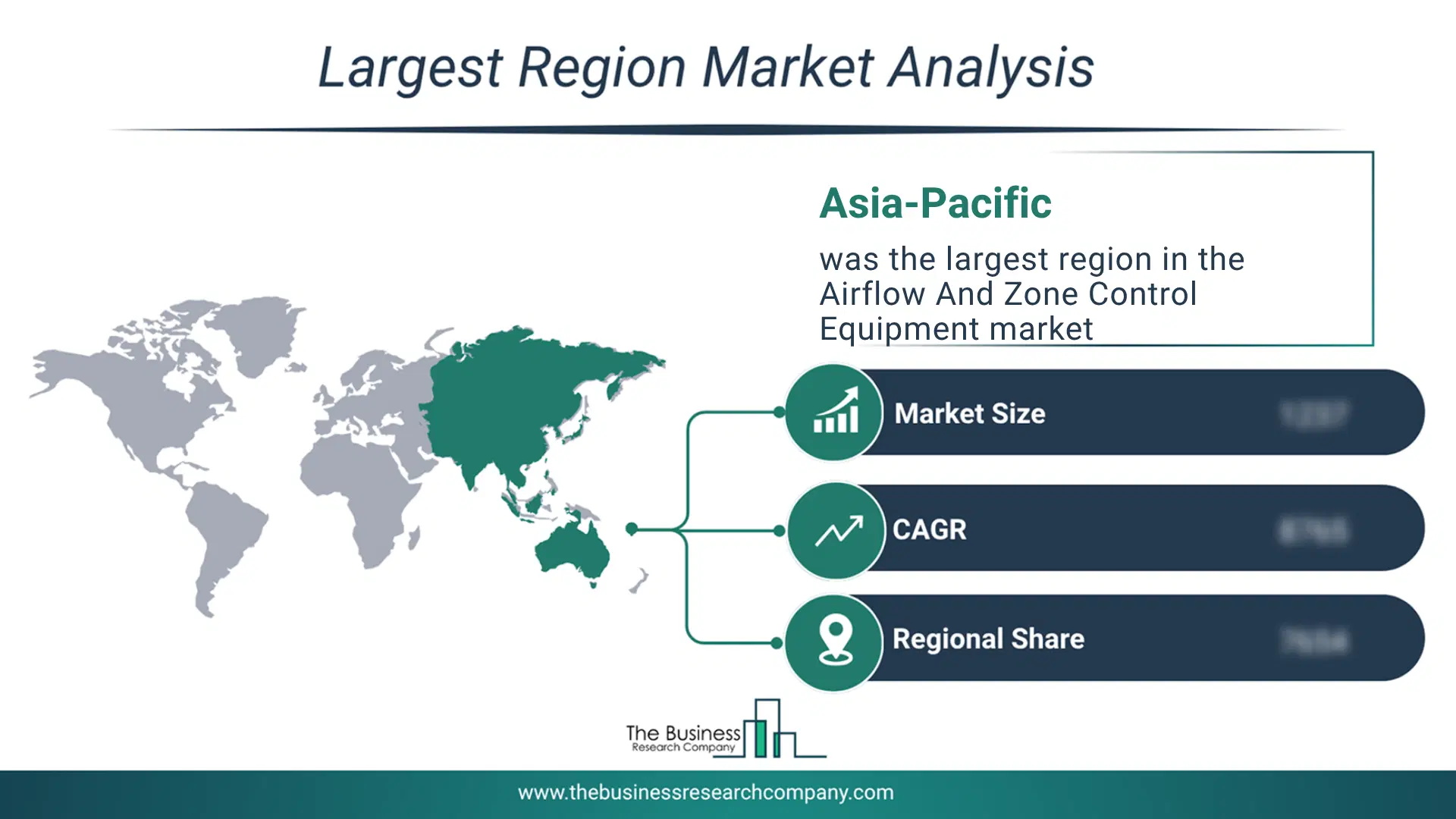
Regional Outlook
Asia-Pacific was the largest region in the airflow and zone control equipment market in 2025. North America is expected to be the fastest-growing region in the forecast period. The regions covered in this market report are Asia-Pacific, South East Asia, Western Europe, Eastern Europe, North America, South America, Middle East, Africa The countries covered in this market report are Australia, Brazil, China, France, Germany, India, Indonesia, Japan, Taiwan, Russia, South Korea, UK, USA, Canada, Italy, Spain.What Defines the Airflow And Zone Control Equipment Market?
The airflow and zone control equipment market consists of sales of diffusers and grilles, plenums and duct silencers, inline fans, centrifugal blowers, exhaust fans, building management system interfaces, communication modules, energy recovery units, humidifiers and dehumidifiers, air purifiers and filtration units, and heat exchangers. Values in this market are ‘factory gate’ values, that is the value of goods sold by the manufacturers or creators of the goods, whether to other entities (including downstream manufacturers, wholesalers, distributors and retailers) or directly to end customers. The value of goods in this market includes related services sold by the creators of the goods.How is Market Value Defined and Measured?
The market value is defined as the revenues that enterprises gain from the sale of goods and/or services within the specified market and geography through sales, grants, or donations in terms of the currency (in USD unless otherwise specified). The revenues for a specified geography are consumption values that are revenues generated by organizations in the specified geography within the market, irrespective of where they are produced. It does not include revenues from resales along the supply chain, either further along the supply chain or as part of other products.
This chart presents market attractiveness based on a quantitative evaluation of growth, competition, strategic alignment, and risk, offering a clear view of opportunity areas for decision-making. This chart is for illustrative purposes; the full report contains the complete analysis.

This chart highlights the Total Addressable Market (TAM) by estimating the maximum revenue opportunity using an assumption-driven approach, supporting strategic planning and opportunity sizing across markets. The chart is illustrative; the full report provides a more comprehensive analysis.
What Key Data and Analysis Are Included in the Airflow And Zone Control Equipment Market Report 2026?
The airflow and zone control equipment market research report is one of a series of new reports from The Business Research Company that provides market statistics, including industry global market size, regional shares, competitors with the market share, detailed market segments, market trends and opportunities, and any further data you may need to thrive in the airflow and zone control equipment industry. The market research report delivers a complete perspective of everything you need, with an in-depth analysis of the current and future state of the industry.Airflow And Zone Control Equipment Market Report Forecast Analysis
| Report Attribute | Details |
|---|---|
| Market Size Value In 2026 | $6.67 billion |
| Revenue Forecast In 2030 | $9.36 billion |
| Growth Rate | CAGR of 8.8% from 2026 to 2030 |
| Base Year For Estimation | 2025 |
| Actual Estimates/Historical Data | 2020-2025 |
| Forecast Period | 2026 - 2030 |
| Market Representation | Revenue in USD Billion and CAGR from 2026 to 2030 |
| Segments Covered | Products, Operation, Distribution Channel, Application, End Users |
| Regional Scope | Asia-Pacific, Western Europe, Eastern Europe, North America, South America, Middle East, Africa |
| Key Companies Profiled | Siemens AG, Hitachi Ltd., Panasonic Holdings Corporation, Mitsubishi Electric Corporation, Daikin Industries Ltd., Carrier Global Corporation, Trane Technologies plc, Danfoss A/S, Greenheck Fan Corporation, Blue Star Limited, Zehnder Group International AG, Broan-NuTone LLC, CAREL Industries S.p.A, Aldes Groupe, KMC Controls Inc., EBTRON Inc., Zonefirst, Zonex Systems, Arzel Zoning Technology Inc., ACD Machine Control Company Private Limited |
| Customization Scope | Request for Customization |
| Pricing And Purchase Options | Explore Purchase Options |