

Airport Fingerprint Reader Market Report 2026
Global Outlook – By Type ( Ordinary, Universal Serial Bus (USB)), By Deployment Type ( On-Premises, Cloud-Based), By Technology Type ( Optical Fingerprint Readers, Capacitive Fingerprint Readers, Ultrasonic Fingerprint Readers, Thermal Fingerprint Readers), By Application ( Check-In Process, Boarding Gate Access, Security Control Stations, Passenger Identification And Verification), By End-User ( Airports, Airlines, Security Agencies, Government Authorities) – Market Size, Trends, Strategies, and Forecast to 2030
Airport Fingerprint Reader Market Overview
• Airport Fingerprint Reader market size has reached to $1.21 billion in 2025 • Expected to grow to $1.94 billion in 2030 at a compound annual growth rate (CAGR) of 9.8% • Growth Driver: Rising Volume Of Air Passengers Fueling The Growth Of The Market Due To Increasing Demand For Secure And Efficient Passenger Identification • Market Trend: Innovations In Biometric Fingerprint Scanners For Airports • North America was the largest region and fastest growing region.What Is Covered Under Airport Fingerprint Reader Market?
An airport fingerprint reader is a biometric identification device designed to capture and analyze an individual’s fingerprint to verify their identity. These devices are integrated into various airport operations, including check-in kiosks, security checkpoints, boarding gates, and immigration counters. By matching a passenger's fingerprint with stored data, they help ensure secure, efficient, and contactless processing. The main types of airport fingerprint readers are ordinary and universal serial bus (USB). Ordinary type fingerprint readers are standard devices designed for general biometric identification tasks. They are typically fixed installations that provide basic fingerprint scanning for access control or identity verification. These are used for various deployment types, including on-premises and cloud-based, and the various technology types include optical fingerprint readers, capacitive fingerprint readers, ultrasonic fingerprint readers, and thermal fingerprint readers. These are applied in check-in processes, boarding gate access, security control stations, passenger identification and verification, and are used by various end users such as airports, airlines, security agencies, and government authorities.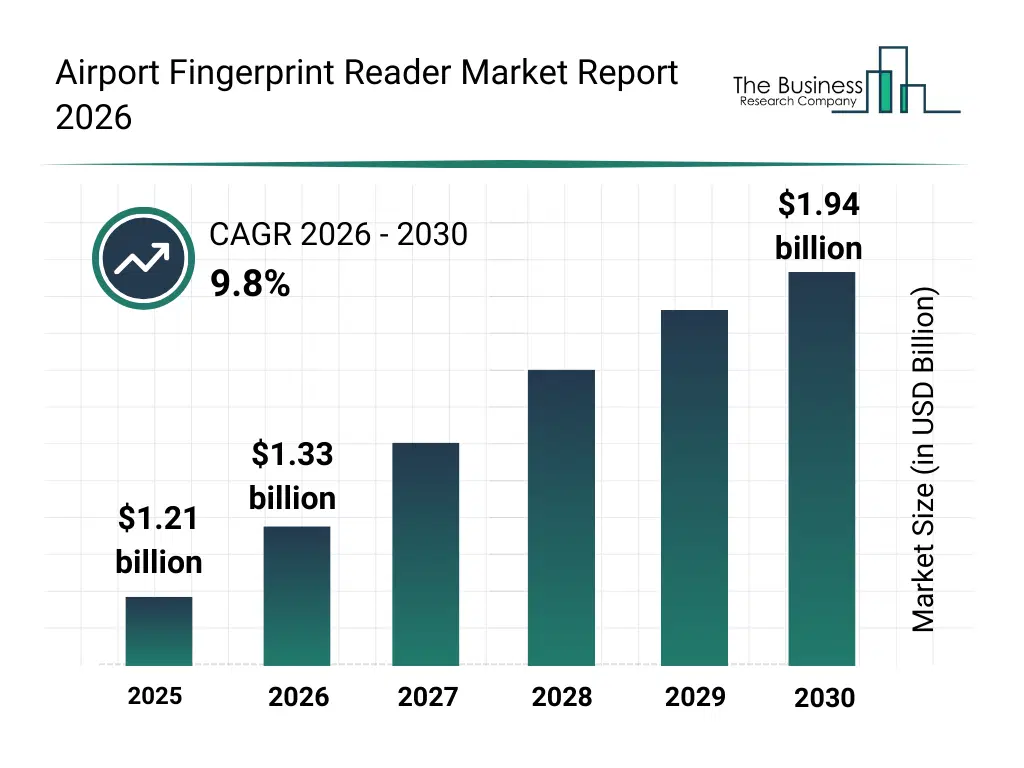
What Is The Airport Fingerprint Reader Market Size 2026 And Growth Rate?
The airport fingerprint reader market size has grown rapidly in recent years. It will grow from $1.21 billion in 2025 to $1.33 billion in 2026 at a compound annual growth rate (CAGR) of 10.2%. The growth in the historic period can be attributed to growing airport security concerns, increasing passenger traffic, adoption of biometric identification, government regulations on security, advancements in fingerprint scanning technology.What Is The Airport Fingerprint Reader Market Growth Forecast?
The airport fingerprint reader market size is expected to see strong growth in the next few years. It will grow to $1.94 billion in 2030 at a compound annual growth rate (CAGR) of 9.8%. The growth in the forecast period can be attributed to rise in smart airport initiatives, integration with AI and IoT, demand for contactless solutions, expansion of airport infrastructure, enhanced data analytics for passenger management. Major trends in the forecast period include contactless biometric verification, multi-modal biometric integration, real-time identity authentication, airport operational efficiency, enhanced passenger experience.
Global Airport Fingerprint Reader Market Segmentation
1) By Type: Ordinary, Universal Serial Bus (USB) 2) By Deployment Type: On-Premises, Cloud-Based 3) By Technology Type: Optical Fingerprint Readers, Capacitive Fingerprint Readers, Ultrasonic Fingerprint Readers, Thermal Fingerprint Readers 4) By Application: Check-In Process, Boarding Gate Access, Security Control Stations, Passenger Identification And Verification 5) By End-User: Airports, Airlines, Security Agencies, Government Authorities Subsegments: 1) By Ordinary Type: Optical Fingerprint Readers, Capacitive Fingerprint Readers, Thermal Fingerprint Readers, Pressure-Based Fingerprint Readers 2) By Universal Serial Bus (USB) Type: USB 2.0 Fingerprint Readers, USB 3.0 Fingerprint Readers, Plug-And-Play USB Fingerprint Modules, Encrypted USB Fingerprint DevicesWhat Is The Driver Of The Airport Fingerprint Reader Market?
The rising volume of air passengers is expected to propel the growth of the airport fingerprint reader market going forward. Air passengers refer to people who travel by airplane from one place to another for reasons such as work, vacation, or personal needs. The rising volume of air passengers is due to economic growth because increasing disposable incomes and an expanding middle-class population worldwide enable more people to afford air travel. The rising volume of air passengers is helping airport fingerprint reader adoption by increasing the need for faster and more secure passenger identification, encouraging airports to implement biometric systems that reduce wait times, enhance security, and improve the overall travel experience. For instance, in January 2023, according to a report published by the International Trade Administration, a US-based government agency, US international air traffic passengers numbered 20.468 million in January 2024, up 13.5% compared to January 2023. Therefore, the rising volume of air passengers is driving the growth of the airport fingerprint reader industry.Key Players In The Global Airport Fingerprint Reader Market
Major companies operating in the airport fingerprint reader market are NEC Corporation, Thales Group, IDEMIA, Precise Biometrics AB, Bio-Key International Inc., HID Global Corporation, Fujitsu, Secunet Security Networks AG, Vision-Box, Anviz Global Inc., Aware Inc., SITA, Indra Sistemas, S.A., Gunnebo AB, Assa Abloy, Mantra Softech India Pvt Ltd, ZKTeco, SecuGen Corporation, Nitgen Co. Ltd., Suprema Inc., IDloop GmbH, DERMALOG Identification Systems GmbH, M2SYS Technology Inc., BioEnable Technologies
This chart is for illustrative purposes; the full report includes a detailed competitor analysis and comprehensive overview of the top 10 companies in the market.
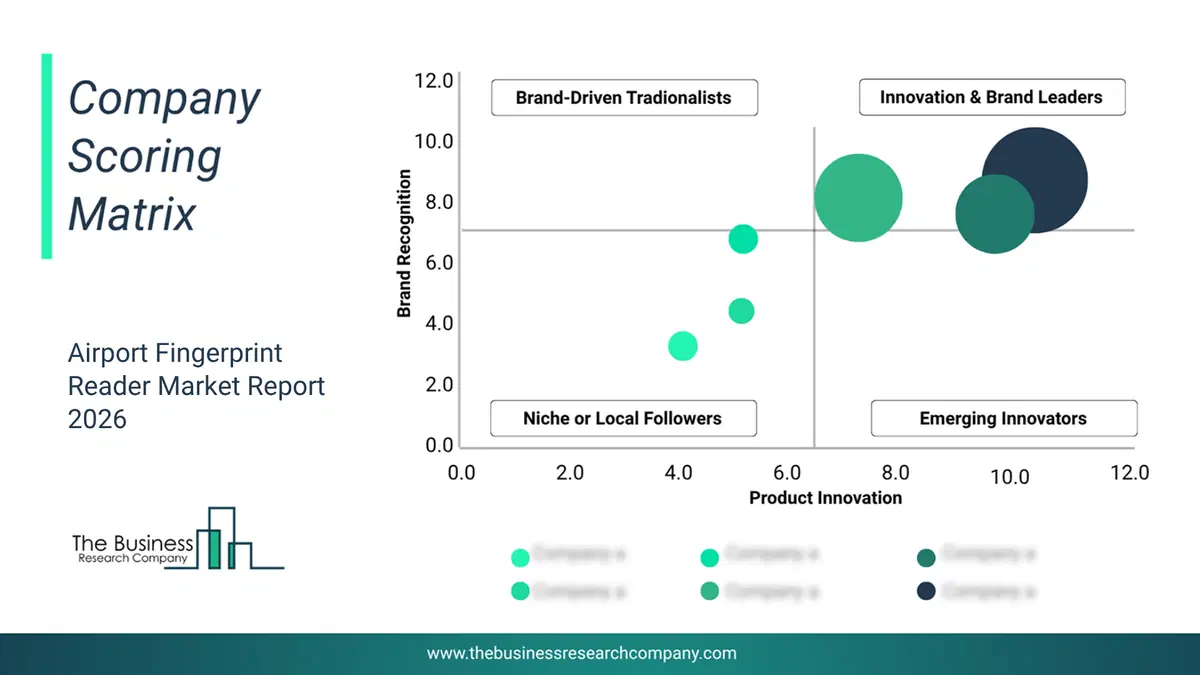
This chart maps companies by product innovation and brand strength, with bubble size indicating relative revenue, helping identify market leaders, challengers, and niche players. This is an illustrative chart; the full report provides a complete and accurate competitive analysis.
Global Airport Fingerprint Reader Market Trends and Insights
Major companies operating in the airport fingerprint reader market are focusing on advancements in fingerprint recognition systems, such as 3D contactless fingerprint biometric scanners, to enhance accuracy, speed, and security in passenger identification processes. A 3D contactless fingerprint biometrics scanner refers to a type of biometric device that captures high-resolution, three-dimensional images of a person’s fingerprint without requiring any physical contact. For instance, in June 2024, IDloop, a Germany-based biometric security company, introduced CFS Flats, an optical contactless fingerprint scanner that incorporates advanced 3D imaging technology. The CFS Flats scanner offers unique features such as contactless 3D fingerprint capture, high-resolution imaging with over 5 million data points, rapid scan speeds under 100 milliseconds, and robust performance across all skin types and lighting conditions, making it ideal for secure, hygienic, and high-throughput environments such as airports.What Are Latest Mergers And Acquisitions In The Airport Fingerprint Reader Market?
In January 2024, Amadeus IT Group S.A., a Spain-based technology company, acquired Vision-Box HQ for $345.6 million. With this acquisition, it aims to strengthen its portfolio in biometric and identity management technologies, enhancing its capabilities in secure and seamless passenger processing solutions across the travel and transportation sectors. Vision-Box HQ is a Portugal-based biometric company that specializes in airport fingerprint readers.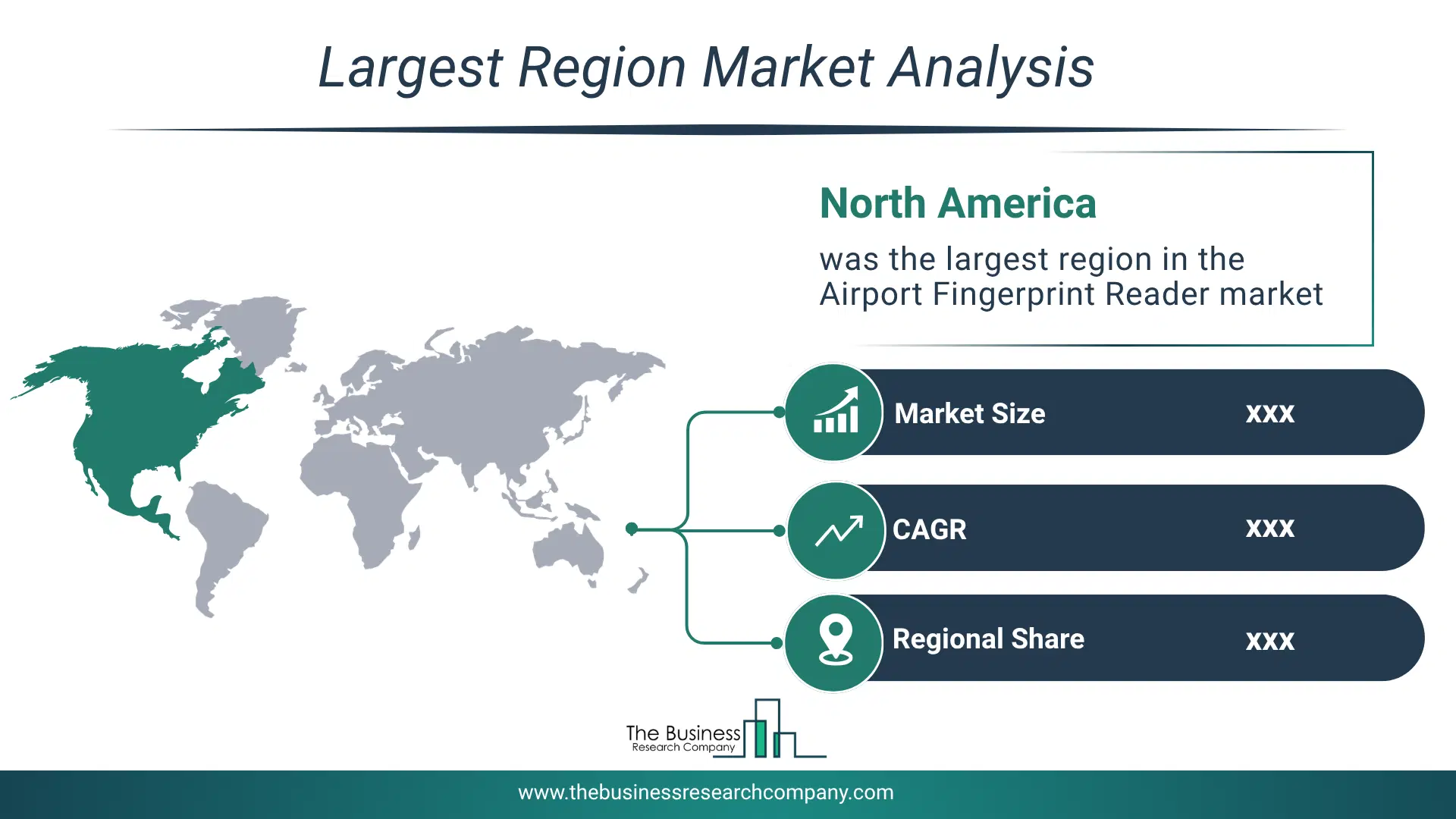
Regional Outlook
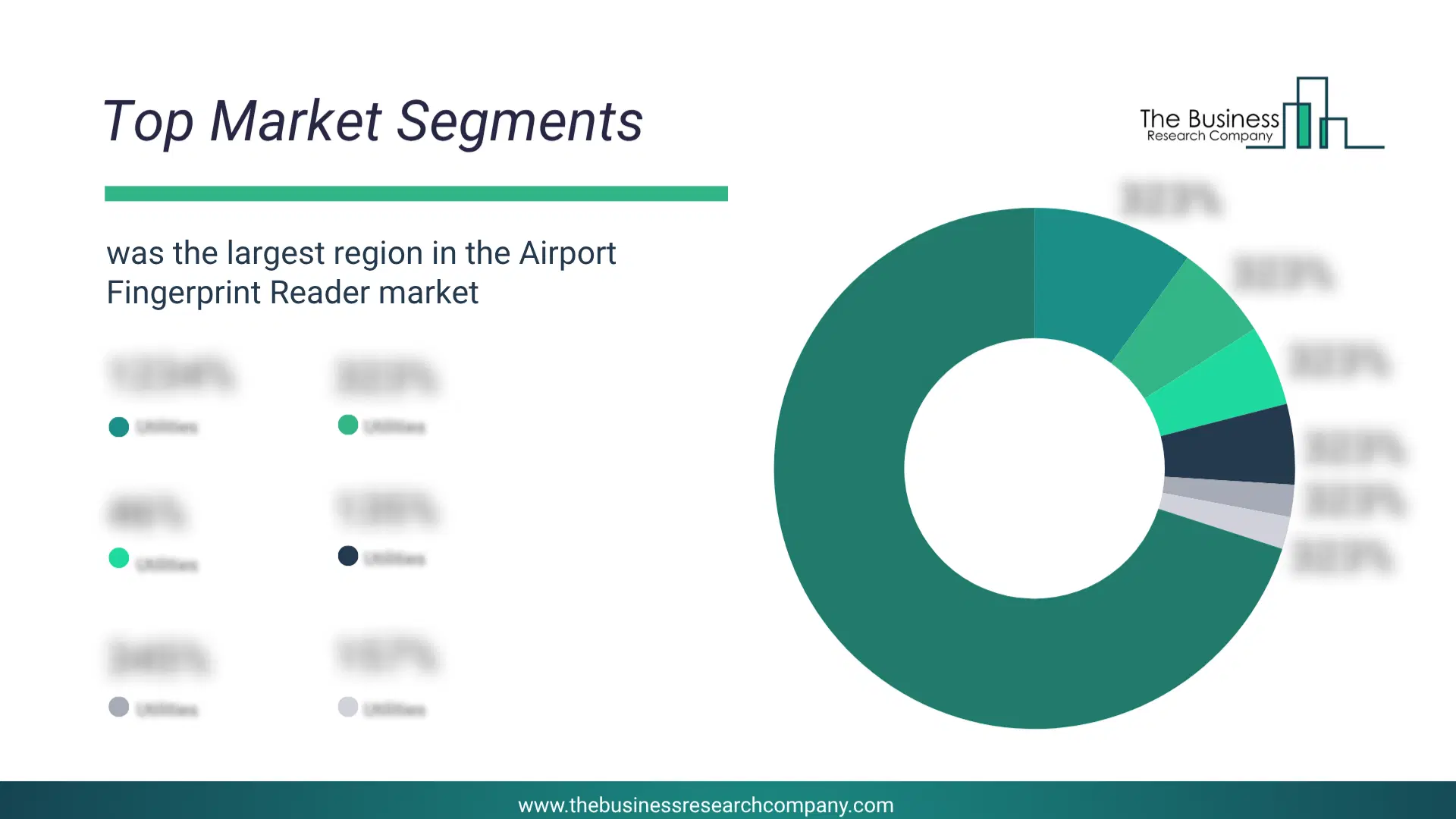
North America was the largest region in the airport fingerprint reader market in 2025, and it is expected to be the fastest-growing region in the forecast period. The regions covered in this market report are Asia-Pacific, South East Asia, Western Europe, Eastern Europe, North America, South America, Middle East, Africa. The countries covered in this market report are Australia, Brazil, China, France, Germany, India, Indonesia, Japan, Taiwan, Russia, South Korea, UK, USA, Canada, Italy, Spain.What Defines the Airport Fingerprint Reader Market?
The airport fingerprint reader market consists of revenues earned by entities by providing services such as fingerprint scanning, biometric identity verification, passenger authentication, access control, and security management. The market value includes the value of related goods sold by the service provider or included within the service offering. The airport fingerprint reader market also includes sales of fingerprint scanners, biometric terminals, fingerprint sensors, integrated biometric systems, and related hardware and software. Values in this market are ‘factory gate’ values, that is the value of goods sold by the manufacturers or creators of the goods, whether to other entities (including downstream manufacturers, wholesalers, distributors and retailers) or directly to end customers. The value of goods in this market includes related services sold by the creators of the goods.How is Market Value Defined and Measured?
The market value is defined as the revenues that enterprises gain from the sale of goods and/or services within the specified market and geography through sales, grants, or donations in terms of the currency (in USD unless otherwise specified). The revenues for a specified geography are consumption values that are revenues generated by organizations in the specified geography within the market, irrespective of where they are produced. It does not include revenues from resales along the supply chain, either further along the supply chain or as part of other products.
This chart presents market attractiveness based on a quantitative evaluation of growth, competition, strategic alignment, and risk, offering a clear view of opportunity areas for decision-making. This chart is for illustrative purposes; the full report contains the complete analysis.

This chart highlights the Total Addressable Market (TAM) by estimating the maximum revenue opportunity using an assumption-driven approach, supporting strategic planning and opportunity sizing across markets. The chart is illustrative; the full report provides a more comprehensive analysis.
What Key Data and Analysis Are Included in the Airport Fingerprint Reader Market Report 2026?
The airport fingerprint reader market research report is one of a series of new reports from The Business Research Company that provides market statistics, including industry global market size, regional shares, competitors with the market share, detailed market segments, market trends and opportunities, and any further data you may need to thrive in the airport fingerprint reader industry. The market research report delivers a complete perspective of everything you need, with an in-depth analysis of the current and future state of the industry.Airport Fingerprint Reader Market Report Forecast Analysis
| Report Attribute | Details |
|---|---|
| Market Size Value In 2026 | $1.33 billion |
| Revenue Forecast In 2030 | $1.94 billion |
| Growth Rate | CAGR of 9.8% from 2026 to 2030 |
| Base Year For Estimation | 2025 |
| Actual Estimates/Historical Data | 2020-2025 |
| Forecast Period | 2026 - 2030 |
| Market Representation | Revenue in USD Billion and CAGR from 2026 to 2030 |
| Segments Covered | Type, Deployment Type, Technology Type, Application, End-User |
| Regional Scope | Asia-Pacific, Western Europe, Eastern Europe, North America, South America, Middle East, Africa |
| Country Scope | The countries covered in the report are Australia, Brazil, China, France, Germany, India, Indonesia, Japan, Taiwan, Russia, South Korea, UK, USA, Canada, Italy, Spain. |
| Key Companies Profiled | NEC Corporation, Thales Group, IDEMIA, Precise Biometrics AB, Bio-Key International Inc., HID Global Corporation, Fujitsu, Secunet Security Networks AG, Vision-Box, Anviz Global Inc., Aware Inc., SITA, Indra Sistemas, S.A., Gunnebo AB, Assa Abloy, Mantra Softech India Pvt Ltd, ZKTeco, SecuGen Corporation, Nitgen Co. Ltd., Suprema Inc., IDloop GmbH, DERMALOG Identification Systems GmbH, M2SYS Technology Inc., BioEnable Technologies |
| Customization Scope | Request for Customization |
| Pricing And Purchase Options | Explore Purchase Options |