
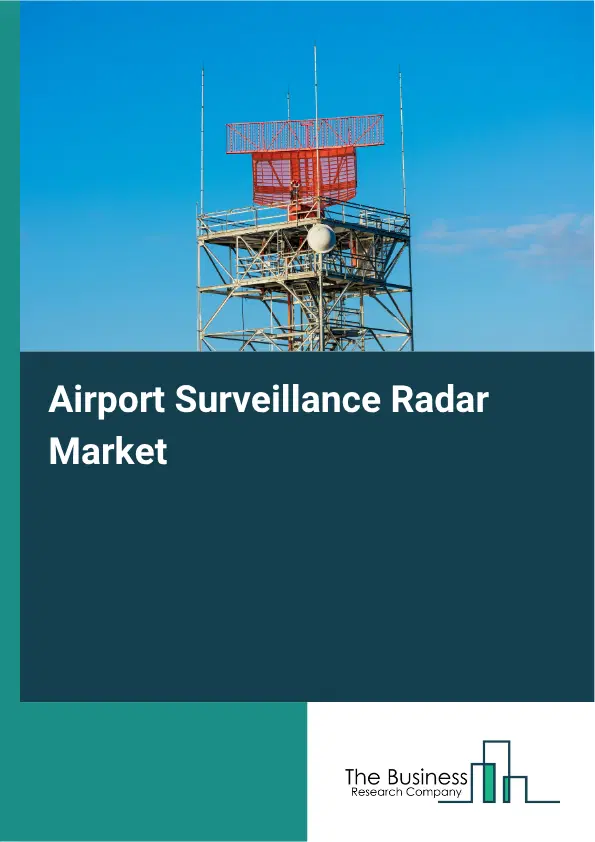
Airport Surveillance Radar Market Report 2026
Global Outlook – By Type (Primary Surveillance Radar, Secondary Surveillance Radar, Multilateration Systems, Mode S Radar), By Range of Operation (Short Range Radar, Medium Range Radar, Long Range Radar, Very Long Range Radar), By Application (Air Traffic Control, Ground Surveillance, Weather Monitoring, Airspace Management), By End User (Commercial Airports, Military Airports, Private Aviation, Heliports) – Market Size, Trends, Strategies, and Forecast to 2035
Airport Surveillance Radar Market Overview
• Airport Surveillance Radar market size has reached to $9.89 billion in 2025 • Expected to grow to $15.12 billion in 2030 at a compound annual growth rate (CAGR) of 8.8% • Growth Driver: Growing Air Traffic Fueling The Growth Of The Market Due To Rising Demand For Accurate Aircraft Detection, Tracking, And Airspace Monitoring • Market Trend: Multi-Beam Surveillance Radar Improves Airport Airspace Monitoring • North America was the largest region in 2025 and Asia-Pacific is the fastest growing region.What Is Covered Under Airport Surveillance Radar Market?
Airport surveillance radar (ASR) is a ground-based radar system used to detect and track aircraft operating within and around an airport's terminal airspace. It provides surveillance information to air traffic controllers to support the safe management of aircraft arrivals and departures, enhance situational awareness, and maintain safe aircraft separation under varying weather and visibility conditions. The main types of airport surveillance radar include primary surveillance radar, secondary surveillance radar, multilateration systems, and Mode S radar. Primary surveillance radar refers to radar systems that detect and track aircraft by transmitting radio signals and analyzing their reflections, without relying on onboard transponder responses. These systems operate across short range radar, medium range radar, long range radar, and very long range radar categories. The various applications involved are air traffic control, ground surveillance, weather monitoring, and airspace management and they are utilized by end users including commercial airports, military airports, private aviation, and heliports.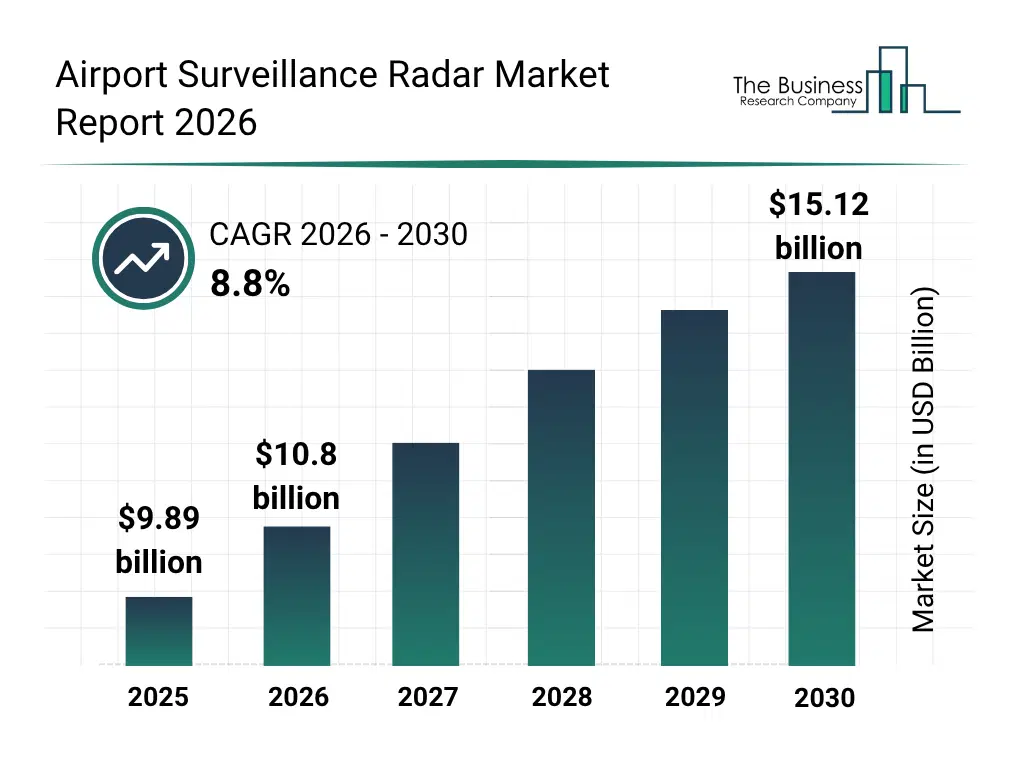
What Is The Airport Surveillance Radar Market Size and Share 2026?
The airport surveillance radar market size has grown strongly in recent years. It will grow from $9.89 billion in 2025 to $10.8 billion in 2026 at a compound annual growth rate (CAGR) of 9.2%. The growth in the historic period can be attributed to increasing aircraft movements at major airports, rising demand for reliable air traffic surveillance, growing airport congestion, increasing airspace safety requirements, expanding airport infrastructure capacity.What Is The Airport Surveillance Radar Market Growth Forecast?
The airport surveillance radar market size is expected to see strong growth in the next few years. It will grow to $15.12 billion in 2030 at a compound annual growth rate (CAGR) of 8.8%. The growth in the forecast period can be attributed to increasing demand for high-precision aircraft tracking, rising adoption of next-generation surveillance infrastructure, growing need for enhanced airport surface monitoring, increasing demand for integrated air traffic surveillance, expanding modernization of air traffic control infrastructure. Major trends in the forecast period include increasing deployment of advanced secondary surveillance radar systems, rising adoption of multilateration for airport surface surveillance, growing integration of mode s radar for aircraft identification, increasing demand for all-weather airport surveillance capabilities, expanding use of surface movement radar for ground traffic monitoring.Tariff Impact On Airport Surveillance Radar Market
Tariffs are impacting the airport surveillance radar market by increasing the cost of imported radar components, antennas, signal processors, semiconductor devices, and specialized surveillance equipment required for airport radar deployments. This is raising procurement and installation costs and may delay radar replacement and modernization projects, particularly in regions dependent on imported radar technologies such as Asia-Pacific and Latin America. Hardware-intensive segments such as primary surveillance radar, secondary surveillance radar, multilateration systems, and Mode S radar are most affected due to global component supply chain dependencies. However, tariffs are also encouraging local manufacturing, regional supplier diversification, and increased investment in domestic radar production capabilities, creating greater long-term supply chain resilience.
Global Airport Surveillance Radar Market Segmentation
2) By Range of Operation: Short Range Radar, Medium Range Radar, Long Range Radar, Very Long Range Radar 3) By Application: Air Traffic Control, Ground Surveillance, Weather Monitoring, Airspace Management 4) By End User: Commercial Airports, Military Airports, Private Aviation, Heliports Subsegments: 1) By Primary Surveillance Radar: Long Range Primary Surveillance Radar, Medium Range Primary Surveillance Radar, Short Range Primary Surveillance Radar, Surface Movement Radar 2) By Secondary Surveillance Radar: Monopulse Secondary Surveillance Radar, Conventional Secondary Surveillance Radar 3) By Multilateration Systems: Surface Multilateration, Wide Area Multilateration 4) By Mode S Radar: Elementary Surveillance Mode S, Enhanced Surveillance Mode SWhat Is The Driver Of The Airport Surveillance Radar Market?
The growing air traffic is expected to propel the growth of the airport surveillance radar market going forward. Air traffic refers to the movement of aircraft carrying passengers or cargo through controlled airspace and airports over a specific period. The growth in air traffic is driven by rising disposable incomes, as higher household earnings enable more people to afford air travel for business and leisure purposes. Growing air traffic drives demand for airport surveillance radar by increasing the need for accurate aircraft detection, tracking, and airspace monitoring to ensure safe and efficient airport operations. For instance, in August 2026, according to the International Air Transport Association (IATA), a Canada-based trade association, domestic demand increased by 0.6% compared with July 2025, while capacity grew by 0.2% year-on-year. Therefore, the growing air traffic is driving the growth of the airport surveillance radar industry.Key Players In The Global Airport Surveillance Radar Market
Major companies operating in the airport surveillance radar market are RTX Corporation, Lockheed Martin Corporation, Thales, Northrop Grumman Corporation, Leonardo S.p.A., Mitsubishi Electric Corporation, L3Harris Technologies Inc., Indra Sistemas S.A., Saab AB, NEC Corporation, BAE Systems plc, Israel Aerospace Industries Ltd., Bharat Electronics Limited, Aselsan A.Ş., Elbit Systems Ltd., Terma A/S, Blighter Surveillance Systems Limited, DeTect Inc., Cambridge Pixel Ltd., Easat Radar Systems Limited, Hensoldt AG, Frequentis AG
This chart is for illustrative purposes; the full report includes a detailed competitor analysis and comprehensive overview of the top 10 companies in the market.
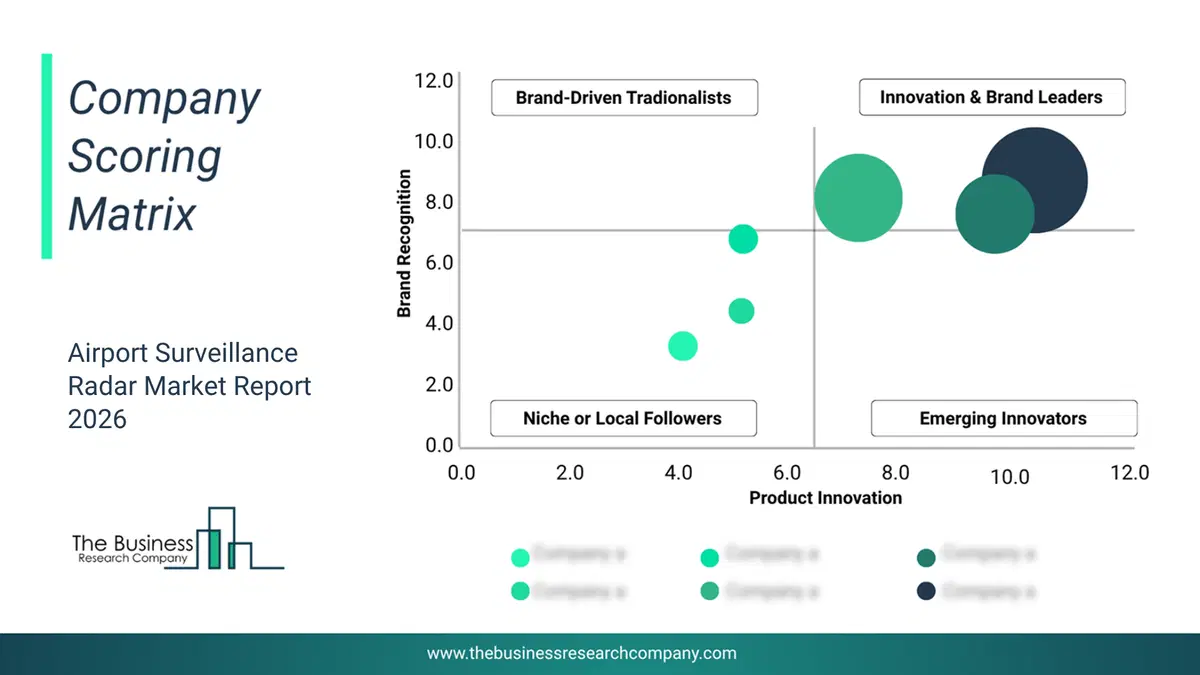
This chart maps companies by product innovation and brand strength, with bubble size indicating relative revenue, helping identify market leaders, challengers, and niche players. This is an illustrative chart; the full report provides a complete and accurate competitive analysis.
Global Airport Surveillance Radar Market Trends and Insights
Major companies operating in the airport surveillance radar market are focusing on developing advanced solutions, such as solid-state surface movement radar systems, to improve aircraft and vehicle detection, tracking accuracy, airport situational awareness, and operational safety. Solid-state surface movement radar systems refer to radar technologies that use solid-state electronics to continuously detect and track aircraft and ground vehicles across airport runways and taxiways, providing reliable surveillance and enhanced visibility of airport surface operations. For instance, in February 2026, Saab AB, a Sweden-based aerospace and defense company, partnered with the Federal Aviation Administration (FAA) to modernize surface movement radar systems at 44 U.S. airports by replacing legacy ASDE-3 and SMRi radars with Saab's SR-3-based systems. The systems are designed to provide reliable surface surveillance and improve airport situational awareness, operational reliability, and safety.What Are Latest Mergers And Acquisitions In The Airport Surveillance Radar Market?
In July 2026, Thales, a France-based aerospace and defense company, partnered with Ankaa Space and Technologies to deploy one TRAC SIGMA primary surveillance radar and two RSM NG secondary surveillance radars in Oman. The partnership aims to strengthen the country's air traffic surveillance infrastructure and support the modernization of civil and military airspace operations. Ankaa Space and Technologies is an Oman-based aerospace and technology company specializing in space, satellite, and advanced technology solutions.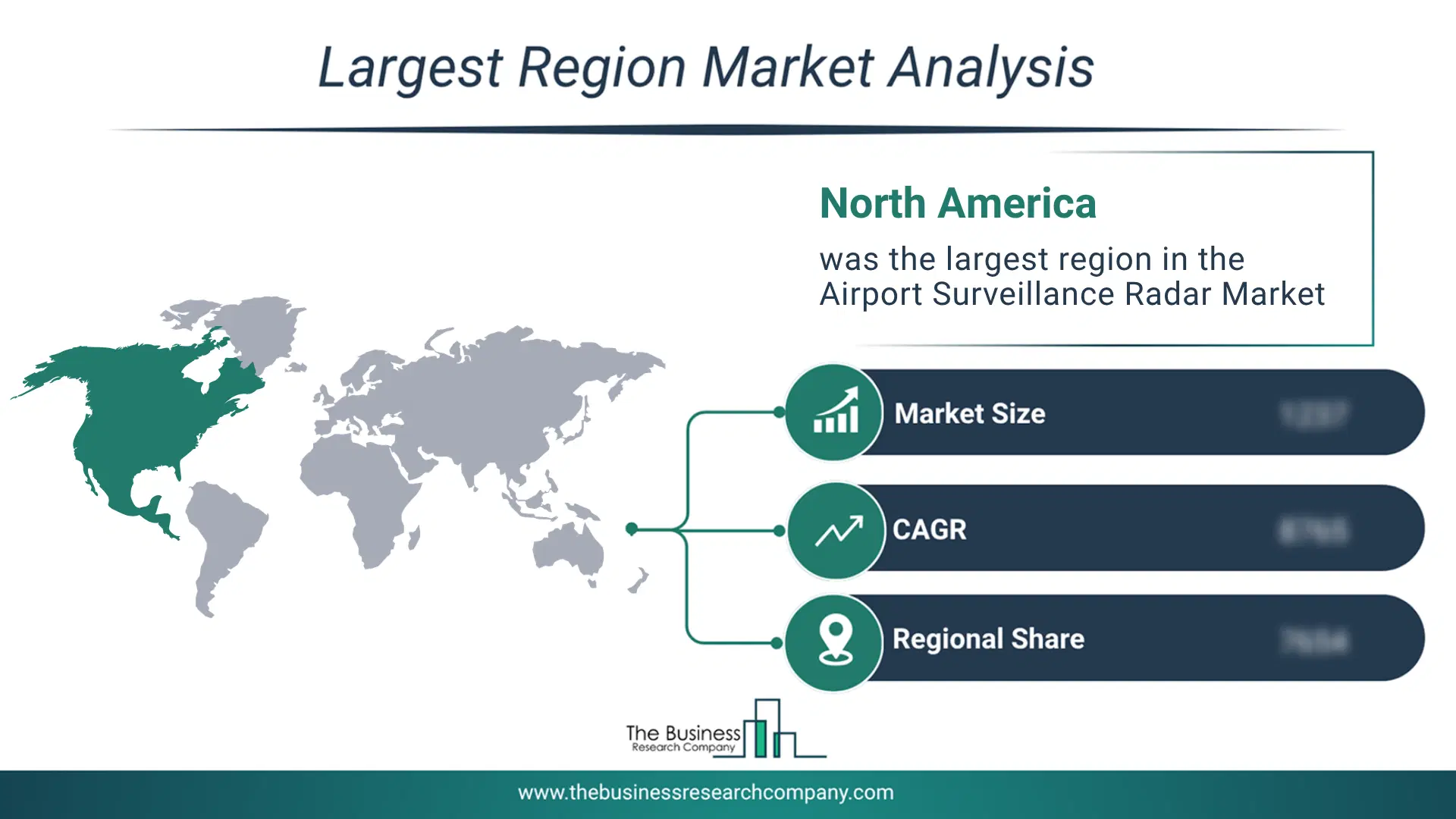
Regional Outlook/Insights
North America was the largest region in the airport surveillance radar market in 2025. Asia-Pacific is expected to be the fastest-growing region in the forecast period. The regions covered in this market report are Asia-Pacific, South East Asia, Western Europe, Eastern Europe, North America, South America, Middle East, Africa. The countries covered in this market report are Australia, Brazil, China, France, Germany, India, Indonesia, Japan, Taiwan, Russia, South Korea, UK, USA, Canada, Italy, Spain.What Defines the Airport Surveillance Radar Market?
The airport surveillance radar market consists of sales of radar antennas, radar sensor units, transceivers, tracking and detection modules, radar control units, monitoring consoles, communication interfaces, power supply units, and integrated surveillance radar systems. Values in this market are ‘factory gate’ values, that is the value of goods sold by the manufacturers or creators of the goods, whether to other entities (including downstream manufacturers, wholesalers, distributors and retailers) or directly to end customers. The value of goods in this market includes related services sold by the creators of the goods.How is Market Value Defined and Measured?
The market value is defined as the revenues that enterprises gain from the sale of goods and/or services within the specified market and geography through sales, grants, or donations in terms of the currency (in USD unless otherwise specified). The revenues for a specified geography are consumption values that are revenues generated by organizations in the specified geography within the market, irrespective of where they are produced. It does not include revenues from resales along the supply chain, either further along the supply chain or as part of other products.
This chart presents market attractiveness based on a quantitative evaluation of growth, competition, strategic alignment, and risk, offering a clear view of opportunity areas for decision-making. This chart is for illustrative purposes; the full report contains the complete analysis.

This chart highlights the Total Addressable Market (TAM) by estimating the maximum revenue opportunity using an assumption-driven approach, supporting strategic planning and opportunity sizing across markets. The chart is illustrative; the full report provides a more comprehensive analysis.
What Key Data and Analysis Are Included in the Airport Surveillance Radar Market Report 2026?
The airport surveillance radar market research report is one of a series of new reports from The Business Research Company that provides market statistics, including industry global market size, regional shares, competitors with the market share, detailed market segments, market trends and opportunities, and any further data you may need to thrive in the airport surveillance radar industry. The market research report delivers a complete perspective of everything you need, with an in-depth analysis of the current and future state of the industry.Airport Surveillance Radar Market Report Forecast Analysis
| Report Attribute | Details |
|---|---|
| Market Size Value In 2026 | $10.8 billion |
| Revenue Forecast In 2030 | $15.12 billion |
| Growth Rate | CAGR of 8.8% from 2026 to 2035 |
| Base Year For Estimation | 2025 |
| Actual Estimates/Historical Data | 2020-2025 |
| Forecast Period | 2026 - 2030 |
| Market Representation | Revenue in USD Billion and CAGR from 2026 to 2030 |
| Segments Covered | Type, Range of Operation, Application, End User |
| Regional Scope | Asia-Pacific, Western Europe, Eastern Europe, North America, South America, Middle East, Africa |
| Country Scope | The countries covered in the report are Australia, Brazil, China, France, Germany, India, Indonesia, Japan, Taiwan, Russia, South Korea, UK, USA, Canada, Italy, Spain. |
| Customization Scope | Request for Customization |
| Pricing And Purchase Options | Explore Purchase Options |