
Algorithmic Trading Software Market Report 2026
Global Outlook – By Component (Solutions, Services), By Deployment (Cloud-Based, On-Premise), By Application (Investment Banks, Funds, Personal Investors, Other Applications) – Market Size, Trends, Strategies, and Forecast to 2030
Algorithmic Trading Software Market Overview
• Algorithmic Trading Software market size has reached to $2.74 billion in 2025 • Expected to grow to $4.11 billion in 2030 at a compound annual growth rate (CAGR) of 8.2% • Growth Driver: The Impact Of Cloud-Based Solutions On The Growth Of Algorithmic Trading Software Market • Market Trend: Innovations In Artificial Intelligence (AI) Technology Enhance Algorithmic Execution And Trading Performance • North America was the largest region in 2025 and Asia-Pacific is the fastest growing region.What Is Covered Under Algorithmic Trading Software Market?
Algorithmic trading software automates the execution of trading strategies based on predefined rules and algorithms. It enables traders to execute large orders at optimal prices and speeds by leveraging mathematical models and data analysis. This software facilitates rapid decision-making, reduces human error, and enhances trading efficiency in financial markets. The main types of components of algorithmic trading software are solutions and services. Algorithmic trading software solutions offer traders the tools and functionalities they need to develop, test, and execute their trading strategies. The various products include algorithmic trading software, and algorithmic trading platforms that are deployed through cloud-based, on-premise. These are used in various applications such as investment banks, funds, personal investors, and others.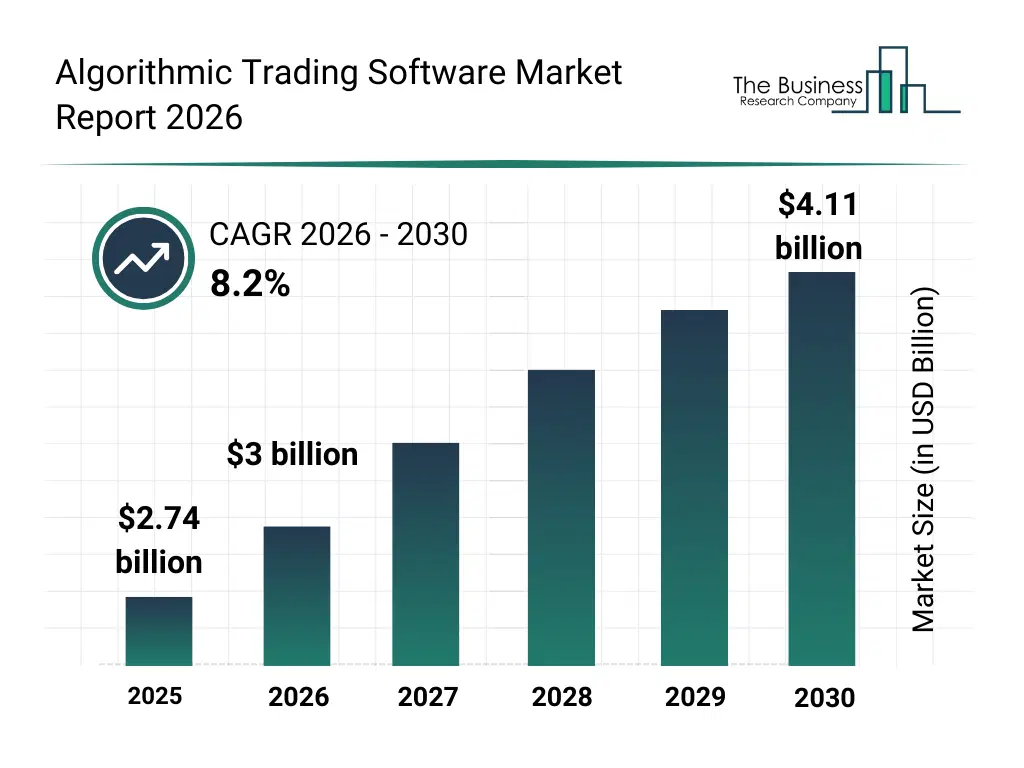
What Is The Algorithmic Trading Software Market Size and Share 2026?
The algorithmic trading software market size has grown strongly in recent years. It will grow from $2.74 billion in 2025 to $3 billion in 2026 at a compound annual growth rate (CAGR) of 9.7%. The growth in the historic period can be attributed to increasing use of electronic trading software, growing demand for automated execution tools, expansion of multi-asset trading platforms, adoption of quantitative analysis techniques, rising availability of market data feeds.What Is The Algorithmic Trading Software Market Growth Forecast?
The algorithmic trading software market size is expected to see strong growth in the next few years. It will grow to $4.11 billion in 2030 at a compound annual growth rate (CAGR) of 8.2%. The growth in the forecast period can be attributed to increasing shift toward SaaS-based trading software, rising demand for real-time analytics platforms, expansion of AI-powered trading solutions, growing focus on regulatory-compliant software, increasing integration with financial ecosystems. Major trends in the forecast period include increasing adoption of cloud-based trading platforms, rising use of advanced backtesting and simulation tools, growing integration of ai-driven trading signals, expansion of end-to-end algorithm deployment solutions, enhanced focus on scalability and reliability.
Global Algorithmic Trading Software Market Segmentation
1) By Component: Solutions, Services 2) By Deployment: Cloud-Based, On-Premise 3) By Application: Investment Banks, Funds, Personal Investors, Other Applications Subsegments: 1) By Solutions: Trading Algorithms, Risk Management Solutions, Market Data Feeds, Backtesting Solutions, Order Execution Management Systems (Oems), Portfolio Management Solutions 2) By Services: Consulting And Advisory Services, Implementation And Integration Services, Managed Services, Maintenance And Support Services, Training And Education ServicesWhat Is The Driver Of The Algorithmic Trading Software Market?
The rise of cloud-based trading solutions is expected to propel the growth of the algorithmic trading software market going forward. Cloud-based refers to services and applications that are hosted on remote servers accessed via the internet rather than being stored on local devices. The increase in cloud-based services is driven by the need for greater flexibility, cost savings, and easy access to data from anywhere. Algorithmic trading software benefits from cloud-based solutions by enabling faster data processing, real-time analytics, and easier scalability for trading strategies without the need for extensive local infrastructure. For instance, in December 2023, according to Eurostat, Luxembourg -based government agency in 2023, 45% of businesses in the EU bought cloud computing services. Further, in 2023, 78% of large businesses bought cloud services, while 44% of SMEs did. Therefore, the rise of cloud-based trading solutions is driving the algorithmic trading software industry.Key Players In The Global Algorithmic Trading Software Market
Major companies operating in the algorithmic trading software market are AlgoTrader AG, Interactive Brokers LLC, Virtu Financial, Flow Traders Ltd., DRW Holdings LLC, TradeStation Group Inc., Tower Research Capital LLC, Hudson River Trading LLC, Jump Trading LLC, FlexTrade Systems Inc., NinjaTrader Group LLC, Trading Technologies International Inc., MetaQuotes Software Corp., Teza Technologies, RSJ Group, Quantlab Financial LLC, Tradebot Systems Inc, Tethys Technology Inc., IQBroker LLC, QuantRocket, Sierra Chart, QuantConnect Corporation, StockSharp, Wealth-Lab, Python Quants GmbH
This chart is for illustrative purposes; the full report includes a detailed competitor analysis and comprehensive overview of the top 10 companies in the market.
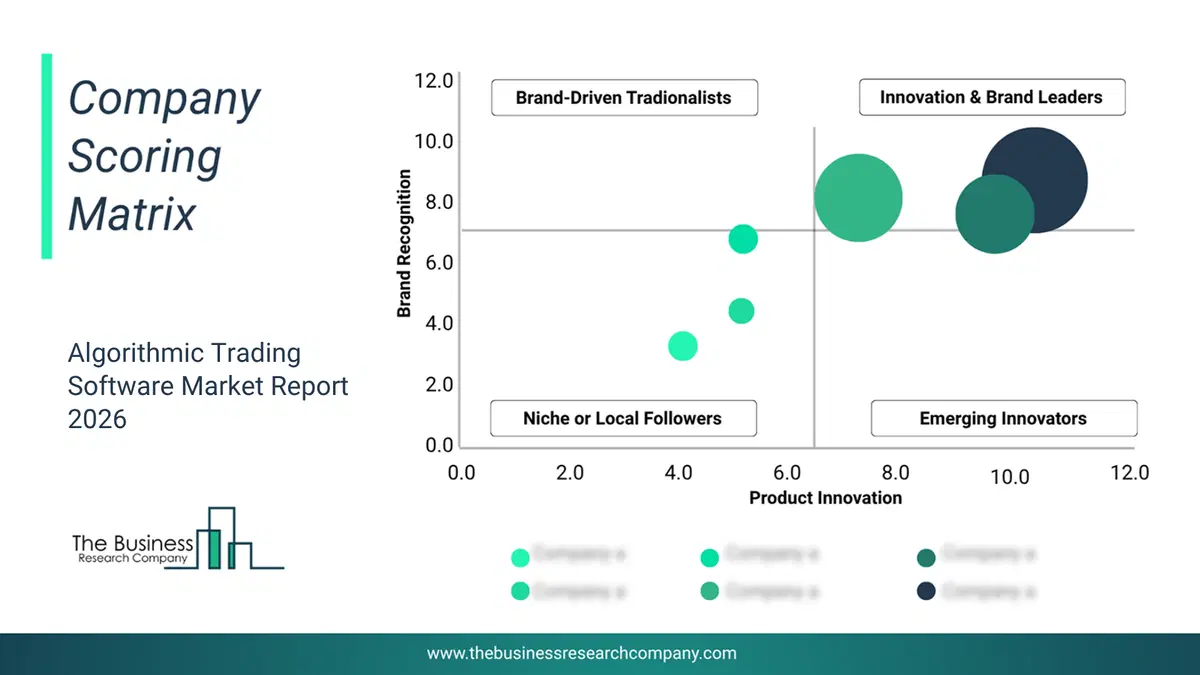
This chart maps companies by product innovation and brand strength, with bubble size indicating relative revenue, helping identify market leaders, challengers, and niche players. This is an illustrative chart; the full report provides a complete and accurate competitive analysis.
Global Algorithmic Trading Software Market Trends and Insights
Major companies operating in the algorithmic trading software market are focusing on developing next generation platforms that leverage artificial intelligence (AI) to improve execution quality, optimize strategy performance, and expand cross market trading capabilities. AI-driven algorithmic trading platforms use machine learning, real-time analytics, and adaptive execution strategies to automate complex trades, manage risk, and reduce transaction costs for institutional and retail clients. For instance, in October 2025, MasterQuant, a US-based financial technology company, launched its next-generation AI-powered quantitative trading platform designed for crypto and digital-asset markets. The platform features deep-learning-based execution algorithms, real-time market sentiment analysis, adaptive risk management, and multi-asset trading support, enabling traders to execute automated strategies more efficiently while improving performance outcomes.What Are Latest Mergers And Acquisitions In The Algorithmic Trading Software Market?
In October 2023, MarketAxess Holdings Inc., a US‑based financial technology company specializing in electronic trading platforms for fixed‑income securities, acquired Pragma LLC for an $125 million. With this acquisition, MarketAxess aimed to enhance its technological capabilities by accelerating the development of quantitative execution algorithms and data‑driven analytics across its fixed‑income products and broaden automation and algorithmic trading solutions. Pragma LLC is a US‑based quantitative trading technology company that specializes in providing algorithmic and analytical trading services across equities, foreign exchange (FX), and fixed‑income markets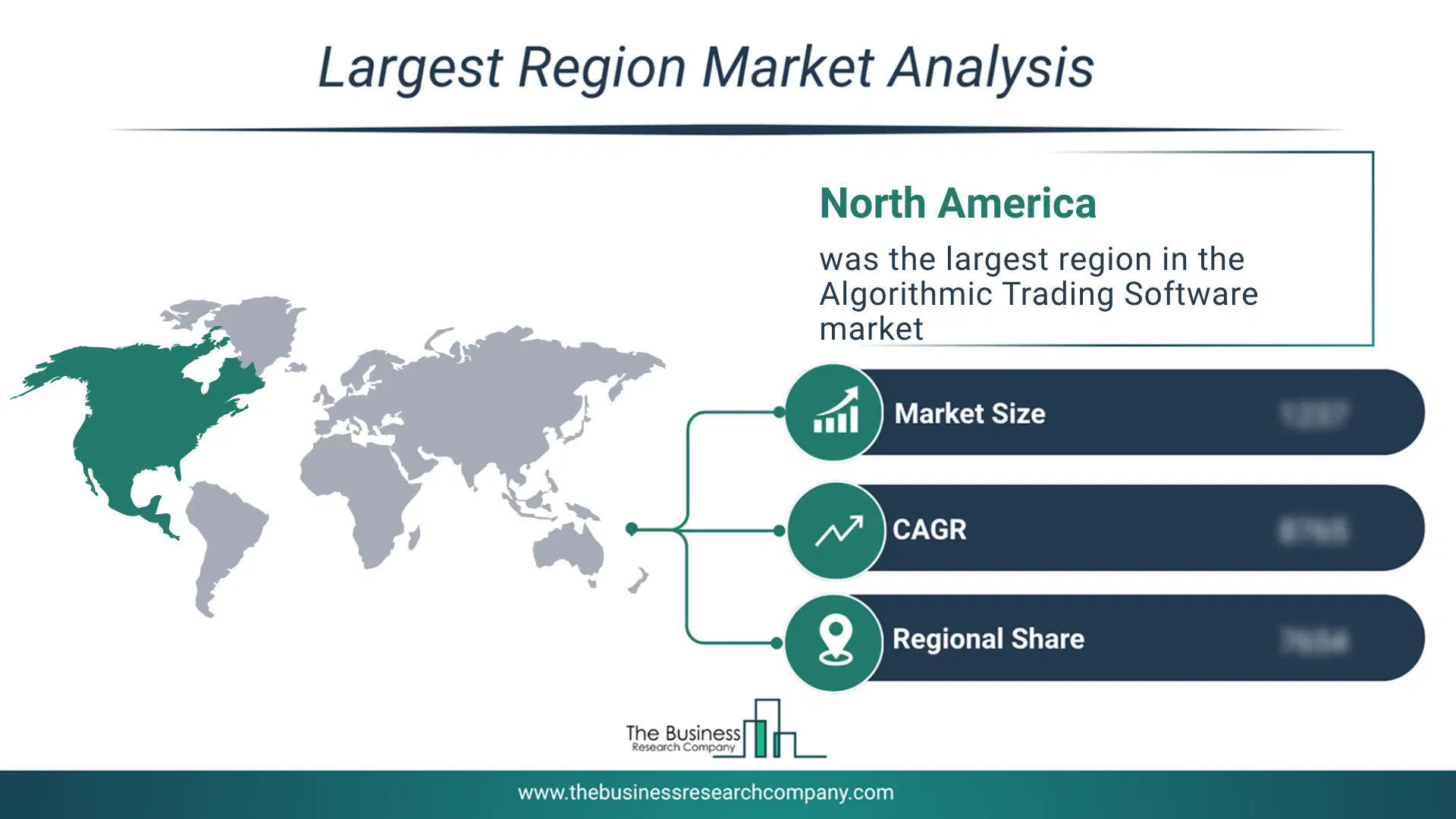
Regional Outlook
North America was the largest region in the algorithmic trading software market in 2025. Asia-Pacific is expected to be the fastest-growing region in the forecast period. The regions covered in this market report are Asia-Pacific, South East Asia, Western Europe, Eastern Europe, North America, South America, Middle East, Africa. The countries covered in this market report are Australia, Brazil, China, France, Germany, India, Indonesia, Japan, Taiwan, Russia, South Korea, UK, USA, Canada, Italy, Spain.What Defines the Algorithmic Trading Software Market?
The algorithmic trading software market consists of revenues earned by entities providing services such as the development, licensing, and maintenance of software solutions designed to automate the execution of trading strategies based on predefined algorithms and rulesets. The market value includes the value of related goods sold by the service provider or included within the service offering. The algorithmic trading software market also includes sales of trading platforms, APIs (application programming interfaces), trading algorithms, market data feeds, and related hardware infrastructure utilized in the development and implementation of algorithmic trading strategies. Values in this market are ‘factory gate’ values, that is, the value of goods sold by the manufacturers or creators of the goods, whether to other entities (including downstream manufacturers, wholesalers, distributors, and retailers) or directly to end customers. The value of goods in this market includes related services sold by the creators of the goods.How is Market Value Defined and Measured?
The market value is defined as the revenues that enterprises gain from the sale of goods and/or services within the specified market and geography through sales, grants, or donations in terms of the currency (in USD unless otherwise specified). The revenues for a specified geography are consumption values that are revenues generated by organizations in the specified geography within the market, irrespective of where they are produced. It does not include revenues from resales along the supply chain, either further along the supply chain or as part of other products.
This chart presents market attractiveness based on a quantitative evaluation of growth, competition, strategic alignment, and risk, offering a clear view of opportunity areas for decision-making. This chart is for illustrative purposes; the full report contains the complete analysis.

This chart highlights the Total Addressable Market (TAM) by estimating the maximum revenue opportunity using an assumption-driven approach, supporting strategic planning and opportunity sizing across markets. The chart is illustrative; the full report provides a more comprehensive analysis.
What Key Data and Analysis Are Included in the Algorithmic Trading Software Market Report 2026?
The algorithmic trading software market research report is one of a series of new reports from The Business Research Company that provides market statistics, including Market Report 2026?global market size, regional shares, competitors with the market share, detailed market segments, market trends and opportunities, and any further data you may need to thrive in the algorithmic trading software Market Report 2026? The market research report delivers a complete perspective of everything you need, with an in-depth analysis of the current and future state of the Market Report 2026?Algorithmic Trading Software Market Report Forecast Analysis
| Report Attribute | Details |
|---|---|
| Market Size Value In 2026 | $3 billion |
| Revenue Forecast In 2030 | $4.11 billion |
| Growth Rate | CAGR of 6.8% from 2026 to 2030 |
| Base Year For Estimation | 2025 |
| Actual Estimates/Historical Data | 2020-2025 |
| Forecast Period | 2026 - 2030 |
| Market Representation | Revenue in USD Billion and CAGR from 2026 to 2030 |
| Segments Covered | Component, Deployment, Application |
| Regional Scope | Asia-Pacific, Western Europe, Eastern Europe, North America, South America, Middle East, Africa |
| Country Scope | The countries covered in the report are Australia, Brazil, China, France, Germany, India, Indonesia, Japan, Taiwan, Russia, South Korea, UK, USA, Canada, Italy, Spain. |
| Key Companies Profiled | AlgoTrader AG, Interactive Brokers LLC, Virtu Financial, Flow Traders Ltd., DRW Holdings LLC, TradeStation Group Inc., Tower Research Capital LLC, Hudson River Trading LLC, Jump Trading LLC, FlexTrade Systems Inc., NinjaTrader Group LLC, Trading Technologies International Inc., MetaQuotes Software Corp., Teza Technologies, RSJ Group, Quantlab Financial LLC, Tradebot Systems Inc, Tethys Technology Inc., IQBroker LLC, QuantRocket, Sierra Chart, QuantConnect Corporation, StockSharp, Wealth-Lab, Python Quants GmbH |
| Customization Scope | Request for Customization |
| Pricing And Purchase Options | Explore Purchase Options |