
Alkaloidal Chemical Market Report 2026
Global Outlook – By Type (Primary Alkaloids, Secondary Alkaloids, Complex Alkaloids), By Source Of Extraction (Plant-Derived Alkaloids, Opium Poppy, Cinchona Bark, Nightshade Family, Synthetic Alkaloids), By Formulation (Liquid Formulations, Solid Formulations, Pills And Capsules, Powders, Topical Preparations), By Distribution Channel (Online Stores, Specialty Stores), By Application (Pharmaceuticals, Analgesics, Antimalarials, Antidepressants, Cosmetics, Skin Care Products, Agriculture, Pesticides) – Market Size, Trends, Strategies, and Forecast to 2030
Alkaloidal Chemical Market Overview
• Alkaloidal Chemical market size has reached to $4.55 billion in 2025 • Expected to grow to $6.94 billion in 2030 at a compound annual growth rate (CAGR) of 8.8% • Growth Driver: Surge In Natural Products Fueling The Growth Of The Market Due To Rising Consumer Demand For Safer And Sustainable Alternatives • Market Trend: Innovative Testing Techniques Ensure Safety And Regulatory Compliance • North America was the largest region in 2025 and Europe is the fastest growing region.What Is Covered Under Alkaloidal Chemical Market?
Alkaloidal chemicals refer to a class of naturally occurring organic compounds that mostly contain basic nitrogen atoms and are primarily derived from plant sources. They are known for their potent physiological effects on humans and animals and are commonly used in pharmaceuticals, stimulants, and narcotics. The main types of alkaloidal chemicals are primary alkaloids, secondary alkaloids, and complex alkaloids. Primary alkaloids are naturally occurring nitrogen-containing organic compounds synthesized directly from amino acids in plants, often serving defensive or physiological roles. Sources of extraction include plant-derived alkaloids such as opium poppy, cinchona bark, and the nightshade family, synthetic alkaloids, and microbial alkaloids. They come in various formulations, such as liquid formulations, solid formulations, pills and capsules, powders, and topical preparations, and are distributed through different channels, including online stores, specialty stores, and supermarkets or hypermarkets. They are used in applications such as pharmaceuticals, analgesics, antimalarials, antidepressants, cosmetics, skin care products, hair care products, agriculture, pesticides, and herbicides.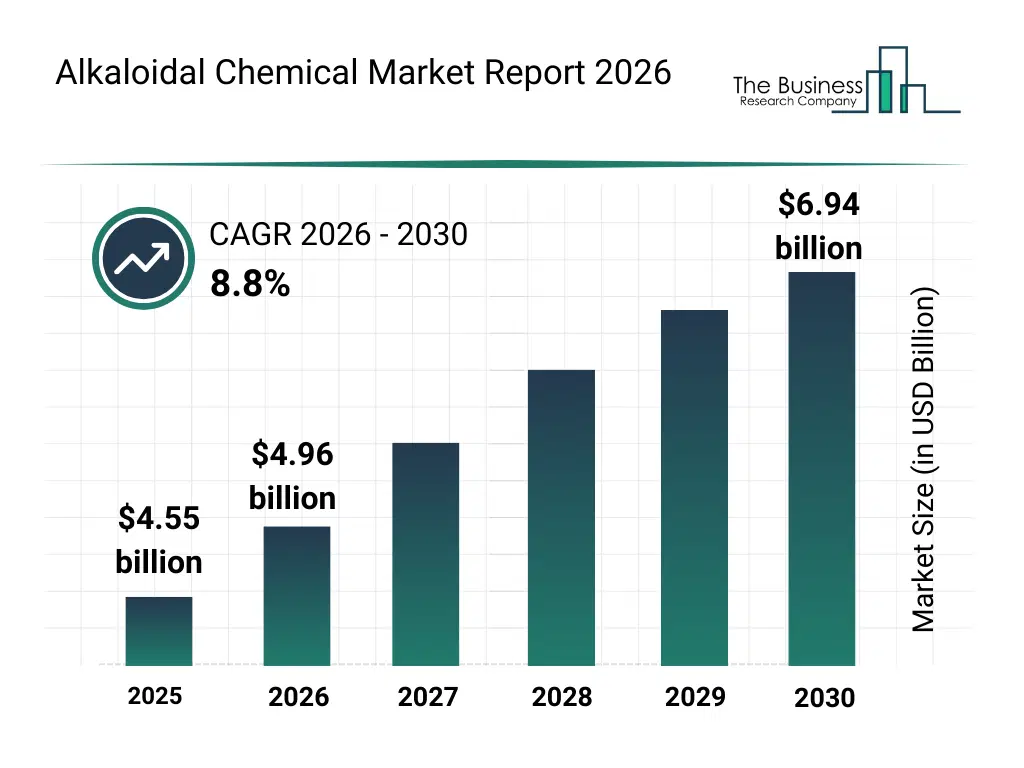
What Is The Alkaloidal Chemical Market Size and Share 2026?
The alkaloidal chemical market size has grown strongly in recent years. It will grow from $4.55 billion in 2025 to $4.96 billion in 2026 at a compound annual growth rate (CAGR) of 9.1%. The growth in the historic period can be attributed to traditional medicine usage, pharmaceutical research growth, natural product chemistry development, demand for pain management drugs, agricultural alkaloid extraction.What Is The Alkaloidal Chemical Market Growth Forecast?
The alkaloidal chemical market size is expected to see strong growth in the next few years. It will grow to $6.94 billion in 2030 at a compound annual growth rate (CAGR) of 8.8%. The growth in the forecast period can be attributed to growth of botanical pharmaceuticals, rising cancer treatments demand, expansion of regulated narcotics, innovation in synthetic alkaloids, precision medicine adoption. Major trends in the forecast period include growing demand for plant derived drugs, expansion of natural stimulants usage, increased use in oncology treatments, rising application in herbal cosmetics, focus on controlled alkaloid extraction.
Global Alkaloidal Chemical Market Segmentation
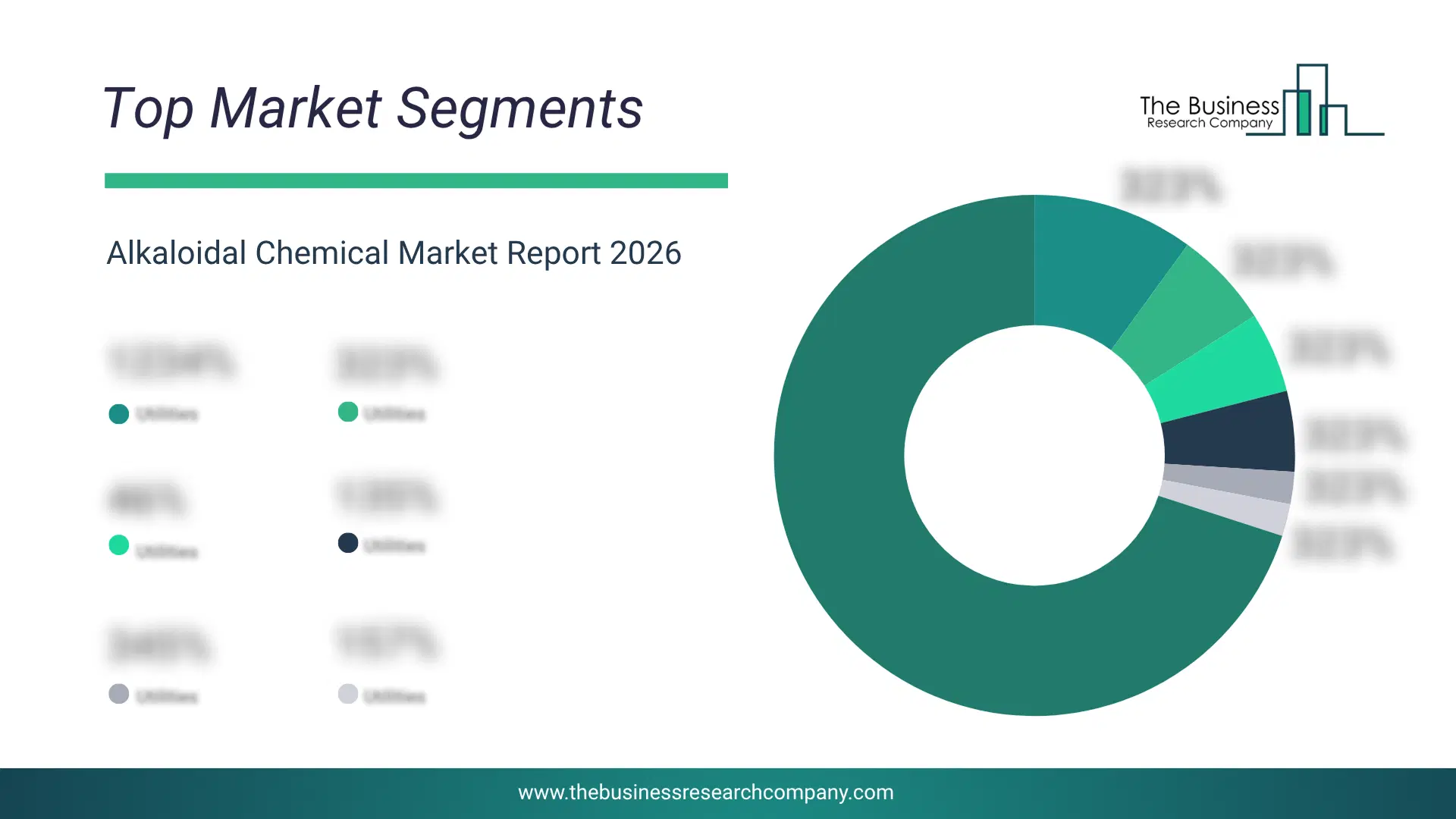
1) By Type: Primary Alkaloids, Secondary Alkaloids, Complex Alkaloids 2) By Source Of Extraction: Plant-Derived Alkaloids, Opium Poppy, Cinchona Bark, Nightshade Family, Synthetic Alkaloids 3) By Formulation: Liquid Formulations, Solid Formulations, Pills And Capsules, Powders, Topical Preparations 4) By Distribution Channel: Online Stores, Specialty Stores 5) By Application: Pharmaceuticals, Analgesics, Antimalarials, Antidepressants, Cosmetics, Skin Care Products, Agriculture, Pesticides Subsegments: 1) By Primary Alkaloids: Morphine, Caffeine, Nicotine, Quinine 2) By Secondary Alkaloids: Berberine, Sanguinarine, Harmine, Yohimbine 3) By Complex Alkaloids: Vincristine, Vinblastine, Ergotamine, ReserpineWhat Is The Driver Of The Alkaloidal Chemical Market?
The increasing demand for natural products is expected to propel the growth of the alkaloidal chemical market going forward. Natural products refer to substances that are derived from natural sources such as plants, animals, microorganisms, and minerals. The rise in natural products is due to increasing consumer demand for safer and more sustainable alternatives, as people become more aware of the side effects of synthetic chemicals. Alkaloidal chemicals contribute to natural products by offering bioactive compounds that enhance therapeutic efficacy, flavor, or functional benefits in various applications such as medicine, nutraceuticals, and cosmetics. For instance, in February 2025, according to CBI (Centre for the Promotion of Imports from Developing Countries), a Netherlands-based organization that supports developing countries in exporting their products to Europe, over the past five years, European imports of natural ingredients for cosmetics have grown by 5.5% in value and 3.6% in volume annually. Moreover, in April 2023, according to Nutraceuticals World, a US-based manufacturer of dietary supplements, the natural and organic products market surpassed the $300 billion milestone. Therefore, increasing demand for natural products is driving the growth of the alkaloidal chemical industry.Key Players In The Global Alkaloidal Chemical Market
Major companies operating in the alkaloidal chemical market are Merck KGaA, Mallinckrodt Pharmaceuticals plc, Indena S.p.A., Alkaloids Corporation, Alchem International Private Limited, Sabinsa Corporation, C2 PHARMA S.A., Minakem SAS, Phytex Australia Pty Ltd., INGA Pharmaceuticals, Zhejiang Medicine Co. Ltd., Alkaloid AD Skopje, Boehringer Ingelheim International GmbH, Johnson Matthey Plc, Cambrex Corporation, Pfizer Inc., Teva Pharmaceutical Industries Ltd., Novartis AG, Sun Pharmaceutical Industries Ltd., Cipla Limited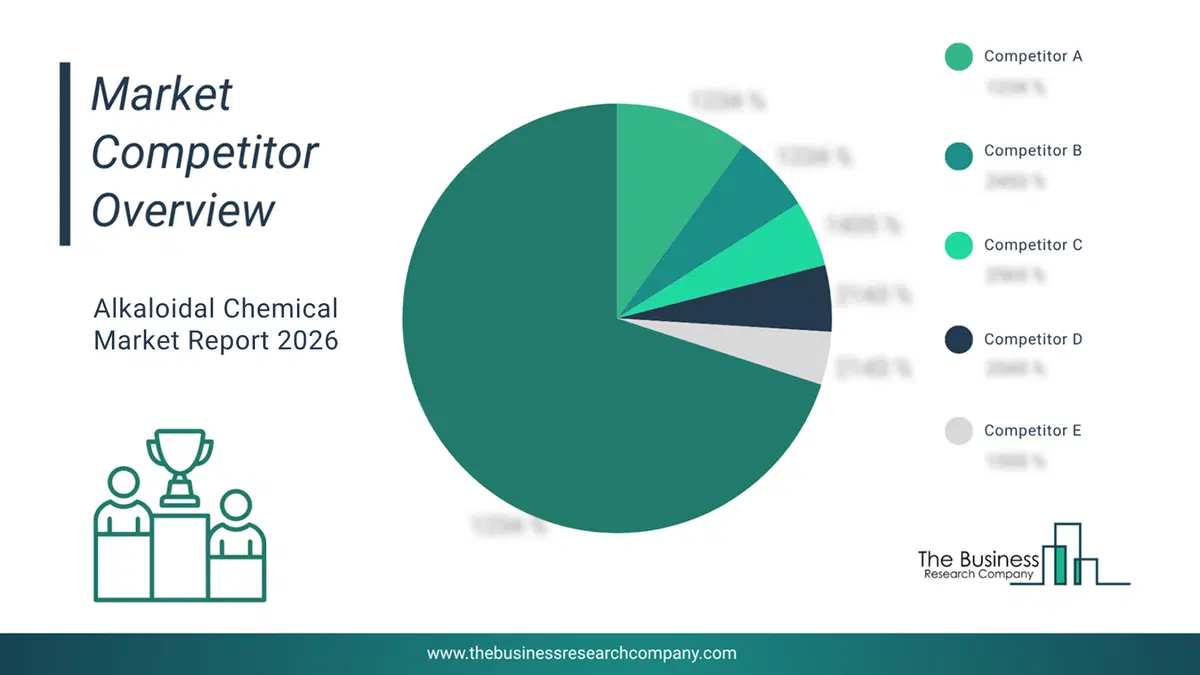
This chart is for illustrative purposes; the full report includes a detailed competitor analysis and comprehensive overview of the top 10 companies in the market.
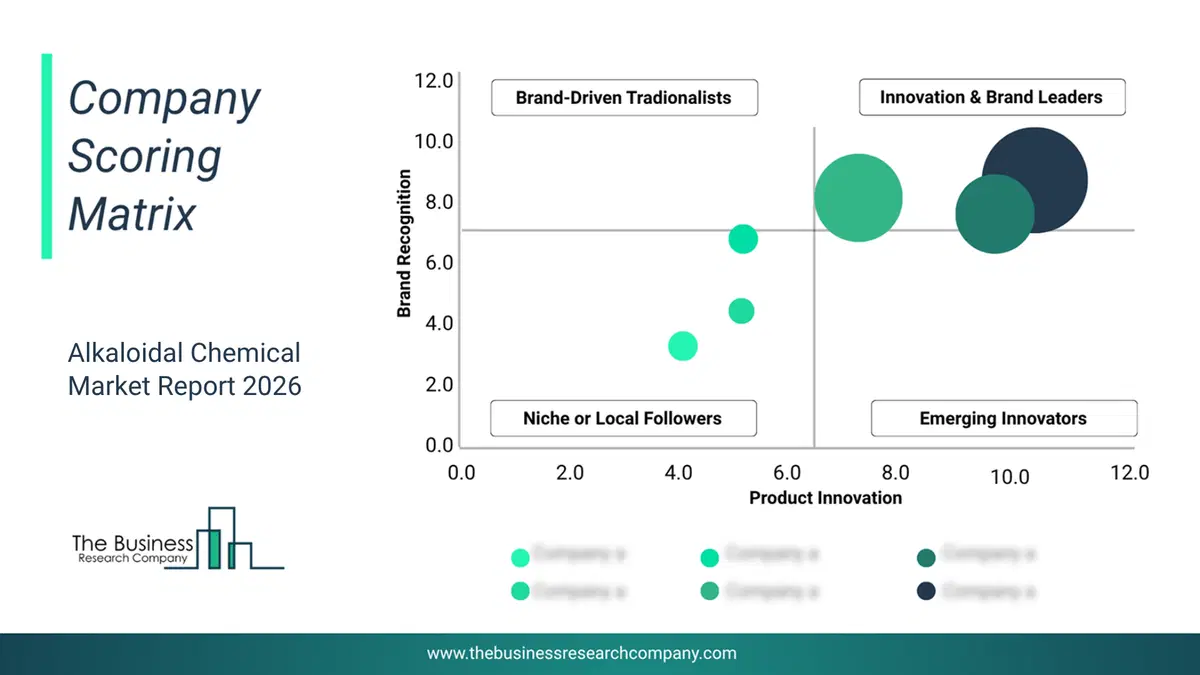
This chart maps companies by product innovation and brand strength, with bubble size indicating relative revenue, helping identify market leaders, challengers, and niche players. This is an illustrative chart; the full report provides a complete and accurate competitive analysis.
Global Alkaloidal Chemical Market Trends and Insights
Major companies operating in the alkaloidal chemical market are focusing on developing innovative solutions, such as advanced food and chemical testing laboratories, to ensure product quality, safety, and regulatory compliance compared with traditional testing methods that may be slower or less comprehensive. Alkaloidal chemical testing involves detecting and quantifying naturally occurring alkaloids in food, herbal, or pharmaceutical products using high-precision analytical techniques like HPLC, GC-MS, or spectrophotometry; these methods provide faster, more accurate, and broader-spectrum analysis than conventional spot tests. For instance, in July 2025, Geo-Chem Laboratories Private Limited, an India-based analytical testing company, launched a new food and chemical testing laboratory in Unjha, Gujarat, India. The lab is equipped with state-of-the-art instrumentation for alkaloid detection, chemical residue analysis, and quality verification, offering faster turnaround, high-accuracy results, and compliance with Indian and international regulatory standards; applications include food safety testing, herbal product quality verification, and pharmaceutical raw material analysis; benefits include improved consumer safety, enhanced regulatory compliance, reliable product validation, and reduced testing cycle times.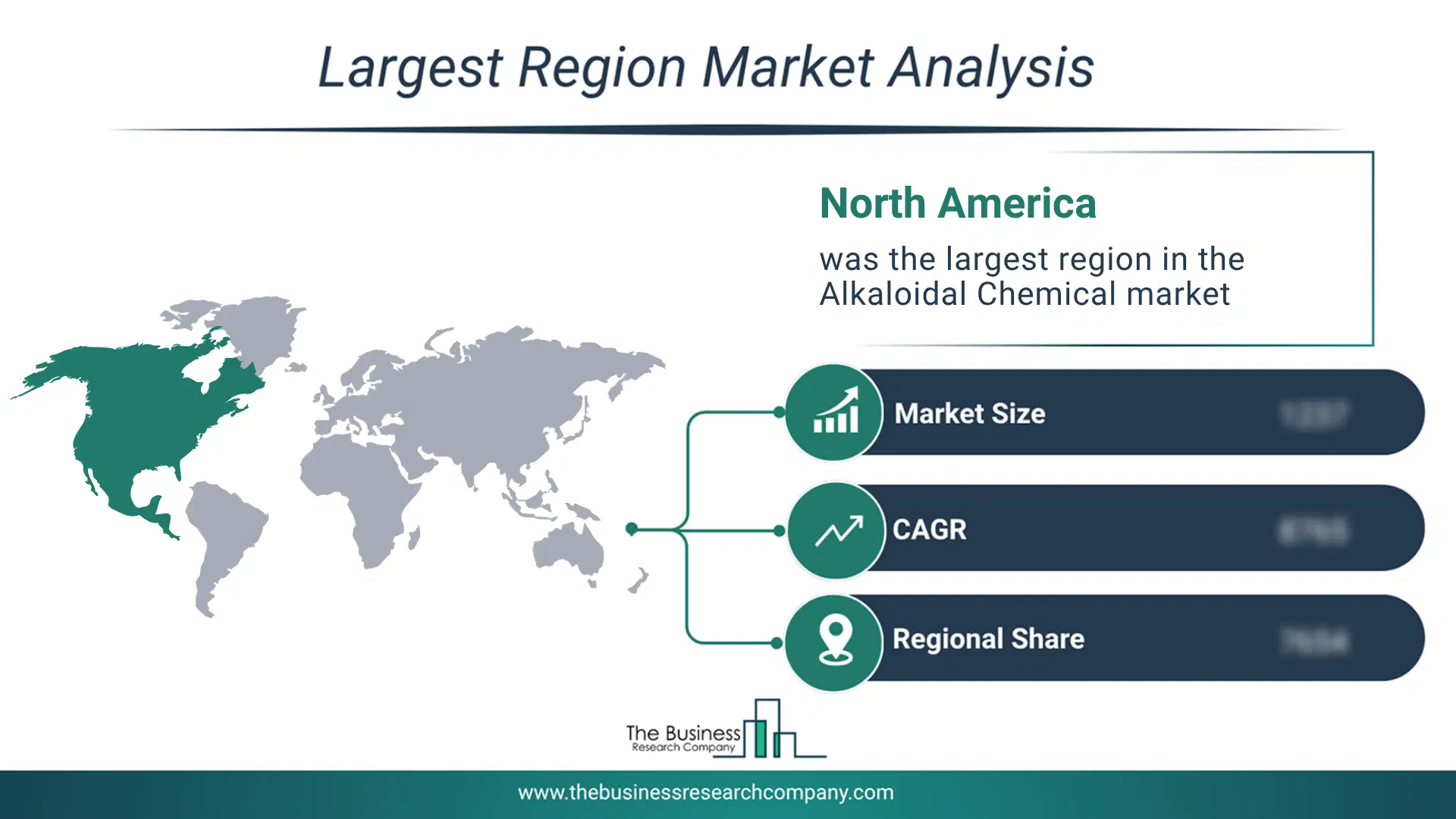
Regional Insights
North America was the largest region in the alkaloidal chemical market in 2025. Asia-Pacific is expected to be the fastest-growing region in the forecast period. The regions covered in this market report are Asia-Pacific, South East Asia, Western Europe, Eastern Europe, North America, South America, Middle East, Africa The countries covered in this market report are Australia, Brazil, China, France, Germany, India, Indonesia, Japan, Taiwan, Russia, South Korea, UK, USA, Canada, Italy, SpainWhat Defines the Alkaloidal Chemical Market?
The alkaloidal chemical market consists of sales of berberine, ergot alkaloids, pilocarpine, harmala alkaloids, sanguinarine, theobromine, and yohimbine. Values in this market are ‘factory gate’ values, that is, the value of goods sold by the manufacturers or creators of the goods, whether to other entities (including downstream manufacturers, wholesalers, distributors, and retailers) or directly to end customers. The value of goods in this market includes related services sold by the creators of the goods.How is Market Value Defined and Measured?
The market value is defined as the revenues that enterprises gain from the sale of goods and/or services within the specified market and geography through sales, grants, or donations in terms of the currency (in USD unless otherwise specified). The revenues for a specified geography are consumption values that are revenues generated by organizations in the specified geography within the market, irrespective of where they are produced. It does not include revenues from resales along the supply chain, either further along the supply chain or as part of other products.
This chart presents market attractiveness based on a quantitative evaluation of growth, competition, strategic alignment, and risk, offering a clear view of opportunity areas for decision-making. This chart is for illustrative purposes; the full report contains the complete analysis.

This chart highlights the Total Addressable Market (TAM) by estimating the maximum revenue opportunity using an assumption-driven approach, supporting strategic planning and opportunity sizing across markets. The chart is illustrative; the full report provides a more comprehensive analysis.
What Key Data and Analysis Are Included in the Alkaloidal Chemical Market Report 2026?
The alkaloidal chemical market research report is one of a series of new reports from The Business Research Company that provides market statistics, including industry global market size, regional shares, competitors with the market share, detailed market segments, market trends and opportunities, and any further data you may need to thrive in the alkaloidal chemical industry. The market research report delivers a complete perspective of everything you need, with an in-depth analysis of the current and future state of the industry.Alkaloidal Chemical Market Report Forecast Analysis
| Report Attribute | Details |
|---|---|
| Market Size Value In 2026 | $4.96 billion |
| Revenue Forecast In 2030 | $6.94 billion |
| Growth Rate | CAGR of 9.1% from 2026 to 2030 |
| Base Year For Estimation | 2025 |
| Actual Estimates/Historical Data | 2020-2025 |
| Forecast Period | 2026 - 2030 |
| Market Representation | Revenue in USD Billion and CAGR from 2026 to 2030 |
| Segments Covered | Type, Source Of Extraction, Formulation, Distribution Channel, Application |
| Regional Scope | Asia-Pacific, Western Europe, Eastern Europe, North America, South America, Middle East, Africa |
| Country Scope | The countries covered in this market report are Australia, Brazil, China, France, Germany, India, Indonesia, Japan, Taiwan, Russia, South Korea, UK, USA, Canada, Italy, Spain |
| Key Companies Profiled | Merck KGaA, Mallinckrodt Pharmaceuticals plc, Indena S.p.A., Alkaloids Corporation, Alchem International Private Limited, Sabinsa Corporation, C2 PHARMA S.A., Minakem SAS, Phytex Australia Pty Ltd., INGA Pharmaceuticals, Zhejiang Medicine Co. Ltd., Alkaloid AD Skopje, Boehringer Ingelheim International GmbH, Johnson Matthey Plc, Cambrex Corporation, Pfizer Inc., Teva Pharmaceutical Industries Ltd., Novartis AG, Sun Pharmaceutical Industries Ltd., Cipla Limited |
| Customization Scope | Request for Customization |
| Pricing And Purchase Options | Explore Purchase Options |