
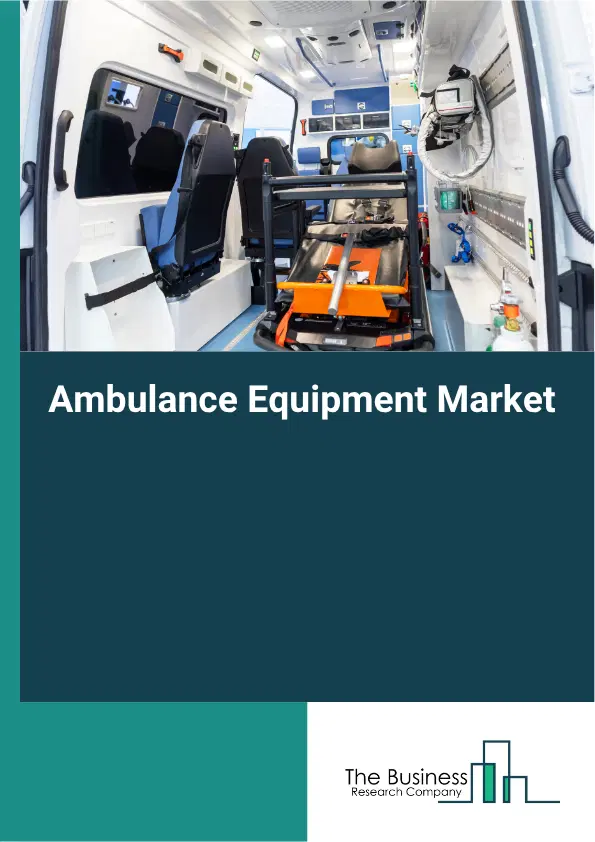
Ambulance Equipment Market Report 2026
Global Outlook – By Product Type (Life Support And Emergency Resuscitation Equipment, Airway And Respiratory Support Equipment, Patient Monitoring And Diagnostic Equipment, Transportation And Mobility Equipment), By Technology (Traditional Equipment, Smart And Connected Equipment, Telemedicine Enabled Equipment, Artificial Intelligence Assisted Monitoring And Decision Support Equipment), By Type Of Vehicle (Ground Ambulances, Air Ambulances, Water Ambulances), By Application Area (Emergency Medical Services, Patient Transport, Disaster Response Operations, Event Medical Services), By End User (Public Ambulance Services, Private Ambulance Services, Hospital Based Ambulance Services, Non Emergency Medical Transportation Providers) – Market Size, Trends, Strategies, and Forecast to 2035
Ambulance Equipment Market Overview
• Ambulance Equipment market size has reached to $5.31 billion in 2025 • Expected to grow to $7.36 billion in 2030 at a compound annual growth rate (CAGR) of 6.6% • Growth Driver: Rising Incidence Of Road Accidents And Trauma Cases Driving The Growth Of The Market Due To Increasing Vehicle Ownership And Traffic Congestion • Market Trend: Innovations In Powered Patient Handling Equipment Enhance Safety And Efficiency In Air Ambulance Operations • North America was the largest region in 2025 and Asia-Pacific is the fastest growing region.What Is Covered Under Ambulance Equipment Market?
Ambulance equipment refers to the medical devices, emergency tools, and support systems installed or carried in ambulances to provide immediate pre-hospital care, stabilize patients, and enable safe transportation to healthcare facilities. It includes equipment such as patient monitoring devices, defibrillators, ventilators, stretchers, oxygen delivery systems, suction units, and trauma care supplies used by emergency medical personnel during patient transport. The main product types of ambulance equipment include life support and emergency resuscitation equipment, airway and respiratory support equipment, patient monitoring and diagnostic equipment, and transportation and mobility equipment. Life support and emergency resuscitation equipment refers to medical devices used to stabilize patients and provide immediate critical care during medical emergencies and transport. These products incorporate traditional equipment, smart and connected equipment, telemedicine enabled equipment, and artificial intelligence assisted monitoring and decision support equipment, and are used in ground ambulances, air ambulances, and water ambulances. They find application in emergency medical services, patient transport, disaster response operations, and event medical services, serving end users including public ambulance services, private ambulance services, hospital based ambulance services, and non emergency medical transportation providers.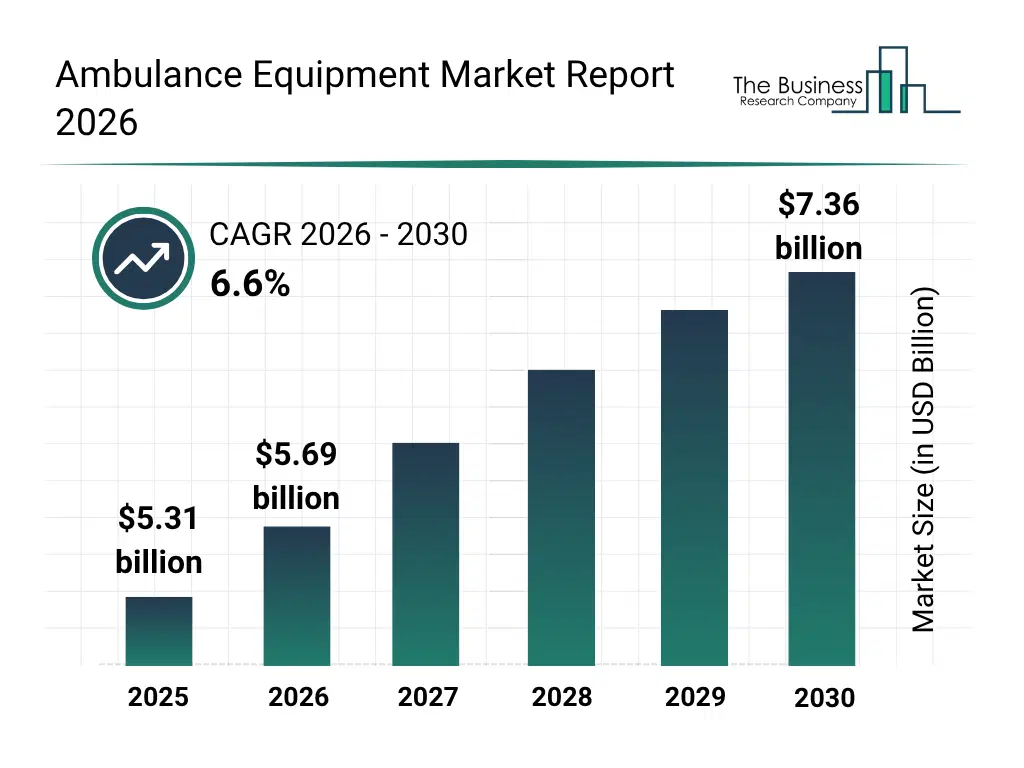
What Is The Ambulance Equipment Market Size and Share 2026?
The ambulance equipment market size has grown strongly in recent years. It will grow from $5.31 billion in 2025 to $5.69 billion in 2026 at a compound annual growth rate (CAGR) of 7.1%. The growth in the historic period can be attributed to rising emergency medical service utilization, increasing road traffic accidents, growing demand for pre-hospital patient stabilization, expansion of ambulance fleets, increasing adoption of advanced patient monitoring equipment.What Is The Ambulance Equipment Market Growth Forecast?
The ambulance equipment market size is expected to see strong growth in the next few years. It will grow to $7.36 billion in 2030 at a compound annual growth rate (CAGR) of 6.6%. The growth in the forecast period can be attributed to increasing demand for rapid emergency response, rising investments in ambulance fleet modernization, growing need for advanced respiratory support equipment, expansion of air ambulance services, increasing demand for specialized disaster response equipment. Major trends in the forecast period include advanced portable emergency care equipment, compact and lightweight ambulance equipment, integrated pre-hospital patient monitoring systems, advanced trauma stabilization equipment, multi-functional emergency medical devices.Tariff Impact On Ambulance Equipment Market
Tariffs are impacting the ambulance equipment market by increasing the cost of imported medical devices, electronic components, respiratory equipment, and specialized emergency care systems used in ambulances. Life support, patient monitoring, and smart and connected equipment segments are likely to face greater cost pressures, particularly in North America, Europe, and Asia-Pacific due to dependence on globally sourced medical technologies and components. However, tariffs may encourage manufacturers to localize production, diversify suppliers, and develop domestic medical equipment capabilities, potentially strengthening regional supply chains and reducing long-term import dependence.
Global Ambulance Equipment Market Segmentation
2) By Technology: Traditional Equipment, Smart And Connected Equipment, Telemedicine Enabled Equipment, Artificial Intelligence Assisted Monitoring And Decision Support Equipment 3) By Type Of Vehicle: Ground Ambulances, Air Ambulances, Water Ambulances 4) By Application Area: Emergency Medical Services, Patient Transport, Disaster Response Operations, Event Medical Services 5) By End User: Public Ambulance Services, Private Ambulance Services, Hospital Based Ambulance Services, Non Emergency Medical Transportation Providers Subsegments: 1) By Life Support And Emergency Resuscitation Equipment: Defibrillators, Cardiopulmonary Resuscitation Devices, Automated External Defibrillators, Ventilators, Infusion Pumps 2) By Airway And Respiratory Support Equipment: Oxygen Delivery Systems, Suction Units, Bag Valve Masks, Airway Management Devices, Nebulizers 3) By Patient Monitoring And Diagnostic Equipment: Multiparameter Patient Monitors, Electrocardiogram Monitors, Pulse Oximeters, Blood Pressure Monitors, Blood Glucose Meters 4) By Transportation And Mobility Equipment: Ambulance Stretchers, Stair Chairs, Scoop Stretchers, Spinal Boards, Wheelchairs, Patient Transfer SheetsWhat Is The Driver Of The Ambulance Equipment Market?
The rising incidence of road accidents and trauma cases is expected to propel the growth of the ambulance equipment market going forward. Road accidents and trauma cases refer to incidents involving vehicle collisions or other roadway-related events that result in physical injuries requiring immediate medical assessment, emergency treatment, and transportation to healthcare facilities. The rising incidence of road accidents and trauma cases is due to increasing vehicle ownership and traffic congestion, which lead to higher traffic density, greater exposure to collision risks, and a higher likelihood of injuries requiring emergency medical care. Ambulance equipment enables the rapid stabilization, monitoring, and treatment of trauma patients at the accident scene and during transport, improving survival rates and supporting timely emergency medical care for road accident victims. For instance, in August 2026, according to the U.S. Department of Transportation (USDOT), a US-based federal government department, an estimated 36,640 people lost their lives in motor vehicle crashes in 2025. Therefore, the rising incidence of road accidents and trauma cases is driving the growth of the ambulance equipment industry.Key Players In The Global Ambulance Equipment Market
Major companies operating in the ambulance equipment market are Cardinal Health Inc., Abbott Laboratories, Medtronic plc, Medline Industries LP, Stryker Corporation, Becton Dickinson and Company, GE HealthCare Technologies Inc., Koninklijke Philips N.V., Asahi Kasei Corporation, Baxter International Inc., Shenzhen Mindray Bio-Medical Electronics Co. Ltd., Drägerwerk AG & Co. KGaA, Getinge AB, ICU Medical Inc., Teleflex Incorporated, Nihon Kohden Corporation, Ambu A/S, Laerdal Medical AS, Ferno-Washington Inc.
This chart is for illustrative purposes; the full report includes a detailed competitor analysis and comprehensive overview of the top 10 companies in the market.
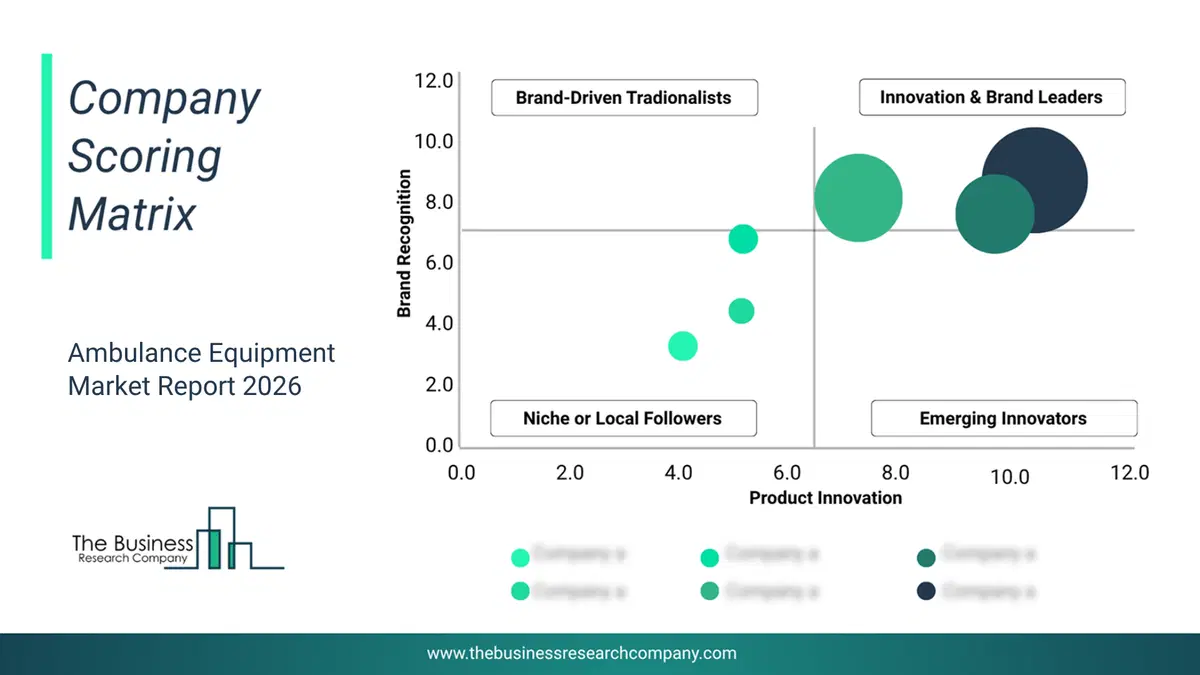
This chart maps companies by product innovation and brand strength, with bubble size indicating relative revenue, helping identify market leaders, challengers, and niche players. This is an illustrative chart; the full report provides a complete and accurate competitive analysis.
Global Ambulance Equipment Market Trends and Insights
Major companies operating in the ambulance equipment market are focusing on developing advanced patient handling solutions, such as powered stretcher loaders, to improve patient transfer safety, reduce crew strain, and enhance operational efficiency during emergency medical transport. Powered stretcher loaders are ambulance equipment solutions that use motorized lifting and movement mechanisms to assist medical crews in safely loading and unloading patients, reducing the physical effort required during transfers. For instance, in February 2026, iAERO, a Canada-based engineering and manufacturing company, launched ATLAS (Aircraft Transfer Lift and Assistance System), a powered stretcher loader designed for air ambulance operators. The system provides controlled, battery-powered lifting and movement to reduce crew strain, injury risk, and fatigue while enabling faster and more consistent patient transfers, particularly in tight cabin access and stairway loading scenarios. ATLAS is adaptable to various fixed-wing and rotary-wing air ambulance platforms and operates independently of aircraft or ground power, supporting reliable patient handling during remote and time-critical medical missions.What Are Latest Mergers And Acquisitions In The Ambulance Equipment Market?
In June 2025, J.B. Poindexter and Co. Inc., a US-based manufacturing company, acquired Demers Braun Crestline Medix for an undisclosed amount. With this acquisition, J.B. Poindexter and Co. aims to enter and strengthen its position in the emergency vehicle industry, expand its specialty vehicle portfolio, and add a leading ambulance manufacturing platform with established brands across the U.S. and Canadian markets. Demers Braun Crestline Medix is a Canada-based company that manufactures and supplies ambulance equipment through its comprehensive portfolio of ambulances and specialized emergency vehicles.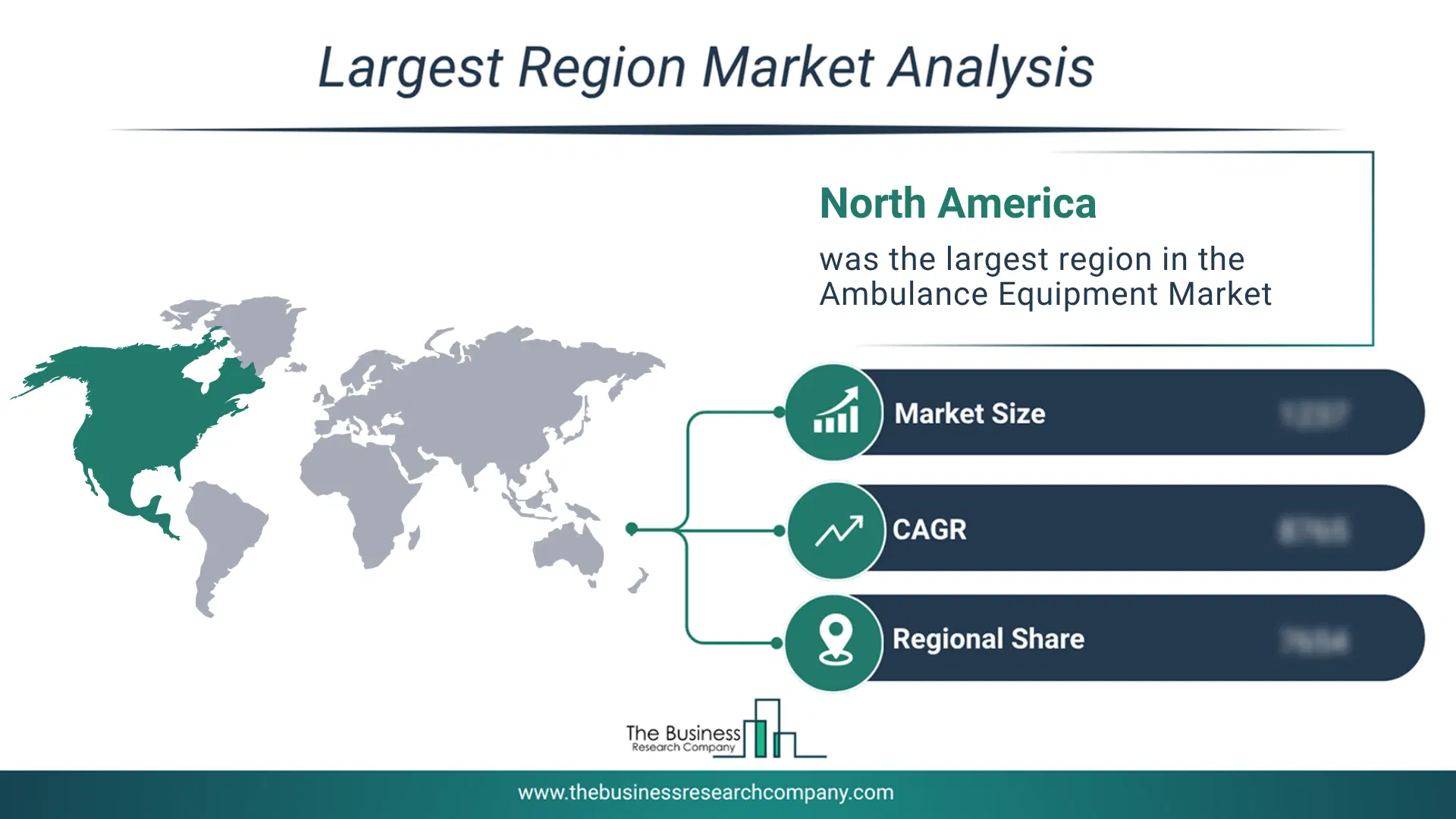
Regional Outlook/Insights
North America was the largest region in the ambulance equipment market in 2025. Asia-Pacific is expected to be the fastest-growing region in the forecast period. The regions covered in this market report are Asia-Pacific, South East Asia, Western Europe, Eastern Europe, North America, South America, Middle East, Africa. The countries covered in this market report are Australia, Brazil, China, France, Germany, India, Indonesia, Japan, Taiwan, Russia, South Korea, UK, USA, Canada, Italy, Spain.What Defines the Ambulance Equipment Market?
The ambulance equipment market consists of sales of stretchers, defibrillators, ventilators, and suction units. Values in this market are ‘factory gate’ values, that is, the value of goods sold by the manufacturers or creators of the goods, whether to other entities (including downstream manufacturers, wholesalers, distributors, and retailers) or directly to end customers. The value of goods in this market includes related services sold by the creators of the goods.How is Market Value Defined and Measured?
The market value is defined as the revenues that enterprises gain from the sale of goods and/or services within the specified market and geography through sales, grants, or donations in terms of the currency (in USD unless otherwise specified). The revenues for a specified geography are consumption values that are revenues generated by organizations in the specified geography within the market, irrespective of where they are produced. It does not include revenues from resales along the supply chain, either further along the supply chain or as part of other products.
This chart presents market attractiveness based on a quantitative evaluation of growth, competition, strategic alignment, and risk, offering a clear view of opportunity areas for decision-making. This chart is for illustrative purposes; the full report contains the complete analysis.

This chart highlights the Total Addressable Market (TAM) by estimating the maximum revenue opportunity using an assumption-driven approach, supporting strategic planning and opportunity sizing across markets. The chart is illustrative; the full report provides a more comprehensive analysis.
What Key Data and Analysis Are Included in the Ambulance Equipment Market Report 2026?
The ambulance equipment market research report is one of a series of new reports from The Business Research Company that provides market statistics, including industry global market size, regional shares, competitors with the market share, detailed market segments, market trends and opportunities, and any further data you may need to thrive in the ambulance equipment industry. The market research report delivers a complete perspective of everything you need, with an in-depth analysis of the current and future state of the industry.Ambulance Equipment Market Report Forecast Analysis
| Report Attribute | Details |
|---|---|
| Market Size Value In 2026 | $5.69 billion |
| Revenue Forecast In 2030 | $7.36 billion |
| Growth Rate | CAGR of 6.6% from 2026 to 2035 |
| Base Year For Estimation | 2025 |
| Actual Estimates/Historical Data | 2020-2025 |
| Forecast Period | 2026 - 2030 |
| Market Representation | Revenue in USD Billion and CAGR from 2026 to 2030 |
| Segments Covered | Product Type, Technology, Type Of Vehicle, Application Area, End User |
| Regional Scope | Asia-Pacific, Western Europe, Eastern Europe, North America, South America, Middle East, Africa |
| Country Scope | The countries covered in the report are Australia, Brazil, China, France, Germany, India, Indonesia, Japan, Taiwan, Russia, South Korea, UK, USA, Canada, Italy, Spain. |
| Customization Scope | Request for Customization |
| Pricing And Purchase Options | Explore Purchase Options |