

Ammonia Market 2026
By Product Type (Anhydrous Ammonia, Aqueous Ammonia), By Form Type (Liquid, Powder, Gas), By Application (Fertilizers, Chemicals, Refrigeration, Pharmaceutical, Fibers And Plastics, Pulp And Papers, Other Applications), And By Region, Opportunities And Strategies – Global Forecast To 2035
Ammonia Market Definition
Ammonia (NH3) is a compound composed of nitrogen and hydrogen atoms. It is a colorless gas with a characteristic pungent odor. Ammonia is commonly produced through the Haber-Bosch process, which involves the reaction of nitrogen and hydrogen gases in the presence of a catalyst at high temperature and pressure. The ammonia market consists of sales, by entities (organizations, sole traders and partnerships), of ammonia, which is a colorless gas with a pungent smell and is lighter than air, with a density 0.589 times that of air. In its concentrated form, ammonia is considered to be a weak base, and is classified as an extremely hazardous substance in many countries.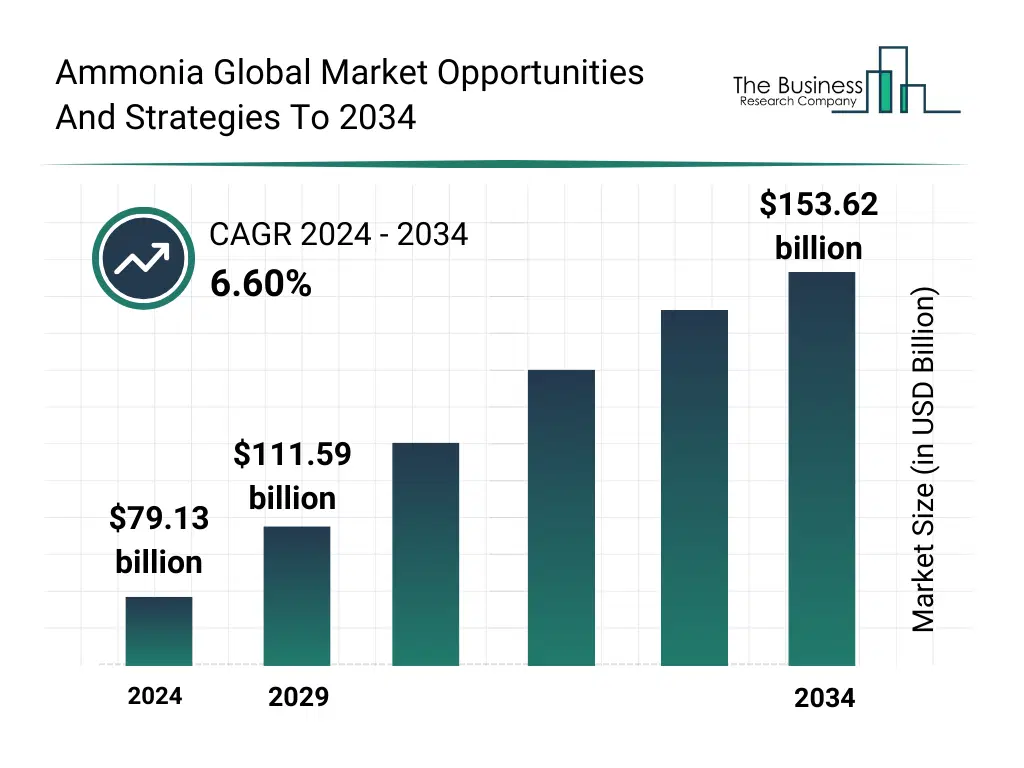
Ammonia Market Size
The global ammonia market reached a value of nearly $79,132.54 million in 2024, having grown at a compound annual growth rate (CAGR) of 5.56% since 2019. The market is expected to grow from $79,132.54 million in 2024 to $111,590.66 million in 2029 at a rate of 7.12%. The market is then expected to grow at a CAGR of 6.60% from 2029 and reach $153,622.98 million in 2034. Growth in the historic period resulted from favorable government support, increasing infrastructure development, rising cold storage and refrigeration demand and growing demand in mining and explosives. Factors that negatively affected growth in the historic period were environmental and safety concerns and high energy and feedstock costs. Going forward, industrial applications expansion, rising demand for clean energy, rising fertilizer demand and rise in demand for energy storage applications will drive the growth. Factors that could hinder the growth of the ammonia market in the future include impact of trade war and tariff, carbon emissions and regulatory pressure and competition from alternative fertilizers.Ammonia Market Drivers
The key drivers of the ammonia market include: Rising Fertilizer Demand During the forecast period, rising demand for fertilizers is expected to drive the growth of the ammonia market. Ammonia is a critical raw material for nitrogen-based fertilizers, which play a vital role in maintaining crop productivity and ensuring global food security. As agricultural activity intensifies to meet the food requirements of a growing population, the need for fertilizers—such as urea and other ammonia-based products—continues to rise. Additionally, government policies and agribusiness initiatives aimed at improving fertilizer access and distribution are further supporting ammonia adoption in the agricultural sector. As a result, the increasing demand for fertilizers is significantly contributing to the expansion of the ammonia market, especially in regions with high agricultural activity. The rising fertilizer demand growth contribution during the forecast period in 2024 is 2.04%.Ammonia Market Restraints
The key restraints on the ammonia market include: Carbon Emissions and Regulatory Pressure During the forecast period, carbon emissions and increasing regulatory pressure are expected to limit the growth of the ammonia market. Ammonia production is highly energy-intensive and generates substantial greenhouse gas emissions, making it a key focus of environmental regulations. Governments around the world are tightening emissions standards, introducing carbon pricing mechanisms, and promoting the use of low-emission or green fertilizers. These regulatory actions force producers to invest in cleaner production technologies and adopt more sustainable practices—often at a higher cost—which can constrain profitability and slow market expansion. Furthermore, the transition to low-carbon alternatives, such as green ammonia, requires significant infrastructure development and energy input, posing additional challenges for large-scale adoption. As a result, environmental concerns and regulatory frameworks are expected to restrain the growth of the ammonia market over the forecast period. Growth affected by carbon emissions and regulatory pressure during the forecast period in 2024 is -2.00%.Ammonia Market Trends
Major trends shaping the ammonia market include: Development Of Modular Green Anhydrous Ammonia Production Systems For On-Site Fertilizer Solutions Major companies in the ammonia market are focusing on the development of modular green ammonia production systems designed to provide sustainable, on-site fertilizer solutions for farmers. These innovations aim to reduce reliance on traditional hydrocarbon-based ammonia production, lower carbon emissions, and improve accessibility to ammonia for agricultural applications. For instance, in February 2025, Landus, an Iowa-based agriculture solutions company, partnered with TalusAg, an agriculture technology company, to deploy a containerized, modular anhydrous ammonia production system in Boone, Iowa. This system utilizes renewable energy to produce green ammonia on-site and is designed to optimize efficiency and reliability while maintaining safe and scalable operations. By leveraging advanced production technology and renewable power, the company aims to enhance fertilizer supply chain resilience and support sustainable farming practices across the US Midwest. Development Of Renewable-Powered Green Ammonia Production Facilities Key companies in the ammonia sector are focusing on the development of facilities that integrate renewable power sources with ammonia production to create cost-effective and sustainable solutions. These innovations aim to reduce reliance on traditional fossil fuel-based ammonia synthesis and contribute to the decarbonization of industrial processes. For instance, in August 2024, a Danish partnership comprising Topsoe (Denmark-based company specializes in technologies aimed at reducing carbon emissions, supplying technology, catalysts, and services for the global energy transition), Skovgaard Energy (Denmark-based Operator of a renewable energy production and green fuel company) and Vestas (Denmark-based manufacturer, seller, installer, and servicer of wind turbines) inaugurated a green ammonia plant in Ramme, Northwest Jutland, Denmark. The facility demonstrates the direct coupling of renewable power sources to ammonia production, effectively managing power fluctuations and offering a cost-effective method for producing green ammonia. This project marks a significant step towards sustainable ammonia production by integrating renewable energy into the synthesis process.Opportunities And Recommendations In The Ammonia Market
Opportunities – The top opportunities in the ammonia market segmented by product type will arise in the anhydrous ammonia segment, which will gain $21,312.31 million of global annual sales by 2029. The top opportunities in the ammonia market segmented by form type will arise in the liquid segment, which will gain $20,058.87 million of global annual sales by 2029. The top opportunities in the ammonia market segmented by application will arise in the fertilizers segment, which will gain $21,711.26 million of global annual sales by 2029. The ammonia market size will gain the most in China at $6,941.32 million. Recommendations- To take advantage of the opportunities, The Business Research Company recommends the ammonia companies to focus on expanding modular green ammonia systems through renewable integration, focus on integrating renewable power with ammonia production to enhance sustainability, focus on advancing modular on-farm green ammonia production for sustainable agriculture, focus on scaling modular aqueous ammonia systems to strengthen agricultural sustainability, focus on the anhydrous ammonia segment for accelerated growth, focus on the gaseous ammonia segment to capture emerging energy opportunities, expand in emerging markets , focus on strengthening multi-channel distribution for market reach, focus on competitive and value-based pricing strategies, strengthen value-driven communication and industry positioning , optimize digital engagement and market visibility, focus on fertilizers for sustained market expansion.
Ammonia Market Segmentation
The Ammonia market is segmented by product type, by form type and by application.By Product Type –
The Ammonia market is segmented by product type into:
- a) Anhydrous Ammonia
- b) Aqueous Ammonia
By Form Type –
The Ammonia market is segmented by form type into:
- a) Liquid
- b) Powder
- c) Gas
By Application –
The Ammonia market is segmented by application into:
- a) Fertilizers
- b) Chemicals
- c) Refrigeration
- d) Pharmaceutical
- e) Fibers And Plastic
- f) Pulp And Papers
- g) Other Applications
By Geography - The ammonia market is segmented by geography into:
- • China
- • India
- • Japan
- • Australia
- • Indonesia
- • South Korea
- • USA
- • Canada
- • Brazil
- • France
- • Germany
- • UK
- • Italy
- • Spain
- • Russia
-
o Asia Pacific
o Africa