
Ammonia Water Market Report 2026
Global Outlook – By Type (Industrial Grade Ammonia Water, Technical Grade Ammonia Water, Electronic Grade Ammonia Water, Pharmaceutical Grade Ammonia Water, Food Grade Ammonia Water), By Concentration Level (Low Concentration, Medium Concentration, High Concentration), By Distribution Channel (Direct Sales, Distributors And Wholesalers, Industrial Suppliers, Online Business To Business Platforms, Retail Chemical Dealers), By Application (Agriculture, Pharmaceuticals, Chemicals, Water Treatment, Other Applications), By End Use (Industrial, Commercial, Residential) – Market Size, Trends, Strategies, and Forecast to 2030
Ammonia Water Market Overview
• Ammonia Water market size has reached to $4.17 billion in 2025 • Expected to grow to $5.77 billion in 2030 at a compound annual growth rate (CAGR) of 6.8% • Growth Driver: Expansion Of Semiconductor And Electronics Driving The Market Growth Due To Rising Demand For High-Purity Cleaning And Etching Chemicals • Market Trend: Development Of High-Purity Aqueous Ammonia Solutions For Enhanced Industrial Process Performance • North America was the largest region in 2025 and Asia-Pacific is the fastest growing region.What Is Covered Under Ammonia Water Market?
Ammonia water is a clear, colorless solution formed by dissolving ammonia gas in water, commonly represented as ammonium hydroxide (NH₄OH). It has a strong pungent odor and exhibits alkaline properties due to the formation of ammonium and hydroxide ions in solution. Ammonia water has a weak basic nature and high solubility, making it widely used as a chemical reagent and neutralizing agent in industrial and laboratory applications. The main types of ammonia water include industrial grade ammonia water, technical grade ammonia water, electronic grade ammonia water, pharmaceutical grade ammonia water, and food grade ammonia water. Industrial grade ammonia water refers to an aqueous solution of ammonia formulated for industrial processes such as chemical manufacturing, cleaning, and water treatment where high purity for consumer use is not required. These products are available in low concentration, medium concentration, and high concentration levels and are distributed through direct sales, distributors and wholesalers, industrial suppliers, online business to business platforms, and retail chemical dealers. They find applications including agriculture, pharmaceuticals, chemicals, water treatment, and others, serving industrial, commercial, and residentials.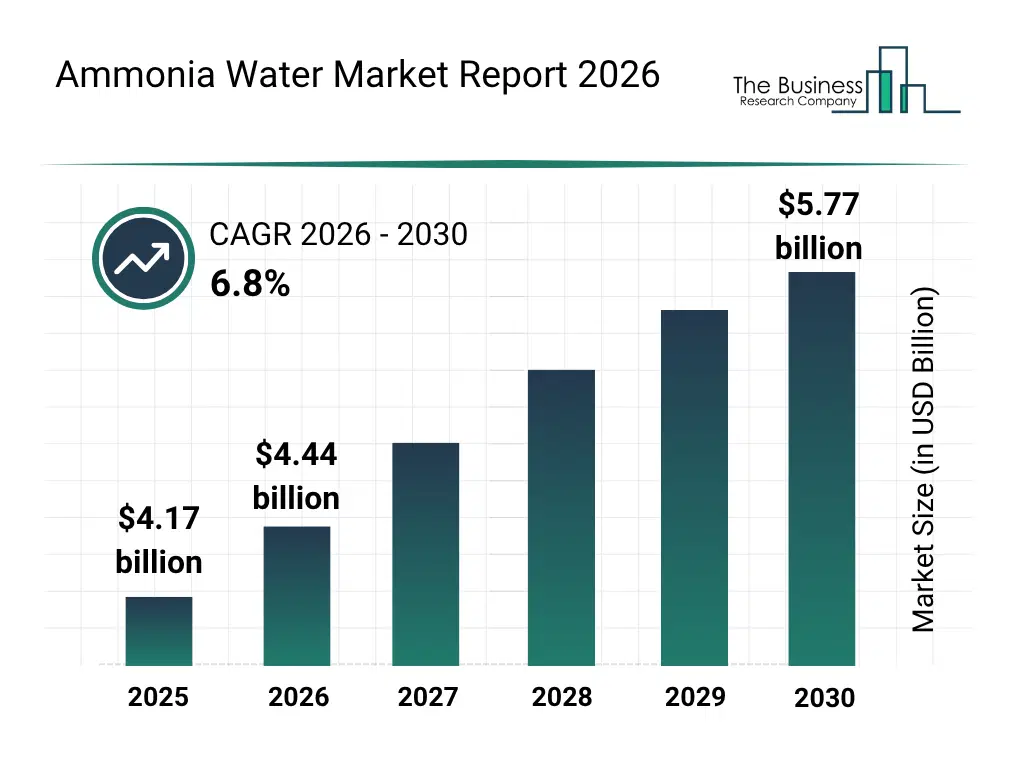
What Is The Ammonia Water Market Size and Share 2026?
The ammonia water market size has grown strongly in recent years. It will grow from $4.17 billion in 2025 to $4.44 billion in 2026 at a compound annual growth rate (CAGR) of 6.5%. The growth in the historic period can be attributed to increasing demand from chemical manufacturing, growing use in water treatment facilities, rising consumption in agricultural applications, expansion of pharmaceutical manufacturing, increasing industrialization across emerging economies.What Is The Ammonia Water Market Growth Forecast?
The ammonia water market size is expected to see strong growth in the next few years. It will grow to $5.77 billion in 2030 at a compound annual growth rate (CAGR) of 6.8%. The growth in the forecast period can be attributed to growing demand for electronic grade ammonia water, increasing investments in semiconductor manufacturing, rising adoption in high purity industrial applications, expanding pharmaceutical production capacity, increasing demand for specialty chemical processing. Major trends in the forecast period include rising demand for high purity ammonia water, increasing adoption of ammonia water in water treatment applications, growing use of ammonia water as an industrial neutralizing agent, rising consumption of ammonia water in chemical processing industries, expansion of pharmaceutical and laboratory grade ammonia water production.
Global Ammonia Water Market Segmentation
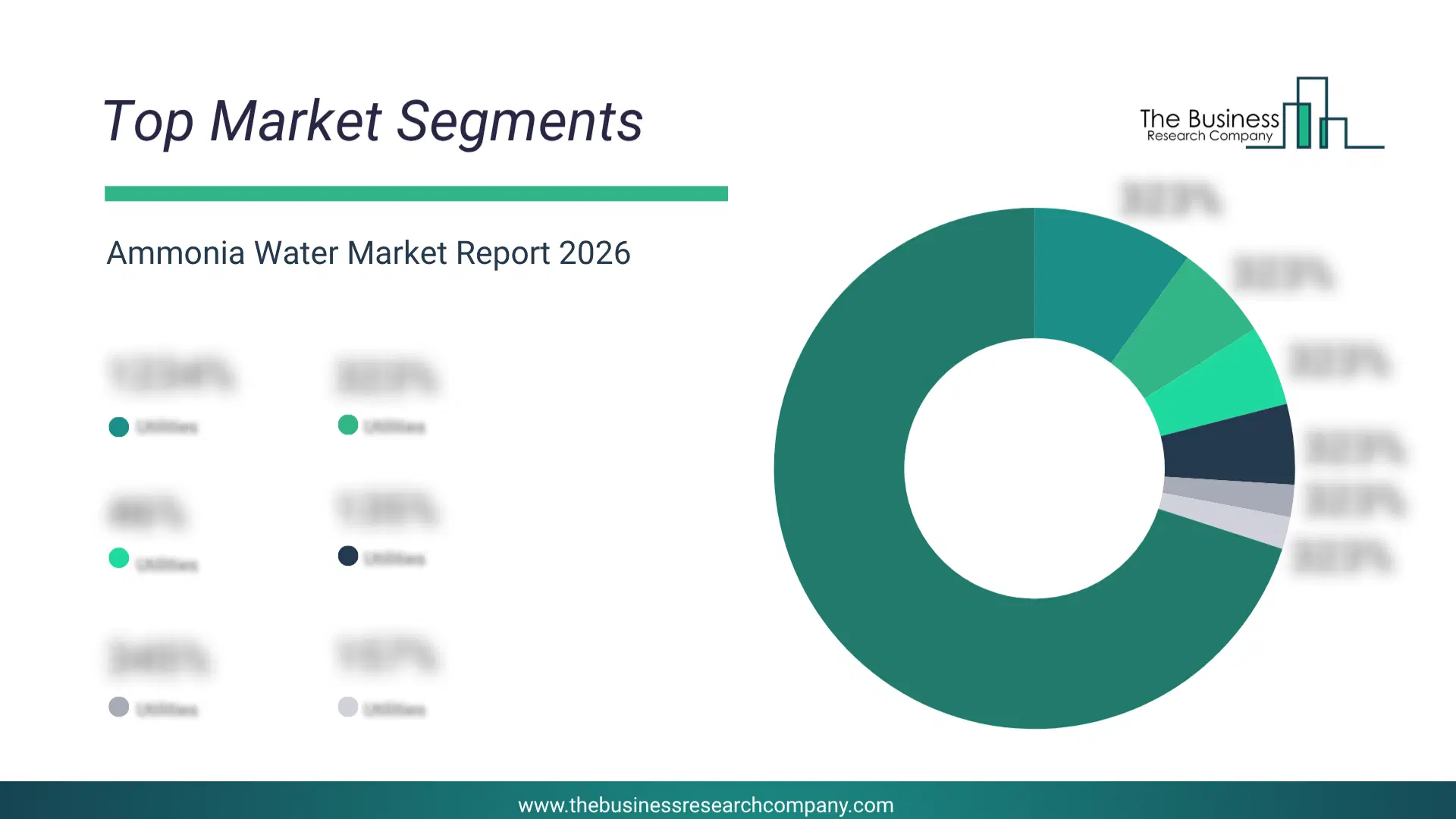
2) By Concentration Level: Low Concentration, Medium Concentration, High Concentration 3) By Distribution Channel: Direct Sales, Distributors And Wholesalers, Industrial Suppliers, Online Business To Business Platforms, Retail Chemical Dealers 4) By Application: Agriculture, Pharmaceuticals, Chemicals, Water Treatment, Other Applications 5) By End Use: Industrial, Commercial, Residential Subsegments: 1) By Industrial Grade Ammonia Water: Low Concentration Industrial Grade Ammonia Water, Medium Concentration Industrial Grade Ammonia Water, High Concentration Industrial Grade Ammonia Water 2) By Technical Grade Ammonia Water: Standard Purity Technical Grade Ammonia Water, High Purity Technical Grade Ammonia Water, Ultra High Purity Technical Grade Ammonia Water 3) By Electronic Grade Ammonia Water: Semiconductor Grade Electronic Grade Ammonia Water, Integrated Circuit Grade Electronic Grade Ammonia Water, Display Panel Grade Electronic Grade Ammonia Water 4) By Pharmaceutical Grade Ammonia Water: Oral Formulation Grade Pharmaceutical Grade Ammonia Water, Topical Formulation Grade Pharmaceutical Grade Ammonia Water, Laboratory Reagent Grade Pharmaceutical Grade Ammonia Water 5) By Food Grade Ammonia Water: Beverage Processing Grade Food Grade Ammonia Water, Bakery Processing Grade Food Grade Ammonia Water, Food Additive Grade Food Grade Ammonia WaterWhat Are The Drivers Of The Ammonia Water Market?
The expansion of semiconductors and electronics is expected to propel the growth of the ammonia water market going forward. The semiconductor and electronics sector refers to the industry involved in designing, manufacturing, and commercializing electronic components, integrated circuits, and consumer electronic devices. The expansion of semiconductors and electronics due to the rapid adoption of artificial intelligence, 5G, and the Internet of Things (IoT) is increasing demand for high-performance chips and large-scale semiconductor wafer fabrication. The growing semiconductor and electronics sector increases the consumption of high-purity ammonia water, as it is an essential cleaning and etching agent used in semiconductor wafer fabrication to remove contaminants and precisely pattern circuit structures. For instance, in March 2026, according to the Semiconductor Industry Association, a US-based trade organization, global semiconductor sales totaled $82.5 billion in January 2026, marking a 46.1% increase compared to $56.5 billion in January 2025. Therefore, the expansion of semiconductors and electronics is driving the growth of the ammonia water industry. The growth in the chemical manufacturing industry is expected to propel the growth of the ammonia water market going forward. The chemical manufacturing industry refers to the sector involved in transforming raw materials through chemical processes to produce a wide range of products, including industrial chemicals, fertilizers, pharmaceuticals, plastics, and cleaning agents. Chemical manufacturing growth is primarily driven by increased industrial production and expanding pharmaceutical manufacturing activity, which has led to a significant rise in the number of chemical establishments and a surge in overall shipment values across the sector. The expansion of chemical manufacturing directly increases the demand for ammonia water, as it serves as a key input in various chemical processes, including the production of fertilizers, cleaning solutions, and industrial compounds. For instance, in July 2025, according to the US Bureau of Labor Statistics, a US-based government department, chemical manufacturing exports reached $285.4 billion in 2024, reflecting a 2.6% rise from 2023, with the top six exporting states accounting for more than half of the total value. Therefore, the growth in the chemical manufacturing industry is driving the growth of the ammonia water industry.Key Players In The Global Ammonia Water Market
Major companies operating in the ammonia water market are BASF, CF Industries Holdings, Yara International, Linde, Nutrien, Dow, Air Liquide, Air Products and Chemicals, Solvay, EuroChem Group, Sumitomo Chemical, Brenntag, Mitsubishi Gas Chemical Company, Arkema, Tosoh Corporation, Koch Fertilizer, Hawkins, Kanto Chemical, Hill Brothers Chemical Company, Ricca Chemical Company, GAC Chemical Corporation, Sasol, Malanadu Ammonia, LSB Industries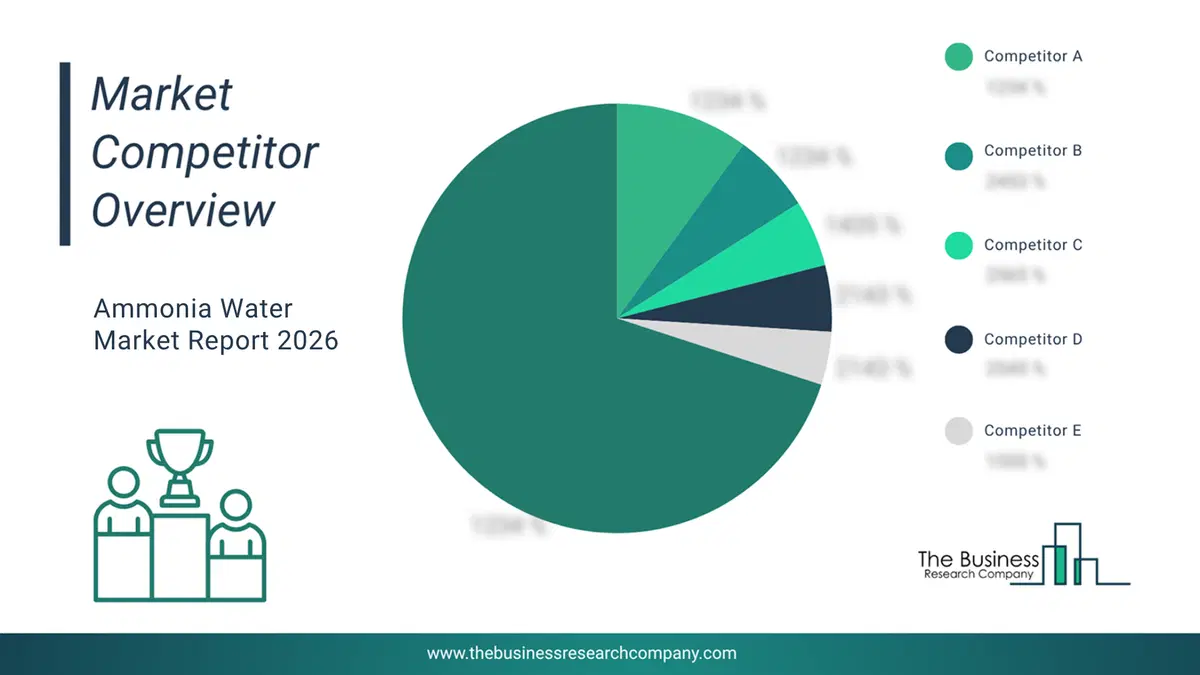
This chart is for illustrative purposes; the full report includes a detailed competitor analysis and comprehensive overview of the top 10 companies in the market.
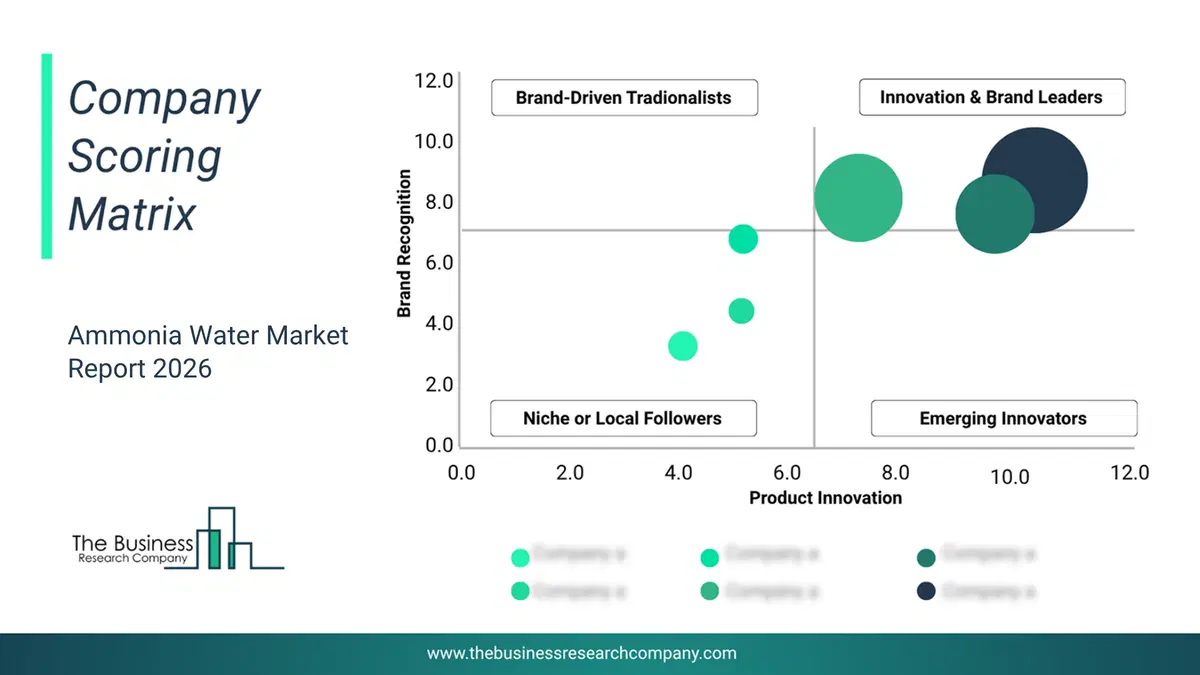
This chart maps companies by product innovation and brand strength, with bubble size indicating relative revenue, helping identify market leaders, challengers, and niche players. This is an illustrative chart; the full report provides a complete and accurate competitive analysis.
Global Ammonia Water Market Trends and Insights
Major companies operating in the ammonia water market are focusing on developing advanced chemical formulations, such as high-purity aqueous ammonia solution, to enhance process efficiency, improve chemical consistency, and support a wide range of industrial applications. High-purity aqueous ammonia solution is a highly refined ammonia and water mixture used in semiconductor, pharmaceutical, and specialty chemical applications requiring stringent purity standards. For instance, in July 2025, Blended Products, a UK-based specialty chemicals and gases company, launched Aquamonia 245, a high-purity aqueous ammonia solution designed for industrial applications. It is designed to support improved chemical handling efficiency and process reliability. The solution enables enhanced purity control, consistent formulation quality, and optimized performance in downstream chemical and water treatment processes, strengthening modern industrial ammonia-based applications.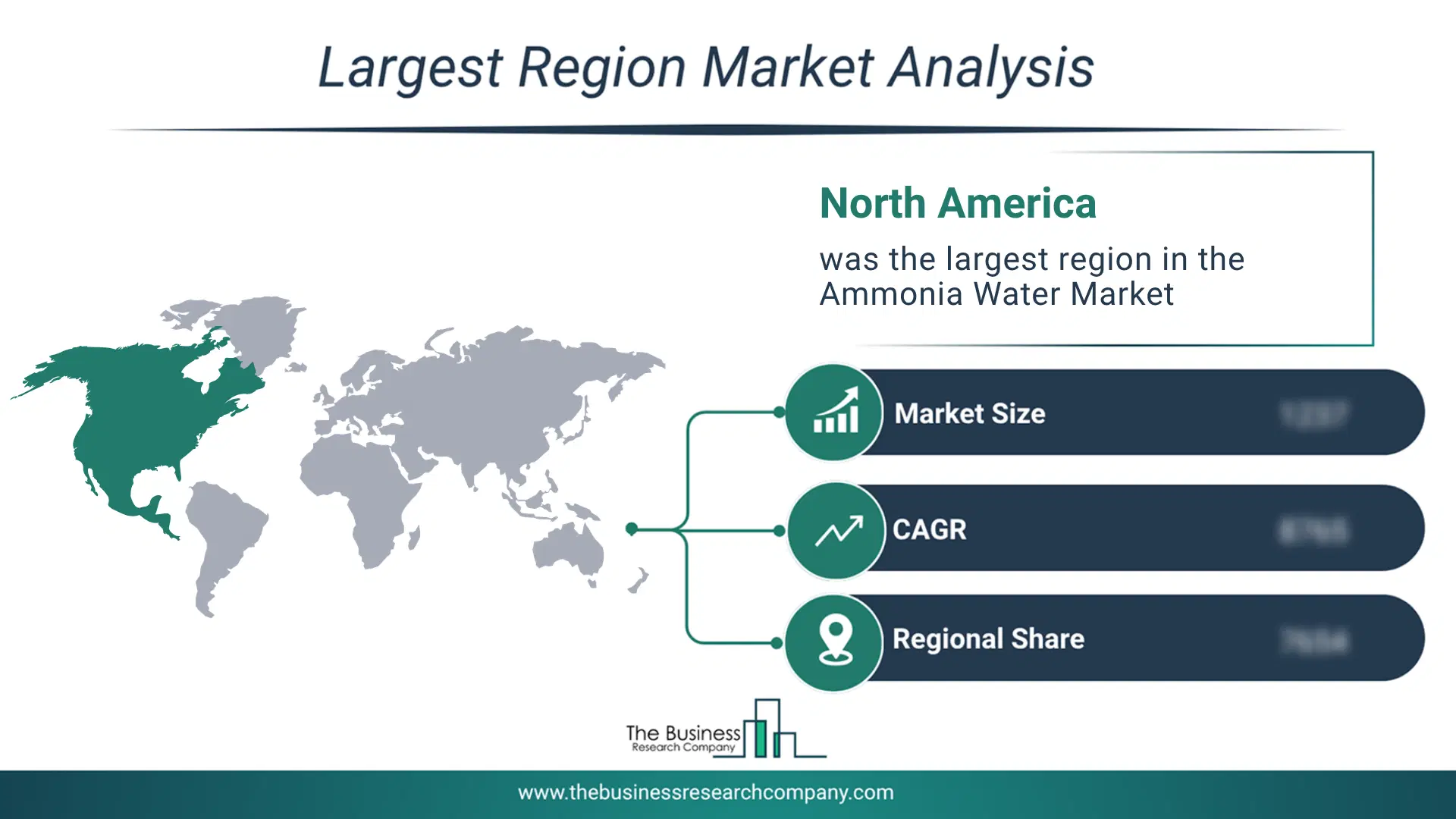
Regional Outlook/Insights
North America was the largest region in the ammonia water market in 2025. Asia-Pacific is expected to be the fastest-growing region in the forecast period. The regions covered in this market report are Asia-Pacific, South East Asia, Western Europe, Eastern Europe, North America, South America, Middle East, Africa. The countries covered in this market report are Australia, Brazil, China, France, Germany, India, Indonesia, Japan, Taiwan, Russia, South Korea, UK, USA, Canada, Italy, Spain.What Defines the Ammonia Water Market?
The ammonia water market consists of sales of cleaning solutions, pH control agents, fertilizer intermediates, water treatment chemicals, and textile processing agents. Values in this market are ‘factory gate’ values, that is, the value of goods sold by the manufacturers or creators of the goods, whether to other entities (including downstream manufacturers, wholesalers, distributors, and retailers) or directly to end customers. The value of goods in this market includes related services sold by the creators of the goods.How is Market Value Defined and Measured?
The market value is defined as the revenues that enterprises gain from the sale of goods and/or services within the specified market and geography through sales, grants, or donations in terms of the currency (in USD unless otherwise specified). The revenues for a specified geography are consumption values that are revenues generated by organizations in the specified geography within the market, irrespective of where they are produced. It does not include revenues from resales along the supply chain, either further along the supply chain or as part of other products.
This chart presents market attractiveness based on a quantitative evaluation of growth, competition, strategic alignment, and risk, offering a clear view of opportunity areas for decision-making. This chart is for illustrative purposes; the full report contains the complete analysis.

This chart highlights the Total Addressable Market (TAM) by estimating the maximum revenue opportunity using an assumption-driven approach, supporting strategic planning and opportunity sizing across markets. The chart is illustrative; the full report provides a more comprehensive analysis.
What Key Data and Analysis Are Included in the Ammonia Water Market Report 2026?
The ammonia water market research report is one of a series of new reports from The Business Research Company that provides ammonia water market statistics, including ammonia water industry global market size, regional shares, competitors with a ammonia water market share, detailed ammonia water market segments, market trends and opportunities, and any further data you may need to thrive in the ammonia water industry. This ammonia water market research report delivers a complete perspective of everything you need, with an in-depth analysis of the current and future scenario of the industry.Ammonia Water Market Report Forecast Analysis
| Report Attribute | Details |
|---|---|
| Market Size Value In 2026 | $4.44 billion |
| Revenue Forecast In 2030 | $5.77 billion |
| Growth Rate | CAGR of 6.8% from 2026 to 2030 |
| Base Year For Estimation | 2025 |
| Actual Estimates/Historical Data | 2020-2025 |
| Forecast Period | 2026 - 2030 |
| Market Representation | Revenue in USD Billion and CAGR from 2026 to 2030 |
| Segments Covered | Type, Concentration Level, Distribution Channel, Application, End Use |
| Regional Scope | Asia-Pacific, Western Europe, Eastern Europe, North America, South America, Middle East, Africa |
| Country Scope | The countries covered in the report are Australia, Brazil, China, France, Germany, India, Indonesia, Japan, Taiwan, Russia, South Korea, UK, USA, Canada, Italy, Spain. |
| Key Companies Profiled | BASF, CF Industries Holdings, Yara International, Linde, Nutrien, Dow, Air Liquide, Air Products and Chemicals, Solvay, EuroChem Group, Sumitomo Chemical, Brenntag, Mitsubishi Gas Chemical Company, Arkema, Tosoh Corporation, Koch Fertilizer, Hawkins, Kanto Chemical, Hill Brothers Chemical Company, Ricca Chemical Company, GAC Chemical Corporation, Sasol, Malanadu Ammonia, LSB Industries |
| Customization Scope | Request for Customization |
| Pricing And Purchase Options | Explore Purchase Options |