
Amphibious Warfare Ship Market Report 2026
Global Outlook – By Type (Dock Landing Ship, Amphibious Transport Dock, Amphibious Assault Ship, Other Types), By Propulsion (Conventional, Nuclear), By Operation Capability (Amphibious Assault Operations, Humanitarian Assistance Operations, Disaster Relief Operations, Combat Logistics Support), By Size Or Displacement (Small Amphibious Crafts (up to 1,500 tons), Medium Size Amphibious Vessels (1,500 - 5,000 tons), Large Amphibious Warfare Ships (above 5,000 tons)), By End-User (Military, Coast Guard, Private Security Firms, Humanitarian Organizations) – Market Size, Trends, Strategies, and Forecast to 2035
Amphibious Warfare Ship Market Overview
• Amphibious Warfare Ship market size has reached to $10.27 billion in 2025 • Expected to grow to $14.75 billion in 2030 at a compound annual growth rate (CAGR) of 7.5% • Growth Driver: Increase In Defense Budgets Driving Growth Of The Market Due To Rising Geopolitical Tensions • Market Trend: Technological Advancements In Integrated Electric Propulsion Systems Fueling The Growth Of The Market Due To Enhanced Power Efficiency And Multi-Mission Capability • North America was the largest region in 2025 and Asia-Pacific is the fastest growing region.What Is Covered Under Amphibious Warfare Ship Market?
An amphibious warfare ship is a naval vessel designed to support ground forces by transporting troops, equipment, and vehicles from sea to shore. It is equipped to conduct amphibious assaults, landing operations, and humanitarian missions in coastal areas. These ships often feature well decks, flight decks, and onboard facilities to deploy landing craft, helicopters, and other amphibious vehicles efficiently. The main types of amphibious warfare ships are dock landing ships, amphibious transport docks, amphibious assault ships, and others. A dock landing ship is a type of amphibious warfare vessel equipped with a well deck to transport and deploy landing craft and amphibious vehicles. The vessels feature different propulsion types, including conventional and nuclear, and offer a range of operational capabilities, such as amphibious assault operations, humanitarian assistance, disaster relief, and combat logistics support. Amphibious warfare ships are classified by size or displacement into small amphibious crafts (up to 1,500 tons), medium-sized amphibious vessels (1,500–5,000 tons), and large amphibious warfare ships (above 5,000 tons), serving various end-users, including the military, coast guards, private security firms, and humanitarian organizations.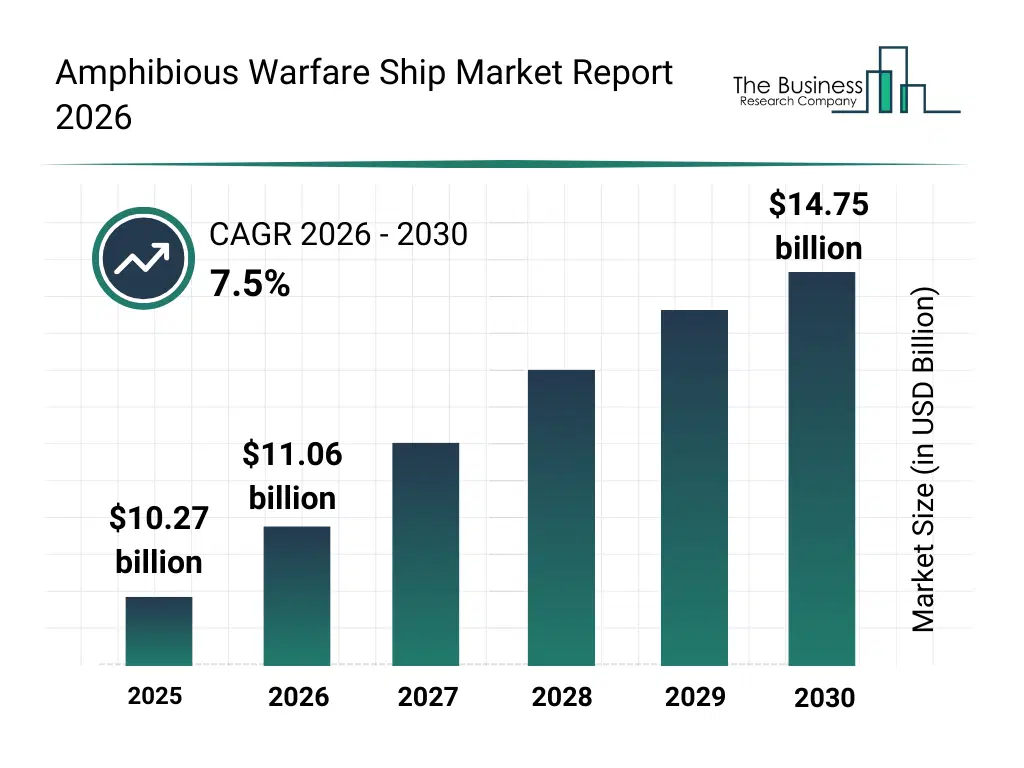
What Is The Amphibious Warfare Ship Market Size and Share 2026?
The amphibious warfare ship market size has grown strongly in recent years. It will grow from $10.27 billion in 2025 to $11.06 billion in 2026 at a compound annual growth rate (CAGR) of 7.7%. The growth in the historic period can be attributed to rising global naval modernization programs, increased geopolitical tensions driving procurement, advancements in landing craft and helicopter operations, enhancements in onboard command and control systems, adoption of modular ship design concepts.What Is The Amphibious Warfare Ship Market Growth Forecast?
The amphibious warfare ship market size is expected to see strong growth in the next few years. It will grow to $14.75 billion in 2030 at a compound annual growth rate (CAGR) of 7.5%. The growth in the forecast period can be attributed to development of hybrid propulsion systems, integration of unmanned aerial and underwater vehicles, enhanced survivability and defensive systems, automation in logistics and onboard operations, expansion of humanitarian and disaster relief capabilities. Major trends in the forecast period include advanced amphibious assault capabilities, modular ship design, enhanced onboard logistics & vehicle deployment, integrated communication & navigation systems, multi-mission operational flexibility.
Global Amphibious Warfare Ship Market Segmentation
1) By Type: Dock Landing Ship, Amphibious Transport Dock, Amphibious Assault Ship, Other Types 2) By Propulsion: Conventional, Nuclear 3) By Operation Capability: Amphibious Assault Operations, Humanitarian Assistance Operations, Disaster Relief Operations, Combat Logistics Support 4) By Size Or Displacement: Small Amphibious Crafts (up to 1,500 tons), Medium Size Amphibious Vessels (1,500 - 5,000 tons), Large Amphibious Warfare Ships (above 5,000 tons) 5) By End-User: Military, Coast Guard, Private Security Firms, Humanitarian Organizations Subsegments: 1) By Dock Landing Ship: Traditional Dock Landing Ship, Modern Advanced Dock Landing Ship 2) By Amphibious Transport Dock: San Antonio Class Amphibious Transport Dock, Albion Class Amphibious Transport Dock 3) By Amphibious Assault Ship: Wasp Class Amphibious Assault Ship, America Class Amphibious Assault Ship 4) By Other Types: Landing Ship Tank, Landing Craft Utility, Multi Role Amphibious ShipWhat Is Driver Of The Amphibious Warfare Ship Market?
The increase in defense budgets is expected to propel the growth of the amphibious warfare ship market going forward. A defense budget is the portion of a government’s national budget that is allocated to funding its military and defense-related activities. Defense budgets are rising mainly due to increasing geopolitical tensions, driving nations to invest more in military readiness and advanced technologies. A high defense budget is essential to the modernization of amphibious warfare ships, as it ensures sustained investment in advanced shipbuilding technologies, the integration of enhanced defensive and offensive systems, and the development of improved logistical capabilities. For instance, in February 2025, according to Stockholm International Peace Research Institute (SIPRI), a Sweden-based independent international research institute that provides open-source analysis and data on conflict, arms control, disarmament, and military expenditure. In 2024, global defense spending rose to USD 2.46 trillion, up from USD 2.24 trillion in the previous year. Therefore, the increase in defense budgets is driving the growth of the amphibious warfare ship industry.Key Players In The Global Amphibious Warfare Ship Market
Major companies operating in the amphibious warfare ship market are Lockheed Martin Corporation, Northrop Grumman Corporation, Thyssenkrupp AG, BAE Systems plc, Larsen & Toubro Limited, Thales S.A., Textron Inc., Kawasaki Heavy Industries Ltd., Huntington Ingalls Industries Inc., HD Hyundai Heavy Industries Co. Ltd., FINCANTIERI S.p.A., ST Engineering Ltd., Saab AB, Naval Group S.A., Damen Shipyards Group B.V., Hanwha Systems Co. Ltd., Austal Limited, Mazagon Dock Shipbuilders Limited, Griffon Hoverwork Ltd., Navantia S.A., Marine Alutech Oy Ab.Global Amphibious Warfare Ship Market Trends and Insights
Major companies operating in the amphibious warfare ship market are emphasizing technological advancements, such as integrated electric propulsion systems, to optimize power generation, enhance fuel efficiency, and supply vessels with the energy needed for advanced weapons and sensor systems. Integrated electric propulsion systems are marine power architectures that combine electric generators, motors, and sophisticated power management, designed to efficiently distribute electrical energy for both propulsion and high-demand mission systems such as radar and directed-energy weapons. For instance, in December 2024, Hudong-Zhonghua Shipbuilding, a China-based subsidiary of China State Shipbuilding Corporation (CSSC), launched its new Type 076 amphibious assault ship. This next-generation warship incorporates electromagnetic catapults and arresting gear (EMALS and AAG) to operate a broader range of fixed-wing aircraft and drones, a first for this class of vessel. This innovation represents a major advancement in China’s amphibious warfare capabilities, effectively bridging the gap between an assault ship and an aircraft carrier. The ship is designed to deliver enhanced air support and power projection for amphibious landing operations and maritime missions.What Are Latest Mergers And Acquisitions In The Amphibious Warfare Ship Market? Fincantieri Boosts Naval Capabilities With Leonardo’s Underwater Systems Acquisition
In January 2025, Fincantieri S.p.A., an Italy-based shipbuilding and defense company, acquired Leonardo S.p.A.'s UAS Underwater Business for an undisclosed amount. This acquisition allows Fincantieri to integrate advanced underwater vehicles and autonomous systems into its amphibious warfare ships, potentially improving mission versatility, reconnaissance, and combat efficiency in naval operations. Leonardo S.p.A. is an Italy-based aerospace and defense company that designs and manufactures advanced sonars, towed arrays, and other naval defense systems.Regional Insights
North America was the largest region in the amphibious warfare ship market in 2025. Asia-Pacific is expected to be the fastest-growing region in the forecast period. The regions covered in this market report are Asia-Pacific, South East Asia, Western Europe, Eastern Europe, North America, South America, Middle East, Africa. The countries covered in this market report are Australia, Brazil, China, France, Germany, India, Indonesia, Japan, Taiwan, Russia, South Korea, UK, USA, Canada, Italy, SpainWhat Defines the Amphibious Warfare Ship Market?
The amphibious warfare ship market consists of sales of landing helicopter docks, landing platform docks, landing ship tanks, and assault vessels. Values in this market are ‘factory gate’ values, that is, the value of goods sold by the manufacturers or creators of the goods, whether to other entities (including downstream manufacturers, wholesalers, distributors, and retailers) or directly to end customers. The value of goods in this market includes related services sold by the creators of the goods.How is Market Value Defined and Measured?
The market value is defined as the revenues that enterprises gain from the sale of goods and/or services within the specified market and geography through sales, grants, or donations in terms of the currency (in USD unless otherwise specified). The revenues for a specified geography are consumption values that are revenues generated by organizations in the specified geography within the market, irrespective of where they are produced. It does not include revenues from resales along the supply chain, either further along the supply chain or as part of other products.What Key Data and Analysis Are Included in the Amphibious Warfare Ship Market Report 2026?
The amphibious warfare ship market research report is one of a series of new reports from The Business Research Company that provides market statistics, including industry global market size, regional shares, competitors with the market share, detailed market segments, market trends and opportunities, and any further data you may need to thrive in the amphibious warfare ship industry. The market research report delivers a complete perspective of everything you need, with an in-depth analysis of the current and future state of the industry.Amphibious Warfare Ship Market Report Forecast Analysis
| Report Attribute | Details |
|---|---|
| Market Size Value In 2026 | $11.06 billion |
| Revenue Forecast In 2035 | $14.75 billion |
| Growth Rate | CAGR of 7.7% from 2026 to 2035 |
| Base Year For Estimation | 2025 |
| Actual Estimates/Historical Data | 2020-2025 |
| Forecast Period | 2026 - 2030 - 2035 |
| Market Representation | Revenue in USD Billion and CAGR from 2026 to 2035 |
| Segments Covered | Type, Propulsion, Operation Capability, Size Or Displacement, End-User |
| Regional Scope | Asia-Pacific, Western Europe, Eastern Europe, North America, South America, Middle East, Africa |
| Country Scope | The countries covered in the report are Australia, Brazil, China, France, Germany, India, ... |
| Key Companies Profiled | Lockheed Martin Corporation, Northrop Grumman Corporation, Thyssenkrupp AG, BAE Systems plc, Larsen & Toubro Limited, Thales S.A., Textron Inc., Kawasaki Heavy Industries Ltd., Huntington Ingalls Industries Inc., HD Hyundai Heavy Industries Co. Ltd., FINCANTIERI S.p.A., ST Engineering Ltd., Saab AB, Naval Group S.A., Damen Shipyards Group B.V., Hanwha Systems Co. Ltd., Austal Limited, Mazagon Dock Shipbuilders Limited, Griffon Hoverwork Ltd., Navantia S.A., Marine Alutech Oy Ab. |
| Customization Scope | Request for Customization |
| Pricing And Purchase Options | Explore Purchase Options |