
Analogue Computing Market Report 2026
Global Outlook – By Component (Hardware, Services), By Technology (Analog Signal Processing And Computation, Hybrid Analog-Digital Computing Systems, Neuromorphic And Brain-Inspired Computing, Analog Hardware Design And Consulting), By Deployment (On-Premises And Embedded Systems, Edge Computing Solutions, Cloud-Based Simulation Services, Custom Hardware Deployments), By Application (Simulation And Modeling, Real-Time Signal Processing, Artificial Intelligence Training And Inference, Control Systems), By End-User (Aerospace And Defense, Healthcare, Automotive, Telecommunications, Industrial Manufacturing, Energy And Utilities) – Market Size, Trends, Strategies, and Forecast to 2030
Analogue Computing Market Overview
• Analogue Computing market size has reached to $0.58 billion in 2025 • Expected to grow to $0.64 billion in 2030 at a compound annual growth rate (CAGR) of 11.8% • Growth Driver: Growing Demand For Energy-Efficient Computing Systems Driving Market Growth Due To Growing Demand For Energy-Efficient Computing Systems • Market Trend: Advancements In Analog Reservoir AI Chips Driving Real-Time, Low-Power Edge Intelligence • North America was the largest region in 2025 and Asia-Pacific is the fastest growing region.What Is Covered Under Analogue Computing Market?
Analogue computing refers to a computing paradigm that processes continuous physical signals to model and solve mathematical problems, rather than relying on discrete binary data. It is used to perform high-speed simulations and real-time computations by representing variables through physical quantities such as voltage, current, or mechanical motion. The main components types of analogue computing Include hardware and services. Hardware refers to the physical electronic and electromechanical components such as analog processors, resistors, capacitors, operational amplifiers, and signal conditioning units that enable the execution of continuous-time computations in analogue computing systems. The technology includes analog signal processing and computation, hybrid analog-digital computing systems, neuromorphic and brain-inspired computing, and analog hardware design and consulting, with key applications in simulation and modeling, real-time signal processing, artificial intelligence training and inference, and control systems, and serves primary end users across aerospace and defense, healthcare, automotive, telecommunications, industrial manufacturing, and energy and utilities.
What Is The Analogue Computing Market Size and Share 2026?
The analogue computing market size has grown rapidly in recent years. It will grow from $0.58 billion in 2025 to $0.64 billion in 2026 at a compound annual growth rate (CAGR) of 11.5%. The growth in the historic period can be attributed to early adoption of electronic circuit based computation models, demand for real time control systems in aerospace and defense, development of operational amplifier technologies, growth of analog signal processing in telecommunications, increasing need for simulation in industrial engineering.What Is The Analogue Computing Market Growth Forecast?
The analogue computing market size is expected to see rapid growth in the next few years. It will grow to $1 billion by 2030 at a compound annual growth rate (CAGR) of 11.8%. The growth in the forecast period can be attributed to rising demand for ultra low power computing architectures, expansion of AI driven hardware acceleration needs, growth of edge computing requiring real time processing, increasing complexity of simulation in autonomous systems, adoption of hybrid analog digital computing models. Major trends in the forecast period include neuromorphic and brain inspired analog computing systems, hybrid analog digital computing architectures, edge based real time analog signal processing, energy efficient high speed simulation computing, analog hardware acceleration for AI workloads.
Global Analogue Computing Market Segmentation
1) By Component: Hardware, Services 2) By Technology: Analog Signal Processing And Computation, Hybrid Analog-Digital Computing Systems, Neuromorphic And Brain-Inspired Computing, Analog Hardware Design And Consulting 3) By Deployment: On-Premises And Embedded Systems, Edge Computing Solutions, Cloud-Based Simulation Services, Custom Hardware Deployments 4) By Application: Simulation And Modeling, Real-Time Signal Processing, Artificial Intelligence Training And Inference, Control Systems 5) By End-User: Aerospace And Defense, Healthcare, Automotive, Telecommunications, Industrial Manufacturing, Energy And Utilities Subsegments: 1) By Hardware: Analog Computing Systems, Analog Signal Processing Units, Operational Amplifier Based Systems, Electronic Circuit Simulation Hardware, Control And Instrumentation Units 2) By Services: Design Services, Consulting Services, Integration Services, Maintenance And Support Services, Training And Education ServicesWhat Is The Driver Of The Analogue Computing Market?
The growing demand for energy-efficient computing systems is expected to propel the growth of the analogue computing market going forward. Energy-efficient computing systems refer to computer hardware and software designs that aim to minimize energy consumption while maintaining required performance, speed and reliability. The rise of energy-efficient computing systems is due to people needing to reduce energy use while still improving computing performance. Analogue computing help energy-efficient computing systems by allowing computations to be performed using continuous physical signals instead of digital binary steps. For instance, in July 2025, according to International Energy Agency (IEA), a France-based intergovernmental organization, data center facilities consume about 485 terawatt hours (TWh) of electricity, representing 1.7% of global demand, and this is projected to rise to around 945 TWh by 2030, reflecting the rapid expansion of global digital infrastructure driven by cloud computing and artificial intelligence workloads. Therefore, the growing demand for energy-efficient computing systems is driving the growth of analogue computing industry.Key Players In The Global Analogue Computing Market
Major companies operating in the analogue computing market are Texas Instruments Incorporated; Infineon Technologies AG; STMicroelectronics N.V.; NXP Semiconductors N.V.; Renesas Electronics Corporation; Microchip Technology Incorporated; Keysight Technologies Inc.; Synopsys Inc.; Cadence Design Systems Inc.; SynSense AG; Innatera Nanosystems B.V.; Mythic Inc.; Aspinity Inc.; GrAI Matter Labs SAS; Rain Neuromorphics Inc.; anabrid GmbH; Blumind Inc.; Extropic Inc.; Vivum Computing Inc.; Aspirare Semiconductor Pvt. Ltd.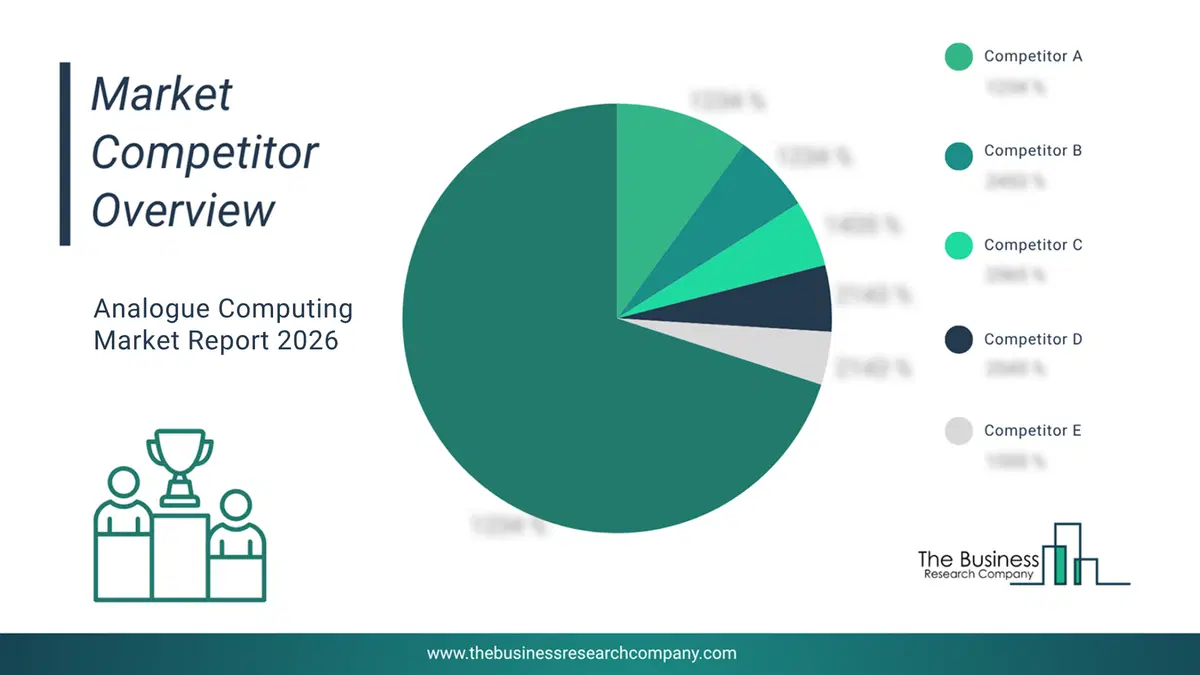
This chart is for illustrative purposes; the full report includes a detailed competitor analysis and comprehensive overview of the top 10 companies in the market.
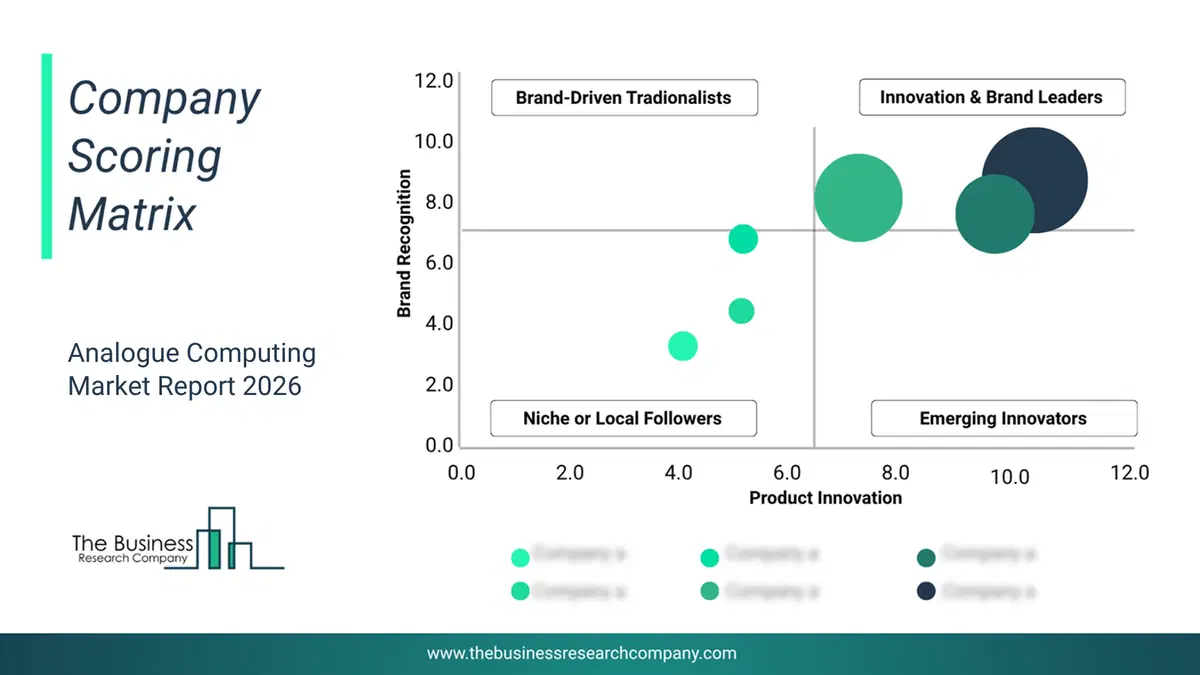
This chart maps companies by product innovation and brand strength, with bubble size indicating relative revenue, helping identify market leaders, challengers, and niche players. This is an illustrative chart; the full report provides a complete and accurate competitive analysis.
Global Analogue Computing Market Trends and Insights
Major companies operating in the analog computing market are increasingly focusing on developing advanced analog signal processing units, such as prototype analog reservoir AI chips, to enable real-time learning, reduce power consumption, and enhance on-device intelligence for next-generation edge applications. Prototype analog reservoir AI chips refer to experimental AI hardware that uses analog circuits and reservoir computing to enable real-time, energy-efficient learning and processing of time-based data directly on-device. For instance, in October 2025, TDK Corporation, a Japan-based electronics and materials technology company, introduces a prototype analogue reservoir artificial intelligence (AI) chip, a compact neuromorphic computing system designed for real-time analogue adaptive sensing that processes live sensor data through physical circuit dynamics by enabling continuous on-device learning and adaptive response without traditional model retraining. Additionally, it also offers ultra-low power operation and strong performance for time-series and motion-based sensing tasks such as gesture recognition and real-time prediction on edge devices.What Are Latest Mergers And Acquisitions In The Analogue Computing Market?
In June 2025, the Hertz Foundation, a US-based organization that provides highly competitive fellowships in applied science, mathematics and engineering, announced a partnership with Analog Devices, Inc. Through this collaboration, the Hertz Foundation and Analog Devices aim to empower analogue, digital and software technologies by providing fellowship support, research engagement with industry leadership and internship opportunities in advanced semiconductor and systems engineering to strengthen innovation in hardware and software integration. Analog Devices, Inc. is a US-based semiconductor company specializing in analogue and digital signal processing technologies.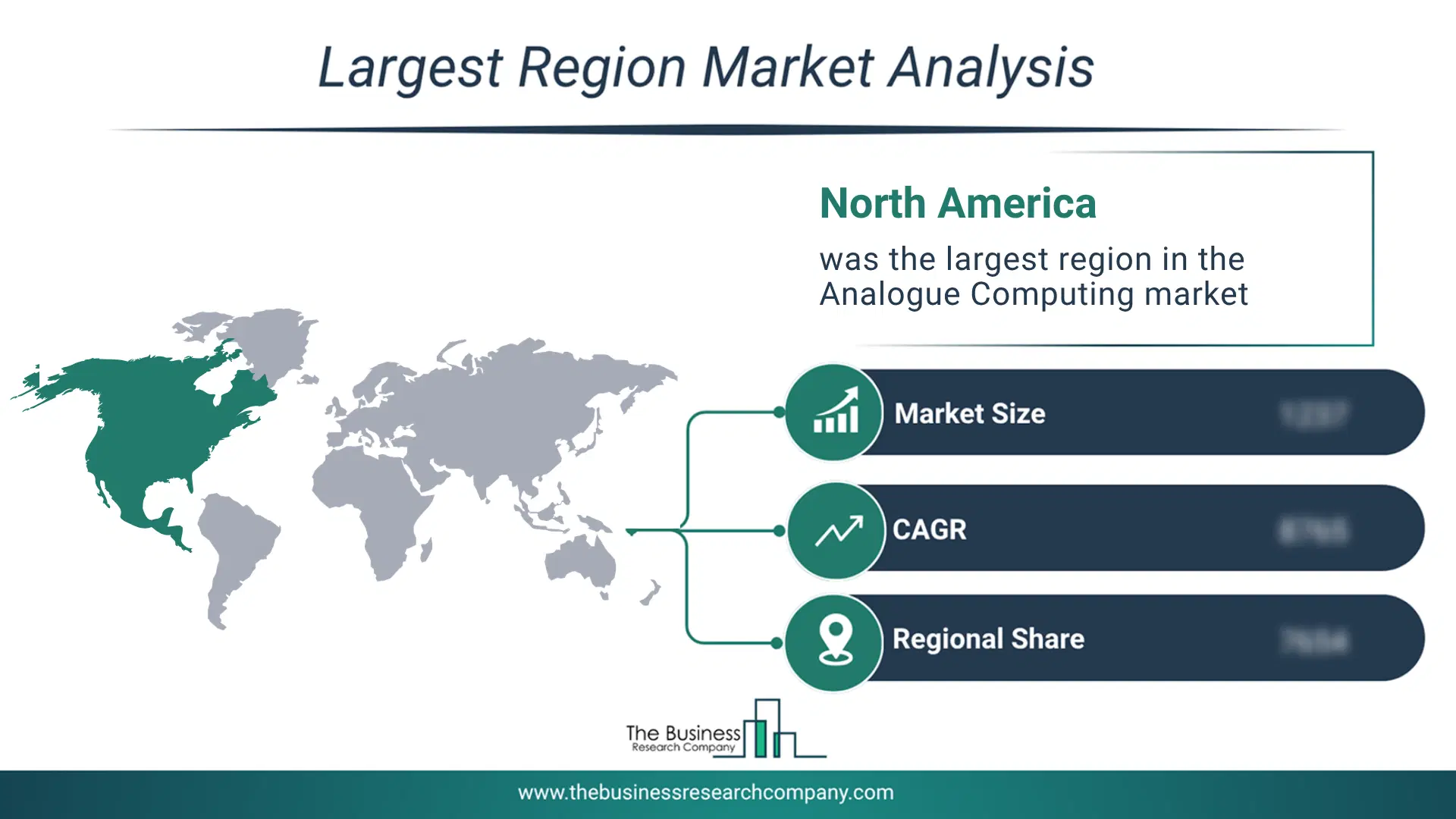
Regional Insights
North America was the largest region in the analogue computing market in 2025. Asia-Pacific is expected to be the fastest-growing region in the forecast period. The regions covered in this market report are Asia-Pacific, South East Asia, Western Europe, Eastern Europe, North America, South America, Middle East, Africa. The countries covered in this market report are Australia, Brazil, China, France, Germany, India, Indonesia, Japan, Taiwan, Russia, South Korea, UK, USA, Canada, Italy, Spain.What Defines the Analogue Computing Market?
The analogue computing market consists of revenues earned by entities by providing services such as analog signal processing and computation services, hybrid analog-digital computing system integration services, neuromorphic and brain-inspired computing solution services, and analog hardware design, development, and consulting services. The market value includes the value of related goods sold by the service provider or included within the service offering. The analogue computing market also includes sales of analogue processors, signal processing units, specialised computing chips, sensors, and embedded control systems. Values in this market are ‘factory gate’ values, that is, the value of goods sold by the manufacturers or creators of the goods, whether to other entities (including downstream manufacturers, wholesalers, distributors, and retailers) or directly to end customers. The value of goods in this market includes related services sold by the creators of the goods.How is Market Value Defined and Measured?
The market value is defined as the revenues that enterprises gain from the sale of goods and/or services within the specified market and geography through sales, grants, or donations in terms of the currency (in USD unless otherwise specified). The revenues for a specified geography are consumption values that are revenues generated by organizations in the specified geography within the market, irrespective of where they are produced. It does not include revenues from resales along the supply chain, either further along the supply chain or as part of other products.
This chart presents market attractiveness based on a quantitative evaluation of growth, competition, strategic alignment, and risk, offering a clear view of opportunity areas for decision-making. This chart is for illustrative purposes; the full report contains the complete analysis.

This chart highlights the Total Addressable Market (TAM) by estimating the maximum revenue opportunity using an assumption-driven approach, supporting strategic planning and opportunity sizing across markets. The chart is illustrative; the full report provides a more comprehensive analysis.
What Key Data and Analysis Are Included in the Analogue Computing Market Report 2026?
The analogue computing market research report is one of a series of new reports from The Business Research Company that provides market statistics, including industry global market size, regional shares, competitors with the market share, detailed market segments, market trends and opportunities, and any further data you may need to thrive in the analogue computing industry. The market research report delivers a complete perspective of everything you need, with an in-depth analysis of the current and future state of the industry.Analogue Computing Market Report Forecast Analysis
| Report Attribute | Details |
|---|---|
| Market Size Value In 2026 | $0.64 billion |
| Revenue Forecast In 2030 | $1 billion |
| Growth Rate | CAGR of 11.8% from 2026 to 2030 |
| Base Year For Estimation | 2025 |
| Actual Estimates/Historical Data | 2020-2025 |
| Forecast Period | 2026 - 2030 |
| Market Representation | Revenue in USD Billion and CAGR from 2026 to 2030 |
| Segments Covered | Component, Technology, Deployment, Application, End-User |
| Regional Scope | Asia-Pacific, Western Europe, Eastern Europe, North America, South America, Middle East, Africa |
| Country Scope | The Countries Covered In This Market Report Are Australia, Brazil, China, France, Germany, India, Indonesia, Japan, Taiwan, Russia, South Korea, Uk, Usa, Canada, Italy, Spain. |
| Key Companies Profiled | Texas Instruments Incorporated, Infineon Technologies AG, STMicroelectronics N.V., NXP Semiconductors N.V., Renesas Electronics Corporation, Microchip Technology Incorporated, Keysight Technologies Inc., Synopsys Inc., Cadence Design Systems Inc., SynSense AG, Innatera Nanosystems B.V., Mythic Inc., Aspinity Inc., GrAI Matter Labs SAS, Rain Neuromorphics Inc., anabrid GmbH, Blumind Inc., Extropic Inc., Vivum Computing Inc., Aspirare Semiconductor Pvt. Ltd. |
| Customization Scope | Request for Customization |
| Pricing And Purchase Options | Explore Purchase Options |