

Angle Encoder Global Market Opportunities And Strategies To 2035
By Type (Incremental Angle Encoders, Absolute Angle Encoders), By Technology (Optical Encoders, Magnetic Encoders, Capacitive Encoders, Mechanical Encoders), By Application Area (Industrial Automation, Automotive, Aerospace, Consumer Electronics), By End-User Industry (Manufacturing, Energy And Power, Telecommunications, Healthcare), And By Region, Opportunities And Strategies – Global Forecast To 2035
Angle Encoder Market Definition
Angle encoders, also known as rotary encoders, are electromechanical sensors used to measure the angular position, rotation and direction of a shaft or rotating component. They convert mechanical motion into electrical signals and are available in types such as incremental encoders (providing relative position) and absolute encoders (providing exact position at any time). The primary purpose of angle encoders is to enable precise motion control and position feedback in automated systems. The angle encoder market consists of sales, by entities (organizations, sole traders or partnerships) of angle encoder devices that are critical components in modern automation and digital control environments where accurate measurement of rotational movement is essential for maintaining operational efficiency and system accuracy. Angle encoders are typically integrated into motors, robotic systems, navigation instruments and other electromechanical assemblies. They are used by manufacturing companies, automotive manufacturers, aerospace organizations, electronics producers and healthcare equipment manufacturers, commonly in industrial robots, computer numerical control (CNC) machines, automotive steering systems, aircraft control mechanisms and precision medical devices. The growing demand for high-precision motion control across automation, robotics and electric mobility positions angle encoders as a critical enabler of modern industrial and technological development.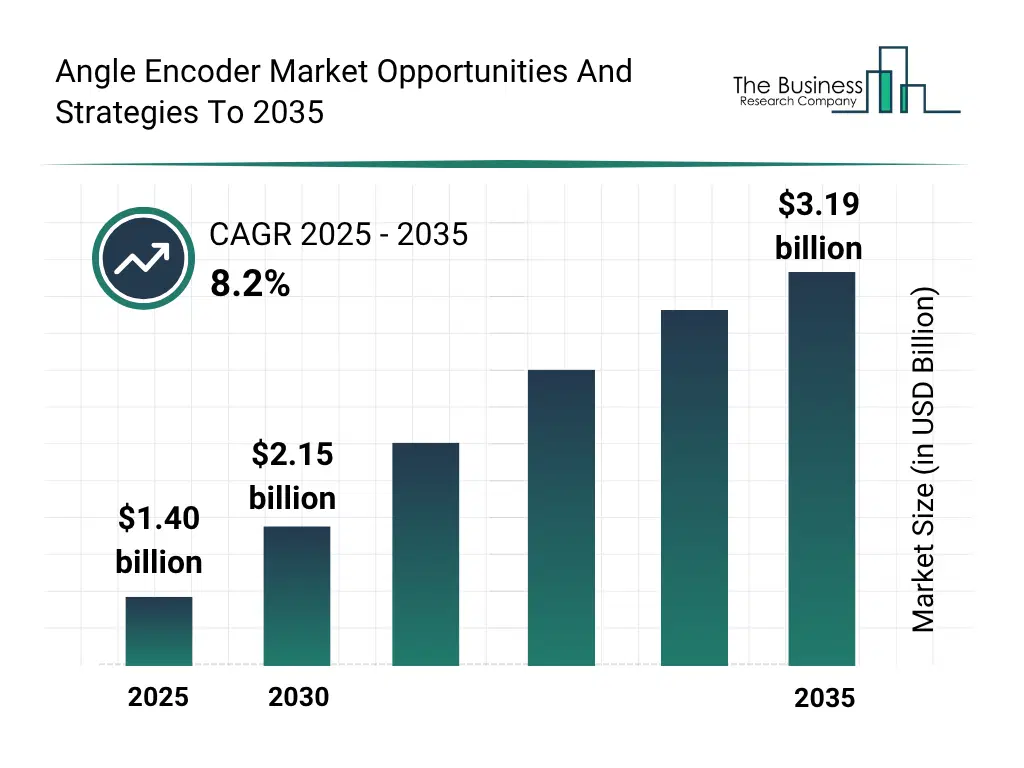
Angle Encoder Market Size
The global angle encoder market reached a value of nearly $1,395.9 million in 2025, having grown at a compound annual growth rate (CAGR) of 9.2% since 2020. The market is expected to grow from $1,395.9 million in 2025 to $2,147.1 million in 2030 at a rate of 9.0%. The market is then expected to grow at a CAGR of 8.2% from 2030 and reach $3,190.4 million in 2035. Growth in the historic period resulted from increasing adoption of robotics, growing automotive and electric vehicle (EV) sector, rising adoption of smart warehousing and logistics automation and increasing deployment of automated material handling systems. Factors that negatively affected growth in the historic period were performance limitations in extreme environmental conditions and intense price competition. Going forward, expansion of smart factories and Industry 4.0, growth in electronics and semiconductor sector, growth of renewable energy installations and expansion of high-speed rail and metro projects globally will drive the growth. Factors that could hinder the growth of the angle encoder market in the future include complex integration with existing systems, availability of low-cost alternatives and impact of trade wars and tariffs.
Angle Encoder Market Segmentation
The angle encoder market is segmented by type, by technology, by application area and by end-user industry.
By Type –
The angle encoder market is segmented by type into:
By Technology –
The angle encoder market is segmented by technology into:
By Application Area –
The angle encoder market is segmented by application area into:
By End-User Industry –
The angle encoder market is segmented by end-user industry into:
By Geography - The angle encoder market is segmented by geography into:
By Type –
The angle encoder market is segmented by type into:
- a) Incremental Angle Encoders
- b) Absolute Angle Encoders
By Technology –
The angle encoder market is segmented by technology into:
- a) Optical Encoders
- b) Magnetic Encoders
- c) Capacitive Encoders
- d) Mechanical Encoders
By Application Area –
The angle encoder market is segmented by application area into:
- a) Industrial Automation
- b) Automotive
- c) Aerospace
- d) Consumer Electronics
By End-User Industry –
The angle encoder market is segmented by end-user industry into:
- a) Manufacturing
- b) Energy And Power
- c) Telecommunications
- d) Healthcare
By Geography - The angle encoder market is segmented by geography into:
- China
- India
- Japan
- Australia
- Indonesia
- South Korea
- USA
- Canada
- Brazil
- France
- Germany
- UK
- Italy
- Spain
- Russia
-
o Asia Pacific
o Africa