
Anomaly Detection Market Report 2026
Global Outlook – By Component (Solutions, Services), By Technology (Big Data Analytics, Data Mining and Business Intelligence, Machine Learning and Artificial Intelligence), By Deployment Type (Cloud, On-Premises, Hybrid), By Application (Intrusion Detection, Fraud Detection, Defect Detection, System Health Monitoring), By Vertical (Banking, Financial Services, and Insurance (BFSI), Retail, Manufacturing, IT and Telecom, Government, Aerospace and Defense, Other Verticals) – Market Size, Trends, Strategies, and Forecast to 2030
Anomaly Detection Market Overview
• Anomaly Detection market size has reached to $6.15 billion in 2025 • Expected to grow to $13.89 billion in 2030 at a compound annual growth rate (CAGR) of 17.7% • Growth Driver: Surge In Connected Devices Fueling Anomaly Detection Market Growth • Market Trend: Advancements In AI-Powered Anomaly Detection Solutions Strengthen Real-Time Threat Identification • North America was the largest region in 2025 and Asia-Pacific is the fastest growing region.Market Gains By 2030 – Top Opportunities By Segment
Market Gain identifies the most promising market opportunities by highlighting the segments or products expected to generate the highest incremental revenue growth over the next five years.
What Is Covered Under Anomaly Detection Market?
Anomaly detection refers to the detection of unexpected occurrences, observations, or objects that greatly depart from the usual. Another name for it is outlier detection. Standard deviations, outliers, noise, novelty, and exceptions are other names for data anomalies. The main types of components in anomaly detection are services and solutions. Solution anomaly detection refers to a set of activities conducted for the development and sales of anomaly detection tools to provide solutions in the organization. Anomaly detection solutions are software that is commonly used by various firms using or managing large databases to provide smooth functioning of business operations. The anomaly detection is deployed on cloud, on-premises, and hybrid models and use several technologies such as big data analytics, data mining and business intelligence, machine learning and artificial intelligence. The various applications include intrusion detection, fraud detection, defect detection, and system health monitoring. It is employed in various verticals such as banking, financial services, and insurance (BFSI), retail, manufacturing, IT and telecom, government, aerospace, and defense, medical care, and others.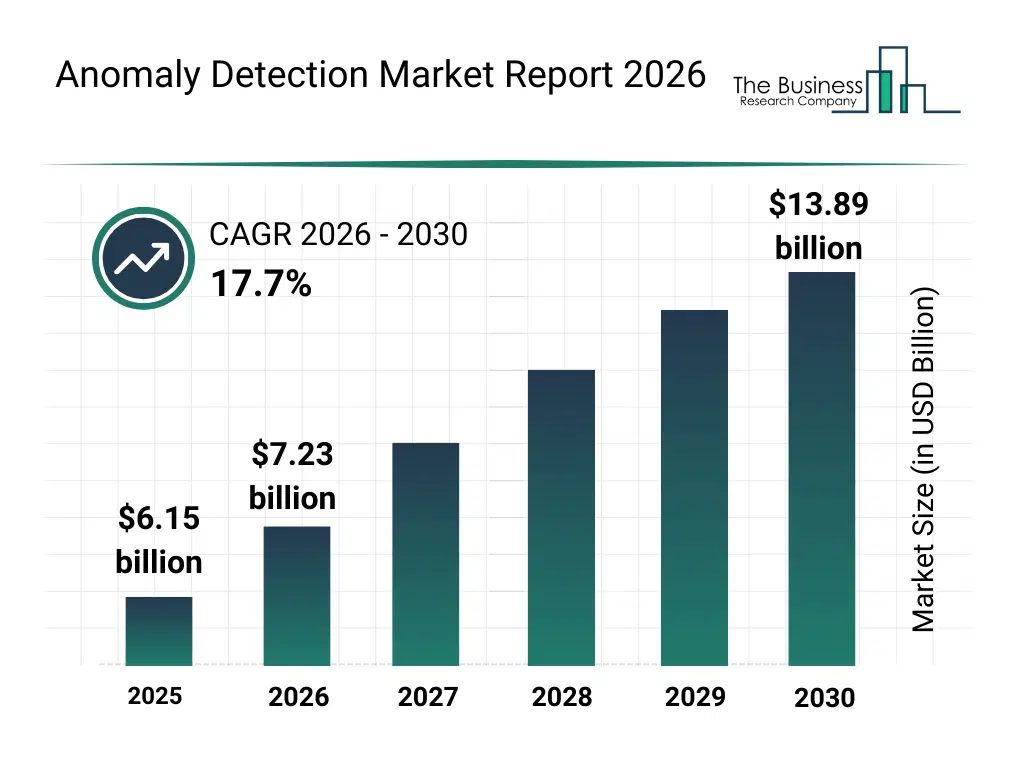
What Is The Anomaly Detection Market Size and Share 2026?
The anomaly detection market size has grown rapidly in recent years. It will grow from $6.15 billion in 2025 to $7.23 billion in 2026 at a compound annual growth rate (CAGR) of 17.6%. The growth in the historic period can be attributed to growth in digital transaction volumes, increasing complexity of data environments, rising cybersecurity threats, expansion of enterprise it systems, adoption of big data analytics platforms.What Is The Anomaly Detection Market Growth Forecast?
The anomaly detection market size is expected to see rapid growth in the next few years. It will grow to $13.89 billion in 2030 at a compound annual growth rate (CAGR) of 17.7%. The growth in the forecast period can be attributed to increasing investments in ai-driven security solutions, rising demand for real-time anomaly detection, expansion of cloud-native analytics adoption, growing focus on proactive risk management, increasing regulatory scrutiny on data integrity. Major trends in the forecast period include increasing deployment of machine learning-based detection models, rising adoption of real-time monitoring systems, growing use of cloud-based anomaly detection platforms, expansion of predictive analytics capabilities, enhanced focus on automated threat and fraud detection.
Global Anomaly Detection Market Segmentation
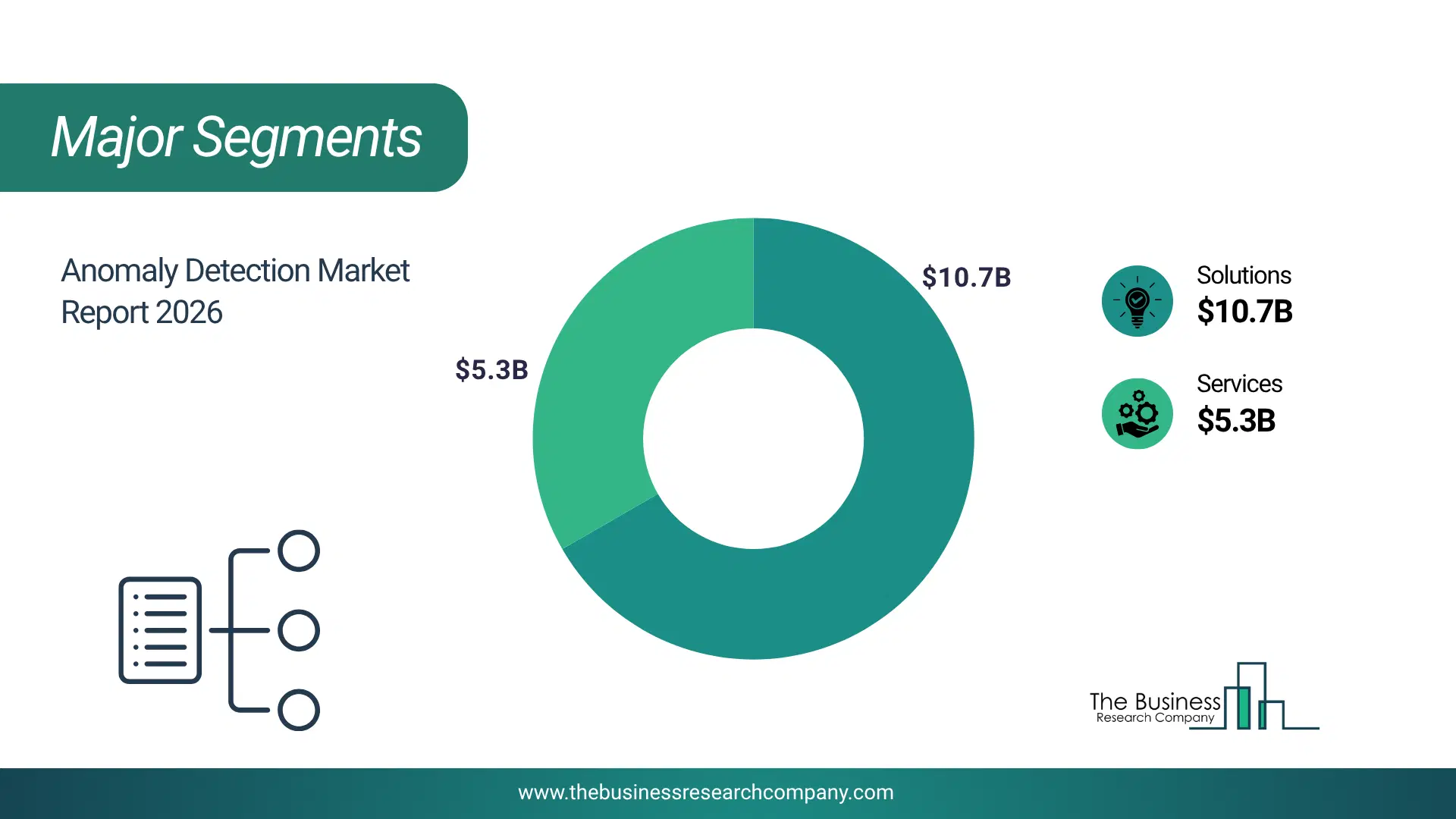
1) By Component: Solutions, Services 2) By Technology: Big Data Analytics, Data Mining and Business Intelligence, Machine Learning and Artificial Intelligence 3) By Deployment Type: Cloud, On-Premises, Hybrid 4) By Application: Intrusion Detection, Fraud Detection, Defect Detection, System Health Monitoring 5) By Vertical: Banking, Financial Services, and Insurance (BFSI), Retail, Manufacturing, IT and Telecom, Government, Aerospace and Defense, Other Verticals Subsegments: 1) By Solutions: Software Solutions, Machine Learning Algorithms, Statistical Analysis Tools, Real-Time Monitoring Systems, Cloud-Based Anomaly Detection Platforms 2) By Services: Consulting Services, Implementation Services, Support And Maintenance Services, Training And Education Services, Data Analysis Services The top segments in the anomaly detection market will be: • Solutions will reach $10.64 billion by 2030. • Services will reach $5.3 billion by 2030.What Is The Driver Of The Anomaly Detection Market?
The increasing number of connected devices is expected to propel the growth of the anomaly detection market going forward. Connected devices are physical smart devices that can be connected via the internet with each other to share data and information within an organization. Anomaly detection is commonly used on connected devices for monitoring the devices connected to a network and to protect data traffic in an organization or household. For instance, in July 2024, according to the Center for Internet Security (CIS), a US-based nonprofit organization, malware-based threats increased by 30% in the first half of 2024 compared to the same period in 2023, with a notable 92%. Therefore, the growing number of connected devices is driving the anomaly detection industry growth.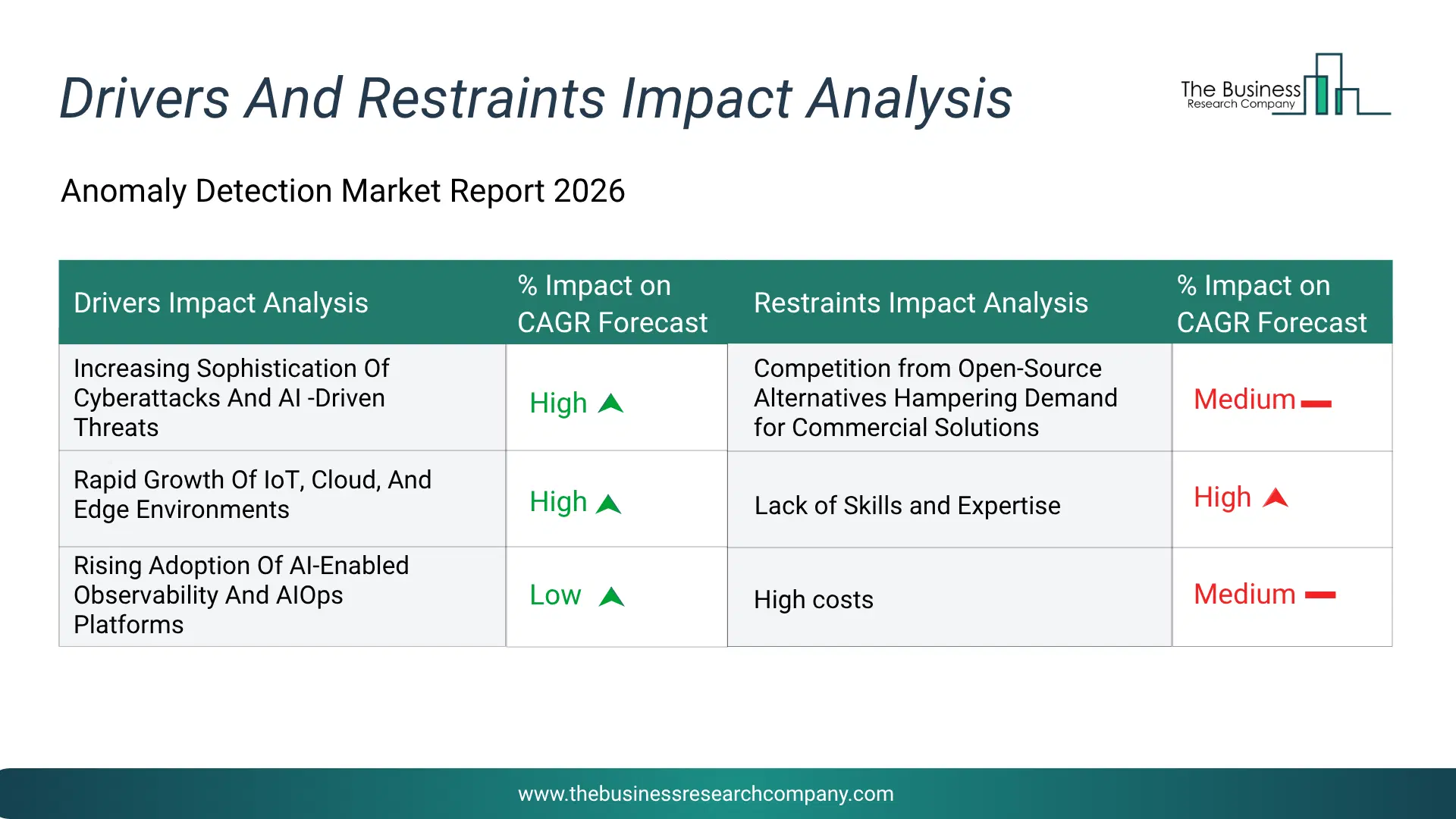
Infographic Chart Showing Key Market Drivers Analysis And Restraints For Anomaly Detection Market
The chart presents an impact analysis of key drivers and restraints, quantifying their relative influence on the market's growth rate and helping assess the balance between growth enablers and limiting factors. This chart offers a high-level perspective; the full report contains more detailed insights.
How Will The Drivers Impact Growth In The Global Anomaly Detection Market?
• Increasing Sophistication Of Cyberattacks And AI -Driven Threats (High) – During the forecast period, the increasing sophistication of cyberattacks and ai -driven threats is expected to become a key growth driver for the anomaly detection market by 2030. Cybercriminals are increasingly deploying advanced tactics such as ai -assisted phishing, automated malware variants, and complex network intrusion techniques that are difficult to identify using traditional rule -based security systems. As digital infrastructures become more interconnected, organizations are prioritizing advanced anomaly detection systems capable of identifying unusual behavioral patterns across networks, applications, and financial transactions in real time. Consequently, enterprises are investing heavily in intelligent security analytics solutions to strengthen proactive defense capabilities. • Rapid Growth Of IoT, Cloud, And Edge Environments (High) – During the forecast period, the rapid growth of iot, cloud, and edge environments is expected to emerge as a major factor driving the expansion of the anomaly detection market by 2030. The rapid expansion of connected devices, distributed computing systems, and hybrid cloud environments is generating large volumes of real -time operational and network data that require continuous monitoring. Traditional tools often struggle to manage these dynamic data streams, increasing the need for advanced anomaly detection solutions capable of identifying abnormal patterns across decentralized systems. Consequently, organizations across industries are adopting intelligent analytics platforms to monitor performance, prevent disruptions, and detect security vulnerabilities across connected ecosystems. • Rising Adoption Of AI-Enabled Observability And AIOps Platforms (Low) – During the forecast period, the rising adoption of ai-enabled observability and aiops platforms is expected to act as a key growth catalyst for the anomaly detection market by 2030. Enterprises are increasingly integrating anomaly detection into observability platforms to gain full visibility across it infrastructure, applications, and data pipelines. These systems analyze logs, metrics, and traces to identify abnormal behaviors before they disrupt operations. As digital transformation and cloud adoption accelerate, demand for intelligent observability and anomaly detection solutions continues to grow.How Will The Restraints Impact Growth In The Global Anomaly Detection Market?
• Competition from Open-Source Alternatives Hampering Demand for Commercial Solutions (Medium) – During the forecast period, the the availability of open-source anomaly detection libraries and frameworks reduces dependency on paid commercial platforms. Many enterprises, particularly small and mid-sized organizations, prefer customizing open-source tools to lower licensing costs. This limits revenue growth for commercial vendors offering packaged anomaly detection solutions. As open-source ecosystems continue to improve in capability and community support, pricing pressure on proprietary platforms increases. Consequently, competition from open-source alternatives acts as a significant restraint on market expansion. • Lack of Skills and Expertise (High) – During the forecast period, the effective deployment of anomaly detection systems requires expertise in machine learning, data science, and cybersecurity analytics. Many organizations struggle with a shortage of skilled professionals capable of configuring, training, and maintaining these systems. Improper implementation can lead to high false positives or missed threats, reducing confidence in the technology. This skills gap slows adoption, particularly among traditional enterprises and developing markets. Therefore, limited technical expertise remains a key barrier to broader market penetration. • High costs (Medium) – During the forecast period, the the deployment of anomaly detection solutions often involves significant upfront investment in advanced software platforms, cloud infrastructure, and integration with existing it systems. Organizations must also allocate resources for data processing, model training, customization, and continuous system optimization. In addition to licensing fees, ongoing maintenance and skilled workforce requirements increase total cost of ownership. Small and mid-sized enterprises may find these costs prohibitive, limiting adoption rates. As a result, high implementation and operational expenses act as a notable restraint on the growth of the anomaly detection market.Key Players In The Global Anomaly Detection Market
Major companies operating in the anomaly detection market are SAS Institute Inc.; Splunk Inc.; International Business Machines Corporation; Microsoft Corporation; Darktrace Limited; Datadog Inc.; Anodot Ltd.; New Relic Inc.; RapidMiner Inc.; TIBCO Software Inc.; Fair Isaac Corporation; Cisco Systems Inc.; Fortinet Inc.; LogRhythm Inc.; Rapid7 Inc.; Vectra AI Inc.; Exabeam Inc.; Cybereason Inc.; Varonis Systems Inc.; Sumo Logic Inc.; Elastic N.V.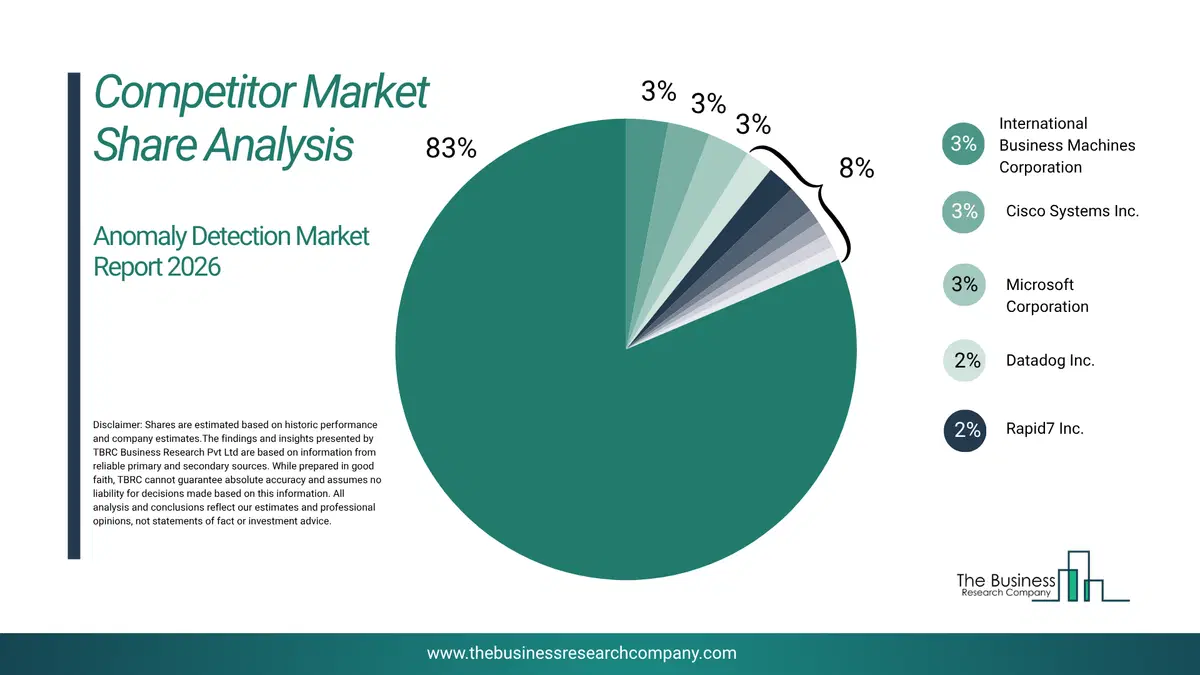
This chart is for illustrative purposes; the full report includes a detailed competitor analysis and comprehensive overview of the top 10 companies in the market.
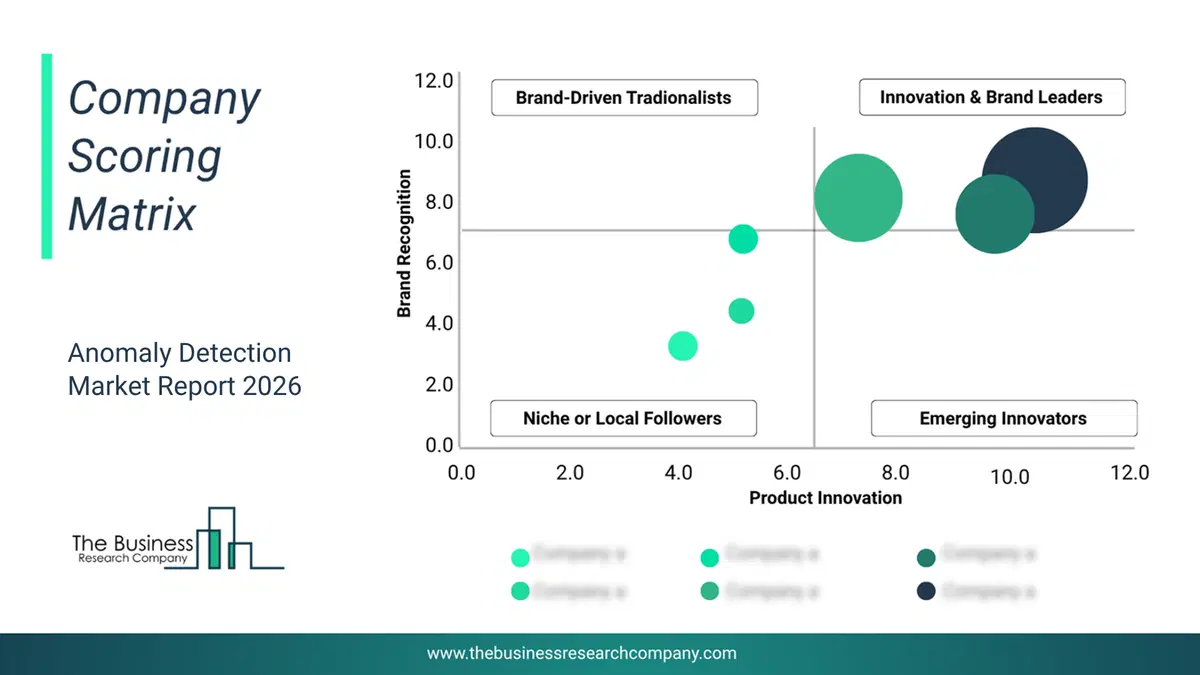
This chart maps companies by product innovation and brand strength, with bubble size indicating relative revenue, helping identify market leaders, challengers, and niche players. This is an illustrative chart; the full report provides a complete and accurate competitive analysis.
Global Anomaly Detection Market Trends and Insights
Major companies operating in the anomaly detection market are focusing on developing advanced AI-powered solutions to enhance real-time monitoring, reduce false positives, and improve the early identification of operational and security anomalies. AI-powered anomaly detection refers to a technological capability that automatically identifies unusual patterns or outliers within a company’s data, helping prioritize critical incidents and streamline decision-making. For instance, in July 2023, Splunk Inc., a US-based cybersecurity and observability company, launched its Splunk AI suite, featuring an embedded anomaly-detection workflow called Splunk App for Anomaly Detection. This solution provides SecOps, ITOps, and engineering teams with a streamlined end-to-end operational workflow to simplify and automate anomaly detection across IT and security environmentsWhat Are Latest Mergers And Acquisitions In The Anomaly Detection Market?
In December 2024, Visa Inc., a US-based payments technology company, acquired Featurespace, a UK-based developer of AI-driven payments-fraud and risk-scoring technology, for an undisclosed amount. Through this acquisition, Visa aims to enhance its real-time fraud and anomaly detection capabilities by integrating Featurespace’s AI-based transaction monitoring platform and expanding its portfolio of risk management solutions. Featurespace is a UK-based software company that provides real-time anomaly detection and fraud prevention for global payment networks.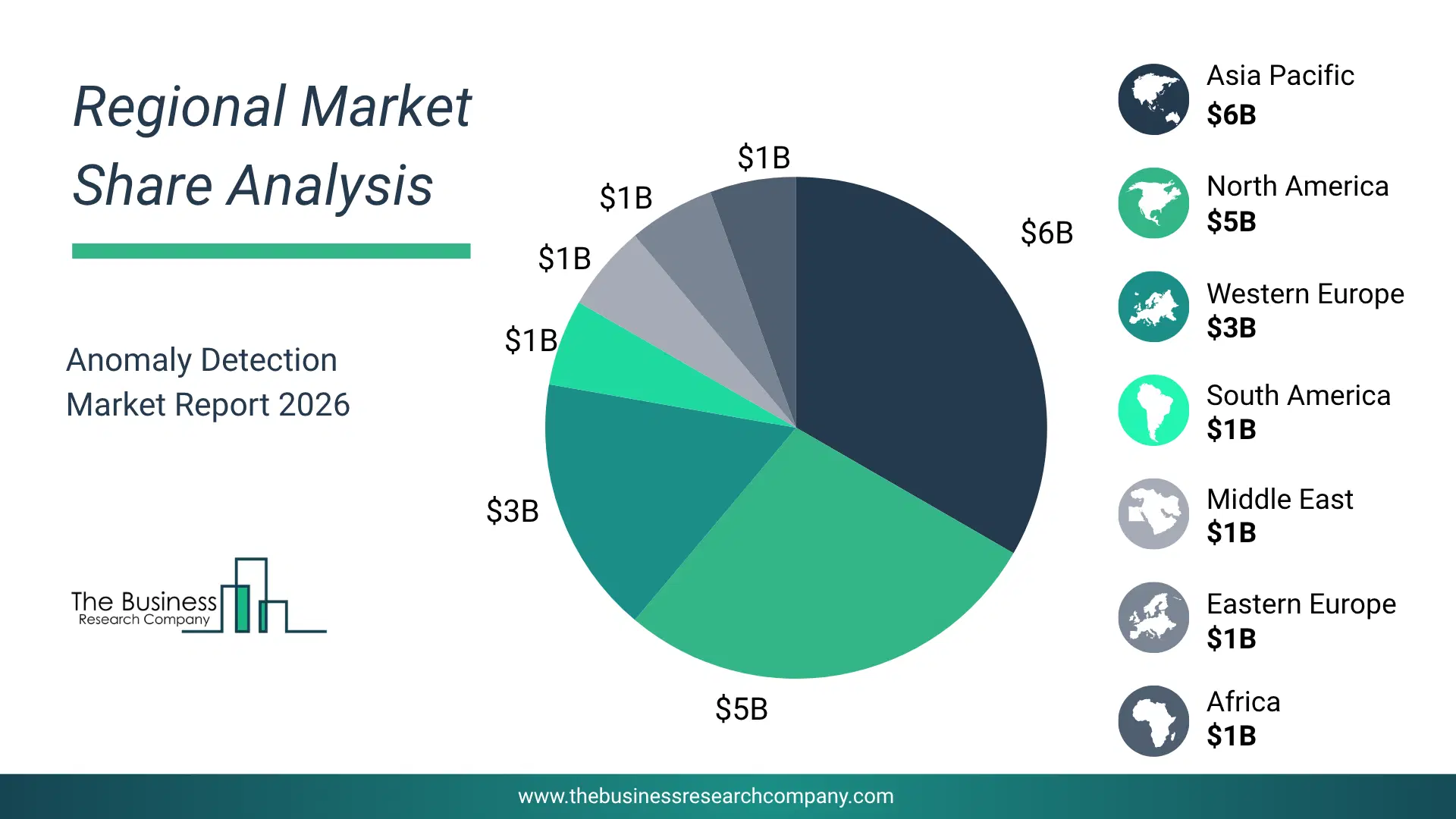
Regional Insights
North America was the largest region in the anomaly detection market in 2025. Asia-Pacific is expected to be the fastest-growing region in the forecast period. The regions covered in this market report are Asia-Pacific, South East Asia, Western Europe, Eastern Europe, North America, South America, Middle East, Africa. The countries covered in this market report are Australia, Brazil, China, France, Germany, India, Indonesia, Japan, Taiwan, Russia, South Korea, UK, USA, Canada, Italy, SpainWhat Defines the Anomaly Detection Market?
The anomaly detection market includes revenues earned by entities by providing detection techniques assisting the chaotic engineering monitoring effort by spotting outliers and alerting the appropriate parties to take action. The market value includes the value of related goods sold by the service provider or included within the service offering. Only goods and services traded between entities or sold to end consumers are included.How is Market Value Defined and Measured?
The market value is defined as the revenues that enterprises gain from the sale of goods and/or services within the specified market and geography through sales, grants, or donations in terms of the currency (in USD unless otherwise specified). The revenues for a specified geography are consumption values that are revenues generated by organizations in the specified geography within the market, irrespective of where they are produced. It does not include revenues from resales along the supply chain, either further along the supply chain or as part of other products.
This chart presents market attractiveness based on a quantitative evaluation of growth, competition, strategic alignment, and risk, offering a clear view of opportunity areas for decision-making. This chart is for illustrative purposes; the full report contains the complete analysis.

This chart highlights the Total Addressable Market (TAM) by estimating the maximum revenue opportunity using an assumption-driven approach, supporting strategic planning and opportunity sizing across markets. The chart is illustrative; the full report provides a more comprehensive analysis.
What Key Data and Analysis Are Included in the Anomaly Detection Market Report 2026?
The anomaly detection market research report is one of a series of new reports from The Business Research Company that provides market statistics, including industry global market size, regional shares, competitors with the market share, detailed market segments, market trends and opportunities, and any further data you may need to thrive in the anomaly detection industry. The market research report delivers a complete perspective of everything you need, with an in-depth analysis of the current and future state of the industry.Anomaly Detection Market Report Forecast Analysis
| Report Attribute | Details |
|---|---|
| Market Size Value In 2026 | $7.23 billion |
| Revenue Forecast In 2030 | $13.89 billion |
| Growth Rate | CAGR of 17.7% from 2026 to 2030 |
| Base Year For Estimation | 2025 |
| Actual Estimates/Historical Data | 2020-2025 |
| Forecast Period | 2026 - 2030 |
| Market Representation | Revenue in USD Billion and CAGR from 2026 to 2030 |
| Segments Covered | Component, Technology, Deployment Type, Application, Vertical |
| Regional Scope | Asia-Pacific, Western Europe, Eastern Europe, North America, South America, Middle East, Africa |
| Country Scope | The countries covered in the report are Australia, Brazil, China, France, Germany, India, ... |
| Key Companies Profiled | SAS Institute Inc.; Splunk Inc.; International Business Machines Corporation; Microsoft Corporation; Darktrace Limited; Datadog Inc.; Anodot Ltd.; New Relic Inc.; RapidMiner Inc.; TIBCO Software Inc.; Fair Isaac Corporation; Cisco Systems Inc.; Fortinet Inc.; LogRhythm Inc.; Rapid7 Inc.; Vectra AI Inc.; Exabeam Inc.; Cybereason Inc.; Varonis Systems Inc.; Sumo Logic Inc.; Elastic N.V. |
| Customization Scope | Request for Customization |
| Pricing And Purchase Options | Explore Purchase Options |