
Anti-Aircraft Missiles Market Report 2026
Global Outlook – By Missile Type (Air To Air, Anti Ballistic, Surface To Air), By Propulsion System (Hybrid Propellant, Liquid Propellant, Solid Propellant), By Warhead Type (Fragmentation, High Explosive, Nuclear), By End User (Air Force, Army, Coast Guard, Navy) – Market Size, Trends, Strategies, and Forecast to 2030
Anti-Aircraft Missiles Market Overview
• Anti-Aircraft Missiles market size has reached to $10.64 billion in 2025 • Expected to grow to $15.34 billion in 2030 at a compound annual growth rate (CAGR) of 7.5% • Growth Driver: Increasing Defense Contracts Propel The Growth Of The Market Due To Rising Geopolitical Tensions And Military Spending • Market Trend: Advanced Drone Technology Enhances Precision In Air Defense Systems • Asia-Pacific was the largest region and fastest growing region.What Is Covered Under Anti-Aircraft Missiles Market?
Anti-aircraft missiles are guided weapons designed to detect, track, and destroy enemy aircraft or airborne threats. They are typically launched from ground-based, sea-based, or air-based platforms to protect military assets and civilian areas. These missiles use radar, infrared, or other targeting systems to accurately intercept fast-moving aerial targets. The main types of anti-aircraft missiles are air-to-air, anti-ballistic, and surface-to-air missiles. Air-to-air missiles operate by transferring heat or energy between air streams without mixing the airflow. Their propulsion systems can be classified into hybrid propellant, liquid propellant, and solid propellant types. The warheads used in these missiles include fragmentation, high-explosive, and nuclear variants. These missiles serve a range of end users, including the air force, army, coast guard, and navy.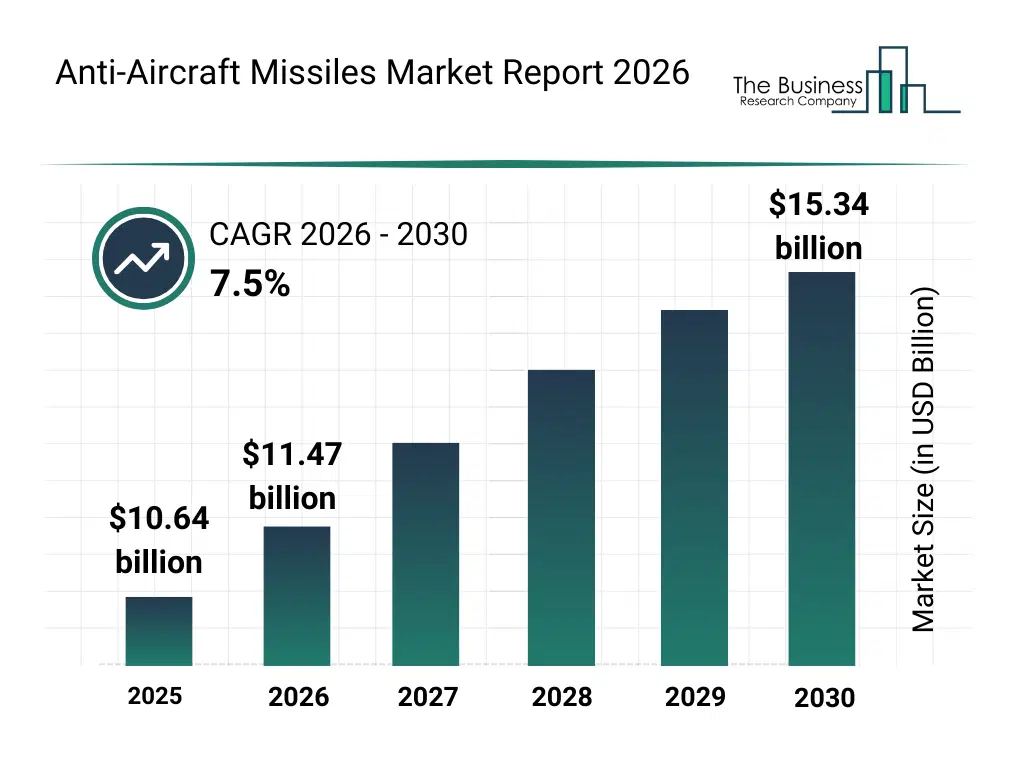
What Is The Anti-Aircraft Missiles Market Size and Share 2026?
The anti-aircraft missiles market size has grown strongly in recent years. It will grow from $10.64 billion in 2025 to $11.47 billion in 2026 at a compound annual growth rate (CAGR) of 7.8%. The growth in the historic period can be attributed to widespread adoption of man-portable air-defense systems (manpads) for tactical defense, development of interceptor missiles for high-speed aerial threats, deployment of missile guidance systems for improved targeting accuracy, rising use of naval air defense missiles for maritime protection, implementation of air defense services for threat deterrence and surveillance.What Is The Anti-Aircraft Missiles Market Growth Forecast?
The anti-aircraft missiles market size is expected to see strong growth in the next few years. It will grow to $15.34 billion in 2030 at a compound annual growth rate (CAGR) of 7.5%. The growth in the forecast period can be attributed to growing investment in next-generation guided anti-aircraft missiles, expansion of integrated air defense networks with rapid response capabilities, increasing adoption of multi-sensor and AI-enhanced targeting systems, rising procurement of modular and mobile missile launch platforms, focus on advanced interceptor technologies for high-altitude and hypersonic threats. Major trends in the forecast period include increased demand for next-generation integrated air defense, growth of multi-layered missile interception systems, expansion of long-range and high-precision interceptor programs, rising procurement of man-portable air-defense systems (manpads), shift toward enhanced survivability and all-weather missile capability.
Global Anti-Aircraft Missiles Market Segmentation
1) By Missile Type: Air To Air, Anti Ballistic, Surface To Air 2) By Propulsion System: Hybrid Propellant, Liquid Propellant, Solid Propellant 3) By Warhead Type: Fragmentation, High Explosive, Nuclear 4) By End User: Air Force, Army, Coast Guard, Navy Subsegments: 1) By Air To Air: Short Range Air-To-Air Missiles (SRAAM), Medium Range Air-To-Air Missiles (MRAAM), Long Range Air-To-Air Missiles (LRAAM) 2) By Anti Ballistic: Exo-Atmospheric Ballistic Missile Interceptors, Endo-Atmospheric Ballistic Missile Interceptors 3) By Surface To Air: Short Range Surface-To-Air Missiles (SHORAD), Medium Range Surface-To-Air Missiles (MRSAM), Long Range Surface-To-Air Missiles (LRSAM)What Is Driver Of The Anti-Aircraft Missiles Market?
The increasing defense contracts are expected to propel the growth of the anti-aircraft missiles market going forward. Defense contracts refer to legally binding agreements between a government and private companies or organizations for the supply of military goods, services, or technology. Increasing defense contracts are primarily driven by rising geopolitical tensions and conflicts, which prompt nations to boost military spending for enhanced security and preparedness. Anti-aircraft missiles enhance defense contracts by providing critical capabilities for national security, driving technological innovation, and sustaining long-term military procurement and development partnerships. For instance, in June 2025, according to the Single Source Regulations Office (SSRO), a UK-based independent public body that oversees the regulation of non-competitive defense procurement, In 2024/25, the number of reported sub-contracts linked to Qualifying Defence Contracts (QDCs) and Qualifying Sub-Contracts (QSCs) rose significantly to 243, up from 82 in 2023/24. Therefore, the increasing defense contracts are driving the growth of the anti-aircraft missile industry.Key Players In The Global Anti-Aircraft Missiles Market
Major companies operating in the anti-aircraft missiles market are Raytheon Technologies Corporation, Lockheed Martin Corporation, Airbus Defense And Space, General Dynamics, Northrop Grumman Corporation, BAE Systems PLC, Thales SA, L3 Harris, Leonardo S.P.A., Hanwha Corporation, Elbit Systems, Israel Aerospace Industries Ltd., Diehl Defence GmbH And Co. KG, Saab AB, Kongsberg Gruppen, MBDA SAS, Aselsan A.S., Rafael Advanced Defense Systems Ltd., Almaz-Antey Air and Space Defense Corporation, Denel SOC Ltd.
This chart is for illustrative purposes; the full report includes a detailed competitor analysis and comprehensive overview of the top 10 companies in the market.
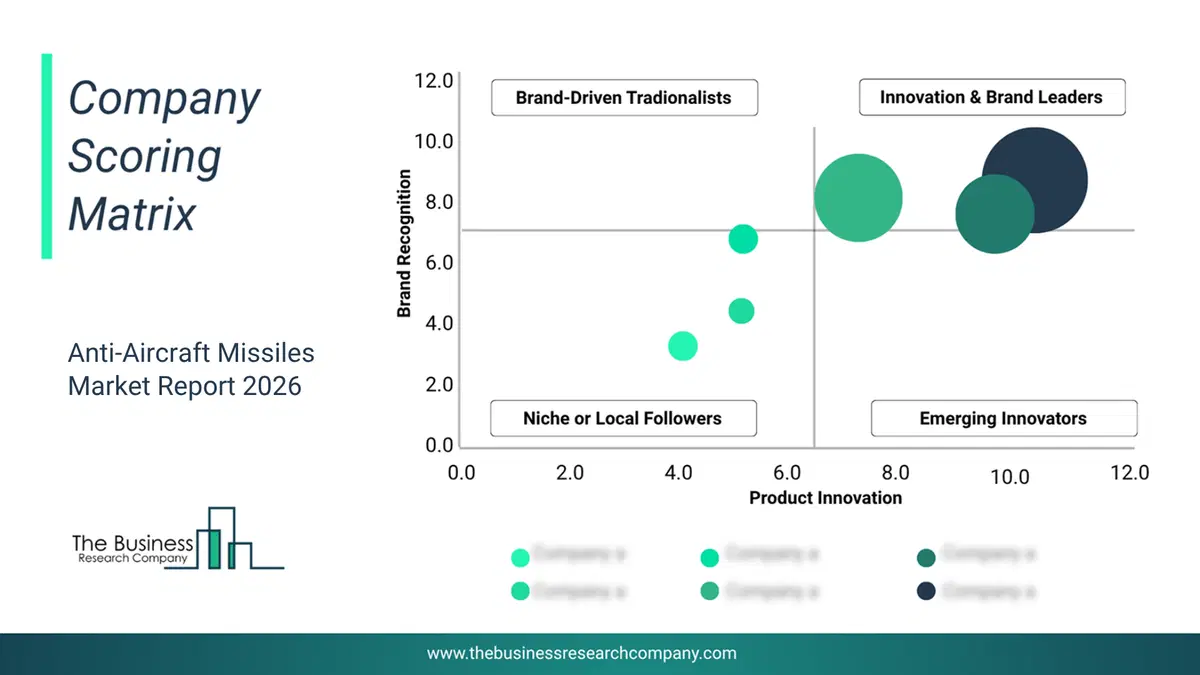
This chart maps companies by product innovation and brand strength, with bubble size indicating relative revenue, helping identify market leaders, challengers, and niche players. This is an illustrative chart; the full report provides a complete and accurate competitive analysis.
Global Anti-Aircraft Missiles Market Trends and Insights
Major companies operating in the anti-aircraft missiles market are focusing on developing advancements such as missile-slinging drones to enhance precision and defense capabilities. Missile-slinging drones are unmanned aerial vehicles equipped to launch missiles for targeted air defense and attack missions. For instance, in March 2025, Airbus SE, a France-based aerospace company, launched a missile-armed drone concept called LOAD (Low-Cost Air Defense). This drone is specifically designed to address the increasing threat posed by enemy drones and loitering munitions. The LOAD system is a low-cost, reusable air defense solution built on the Do-DT25 platform, capable of carrying up to three guided missiles to intercept hostile drones. It has a range of 100 kilometers, is launched via catapult, and recovers by parachute for reuse. This is operated from a ground control station, LOAD can autonomously search for and identify threats, engaging them only after receiving human authorization.What Are Latest Mergers And Acquisitions In The Anti-Aircraft Missiles Market? Bharat Dynamics Limited And Rosoboronexport Partner To Develop Advanced Variants Of Pantsir Air Defence Missile-Gun System
In November 2024, Bharat Dynamics Limited, an India-based company that offers defense manufacturing, partnered with Rosoboronexport to develop and produce variants of the Pantsir air defence missile-gun system. With this partnership, Bharat Dynamics Limited aims to enhance India's air defense capabilities through localized production and technology transfer of the Pantsir system, supporting the country's self-reliance in defense manufacturing. JSC Rosoboronexport is a Russia-based company that manufactures anti-aircraft defense missiles.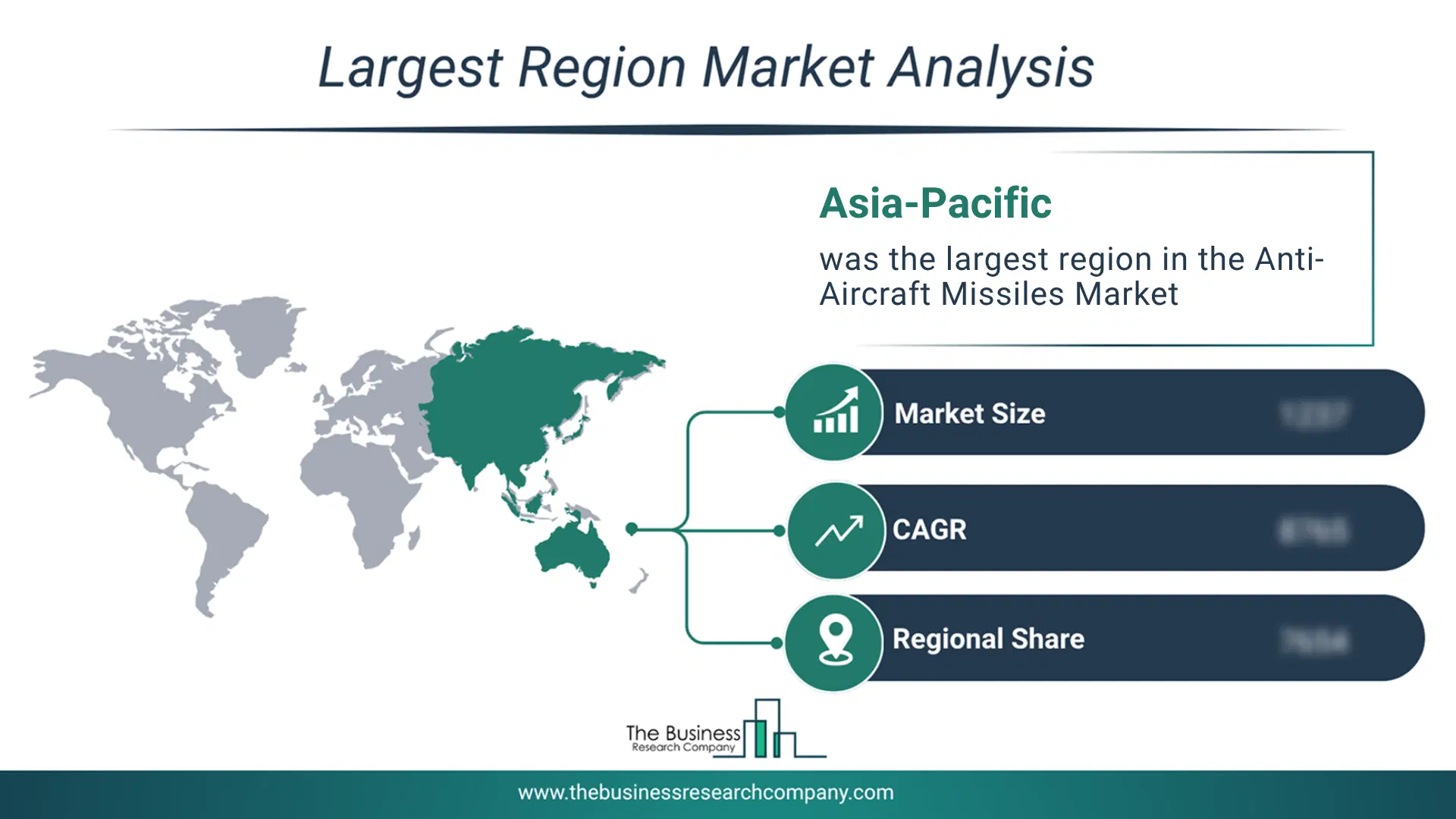
Regional Insights
Asia-Pacific was the largest region in the anti-aircraft missiles market in 2025. Asia-Pacific is expected to be the fastest-growing region in the forecast period. The regions covered in this market report are Asia-Pacific, South East Asia, Western Europe, Eastern Europe, North America, South America, Middle East, Africa. The countries covered in this market report are Australia, Brazil, China, France, Germany, India, Indonesia, Japan, Taiwan, Russia, South Korea, UK, USA, Canada, Italy, SpainWhat Defines the Anti-Aircraft Missiles Market?
The anti-aircraft missiles market consists of revenues earned by entities by providing services such as air defense protection, threat deterrence, surveillance and target tracking, rapid response capability, and force multiplication. The market value includes the value of related goods sold by the service provider or included within the service offering. The anti-aircraft missiles market also includes sales of man-portable air-defense systems, missile launchers and missile guidance systems, interceptor missiles, and naval air defense missiles. Values in this market are ‘factory gate’ values, that is, the value of goods sold by the manufacturers or creators of the goods, whether to other entities (including downstream manufacturers, wholesalers, distributors, and retailers) or directly to end customers. The value of goods in this market includes related services sold by the creators of the goods.How is Market Value Defined and Measured?
The market value is defined as the revenues that enterprises gain from the sale of goods and/or services within the specified market and geography through sales, grants, or donations in terms of the currency (in USD unless otherwise specified). The revenues for a specified geography are consumption values that are revenues generated by organizations in the specified geography within the market, irrespective of where they are produced. It does not include revenues from resales along the supply chain, either further along the supply chain or as part of other products.
This chart presents market attractiveness based on a quantitative evaluation of growth, competition, strategic alignment, and risk, offering a clear view of opportunity areas for decision-making. This chart is for illustrative purposes; the full report contains the complete analysis.

This chart highlights the Total Addressable Market (TAM) by estimating the maximum revenue opportunity using an assumption-driven approach, supporting strategic planning and opportunity sizing across markets. The chart is illustrative; the full report provides a more comprehensive analysis.
What Key Data and Analysis Are Included in the Anti-Aircraft Missiles Market Report 2026?
The anti-aircraft missiles market research report is one of a series of new reports from The Business Research Company that provides market statistics, including industry global market size, regional shares, competitors with the market share, detailed market segments, market trends and opportunities, and any further data you may need to thrive in the anti-aircraft missiles industry. The market research report delivers a complete perspective of everything you need, with an in-depth analysis of the current and future state of the industry.Anti-Aircraft Missiles Market Report Forecast Analysis
| Report Attribute | Details |
|---|---|
| Market Size Value In 2026 | $11.47 billion |
| Revenue Forecast In 2030 | $15.34 billion |
| Growth Rate | CAGR of 7.5% from 2026 to 2030 |
| Base Year For Estimation | 2025 |
| Actual Estimates/Historical Data | 2020-2025 |
| Forecast Period | 2026 - 2030 |
| Market Representation | Revenue in USD Billion and CAGR from 2026 to 2030 |
| Segments Covered | Missile Type, Propulsion System, Warhead Type, End User |
| Regional Scope | Asia-Pacific, Western Europe, Eastern Europe, North America, South America, Middle East, Africa |
| Country Scope | The countries covered in the anti-aircraft missiles market report are Australia, Brazil, China, France, Germany, India, Indonesia, Japan, Taiwan, Russia, South Korea, UK, USA, Canada, Italy, Spain |
| Key Companies Profiled | Raytheon Technologies Corporation, Lockheed Martin Corporation, Airbus Defense And Space, General Dynamics, Northrop Grumman Corporation, BAE Systems PLC, Thales SA, L3 Harris, Leonardo S.P.A., Hanwha Corporation, Elbit Systems, Israel Aerospace Industries Ltd., Diehl Defence GmbH And Co. KG, Saab AB, Kongsberg Gruppen, MBDA SAS, Aselsan A.S., Rafael Advanced Defense Systems Ltd., Almaz-Antey Air and Space Defense Corporation, Denel SOC Ltd. |
| Customization Scope | Request for Customization |
| Pricing And Purchase Options | Explore Purchase Options |