
Anti-Collision Sensor Market Report 2026
Global Outlook – By Vehicle Type ( Passenger Cars, Commercial Vehicles), By Technology ( Camera Sensor, Lidar Sensor, Radar Sensor, Ultrasonic Sensor), By Application ( Forward Collision Warning System, Blind Spot Monitor, Lane Department Warning System, Parking Sensor, Other Applications), By End-User ( Aerospace And Defense, Automotive, Industrial, Rail, Other End Users) – Market Size, Trends, Strategies, and Forecast to 2030
Anti-Collision Sensor Market Overview
• Anti-Collision Sensor market size has reached to $16.97 billion in 2025 • Expected to grow to $41.27 billion in 2030 at a compound annual growth rate (CAGR) of 19.5% • Growth Driver: Automotive Production Boom Fuels The Anti-Collision Sensor Market • Market Trend: Advanced Omnidirectional Safety And Driver-Assistance System Launch • Asia-Pacific was the largest region in 2025.What Is Covered Under Anti-Collision Sensor Market?
Anti-collision sensors detect an object in the path of a moving vehicle, allowing the driver or the vehicle's autonomous system to intervene to avoid a collision. A reverse sensor is the most popular car feature, similar sensors are also ubiquitous in automated guided vehicles in factories and warehouses. It is one of the modern innovations that aid in avoiding collisions between automobiles. The main vehicle types for anti-collision sensors are passenger cars and commercial vehicles. A passenger car refers to a road motor vehicle other than a moped or a motorbike that is meant to transport passengers and seat no more than nine people (including the driver). It is available in various technologies such as camera sensors, lidar sensors, radar sensors, and ultrasonic sensors that are used in applications such as forward collision warning systems, blind-spot monitors, lane departure warning systems, parking sensors, and other adaptive cruise control applications by several end users, including aerospace and defense, automotive, industrial, rail, and other end users.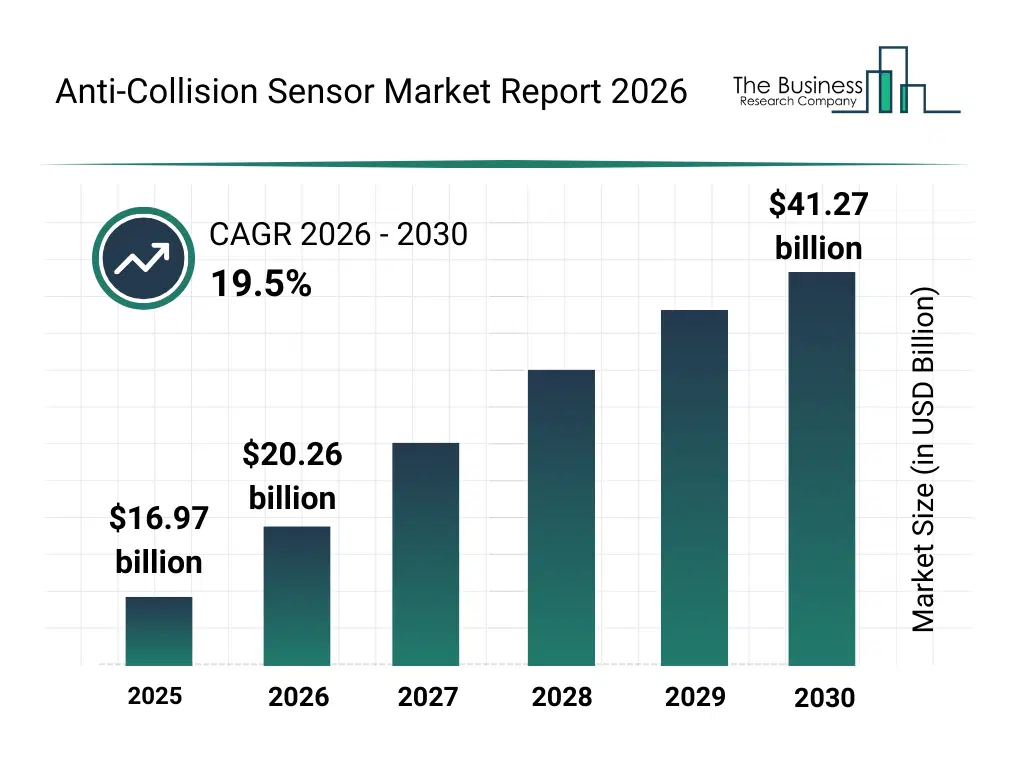
What Is The Anti-Collision Sensor Market Size 2026 And Growth Rate?
The anti-collision sensor market size has grown rapidly in recent years. It will grow from $16.97 billion in 2025 to $20.26 billion in 2026 at a compound annual growth rate (CAGR) of 19.4%. The growth in the historic period can be attributed to early use in basic parking sensors, reliance on ultrasonic detection, growth in entry-level automotive safety features, rising deployment in commercial fleet safety, initial adoption in industrial guided vehicles.What Is The Anti-Collision Sensor Market Growth Forecast?
The anti-collision sensor market size is expected to see rapid growth in the next few years. It will grow to $41.27 billion in 2030 at a compound annual growth rate (CAGR) of 19.5%. The growth in the forecast period can be attributed to increasing integration of advanced driver assistance systems, rising adoption of multi-sensor fusion platforms, expansion of autonomous mobility ecosystems, development of high-precision lidar and radar systems, increasing safety regulations in automotive manufacturing. Major trends in the forecast period include adoption of AI-enhanced collision detection systems, expansion of autonomous driving safety platforms, integration of IoT-connected vehicle sensing modules, advancement of data-driven predictive safety systems, development of electric vehicle sensor architectures.
Global Anti-Collision Sensor Market Segmentation
1) By Vehicle Type: Passenger Cars, Commercial Vehicles 2) By Technology: Camera Sensor, Lidar Sensor, Radar Sensor, Ultrasonic Sensor 3) By Application: Forward Collision Warning System, Blind Spot Monitor, Lane Department Warning System, Parking Sensor, Other Applications 4) By End-User: Aerospace And Defense, Automotive, Industrial, Rail, Other End Users Subsegments: 1) By Passenger Cars: Compact Cars, Sedans, SUVs, Luxury Cars, Electric Vehicles (EVs) 2) By Commercial Vehicles: Light Commercial Vehicles (LCVs), Heavy Commercial Vehicles (HCVs), Buses, Trucks, Freight VehiclesWhat Is The Driver Of The Anti-Collision Sensor Market?
Growth in automotive production is expected to propel the growth of the anti-collision sensor market going forward. Automotive production involves the manufacturing of motor vehicles, such as cars, trucks, buses, and motorcycles, in specialized facilities through large-scale assembly lines. Anti-collision sensors in automobiles play a crucial role in improving road safety by detecting obstacles, pedestrians, and other vehicles and providing real-time data to automated systems or drivers that help them take timely evasive actions. For instance, in August 2023, according to the Board of Governors of the Federal Reserve System, a US-based government agency, total vehicle production in the United States increased to 11.77 million units in July, up from 10.91 million units in June. Therefore, the growth in automotive production is driving the growth of the anti-collision sensor industry.Key Players In The Global Anti-Collision Sensor Market
Major companies operating in the anti-collision sensor market are Delphi Technologies Inc., Denso Corporation, Robert Bosch GmbH, TRW Automotive Holdings Corp., Continental Aktiengesellschaft, ZF Friedrichshafen AG, NXP Semiconductors N.V., Honeywell International Inc., Siemens Aktiengesellschaft, Wadeco Co. Ltd., Texas Instruments Incorporated, Aisin Seiki Co. Ltd., Autoliv AB, Raytheon Technologies Corporation, GEM Electronica Co. Ltd., Volkswagen Aktiengesellschaft, Bayerische Motoren Werke Aktiengesellschaft, Mercedes-Benz Group AG, Volvo Car Corporation, Wabtec Corporation, General Electric Company, Analog Devices Inc., HyundAI Mobis Co. Ltd., Valeo SA, Aptiv PLC, Infineon Technologies AG, STMicroelectronics N.V., Panasonic Corporation, LG Innotek Co. Ltd., Murata Manufacturing Co. Ltd., TE Connectivity Ltd., Sensata Technologies Holding plc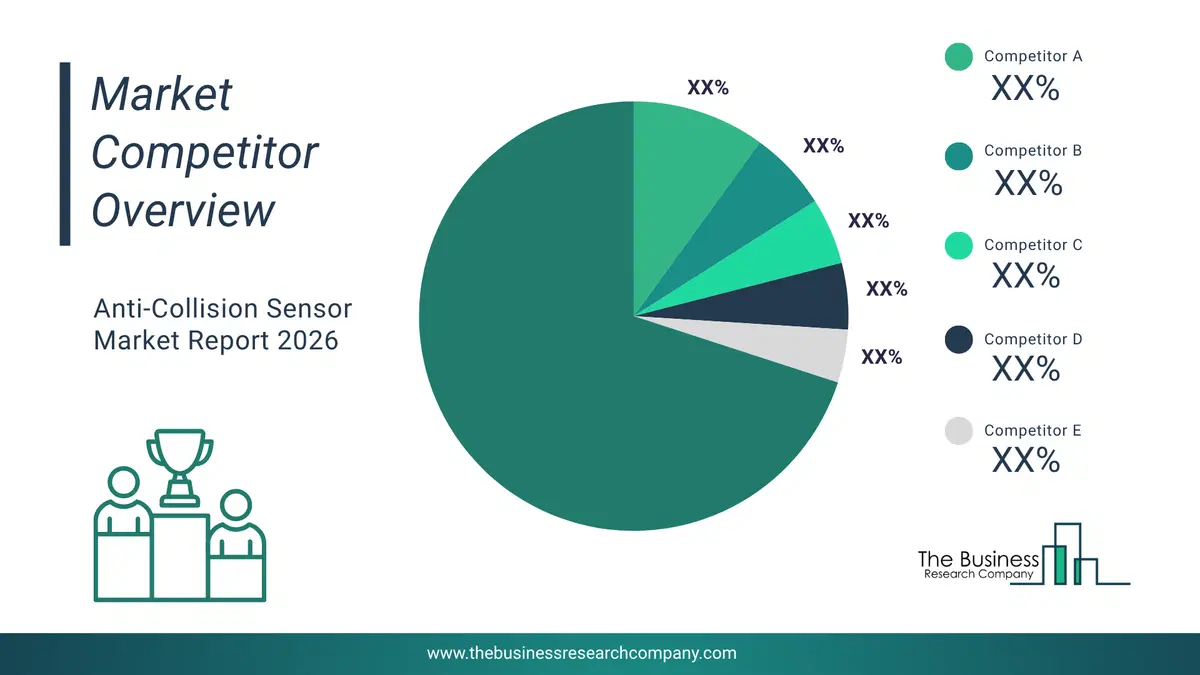
This chart is for illustrative purposes; the full report includes a detailed competitor analysis and comprehensive overview of the top 10 companies in the market.
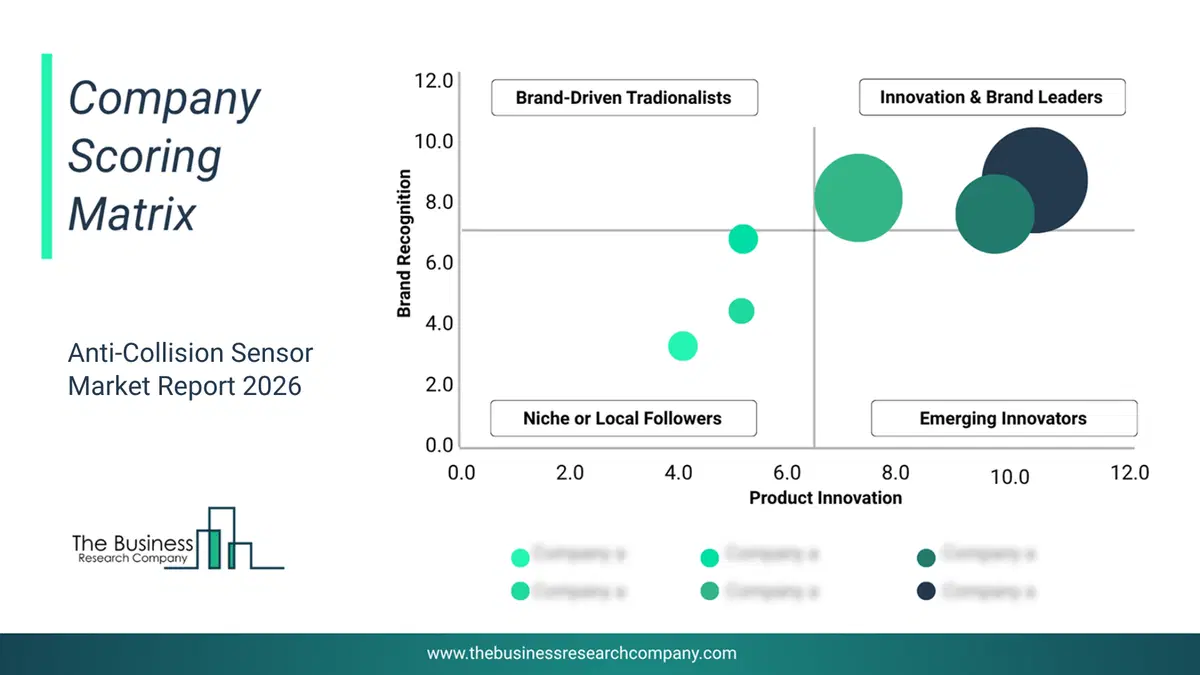
This chart maps companies by product innovation and brand strength, with bubble size indicating relative revenue, helping identify market leaders, challengers, and niche players. This is an illustrative chart; the full report provides a complete and accurate competitive analysis.
Global Anti-Collision Sensor Market Trends and Insights
Major companies operating in the anti-collision sensor market are developing advanced products, such as driver-assistive systems, to enhance vehicle safety, reduce accidents, and improve overall. Driver-assistive systems are technologies designed to enhance vehicle safety and improve the driving experience by providing automated assistance to the driver. For instance, In November 2023, Honda Motor Co., Ltd., a Japan-based automobile manufacturing company, launched the Honda SENSING 360+. Honda SENSING 360+ is an advanced omnidirectional safety and driver-assistive system designed to enhance vehicle safety and reduce driver burden. This new system builds on the existing Honda SENSING 360 technology, which features 360-degree sensing capabilities to eliminate blind spots and assist in collision avoidance. The system utilizes five units of millimeter-wave radar positioned around the vehicle to achieve comprehensive sensing capabilities, helping to detect vehicles and pedestrians in all directions.What Are Latest Mergers And Acquisitions In The Anti-Collision Sensor Market?
In February 2023, Ouster Inc., a US-based lidar technology company, merged with Velodyne Lidar Inc. to create a lidar‑sensor industry powerhouse. The merger strengthens Ouster’s anti-collision sensor capabilities by integrating Velodyne’s established surround-view lidar hardware with Ouster’s high-resolution digital lidar and software technologies. Velodyne Lidar Inc. is a US-based manufacturer of anti-collision sensors.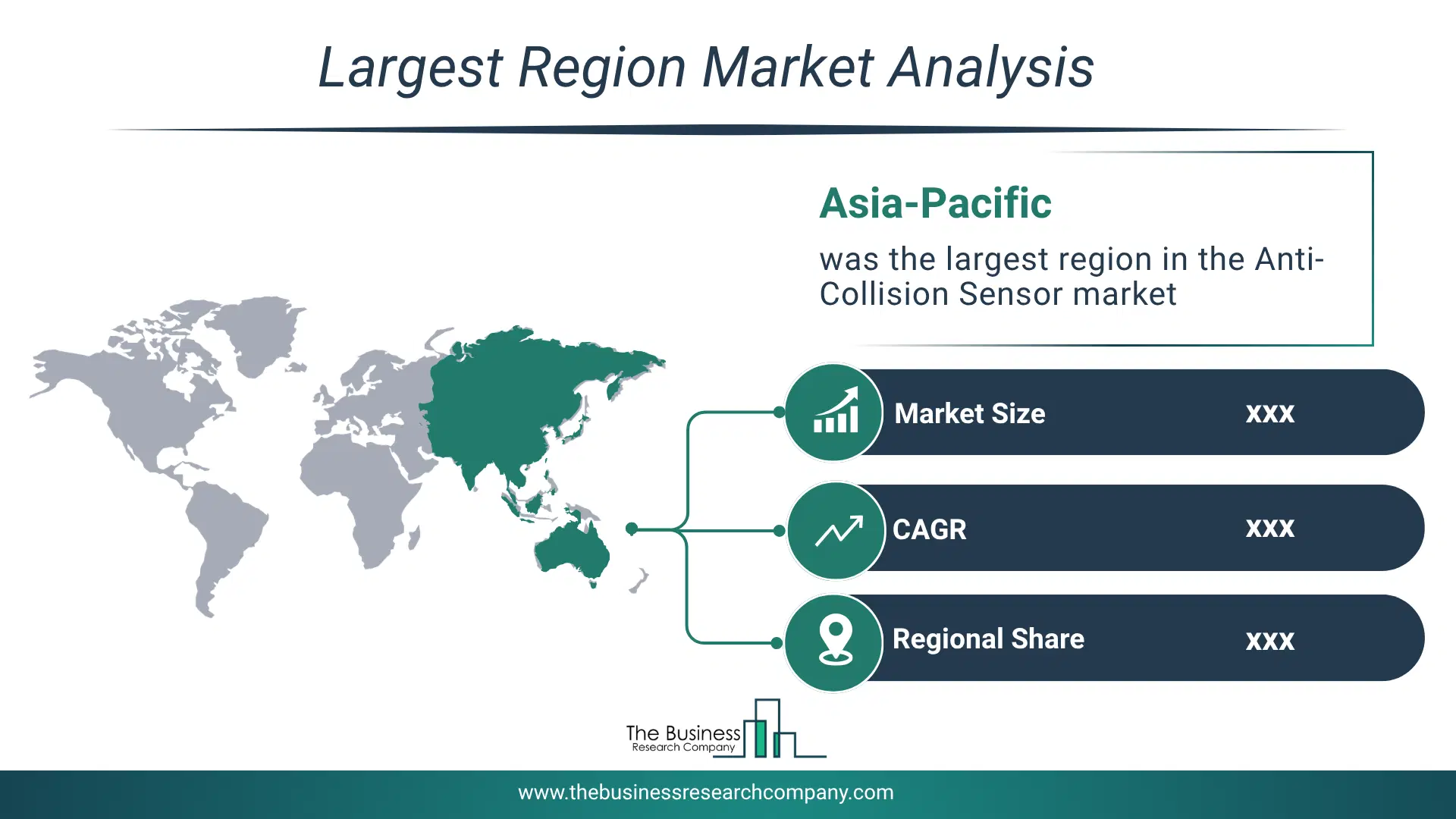
Regional Outlook
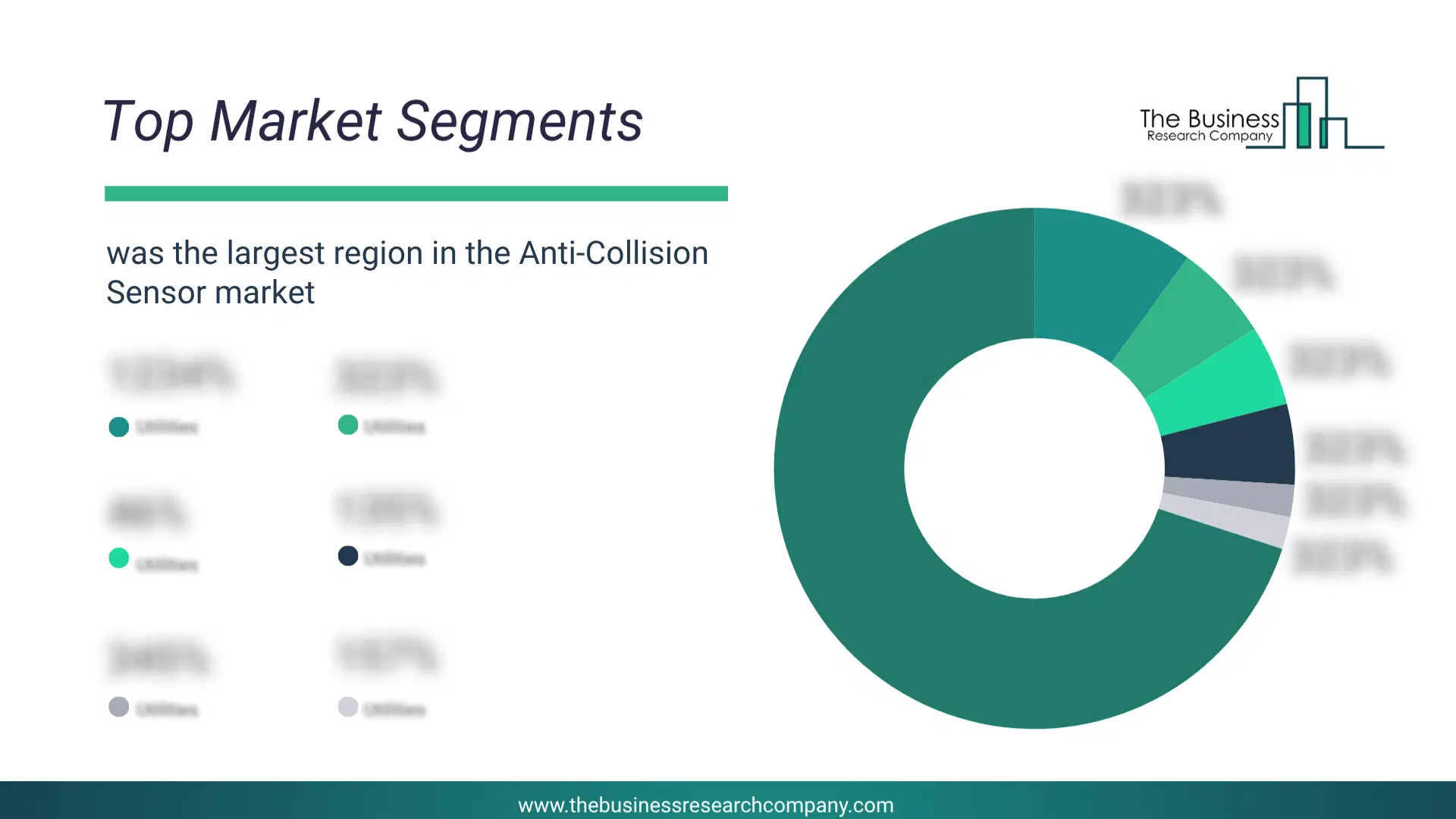
Asia-Pacific was the largest region in the anti-collision sensors market in 2025. The regions covered in this market report are Asia-Pacific, South East Asia, Western Europe, Eastern Europe, North America, South America, Middle East, Africa. The countries covered in this market report are Australia, Brazil, China, France, Germany, India, Indonesia, Japan, Taiwan, Russia, South Korea, UK, USA, Canada, Italy, Spain.What Defines the Anti-Collision Sensor Market?
The anti-collision sensors market consists of sales of Ultrasound sensors, Millimeter wavelength radar sensors, Laser sensors, LED sensors, and GPS RF detection sensors. Values in this market are ‘factory gate’ values, that is the value of goods sold by the manufacturers or creators of the goods, whether to other entities (including downstream manufacturers, wholesalers, distributors and retailers) or directly to end customers. The value of goods in this market includes related services sold by the creators of the goods.How is Market Value Defined and Measured?
The market value is defined as the revenues that enterprises gain from the sale of goods and/or services within the specified market and geography through sales, grants, or donations in terms of the currency (in USD unless otherwise specified). The revenues for a specified geography are consumption values that are revenues generated by organizations in the specified geography within the market, irrespective of where they are produced. It does not include revenues from resales along the supply chain, either further along the supply chain or as part of other products.
This chart presents market attractiveness based on a quantitative evaluation of growth, competition, strategic alignment, and risk, offering a clear view of opportunity areas for decision-making. This chart is for illustrative purposes; the full report contains the complete analysis.

This chart highlights the Total Addressable Market (TAM) by estimating the maximum revenue opportunity using an assumption-driven approach, supporting strategic planning and opportunity sizing across markets. The chart is illustrative; the full report provides a more comprehensive analysis.
What Key Data and Analysis Are Included in the Anti-Collision Sensor Market Report 2026?
The anti-collision sensor market research report is one of a series of new reports from The Business Research Company that provides market statistics, including industry global market size, regional shares, competitors with the market share, detailed market segments, market trends and opportunities, and any further data you may need to thrive in the anti-collision sensor industry. The market research report delivers a complete perspective of everything you need, with an in-depth analysis of the current and future state of the industry.Anti-Collision Sensor Market Report Forecast Analysis
| Report Attribute | Details |
|---|---|
| Market Size Value In 2026 | $20.26 billion |
| Revenue Forecast In 2030 | $41.27 billion |
| Growth Rate | CAGR of 19.5% from 2026 to 2030 |
| Base Year For Estimation | 2025 |
| Actual Estimates/Historical Data | 2020-2025 |
| Forecast Period | 2026 - 2030 |
| Market Representation | Revenue in USD Billion and CAGR from 2026 to 2030 |
| Segments Covered | Vehicle Type, Technology, Application, End-User |
| Regional Scope | Asia-Pacific, Western Europe, Eastern Europe, North America, South America, Middle East, Africa |
| Country Scope | The countries covered in the report are Australia, Brazil, China, France, Germany, India, Indonesia, Japan, Taiwan, Russia, South Korea, UK, USA, Canada, Italy, Spain. |
| Key Companies Profiled | Delphi Technologies Inc., Denso Corporation, Robert Bosch GmbH, TRW Automotive Holdings Corp., Continental Aktiengesellschaft, ZF Friedrichshafen AG, NXP Semiconductors N.V., Honeywell International Inc., Siemens Aktiengesellschaft, Wadeco Co. Ltd., Texas Instruments Incorporated, Aisin Seiki Co. Ltd., Autoliv AB, Raytheon Technologies Corporation, GEM Electronica Co. Ltd., Volkswagen Aktiengesellschaft, Bayerische Motoren Werke Aktiengesellschaft, Mercedes-Benz Group AG, Volvo Car Corporation, Wabtec Corporation, General Electric Company, Analog Devices Inc., HyundAI Mobis Co. Ltd., Valeo SA, Aptiv PLC, Infineon Technologies AG, STMicroelectronics N.V., Panasonic Corporation, LG Innotek Co. Ltd., Murata Manufacturing Co. Ltd., TE Connectivity Ltd., Sensata Technologies Holding plc |
| Customization Scope | Request for Customization |
| Pricing And Purchase Options | Explore Purchase Options |