

Anti-Fingerprint Coating Market Report 2026
Global Outlook – By Type (Hydrophobic Coating, Oleophobic Coating), By Technology (Vacuum Deposition, Sol Gel, Other Technologies), By Material Type (Silicon, Titanium, Fluorine, Other Material Types), By Applications (Consumer Goods, Building And Construction, Automotive, Stainless Steel, Other Applications) – Market Size, Trends, Strategies, and Forecast to 2030
Anti-Fingerprint Coating Market Overview
• Anti-Fingerprint Coating market size has reached to $0.98 billion in 2025 • Expected to grow to $1.31 billion in 2030 at a compound annual growth rate (CAGR) of 5.8% • Growth Driver: Rising Demand For Electronic Devices Drives Anti-Fingerprint Coating Market • Market Trend: Innovative Surface Treatments Enhance Durability And Smudge Resistance In Automotive Applications • North America was the largest region in 2025 and Asia-Pacific is the fastest growing region.What Is Covered Under Anti-Fingerprint Coating Market?
Anti-fingerprint coatings are specialized surface treatments applied to materials such as glass, metal, or plastic to minimize the appearance of fingerprints, smudges, and other oily residues. They repel oils and water, making surfaces easier to clean and enhancing their appearance, and are widely used to improve user experience and maintain aesthetics. The main types of anti-fingerprint coating are hydrophobic coating and oleophobic coating. Hydrophobic coatings refer to a specific sort of coating that repels water. The technologies used for providing anti-fingerprint coating include vacuum deposition, sol gel, and others, and the materials are silicon, titanium, fluorine, and others. Anti-fingerprint coatings are used in various applications such as consumer goods, building and construction, automotive, stainless steel, and others.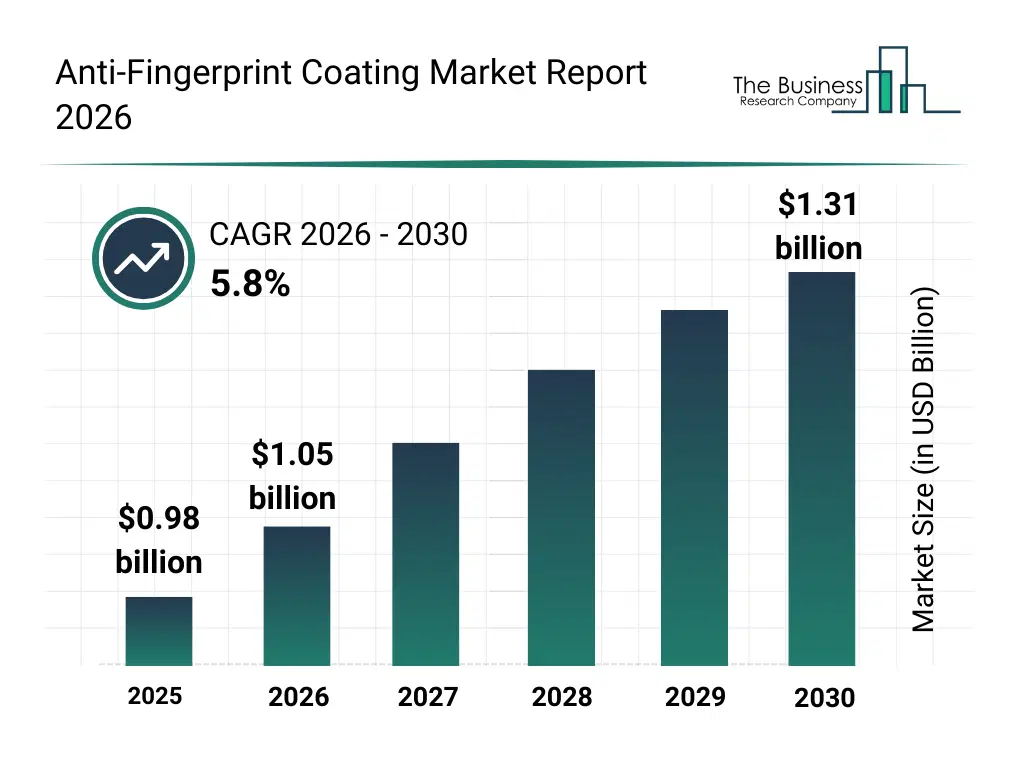
What Is The Anti-Fingerprint Coating Market Size and Share 2026?
The anti-fingerprint coating market size has grown strongly in recent years. It will grow from $0.98 billion in 2025 to $1.05 billion in 2026 at a compound annual growth rate (CAGR) of 6.9%. The growth in the historic period can be attributed to growth of consumer electronics, expansion of smartphone production, increasing use of touch surfaces, availability of coating technologies, rising demand for premium finishes.What Is The Anti-Fingerprint Coating Market Growth Forecast?
The anti-fingerprint coating market size is expected to see strong growth in the next few years. It will grow to $1.31 billion in 2030 at a compound annual growth rate (CAGR) of 5.8%. The growth in the forecast period can be attributed to growth in smart devices, increasing electric vehicle interiors, advancements in coating materials, rising demand for durable surfaces, expansion of smart buildings. Major trends in the forecast period include rising adoption in consumer electronics, growing use in automotive interiors, increasing demand for touch resistant surfaces, expansion of coatings in stainless steel, rising focus on enhanced user experience.
Global Anti-Fingerprint Coating Market Segmentation
1) By Type: Hydrophobic Coating, Oleophobic Coating 2) By Technology: Vacuum Deposition, Sol Gel, Other Technologies 3) By Material Type: Silicon, Titanium, Fluorine, Other Material Types 4) By Applications: Consumer Goods, Building And Construction, Automotive, Stainless Steel, Other Applications Subsegments: 1) By Hydrophobic Coating: Water-Repellent Hydrophobic Coating, Oil-Resistant Hydrophobic Coating 2) By Oleophobic Coating: Oil-Repellent Oleophobic Coating, Fingerprint-Resistant Oleophobic CoatingWhat Is The Driver Of The Anti-Fingerprint Coating Market?
The increasing demand for electronic devices is expected to propel the growth of the anti-fingerprint coating market going forward. Electronic devices are gadgets that control the flow of electric current to perform specific functions such as computing, communication, or entertainment, encompassing items such as smartphones, computers, and televisions. The increasing demand for electronic devices is due to expanding connectivity and the growing need for convenience and efficiency in daily life. Anti-fingerprint coatings on electronic devices reduce smudging and streaking on screens, enhancing the user experience by maintaining a clean and clear display. For instance, in May 2023, according to the Japan Electronics and Information Technology Industries Association, a Japan-based trade association, the total electronic equipment production in Japan reached $4,987.94 million (¥771,457 million). In addition, consumer electronics production reached $207.61 million (¥32,099 million) in May 2023, compared to $163.43 million (¥25,268 million) in May 2022. Therefore, the surge in demand for electronic devices is driving the growth of the anti-fingerprint coating industry.Key Players In The Global Anti-Fingerprint Coating Market
Major companies operating in the anti-fingerprint coating market are Dow Inc., Daikin Industries Ltd, Henkel AG & Co. KGaA, Sherwin-Williams Company, PPG Industries Inc., Shin-Etsu Chemical Co. Ltd., Solvay SA, AGC Inc, Carl Zeiss Limited, Nagase & Co Ltd, I-Photonics, Lienchy Laminated Metal Co. Ltd., Bühler AG, Natoco Co. Ltd., LandGlass Technology Co. Ltd, Plasmatreat GmbH, Nanokote Pty Ltd, SDC Technologies Inc., Aculon Inc, SILIBASE SILICONE, NanoSlic Smart Coatings, WeeTect. Inc., Cytonix LLC
This chart is for illustrative purposes; the full report includes a detailed competitor analysis and comprehensive overview of the top 10 companies in the market.
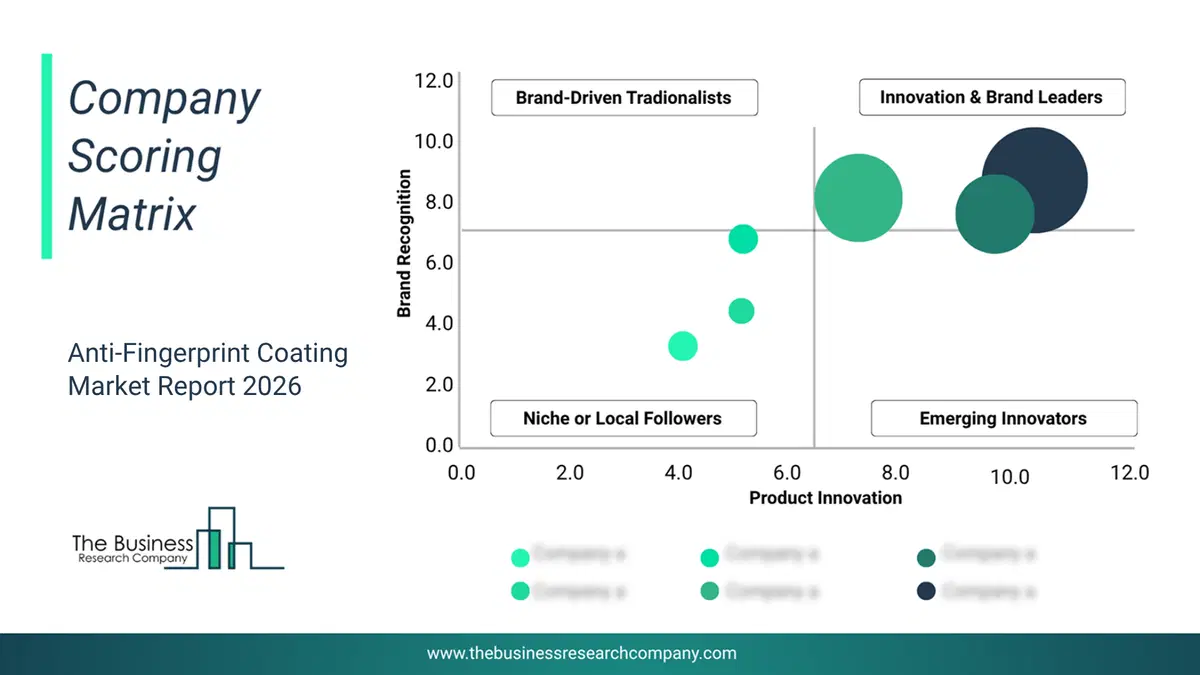
This chart maps companies by product innovation and brand strength, with bubble size indicating relative revenue, helping identify market leaders, challengers, and niche players. This is an illustrative chart; the full report provides a complete and accurate competitive analysis.
Global Anti-Fingerprint Coating Market Trends and Insights
Major companies in the anti-fingerprint coating market are focusing on developing innovative solutions such as oleophobic and hydrophobic coatings to enhance surface durability, reduce smudges, and improve user experience. Oleophobic and hydrophobic coatings are special surface treatments that repel oils and water, respectively, keeping surfaces clean and resistant to smudges or stains. For instance, in October 2024, Tredegar Corporation, a US-based industrial manufacturer company, launched a new line of innovative Obsidian Automotive Protective Films designed specifically for the automotive industry. The Obsidian line offers a range of high-performance protective films tailored for both interior and exterior automotive applications, including automotive displays, augmented reality films within head-up display (HUD) devices, automotive glass and plastic covers, and protective films for automotive cameras and body components.What Are Latest Mergers And Acquisitions In The Anti-Fingerprint Coating Market?
In February 2025, Nanofilm Technologies International Limited, a Singapore-based technology company acquired EuropCoating Group for an undisclosed amount. With this acquisition, NTI Nanofilm aims to expand its footprint in Europe by leveraging EuropCoating’s established presence and customer base to accelerate its market access in decorative and functional coatings across luxury, consumer, and medical-grade segments. EuropCoating Group is a Germany-based coatings company that specializes in advanced thin-film surface coatings, including decorative and functional coatings for luxury and consumer goods as well as medical-grade coatings for instruments and devices.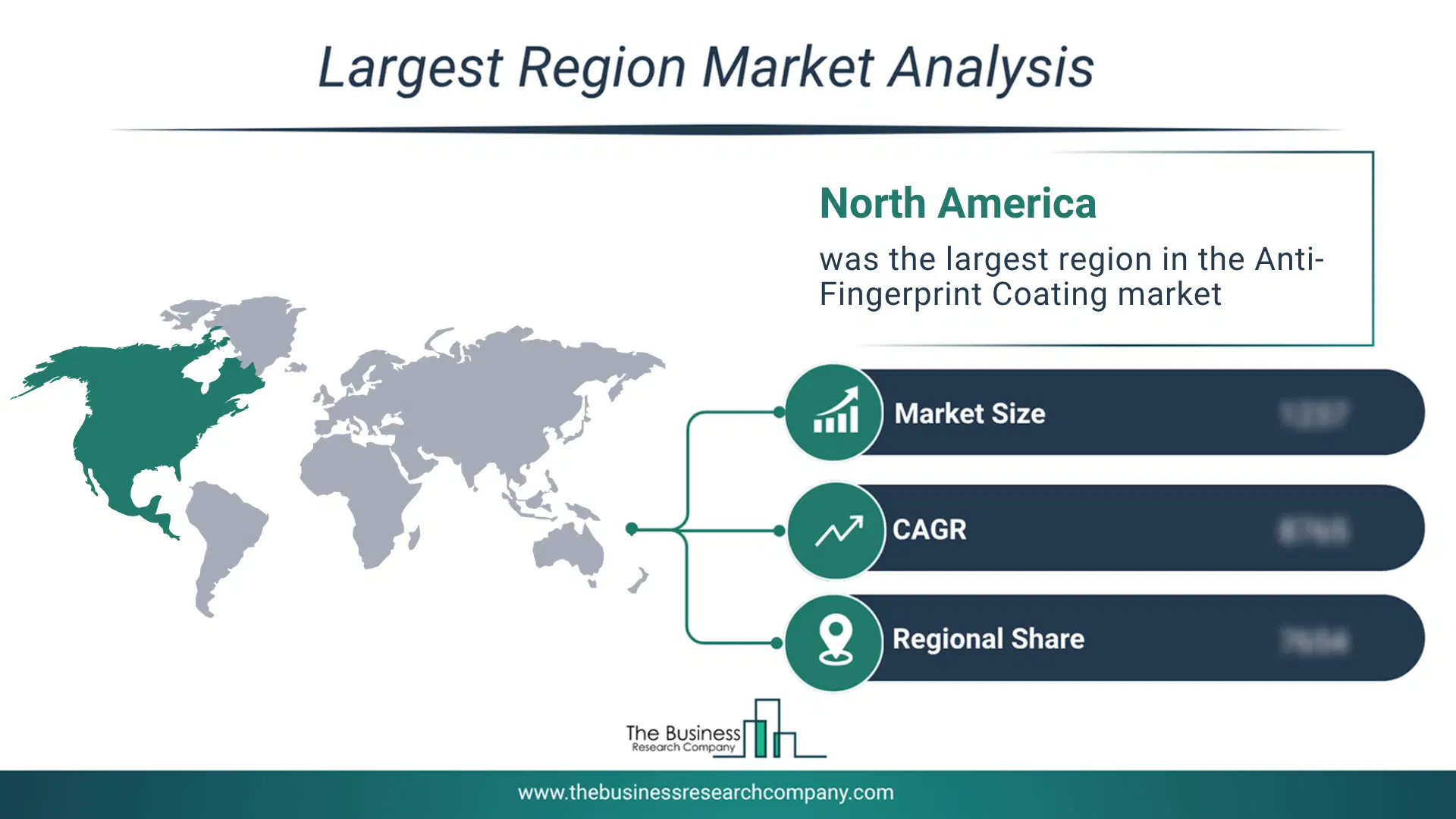
Regional Insights
North America was the largest region in the anti-fingerprint coating market in 2025. Europe is expected to be the fastest-growing region in the forecast period. The regions covered in this market report are Asia-Pacific, South East Asia, Western Europe, Eastern Europe, North America, South America, Middle East, Africa The countries covered in this market report are Australia, Brazil, China, France, Germany, India, Indonesia, Japan, Taiwan, Russia, South Korea, UK, USA, Canada, Italy, SpainWhat Defines the Anti-Fingerprint Coating Market?
The anti-fingerprint coating market consists of sales of coating kits, nano coatings, and screen protectors. Values in this market are ‘factory gate’ values, that is the value of goods sold by the manufacturers or creators of the goods, whether to other entities (including downstream manufacturers, wholesalers, distributors and retailers) or directly to end customers. The value of goods in this market includes related services sold by the creators of the goods.How is Market Value Defined and Measured?
The market value is defined as the revenues that enterprises gain from the sale of goods and/or services within the specified market and geography through sales, grants, or donations in terms of the currency (in USD unless otherwise specified). The revenues for a specified geography are consumption values that are revenues generated by organizations in the specified geography within the market, irrespective of where they are produced. It does not include revenues from resales along the supply chain, either further along the supply chain or as part of other products.
This chart presents market attractiveness based on a quantitative evaluation of growth, competition, strategic alignment, and risk, offering a clear view of opportunity areas for decision-making. This chart is for illustrative purposes; the full report contains the complete analysis.

This chart highlights the Total Addressable Market (TAM) by estimating the maximum revenue opportunity using an assumption-driven approach, supporting strategic planning and opportunity sizing across markets. The chart is illustrative; the full report provides a more comprehensive analysis.
What Key Data and Analysis Are Included in the Anti-Fingerprint Coating Market Report 2026?
The anti-fingerprint coating market research report is one of a series of new reports from The Business Research Company that provides market statistics, including industry global market size, regional shares, competitors with the market share, detailed market segments, market trends and opportunities, and any further data you may need to thrive in the anti-fingerprint coating industry. The market research report delivers a complete perspective of everything you need, with an in-depth analysis of the current and future state of the industry.Anti Fingerprint Coating Market Report Forecast Analysis
| Report Attribute | Details |
|---|---|
| Market Size Value In 2026 | $1.05 billion |
| Revenue Forecast In 2030 | $1.31 billion |
| Growth Rate | CAGR of 6.9% from 2026 to 2030 |
| Base Year For Estimation | 2025 |
| Actual Estimates/Historical Data | 2020-2025 |
| Forecast Period | 2026 - 2030 |
| Market Representation | Revenue in USD Billion and CAGR from 2026 to 2030 |
| Segments Covered | Type, Technology, Material Type, Applications |
| Regional Scope | Asia-Pacific, Western Europe, Eastern Europe, North America, South America, Middle East, Africa |
| Country Scope | The countries covered in this market report are Australia, Brazil, China, France, Germany, India, Indonesia, Japan, Taiwan, Russia, South Korea, UK, USA, Canada, Italy, Spain |
| Key Companies Profiled | Dow Inc., Daikin Industries Ltd, Henkel AG & Co. KGaA, Sherwin-Williams Company, PPG Industries Inc., Shin-Etsu Chemical Co. Ltd., Solvay SA, AGC Inc, Carl Zeiss Limited, Nagase & Co Ltd, I-Photonics, Lienchy Laminated Metal Co. Ltd., Bühler AG, Natoco Co. Ltd., LandGlass Technology Co. Ltd, Plasmatreat GmbH, Nanokote Pty Ltd, SDC Technologies Inc., Aculon Inc, SILIBASE SILICONE, NanoSlic Smart Coatings, WeeTect. Inc., Cytonix LLC |
| Customization Scope | Request for Customization |
| Pricing And Purchase Options | Explore Purchase Options |