
Anti-Satellite (ASAT) Weapons Market Report 2026
Global Outlook – By Type (Kinetic Anti-Satellite Weapons, Directed Energy Weapons, Electronic Warfare Systems, Cyber Warfare Systems, Electromagnetic Pulse Weapons), By Target Orbit (Low Earth Orbit, Medium Earth Orbit, Geostationary Orbit, Highly Elliptical Orbit), By Platform (Ground-Based, Air-Based, Sea-Based, Space-Based), By End User (Armed Forces, Space Force, Intelligence Agencies, Space Agencies) – Market Size, Trends, Strategies, and Forecast to 2035
Anti-Satellite (ASAT) Weapons Market Overview
• Anti-Satellite (ASAT) Weapons market size has reached to $3.89 billion in 2025 • Expected to grow to $6.8 billion in 2030 at a compound annual growth rate (CAGR) of 11.7% • Growth Driver: Rise In Geopolitical Tensions Fueling The Growth Of The Market Due To Increasing Space Security Concerns • Market Trend: Space-Based Counterspace Weapons Transforming ASAT Capabilities • North America was the largest region in 2025 and Asia-Pacific is the fastest growing region.What Is Covered Under Anti-Satellite (ASAT) Weapons Market?
Anti-satellite (ASAT) weapons are military systems designed to detect, target, disable, damage, or destroy satellites operating in space. They are intended to deny, disrupt, or degrade an adversary’s space-based capabilities through kinetic, non-kinetic, electronic, or other means. ASAT systems can affect strategic communications, navigation, surveillance, reconnaissance, and other space-enabled military capabilities. The main types of anti-satellite (ASAT) weapons include kinetic anti-satellite weapons, directed energy weapons, electronic warfare systems, cyber warfare systems, and electromagnetic pulse weapons. Kinetic anti-satellite weapons refer to systems designed to physically disable or destroy satellites through direct impact or collision. These weapons are designed for targets in low Earth orbit, medium Earth orbit, geostationary orbit, and highly elliptical orbit. They can be deployed from ground-based, air-based, sea-based, and space-based platforms, and are used by several end users such as armed forces, space forces, intelligence agencies, and space agencies.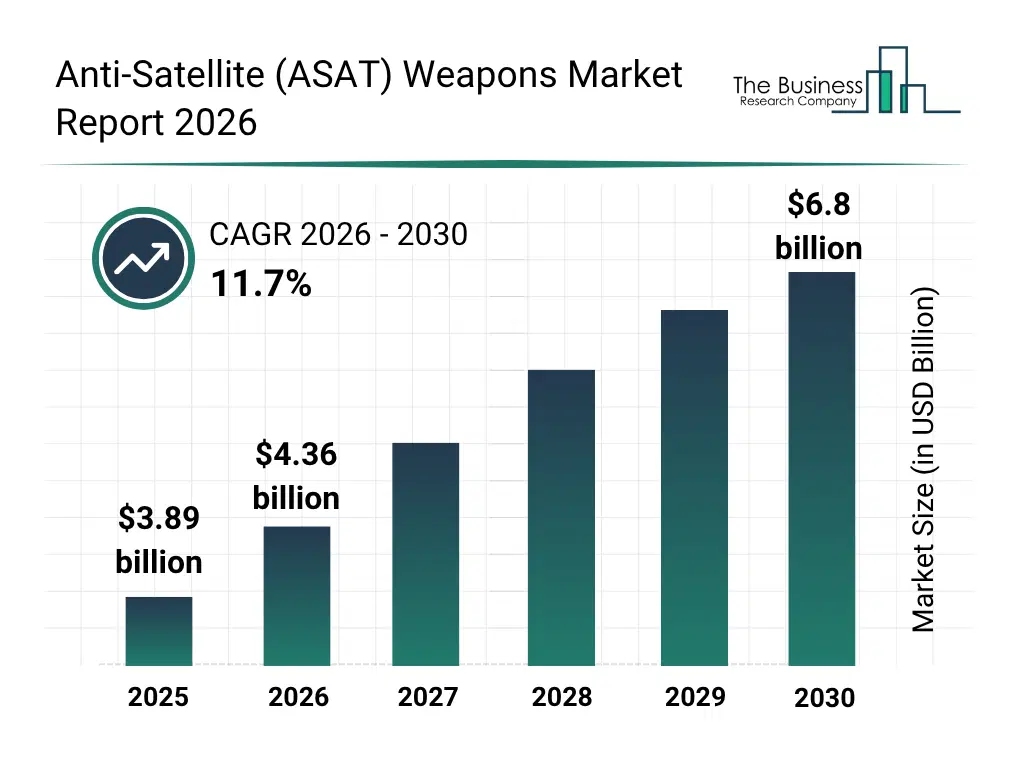
What Is The Anti-Satellite (ASAT) Weapons Market Size and Share 2026?
The anti-satellite (ASAT) weapons market size has grown rapidly in recent years. It will grow from $3.89 billion in 2025 to $4.36 billion in 2026 at a compound annual growth rate (CAGR) of 12.2%. The growth in the historic period can be attributed to increasing military reliance on satellite communications, rising dependence on space-based intelligence and surveillance, growing national focus on space security, increasing deployment of military satellite constellations, expanding strategic importance of satellite-based navigation.What Is The Anti-Satellite (ASAT) Weapons Market Growth Forecast?
The anti-satellite (asat) weapons market size is expected to see rapid growth in the next few years. It will grow to $6.8 billion in 2030 at a compound annual growth rate (CAGR) of 11.7%. The growth in the forecast period can be attributed to increasing demand for resilient space-based defense capabilities, rising focus on protection of critical satellite infrastructure, growing adoption of distributed satellite architectures, increasing requirements for counterspace threat awareness, expanding government space security programs. Major trends in the forecast period include increasing emphasis on multi-domain satellite threat detection, rising demand for space situational awareness capabilities, growing deployment of resilient satellite communication architectures, increasing focus on satellite protection and mission assurance, expanding development of counterspace threat monitoring capabilities.Tariff Impact On Anti-Satellite (ASAT) Weapons Market
Tariffs are impacting the anti-satellite (ASAT) weapons market by increasing the cost of imported aerospace electronics, sensing components, communication equipment, precision manufacturing inputs, and specialized defense hardware. This is raising procurement and production costs, particularly for ground-based, air-based, and space-based systems in regions dependent on imported aerospace and electronic components. Technology-intensive segments such as electronic warfare systems, directed energy systems, and satellite-related sensing equipment are most affected by global supply chain dependencies. However, tariffs are also encouraging domestic sourcing, regional supplier diversification, and increased investment in indigenous aerospace and defense manufacturing ecosystems, creating greater long-term supply chain resilience.
Global Anti-Satellite (ASAT) Weapons Market Segmentation
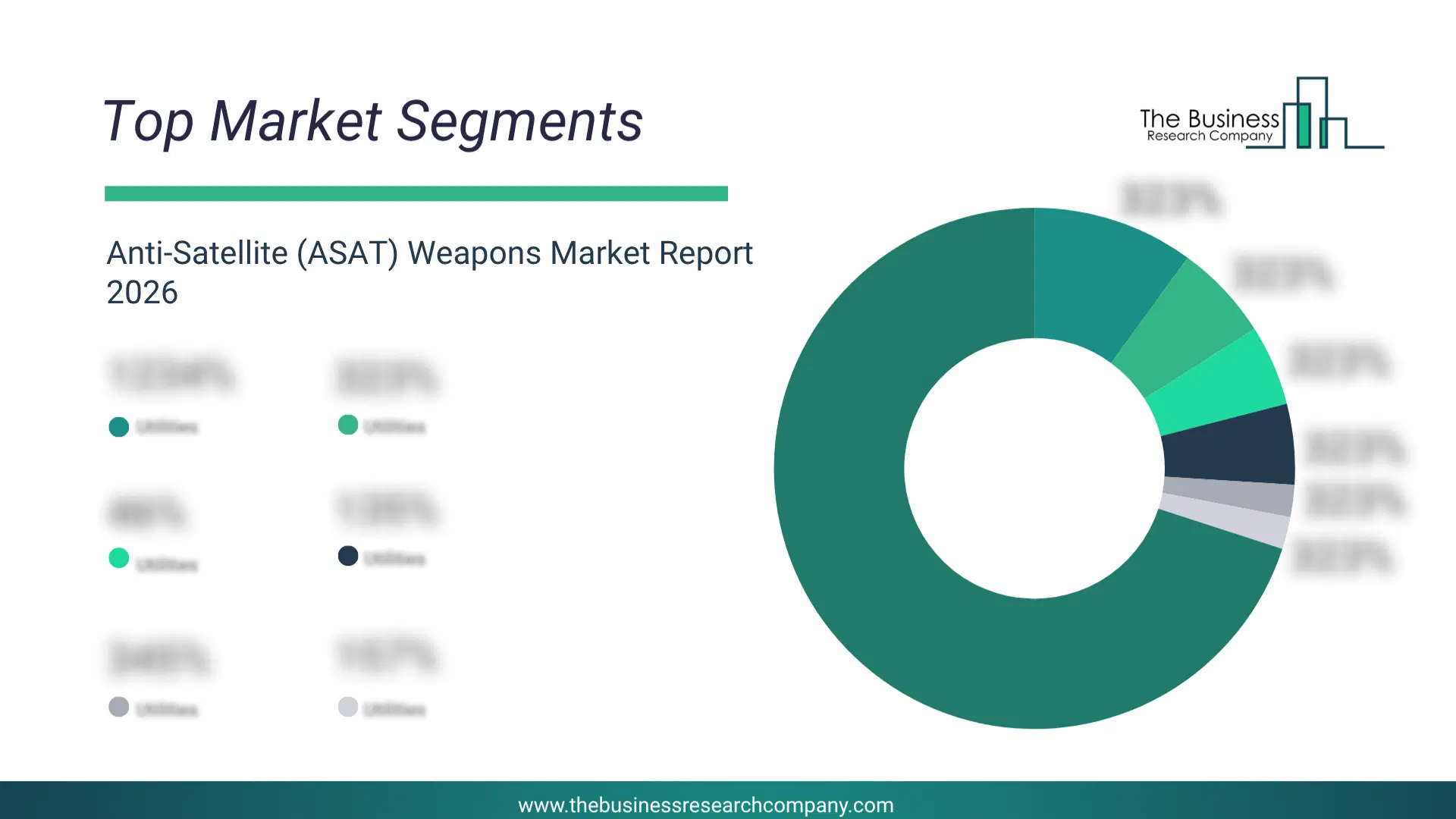
2) By Target Orbit: Low Earth Orbit, Medium Earth Orbit, Geostationary Orbit, Highly Elliptical Orbit 3) By Platform: Ground-Based, Air-Based, Sea-Based, Space-Based 4) By End User: Armed Forces, Space Force, Intelligence Agencies, Space Agencies Subsegments: 1) By Kinetic Anti-Satellite Weapons: Direct Ascent Weapons, Co-Orbital Weapons, Hit-To-Kill Interceptors 2) By Directed Energy Weapons: High Energy Laser Systems, High Power Microwave Systems, Radio Frequency Directed Energy Systems 3) By Electronic Warfare Systems: Satellite Jamming Systems, Signal Interference Systems, Electronic Countermeasure Systems 4) By Cyber Warfare Systems: Satellite Network Cyber Attacks, Ground Control System Cyber Attacks, Communication Link Disruption Systems 5) By Electromagnetic Pulse Weapons: High Altitude Electromagnetic Pulse Systems, Radio Frequency Electromagnetic Pulse Systems, Electromagnetic Pulse GeneratorsWhat Is The Driver Of The Anti-Satellite (ASAT) Weapons Market?
The increasing geopolitical tensions are expected to propel the growth of the anti-satellite (ASAT) weapons market going forward. Geopolitical tensions are conflicts or rivalries between nations arising from differences in political interests, security priorities, territorial disputes, or strategic competition that influence global defense policies. The increasing geopolitical tensions are due to rising military competition among major global powers, leading nations to strengthen their defense capabilities and space security strategies. Geopolitical tensions drive demand for anti-satellite (ASAT) weapons by prompting countries to strengthen counterspace capabilities to protect strategic interests, deter adversaries, and disrupt hostile satellite-based communications, navigation, and surveillance systems. For instance, in June 2026, according to the Institute for Economics & Peace (IEP), an Australia-based independent think tank, the number of countries involved in at least one external conflict increased to 103 in the 2026 Global Peace Index. Therefore, the increasing geopolitical tensions are driving the growth of the anti-satellite (ASAT) weapons industry.Key Players In The Global Anti-Satellite (ASAT) Weapons Market
Major companies operating in the anti-satellite (asat) weapons market are The Boeing Company, RTX Corporation, Lockheed Martin Corporation, Northrop Grumman Corporation, Airbus SE, General Dynamics Corporation, BAE Systems plc, L3Harris Technologies Inc, Thales SA, Leonardo SpA, Mitsubishi Heavy Industries Ltd, Israel Aerospace Industries Ltd, JSC Concern VKO Almaz - Antey, China Aerospace Science and Technology Corporation, Saab AB, Elbit Systems Ltd, General Atomics, QinetiQ Group plc, Kratos Defense & Security Solutions Inc, Huntington Ingalls Industries Inc. (HII), Hensoldt AG, Rohde & Schwarz GmbH & Co KG, Epirus Inc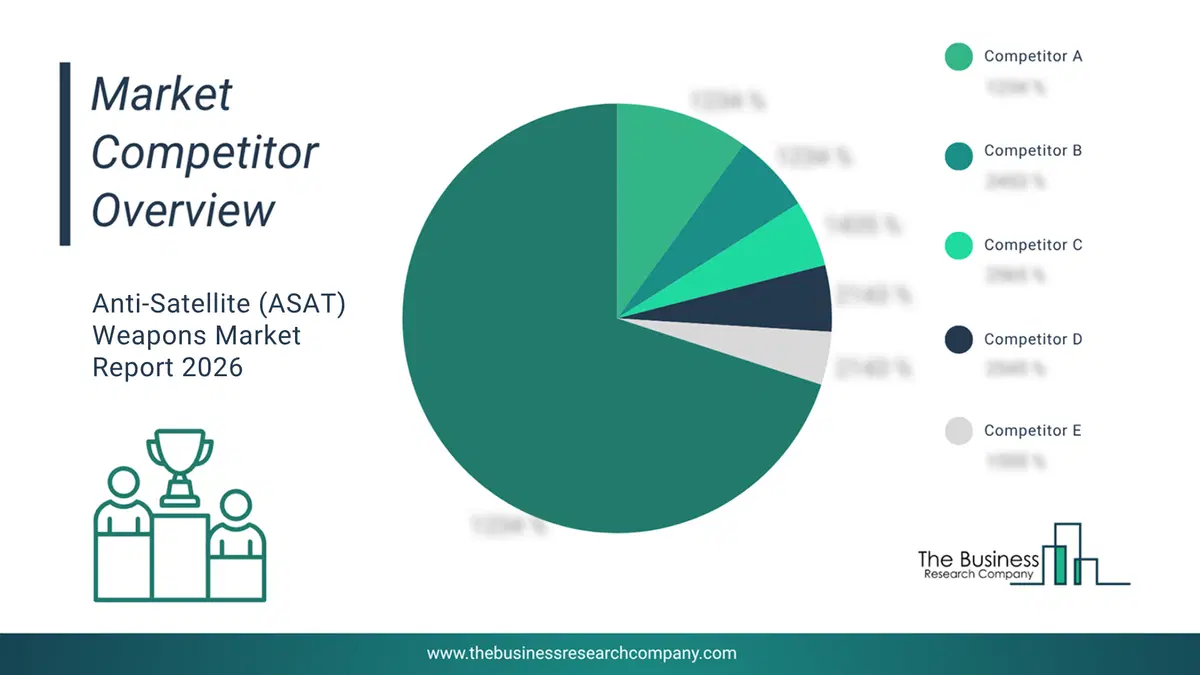
This chart is for illustrative purposes; the full report includes a detailed competitor analysis and comprehensive overview of the top 10 companies in the market.
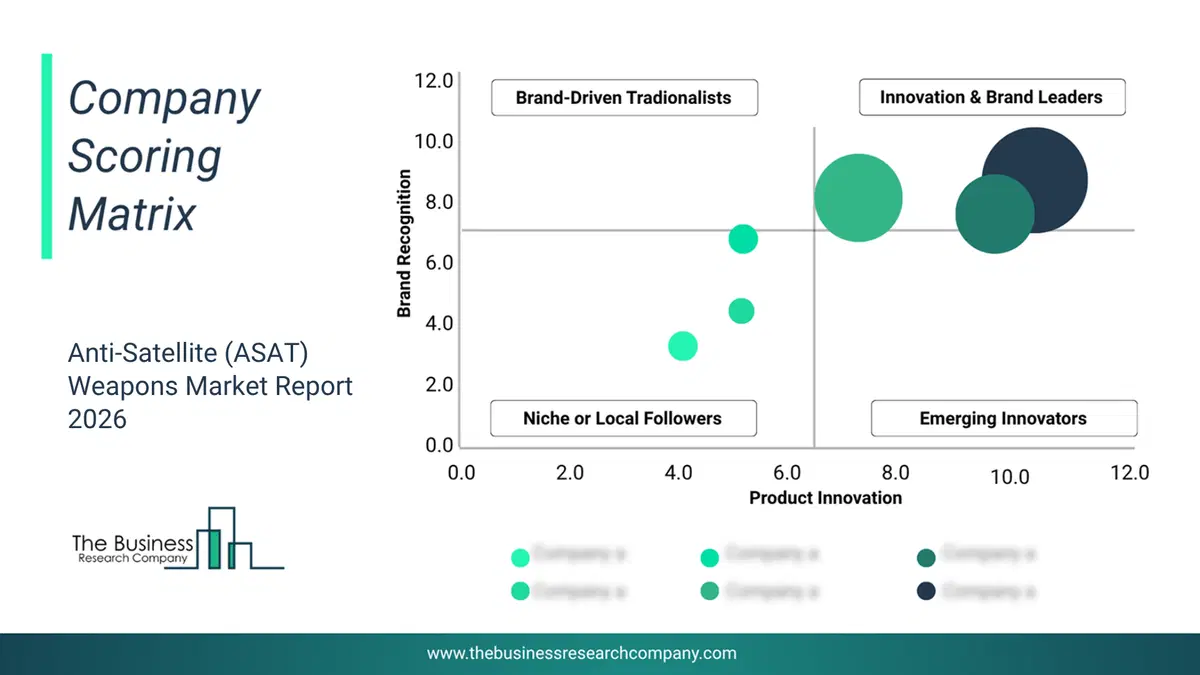
This chart maps companies by product innovation and brand strength, with bubble size indicating relative revenue, helping identify market leaders, challengers, and niche players. This is an illustrative chart; the full report provides a complete and accurate competitive analysis.
Global Anti-Satellite (ASAT) Weapons Market Trends and Insights
Major companies operating in the anti-satellite (ASAT) weapons market are focusing on developing advanced counterspace systems, such as co-orbital anti-satellite weapons, to enhance satellite interception capabilities, strengthen orbital warfare operations, and improve the ability to target adversary space assets. Co-orbital anti-satellite weapons refer to space-based systems designed to maneuver into the vicinity of another satellite and potentially interfere with, disable, damage, or destroy it. For instance, in May 2025, the Russian Aerospace Forces (VKS), Russia-based military aerospace service, launched Kosmos 2588 aboard a Soyuz rocket. The satellite was placed in an orbital plane close to USA 338, a U.S. government reconnaissance satellite, and analysts assessed the activity as potentially representing a co-orbital ASAT capability associated with Russia's Nivelir program, highlighting continued development of maneuverable space-based counterspace systems.What Are Latest Mergers And Acquisitions In The Anti-Satellite (ASAT) Weapons Market?
In September 2025, the U.S. Air Force, a US-based air warfare service branch of the United States Department of the Air Force, partnered with Privateer Space, to develop a Direct-Ascent Anti-Satellite (DA-ASAT) Detection and Classification System. With this contract, Privateer Space aims to develop technology for detecting, classifying, and assessing direct-ascent anti-satellite weapon threats, supporting enhanced space domain awareness and national security operations. Privateer Space is a US-based space technology company specializing in space situational awareness, satellite tracking, and space data analytics.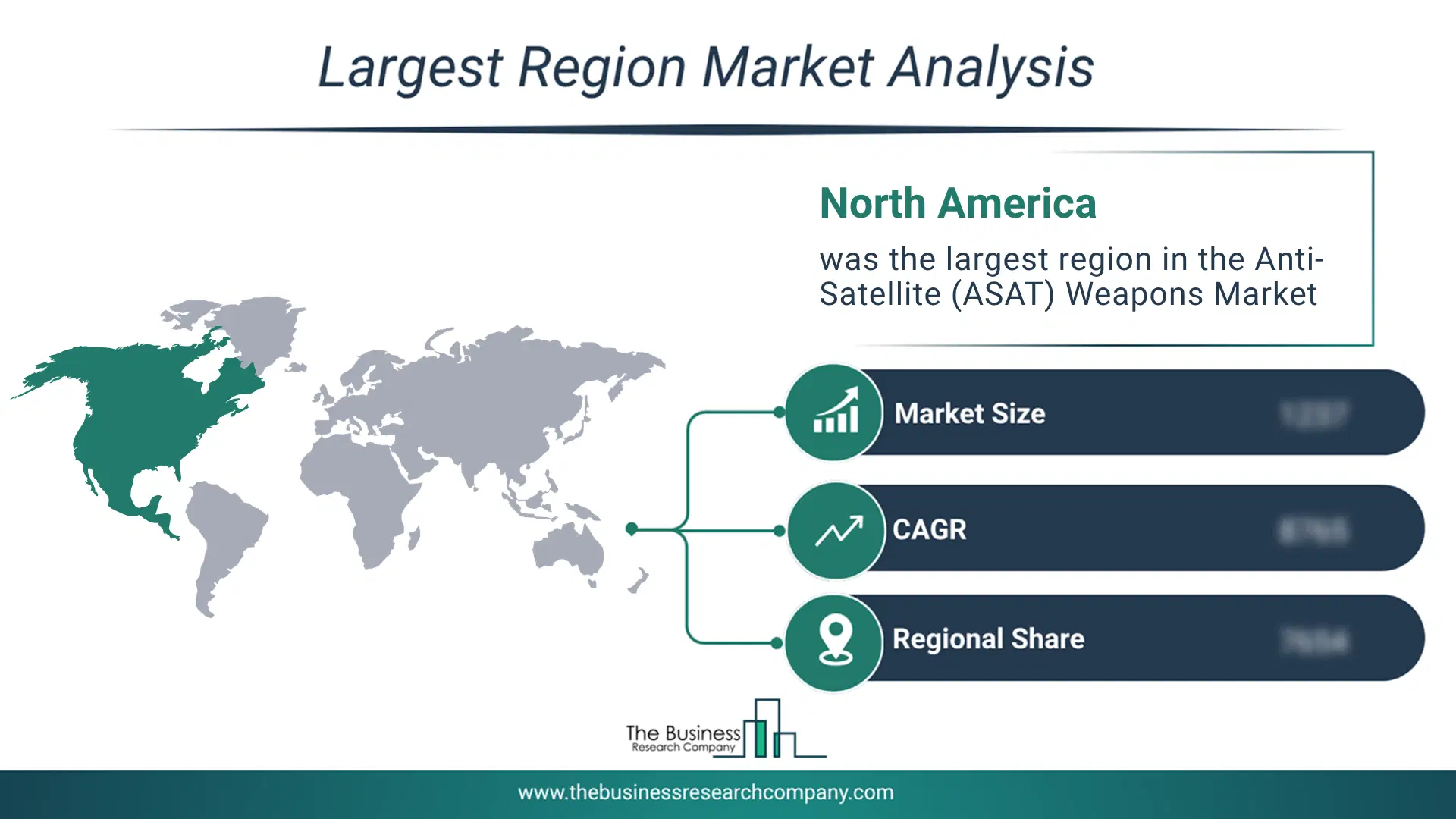
Regional Outlook/Insights
North America was the largest region in the anti-satellite (ASAT) weapons market in 2025. Asia-Pacific is expected to be the fastest-growing region in the forecast period. The regions covered in this market report are Asia-Pacific, South East Asia, Western Europe, Eastern Europe, North America, South America, Middle East, Africa. The countries covered in this market report are Australia, Brazil, China, France, Germany, India, Indonesia, Japan, Taiwan, Russia, South Korea, UK, USA, Canada, Italy, Spain.What Defines the Anti-Satellite (ASAT) Weapons Market?
The anti-satellite (ASAT) weapons market consists of sales of co-orbital anti-satellite systems, missile interceptors, and associated command and control systems. Values in this market are ‘factory gate’ values, that is the value of goods sold by the manufacturers or creators of the goods, whether to other entities (including downstream manufacturers, wholesalers, distributors and retailers) or directly to end customers. The value of goods in this market includes related services sold by the creators of the goods.How is Market Value Defined and Measured?
The market value is defined as the revenues that enterprises gain from the sale of goods and/or services within the specified market and geography through sales, grants, or donations in terms of the currency (in USD unless otherwise specified). The revenues for a specified geography are consumption values that are revenues generated by organizations in the specified geography within the market, irrespective of where they are produced. It does not include revenues from resales along the supply chain, either further along the supply chain or as part of other products.
This chart presents market attractiveness based on a quantitative evaluation of growth, competition, strategic alignment, and risk, offering a clear view of opportunity areas for decision-making. This chart is for illustrative purposes; the full report contains the complete analysis.

This chart highlights the Total Addressable Market (TAM) by estimating the maximum revenue opportunity using an assumption-driven approach, supporting strategic planning and opportunity sizing across markets. The chart is illustrative; the full report provides a more comprehensive analysis.
What Key Data and Analysis Are Included in the Anti-Satellite (ASAT) Weapons Market Report 2026?
The anti-satellite (asat) weapons market research report is one of a series of new reports from The Business Research Company that provides market statistics, including industry global market size, regional shares, competitors with the market share, detailed market segments, market trends and opportunities, and any further data you may need to thrive in the anti-satellite (asat) weapons industry. The market research report delivers a complete perspective of everything you need, with an in-depth analysis of the current and future state of the industry.Anti-Satellite (ASAT) Weapons Market Report Forecast Analysis
| Report Attribute | Details |
|---|---|
| Market Size Value In 2026 | $4.36 billion |
| Revenue Forecast In 2030 | $6.8 billion |
| Growth Rate | CAGR of 11.7% from 2026 to 2035 |
| Base Year For Estimation | 2025 |
| Actual Estimates/Historical Data | 2020-2025 |
| Forecast Period | 2026 - 2030 |
| Market Representation | Revenue in USD Billion and CAGR from 2026 to 2030 |
| Segments Covered | Type, Target Orbit, Platform, End User |
| Regional Scope | Asia-Pacific, Western Europe, Eastern Europe, North America, South America, Middle East, Africa |
| Country Scope | The countries covered in the report are Australia, Brazil, China, France, Germany, India, Indonesia, Japan, Taiwan, Russia, South Korea, UK, USA, Canada, Italy, Spain. |
| Customization Scope | Request for Customization |
| Pricing And Purchase Options | Explore Purchase Options |