

Anti-Static Films Market Report 2026
Global Outlook – By Material Type (Polyethylene (PE), Polyethylene Terephthalate (PET), Polypropylene (PP), Polyvinyl Chloride (PVC), Other Material Types), By Film Type (Anti-Static Films, Static-Dissipative Films, Conductive Films), By Application (Bags And Pouches, Liners, Wraps, Other Applications), By Industry Vertical (Electronics And Semiconductors, Pharmaceutical And Healthcare, Automotive, Other Industrial Verticals) – Market Size, Trends, Strategies, and Forecast to 2030
Anti-Static Films Market Overview
• Anti-Static Films market size has reached to $0.67 billion in 2025 • Expected to grow to $1.02 billion in 2030 at a compound annual growth rate (CAGR) of 8.7% • Growth Driver: E-Commerce Surge Ignites Growth In Anti-Static Films Market • Market Trend: Innovative Product Advancements In The Anti-Static Films Market • North America was the largest region in 2025 and Asia-Pacific is the fastest growing region.Market Gains By 2030 – Top Opportunities By Segment
Market Gain identifies the most promising market opportunities by highlighting the segments or products expected to generate the highest incremental revenue growth over the next five years.
What Is Covered Under Anti-Static Films Market?
The anti-static films are films that protect package components from internal static electricity generation. A single layer of non-amide polyethylene is used to create the anti-static film. These are non-corrosive films that are used to preserve static-sensitive items, such as electronic components and commodities. The film has good mechanical qualities and helps to minimize static charge in electronic components and sensitive electronic equipment. The main types of materials included in anti-static films are polyethylene (PE), polyethylene terephthalate (PET), polyvinyl chloride (PVC), others. The polyethylene (PE) antistatic film has excellent tape adherence quality while also being lightweight and durable. A three-layer co-extrusion blow molding machine is used to create the clear antistatic polyethylene film, which is made up of 65 to 85% polyethylene, 31 to 14% metallocene polyethylene, and 1 to 4% antistatic agent. The smoothness and transparency of the transparent antistatic polyethylene film revealed by the innovation are unaffected after a specified amount of antistatic compound is introduced. It is used in bags and pouches, liners, wraps, tapes, clamshells, others and is implemented in various verticals such as electronics, pharmaceutical and healthcare, automotive, others.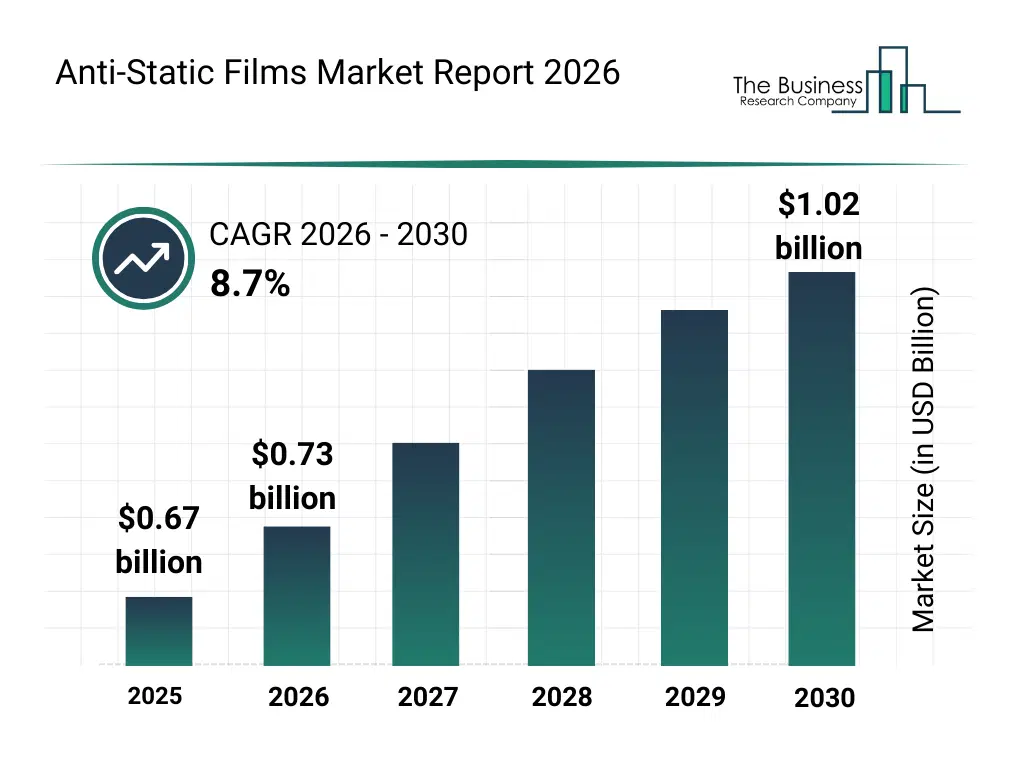
What Is The Anti-Static Films Market Size and Share 2026?
The anti-static films market size has grown strongly in recent years. It will grow from $0.67 billion in 2025 to $0.73 billion in 2026 at a compound annual growth rate (CAGR) of 8.8%. The growth in the historic period can be attributed to growth of electronics manufacturing activities, rising sensitivity of electronic components, expansion of semiconductor packaging, increased demand for safe material handling, availability of polyethylene-based films.What Is The Anti-Static Films Market Growth Forecast?
The anti-static films market size is expected to see strong growth in the next few years. It will grow to $1.02 billion in 2030 at a compound annual growth rate (CAGR) of 8.7%. The growth in the forecast period can be attributed to increasing demand for advanced electronic packaging, rising adoption of automation in electronics assembly, expansion of pharmaceutical supply chains, growing focus on recyclable packaging materials, increasing use of specialty films. Major trends in the forecast period include increasing demand for esd-safe packaging materials, rising adoption of anti-static films in electronics manufacturing, growing use in pharmaceutical packaging, expansion of multi-layer protective films, enhanced focus on material durability and transparency.
Global Anti-Static Films Market Segmentation
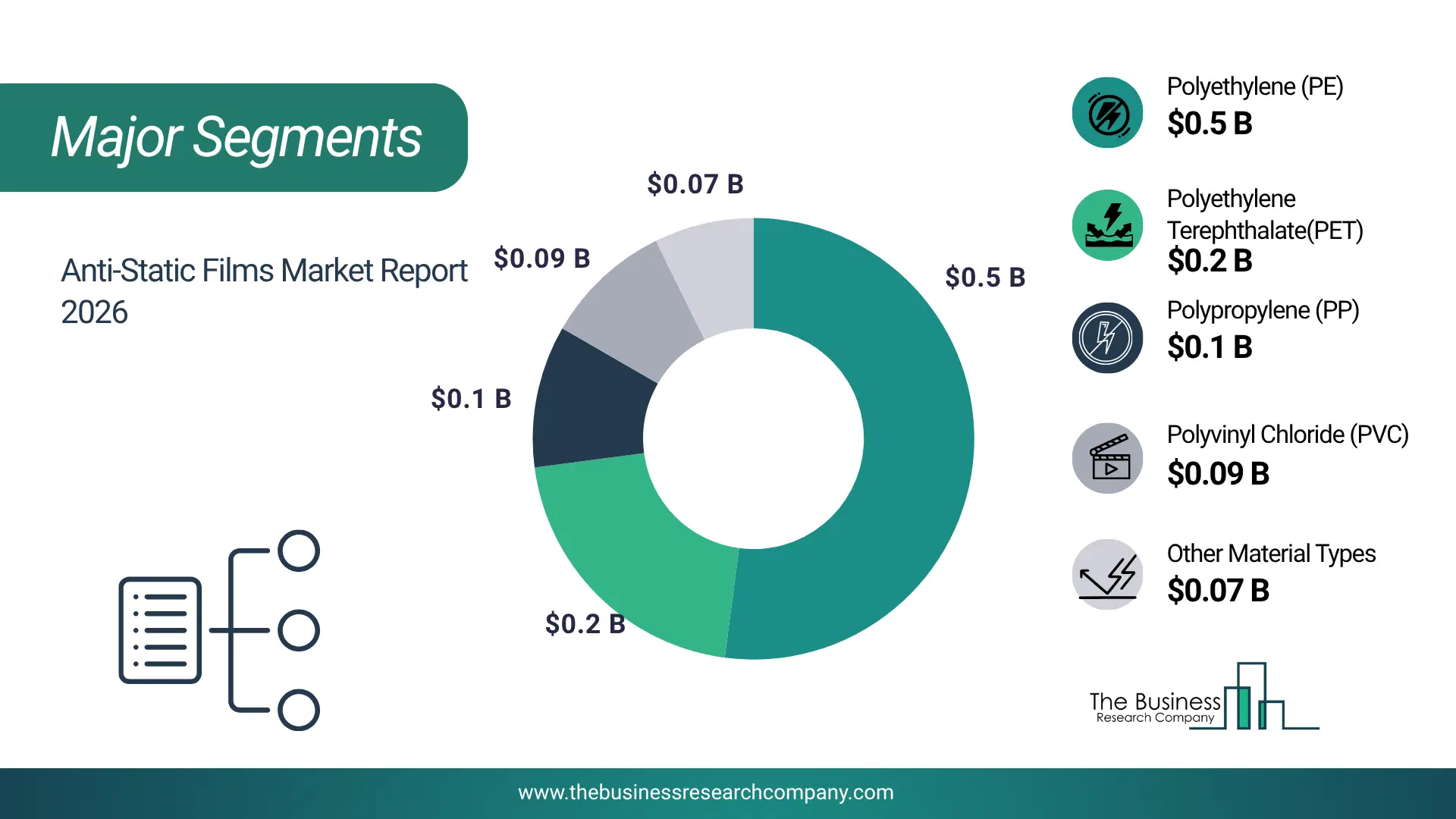
1) By Material Type: Polyethylene (PE), Polyethylene Terephthalate (PET), Polypropylene (PP), Polyvinyl Chloride (PVC), Other Material Types 2) By Film Type: Anti-Static Films, Static-Dissipative Films, Conductive Films 3) By Application: Bags And Pouches, Liners, Wraps, Other Applications 4) By Industry Vertical: Electronics And Semiconductors, Pharmaceutical And Healthcare, Automotive, Other Industrial Verticals Subsegments: 1) By Polyethylene (PE): Low-Density Polyethylene (LDPE), Linear Low-Density Polyethylene (LLDPE), High-Density Polyethylene (HDPE) 2) By Polyethylene Terephthalate (PET): Biaxially Oriented PET (BOPET), Thermally Stable PET Films, Metallized PET Films 3) By Polypropylene (PP): Cast Polypropylene (CPP), Biaxially Oriented Polypropylene (BOPP) 4) By Polyvinyl Chloride (PVC): Flexible PVC Films, Semi-Rigid PVC Films 5) By Other Material Types: Ethylene Vinyl Acetate (EVA), Polyamide (Nylon), Multilayer Co-Extruded Films The top segments in the anti-static films market will be: • Polyethylene (PE) will reach $0.5 Billion by 2030. • Polyethylene Terephthalate(PET) will reach $0.25 Billion by 2030. • Polypropylene (PP) will reach $0.15 Billion by 2030. • Polyvinyl Chloride (PVC) will reach $0.09 Billion by 2030. • Other Material Types will reach $0.07 Billion by 2030.What Are The Drivers Of The Anti-Static Films Market?
The increasing penetration of the e-commerce industry is expected to propel the growth of the anti-static films market in the forecast period. The e-commerce industry is growing mainly because more people are using smartphones, making online shopping easier and more accessible. E-commerce refers to the purchase and sale of goods and services over an electronic network. Anti-static plastic films are available in a range of shapes and sizes, including bubble covers, films, and foams, and these films are commonly used by retailers to package electronics and non-electrical products. For instance, in August 2023, according to the United States Census Bureau, a US-based government agency, compared to the second quarter of 2022, the estimate for e-commerce in the second quarter of 2023 climbed by 7.5% (or 1.4%), while overall retail sales rose by 0.6% (or 0.4%). 15.4% of all sales in the second quarter of 2023 were made through online stores. Therefore, the increasing penetration if the e-commerce industry is driving the the growth of the anti-static films industry. The increasing expansion of the electronics industry is expected to propel the growth of the anti-static films market going forward. The electronics industry refers to a sector of the economy that is involved in the design, development, manufacturing, and sale of electronic devices and components. Anti-static films are widely utilized in the electronics industry to safeguard sensitive electronic components and devices from electrostatic discharge (ESD) and damage. These films are employed in various ways, including as protective packaging materials, covers, and liners for electronic products. For instance, in December 2024, according to the Japan Electronics and Information Technology Industries Association (JEITA), a Japan-based trade organization, global electronics and IT industry production grew by 9% year-on-year in 2024 and is projected to grow by 8% in 2025, reaching $3,990.9 billion in 2025 compared to $3,703.2 billion in 2024. Therefore, the expansion of the electronics industry is driving the anti-static films industry.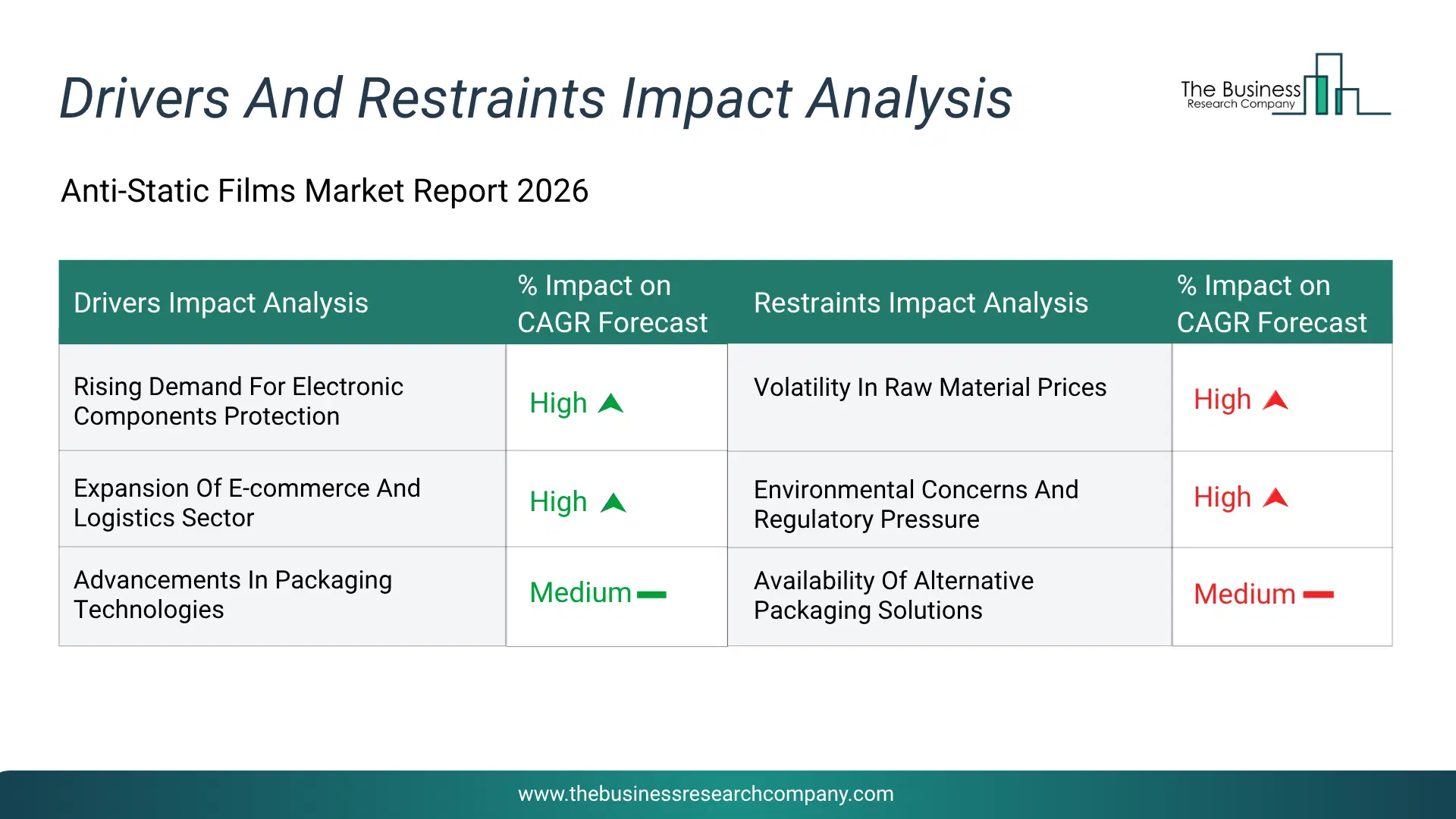
Infographic Chart Showing Key Market Drivers Analysis And Restraints For Anti-Static Films Market
The chart presents an impact analysis of key drivers and restraints, quantifying their relative influence on the market's growth rate and helping assess the balance between growth enablers and limiting factors. This chart offers a high-level perspective; the full report contains more detailed insights.
How Will The Drivers Impact Growth In The Global Anti-Static Films Market?
• Rising Demand For Electronic Components Protection (High) – During the forecast period, the rising demand for electronic components protection is expected to emerge as a major factor driving the expansion of the anti-static films market by 2030. The increasing production of electronic devices such as semiconductors and circuit boards has heightened the need for anti-static films. These films prevent electrostatic discharge (ESD), which can damage sensitive components during storage and transportation. With advancements in technologies like IoT, AI, and 5G, the volume of electronic manufacturing has surged. Miniaturization of components further increases vulnerability to static, making protective packaging essential. Anti-static films ensure product reliability and reduce losses due to static damage. • Expansion Of E-commerce And Logistics Sector (High) – During the forecast period, the expansion of e-commerce and logistics sector is expected to act as a key growth catalyst for the anti-static films market by 2030. The rapid growth of e-commerce has significantly increased the need for protective packaging solutions. Anti-static films are widely used to safeguard electronic goods during shipping and handling. As cross-border trade expands, the importance of reliable packaging materials rises. Logistics providers prefer anti-static films due to their lightweight nature and ability to protect products over long distances. The increase in online electronics sales directly contributes to higher demand for such films. • Advancements In Packaging Technologies (Medium) – During the forecast period, the advancements in packaging technologies is expected to become a key growth driver for the anti-static films market by 2030. Innovations in material science have led to the development of high-performance anti-static films with improved durability and static dissipation properties. Manufacturers are focusing on multi-layer films and advanced polymer blends to enhance efficiency. These improvements make the films suitable for diverse applications including automotive and healthcare. Additionally, the push toward sustainable packaging has resulted in the development of recyclable anti-static films. Continuous R&D investments are enabling customized packaging solutions. Such technological progress expands the usability and adoption of anti-static films across industries.How Will The Restraints Impact Growth In The Global Anti-Static Films Market?
• Volatility In Raw Material Prices (High) – During the forecast period, volatility in raw material prices is significantly restricting the growth of the anti-static films market. Fluctuations in petrochemical-based inputs and supply chain uncertainties are increasing production costs, compressing profit margins, and creating pricing instability for manufacturers. • Environmental Concerns And Regulatory Pressure (High) – During the forecast period, environmental concerns and regulatory pressure are significantly restricting the growth of the anti-static films market. Increasing restrictions on plastic usage, sustainability mandates, and regulatory compliance requirements are pushing manufacturers toward eco-friendly alternatives, thereby limiting conventional anti-static film adoption. • Availability Of Alternative Packaging Solutions (Medium) – During the forecast period, the availability of alternative packaging solutions is restricting the growth of the anti-static films market. The growing adoption of biodegradable, reusable, and advanced conductive packaging materials is diverting demand away from traditional anti-static films and increasing competitive pressure on market players.Key Players In The Global Anti-Static Films Market
Major companies operating in the anti-static films market are Achilles Corporation, Toyobo Co. Ltd., Kolon Industries Inc., Mitsubishi Polyester Film Group, Toray Plastics Inc., Wiman Corporation, Klockner Pentaplast Group, Unitika Ltd., Blueridge Films Inc., Sekisui Film Co., Nan Ya Plastics Corporation, Techno Stat Industry Pvt. Ltd., Syfan USA Corp., Polyplex Corporation Ltd., Jindal Poly Films Ltd., Uflex Limited, Cosmo Films Limited, Berry Global Group Inc., Intertape Polymer Group Inc., 3M Company, Tesa SE, Scapa Group plc, Nitto Denko Corporation, Avery Dennison Corporation, Lintec Corporation, Dunmore Corporation, Ester Industries Ltd., Polinas Plastik Sanayi ve Ticaret AS, Flex Films USA Inc.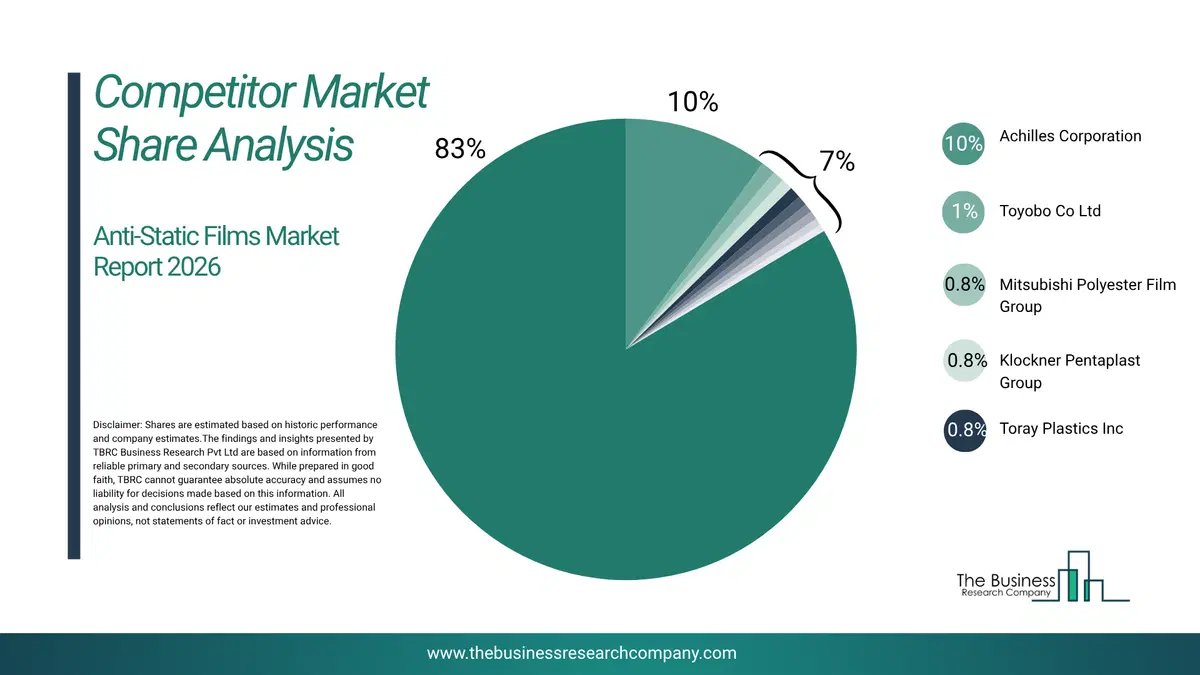
This chart is for illustrative purposes; the full report includes a detailed competitor analysis and comprehensive overview of the top 10 companies in the market.
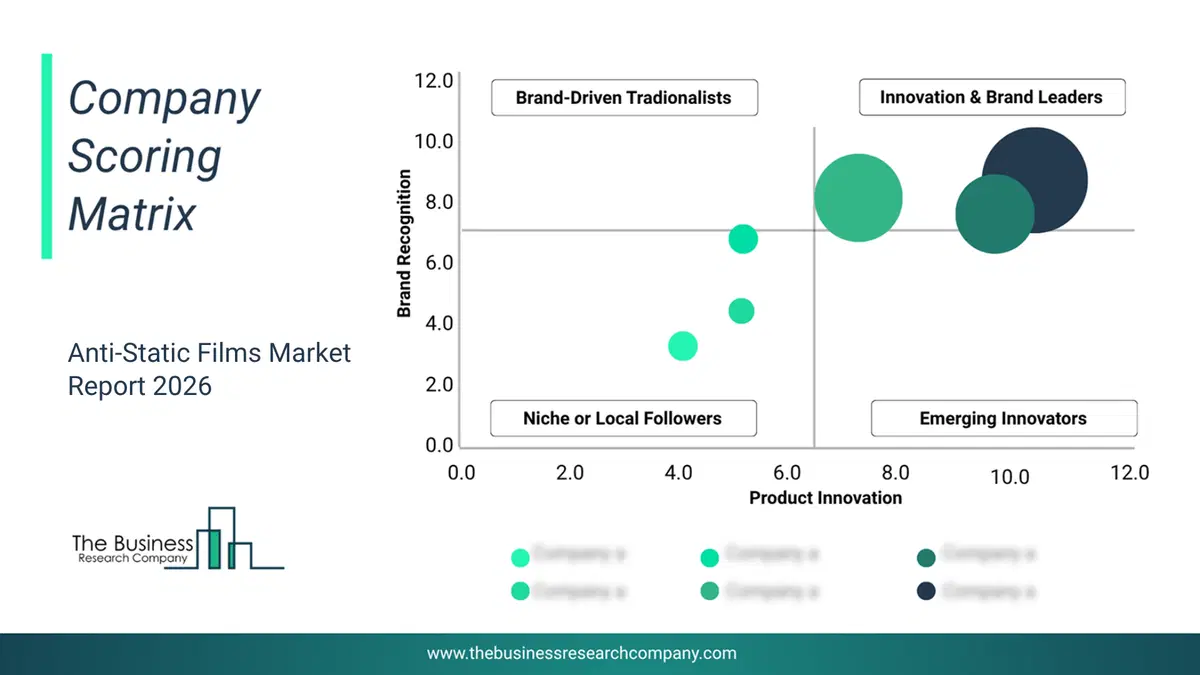
This chart maps companies by product innovation and brand strength, with bubble size indicating relative revenue, helping identify market leaders, challengers, and niche players. This is an illustrative chart; the full report provides a complete and accurate competitive analysis.
Global Anti-Static Films Market Trends and Insights
Major companies operating in the anti-static films market are innovating new innovative products such as, aerospace conductive coating (CM0485115) to increase their profitability in the market. The aerospace conductive coating (CM0485115) is an advanced solution that offers high conductivity to non-conductive substrates by producing an anti-static conductive film. For instance, in September 2023, Sherwin-Williams Company, a US-based paint and coating manufacturing company launched the aerospace conductive coating (CM0485115). When using the aerospace conductive coating (CM0485115), it is advised for best results, for the conductive coating to be applied in one singular, continuous closed film or one cross coat. It is compatible with all non-electrostatic spray equipment and can be applied onto pre-primed aluminum and composite substrates to achieve high conductivity.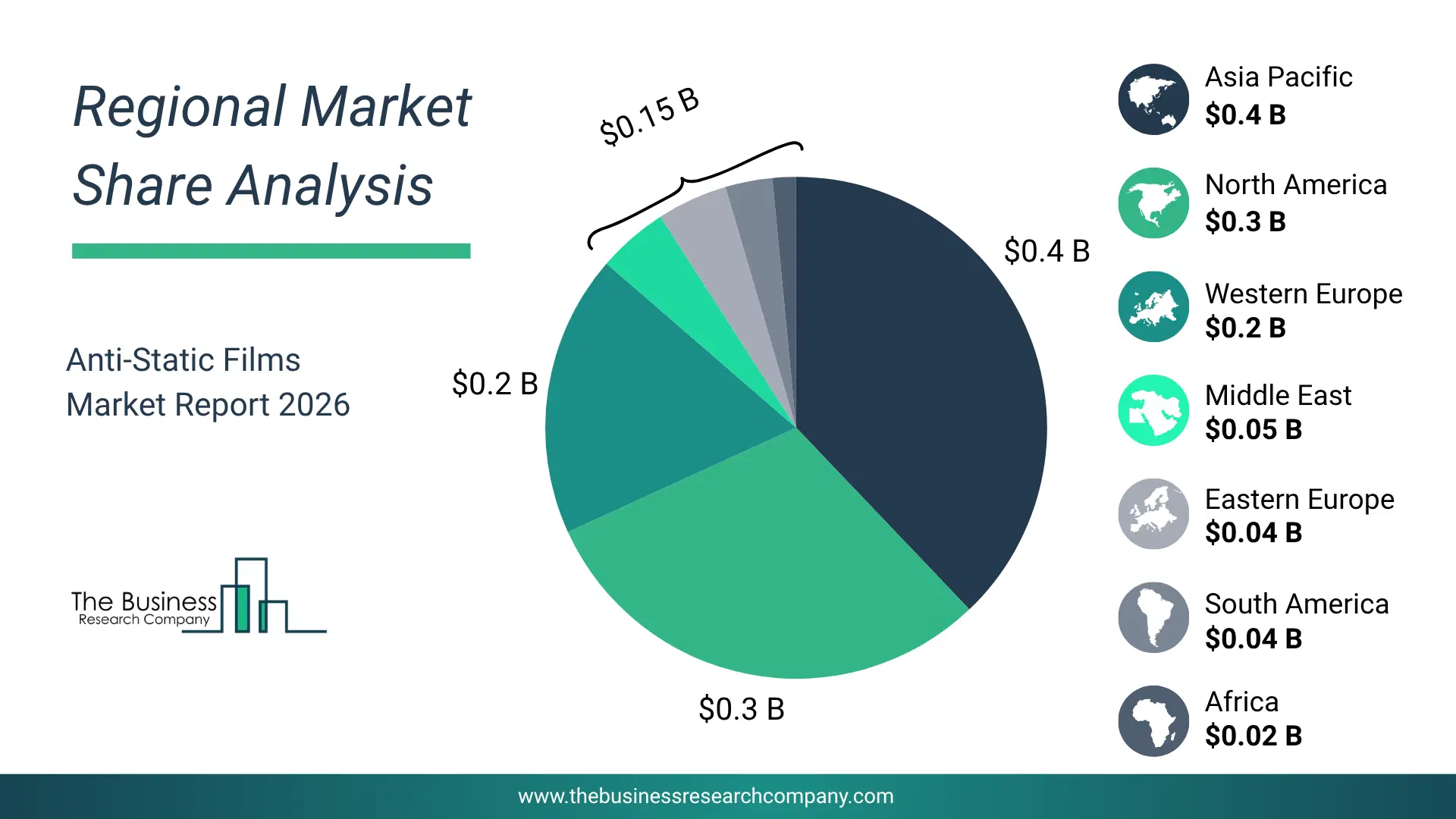
Regional Insights
North America was the largest region in the anti-static films market in 2025. Asia-Pacific is expected to be the fastest region in the forecast period. The regions covered in this market report are Asia-Pacific, South East Asia, Western Europe, Eastern Europe, North America, South America, Middle East, Africa The countries covered in this market report are Australia, Brazil, China, France, Germany, India, Indonesia, Japan, Taiwan, Russia, South Korea, UK, USA, Canada, Italy, SpainWhat Defines the Anti-Static Films Market?
The anti-static films market consists of sales of static dissipative films, conductive films and antistatic films. Values in this market are ‘factory gate’ values, that is the value of goods sold by the manufacturers or creators of the goods, whether to other entities (including downstream manufacturers, wholesalers, distributors, and retailers) or directly to end customers. The value of goods in this market includes related services sold by the creators of the goods.How is Market Value Defined and Measured?
The market value is defined as the revenues that enterprises gain from the sale of goods and/or services within the specified market and geography through sales, grants, or donations in terms of the currency (in USD unless otherwise specified). The revenues for a specified geography are consumption values that are revenues generated by organizations in the specified geography within the market, irrespective of where they are produced. It does not include revenues from resales along the supply chain, either further along the supply chain or as part of other products.
This chart presents market attractiveness based on a quantitative evaluation of growth, competition, strategic alignment, and risk, offering a clear view of opportunity areas for decision-making. This chart is for illustrative purposes; the full report contains the complete analysis.

This chart highlights the Total Addressable Market (TAM) by estimating the maximum revenue opportunity using an assumption-driven approach, supporting strategic planning and opportunity sizing across markets. The chart is illustrative; the full report provides a more comprehensive analysis.
What Key Data and Analysis Are Included in the Anti-Static Films Market Report 2026?
The anti-static films market research report is one of a series of new reports from The Business Research Company that provides market statistics, including industry global market size, regional shares, competitors with the market share, detailed market segments, market trends and opportunities, and any further data you may need to thrive in the anti-static films industry. The market research report delivers a complete perspective of everything you need, with an in-depth analysis of the current and future state of the industry.Anti-Static Films Market Report Forecast Analysis
| Report Attribute | Details |
|---|---|
| Market Size Value In 2026 | $0.73 billion |
| Revenue Forecast In 2030 | $1.02 billion |
| Growth Rate | CAGR of 8.8% from 2026 to 2030 |
| Base Year For Estimation | 2025 |
| Actual Estimates/Historical Data | 2020-2025 |
| Forecast Period | 2026 - 2030 |
| Market Representation | Revenue in USD Billion and CAGR from 2026 to 2030 |
| Segments Covered | Material Type, Film Type, Application, Industry Vertical |
| Regional Scope | Asia-Pacific, Western Europe, Eastern Europe, North America, South America, Middle East, Africa |
| Country Scope | The countries covered in the report are Australia, Brazil, China, France, Germany, India, Indonesia, Japan, Taiwan, Russia, South Korea, UK, USA, Canada, Italy, Spain. |
| Key Companies Profiled | Achilles Corporation, Toyobo Co. Ltd., Kolon Industries Inc., Mitsubishi Polyester Film Group, Toray Plastics Inc., Wiman Corporation, Klockner Pentaplast Group, Unitika Ltd., Blueridge Films Inc., Sekisui Film Co., Nan Ya Plastics Corporation, Techno Stat Industry Pvt. Ltd., Syfan USA Corp., Polyplex Corporation Ltd., Jindal Poly Films Ltd., Uflex Limited, Cosmo Films Limited, Berry Global Group Inc., Intertape Polymer Group Inc., 3M Company, Tesa SE, Scapa Group plc, Nitto Denko Corporation, Avery Dennison Corporation, Lintec Corporation, Dunmore Corporation, Ester Industries Ltd., Polinas Plastik Sanayi ve Ticaret AS, Flex Films USA Inc. |
| Customization Scope | Request for Customization |
| Pricing And Purchase Options | Explore Purchase Options |