
Anti-Tank Missile System Market Report 2026
Global Outlook – By Type (Man-Portable, Vehicle-Mounted), By Platform (Airborne, Ground-Based), By Application (Defense, Homeland Security, Other Applications) – Market Size, Trends, Strategies, and Forecast to 2030
Anti-Tank Missile System Market Overview
• Anti-Tank Missile System market size has reached to $3.11 billion in 2025 • Expected to grow to $3.82 billion in 2030 at a compound annual growth rate (CAGR) of 4.2% • Growth Driver: Increased Defense Expenditure Fuels Growth In Anti-Tank Missile System Market • Market Trend: Advancements in Anti-Tank Missile Systems • North America was the largest region in 2025.What Is Covered Under Anti-Tank Missile System Market?
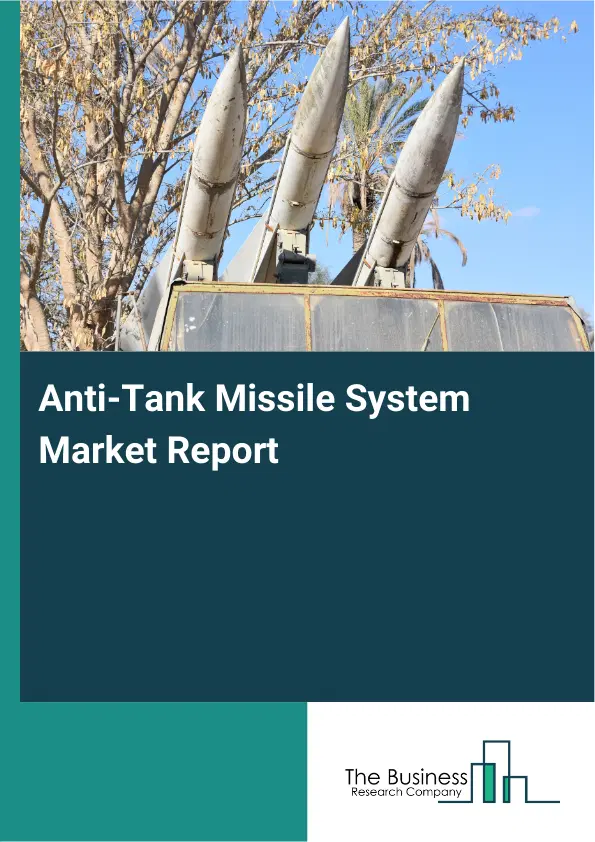
The anti-tank missile system comprises a controlled missile system designed to destroy tankers and other armored vehicles in close combat. It combines the advantages of extensive, crew-operated guided missile systems with the simplicity of light anti-armor weapons. The main types of anti-tank missile systems are man-portable and vehicle-mounted. Airborne refers to something that is done or being in the air, transported by air, wind, or an aircraft. The airborne mobility anti-tank reserve, tasked with destroying a concentration of AFU troops, moved quickly into the area to examine and destroy the objectives. The anti-tank missile systems are of airborne and ground-based platforms, applied in defense, homeland security, and others.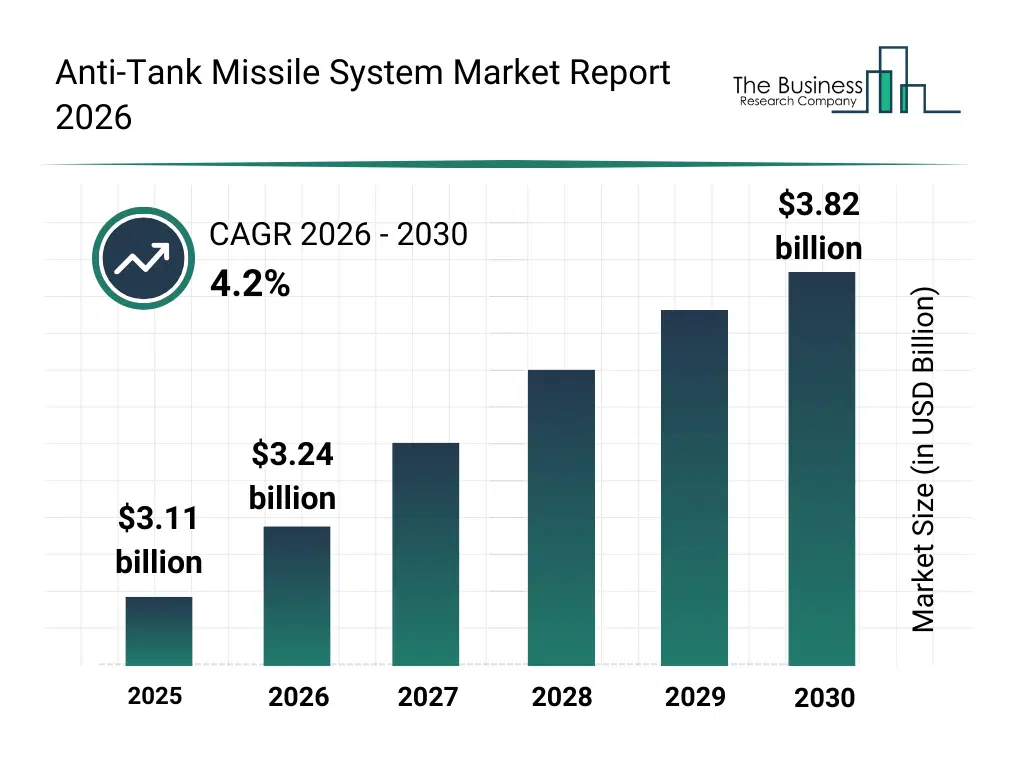
What Is The Anti-Tank Missile System Market Size and Share 2026?
The anti-tank missile system market size has grown steadily in recent years. It will grow from $3.11 billion in 2025 to $3.24 billion in 2026 at a compound annual growth rate (CAGR) of 4.3%. The growth in the historic period can be attributed to growing adoption of anti-tank missile systems to counter advancing armored threats, early development of semi-automatic and automatic guidance technologies to improve strike accuracy, rising integration of composite and explosive reactive armor to enhance missile survivability, expansion of military modernization programs driving procurement of advanced anti-armor systems, increasing use of jammers and countermeasures necessitating improved missile flight and warhead capabilities.What Is The Anti-Tank Missile System Market Growth Forecast?
The anti-tank missile system market size is expected to see steady growth in the next few years. It will grow to $3.82 billion in 2030 at a compound annual growth rate (CAGR) of 4.2%. The growth in the forecast period can be attributed to growing demand for next-generation guided missile systems with longer range and higher penetration capability, increasing integration of advanced seekers and autonomous guidance technologies, rising investment in lightweight and portable missile systems for infantry deployment, expansion of defense budgets globally driving procurement of modern anti-tank solutions, technological advancements enabling improved lethality, reduced collateral damage, and enhanced targeting precision. Major trends in the forecast period include rising adoption of man-portable anti-tank missile systems, integration of advanced guidance and targeting technologies, increased deployment of vehicle-mounted missile platforms, growth in semi-automatic and automatic anti-tank systems, expansion of anti-tank missile use in homeland security and border defense.
Global Anti-Tank Missile System Market Segmentation
1) By Type: Man-Portable, Vehicle-Mounted 2) By Platform: Airborne, Ground-Based 3) By Application: Defense, Homeland Security, Other Applications Subsegments: 1) By Man-Portable: Shoulder-Fired Missiles-global-market-report" target="_blank">missiles, Tripod-Mounted Systems 2) By Vehicle-Mounted: Light Armored Vehicle Systems, Main Battle Tank Systems, Wheeled Vehicle SystemsWhat Is Driver Of The Anti-Tank Missile System Market?
The increasing defense expenditure is expected to propel the growth of the anti-tank missile system market going forward. Defense expenditure refers to the total amount of financial resources dedicated by a state to raising and maintaining its armed forces and other methods essential for defense purposes. Defense expenditure plays a significant role in the adoption and sale of anti-tank missile systems, as countries with higher defense budgets are more likely to invest in advanced military capabilities, including anti-tank missile systems, to enhance their defense capabilities and deterrence. For instance, in October 2025, according to the UK Parliament's House of Commons Library, a UK-based government administration, Defence spending outlined in the 2025 Spending Review is expected to total USD 83.3 billion (£62.2 billion) in 2025/26, increasing to USD 98.2 billion (£73.5 billion) in 2028/29, which corresponds to an annual average real-terms growth rate of 3.8% over this period. Therefore, increasing defense expenditure is driving the growth of the anti-tank missile system industry.Key Players In The Global Anti-Tank Missile System Market
Major companies operating in the anti-tank missile system market are Elbit Systems Ltd., General Dynamics Corporation, Denel Dynamics, Lockheed Martin Corporation, MBDA Missile Systems Inc., KBP Instrument Design Bureau, Rafael Advanced Defense Systems Ltd., Raytheon Technologies Corporation, Roketsan A.S., BAE Systems, Saab AB, Israeli Military Industries Ltd, Northrop Grumman, EuroSpike GmbH, Thales Group, Bharat Dynamics Limited, Diehl Defence GmbH & Co. KG, Leonardo S.p.A., Nexter Systems, Norinco Group Corporation, Rostec State Corporation, Samsung Techwin Co. Ltd., Korea Aerospace Industries Co. Ltd., Aselsan A.S., Otokar Otomotiv ve Savunma Sanayi A.S., CZG - Ceská zbrojovka Group SE, Nammo AS, Hirtenberger Defence Systems GmbH, Mectron S.p.A., Eurosam S.A.S.
This chart is for illustrative purposes; the full report includes a detailed competitor analysis and comprehensive overview of the top 10 companies in the market.
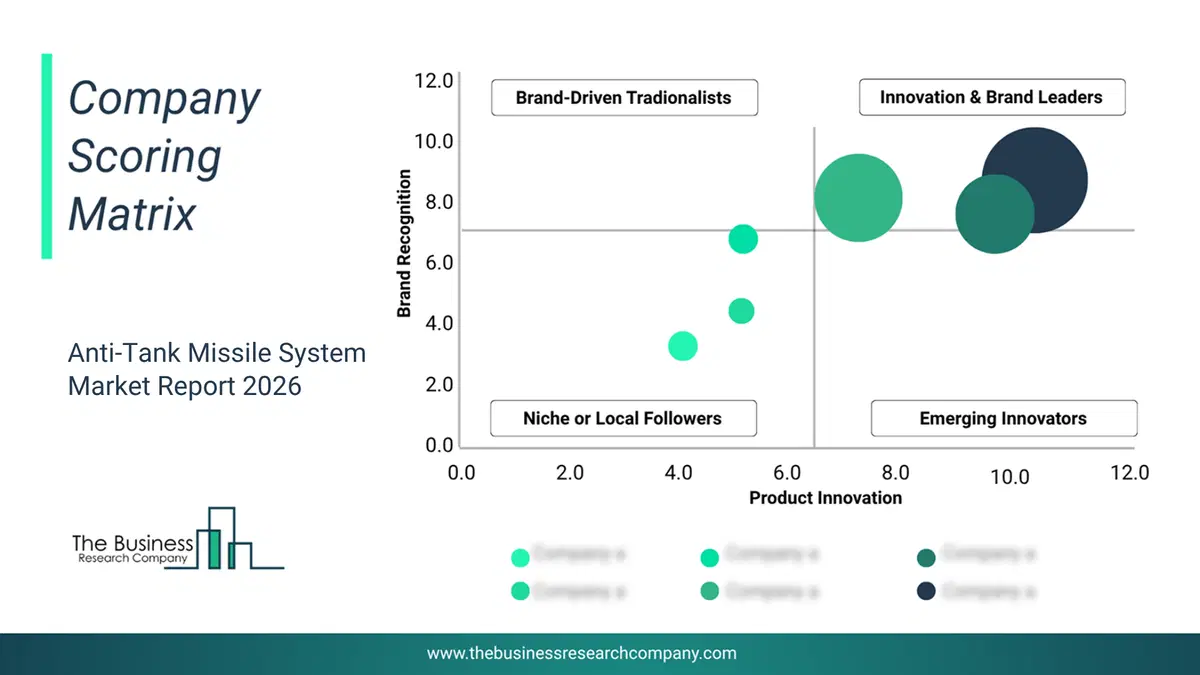
This chart maps companies by product innovation and brand strength, with bubble size indicating relative revenue, helping identify market leaders, challengers, and niche players. This is an illustrative chart; the full report provides a complete and accurate competitive analysis.
Global Anti-Tank Missile System Market Trends and Insights
Major organizations operating in the anti-tank missile system market are focused on testing anti-tank missile systems and solutions to bolster their defense capabilities and gain a competitive edge in the defense sector. Flight testing aims to determine the effects of the human element on the flight and to distinguish between the gunner's aiming error and errors inherent in the weapon. Flight testing is necessary because anti-tank guided missiles have guided flight with a human element in the guidance link, unlike free-flight ballistic trajectories. For instance, in August 2024, the Defense Research and Development Organization (DRDO), an India-based government agency, and the Indian Air Force (IAF), an India-based armed force tested portable anti-tank missiles. The anti-tank missile system is designed to provide ground forces with an effective means of engaging and neutralizing armored threats in various combat environments. This system integrates advanced guidance technologies, allowing for enhanced accuracy and reduced collateral damage.What Are Latest Mergers And Acquisitions In The Anti-Tank Missile System Market? Malaysian Ministry Of Defense Enhances Army Capabilities With Acquisition Of KaraOK-Guided Anti-Tank Missile Systems From Roketsan
In October 2023, the Malaysian Ministry of Defense (MINDEF), a Malaysia-based government ministry, acquired KaraOK-guided anti-tank missile systems from Roketsan for an undisclosed amount. This acquisition is expected to strengthen the capabilities of the Malaysian Army. The arrangement guarantees that the Malaysian Army will receive eighteen medium-range guided anti-tank missile systems (ATGM). Experts surmise that the Malaysian Army has been using these new technologies to replace the antiquated Metis-M equipment for the past 20 years. Roketsan is a Turkey-based defense contractor company that manufactures anti-tank missile systems.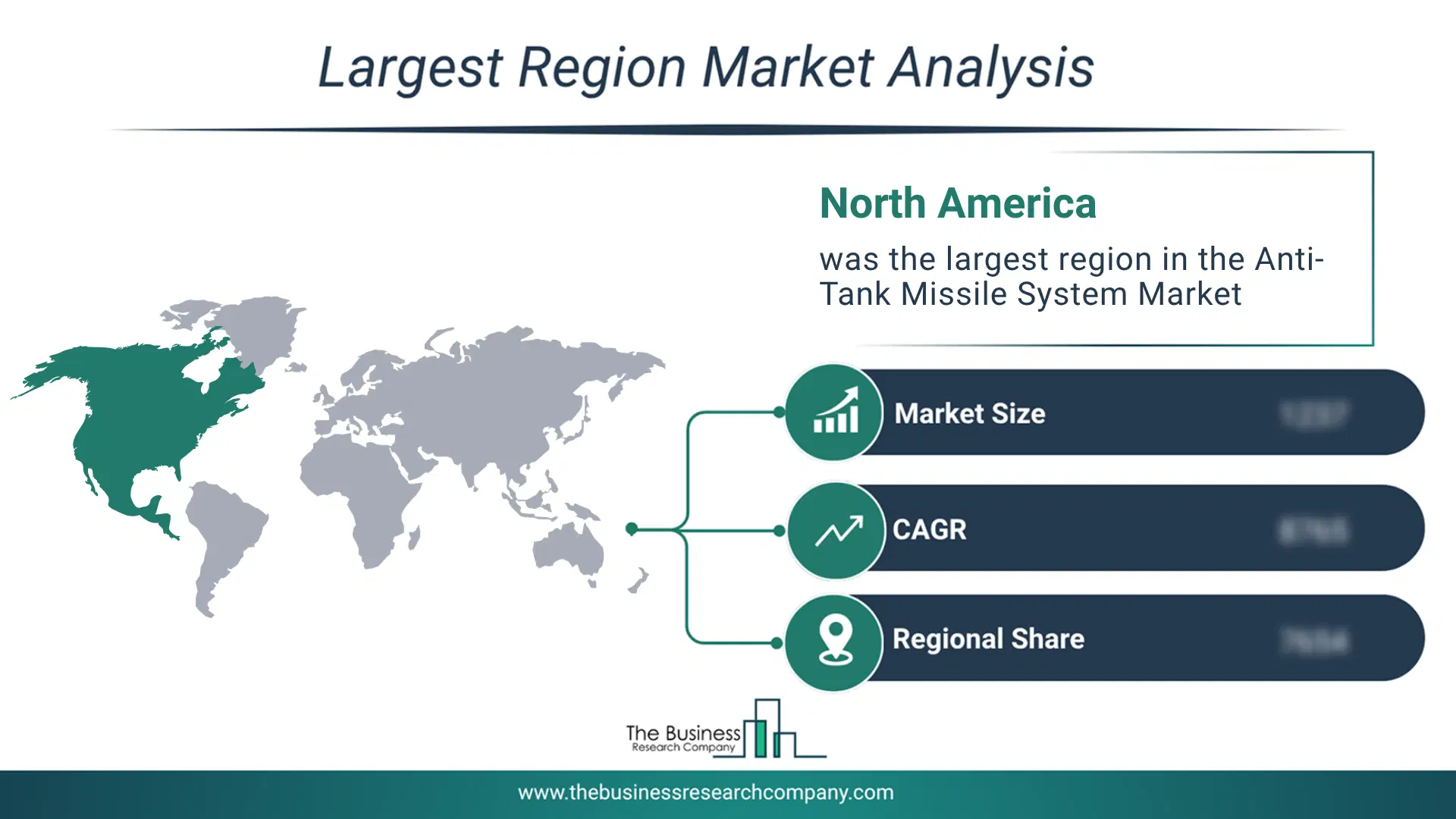
Regional Insights
North America was the largest region in the anti-tank missile system market in 2025. The regions covered in this market report are Asia-Pacific, South East Asia, Western Europe, Eastern Europe, North America, South America, Middle East, Africa. The countries covered in this market report are Australia, Brazil, China, France, Germany, India, Indonesia, Japan, Taiwan, Russia, South Korea, UK, USA, Canada, Italy, SpainWhat Defines the Anti-Tank Missile System Market?
The anti-tank missile system consists of sales of composite or explosive reactive armor, jammers, semi-automatic, and automatic anti-tank missile systems, guidance system, flight system, engine and warhead. Values in this market are ‘factory gate’ values, that is the value of goods sold by the manufacturers or creators of the goods, whether to other entities (including downstream manufacturers, wholesalers, distributors, and retailers) or directly to end customers. The value of goods in this market includes related services sold by the creators of the goods.How is Market Value Defined and Measured?
The market value is defined as the revenues that enterprises gain from the sale of goods and/or services within the specified market and geography through sales, grants, or donations in terms of the currency (in USD unless otherwise specified). The revenues for a specified geography are consumption values that are revenues generated by organizations in the specified geography within the market, irrespective of where they are produced. It does not include revenues from resales along the supply chain, either further along the supply chain or as part of other products.
This chart presents market attractiveness based on a quantitative evaluation of growth, competition, strategic alignment, and risk, offering a clear view of opportunity areas for decision-making. This chart is for illustrative purposes; the full report contains the complete analysis.

This chart highlights the Total Addressable Market (TAM) by estimating the maximum revenue opportunity using an assumption-driven approach, supporting strategic planning and opportunity sizing across markets. The chart is illustrative; the full report provides a more comprehensive analysis.
What Key Data and Analysis Are Included in the Anti-Tank Missile System Market Report 2026?
The anti-tank missile system market research report is one of a series of new reports from The Business Research Company that provides market statistics, including industry global market size, regional shares, competitors with the market share, detailed market segments, market trends and opportunities, and any further data you may need to thrive in the anti-tank missile system industry. The market research report delivers a complete perspective of everything you need, with an in-depth analysis of the current and future state of the industry.Anti-Tank Missile System Market Report Forecast Analysis
| Report Attribute | Details |
|---|---|
| Market Size Value In 2026 | $3.24 billion |
| Revenue Forecast In 2030 | $3.82 billion |
| Growth Rate | CAGR of 4.2% from 2026 to 2030 |
| Base Year For Estimation | 2025 |
| Actual Estimates/Historical Data | 2020-2025 |
| Forecast Period | 2026 - 2030 |
| Market Representation | Revenue in USD Billion and CAGR from 2026 to 2030 |
| Segments Covered | Type, Platform, Application |
| Regional Scope | Asia-Pacific, Western Europe, Eastern Europe, North America, South America, Middle East, Africa |
| Country Scope | The countries covered in the anti-tank missile system market report are Australia, Brazil, China, France, Germany, India, Indonesia, Japan, Taiwan, Russia, South Korea, UK, USA, Canada, Italy, Spain |
| Key Companies Profiled | Elbit Systems Ltd., General Dynamics Corporation, Denel Dynamics, Lockheed Martin Corporation, MBDA Missile Systems Inc., KBP Instrument Design Bureau, Rafael Advanced Defense Systems Ltd., Raytheon Technologies Corporation, Roketsan A.Ş., BAE Systems, Saab AB, Israeli Military Industries Ltd, Northrop Grumman, EuroSpike GmbH, Thales Group, Bharat Dynamics Limited, Diehl Defence GmbH & Co. KG, Leonardo S.p.A., Nexter Systems, Norinco Group Corporation, Rostec State Corporation, Samsung Techwin Co. Ltd., Korea Aerospace Industries Co. Ltd., Aselsan A.Ş., Otokar Otomotiv ve Savunma Sanayi A.Ş., CZG - Česká zbrojovka Group SE, Nammo AS, Hirtenberger Defence Systems GmbH, Mectron S.p.A., Eurosam S.A.S. |
| Customization Scope | Request for Customization |
| Pricing And Purchase Options | Explore Purchase Options |