
Anti Umanned Aerial Vehicle (UAV) Defense System Market Report 2026
Global Outlook – By Type (Portable, Vehicle Mounted), By Technology (High Energy Laser Systems, Directed Energy Weapons, Electromagnetic Pulse Systems, Radio Frequency Jammers, Traditional Kinetic Interceptors), By Platform (Land-Based Systems, Naval Systems, Airborne Systems, Portable Systems, Vehicle-Mounted Systems), By Application (Military, Homeland Security, Critical Infrastructure Protection, Commercial Facilities), By End User (Government Agencies, Military Organizations, Law Enforcement Agencies, Private Security Firms) – Market Size, Trends, Strategies, and Forecast to 2030
Anti Umanned Aerial Vehicle (UAV) Defense System Market Overview
• Anti Umanned Aerial Vehicle (UAV) Defense System market size has reached to $2.64 billion in 2025 • Expected to grow to $5.08 billion in 2030 at a compound annual growth rate (CAGR) of 14% • Growth Driver: Increasing Security Breaches Driving Demand For Market Due To Rising Unauthorized Drone Threats • Market Trend: Advancements In Counter-UAV Technologies Through Innovation And Strategic Deployments • North America was the largest region in 2025 and Asia-Pacific is the fastest growing region.What Is Covered Under Anti Umanned Aerial Vehicle (UAV) Defense System Market?
An anti unmanned aerial vehicle (UAV) defense system is a technology-based solution designed to detect, track, and neutralize unauthorized or hostile unmanned aerial vehicles using methods such as radio frequency jamming, signal interception, kinetic strikes, or directed energy weapons to protect airspace, critical infrastructure, and military assets. The main types of anti unmanned aerial vehicle (UAV) defense systems include portable and vehicle-mounted. A portable system is a mobile, easy-to-deploy technology designed to detect, track, and neutralize unauthorized or hostile drones. The technology includes such as high-energy laser systems, directed energy weapons, electromagnetic pulse systems, radio frequency jammers, and traditional kinetic interceptors across various platforms such as land-based systems, naval systems, airborne systems, portable systems, and vehicle-mounted systems. The applications of these defense systems span military operations, homeland security, critical infrastructure protection, and commercial facilities and are utilized by end users such as government agencies, military organizations, law enforcement agencies, and private security firms.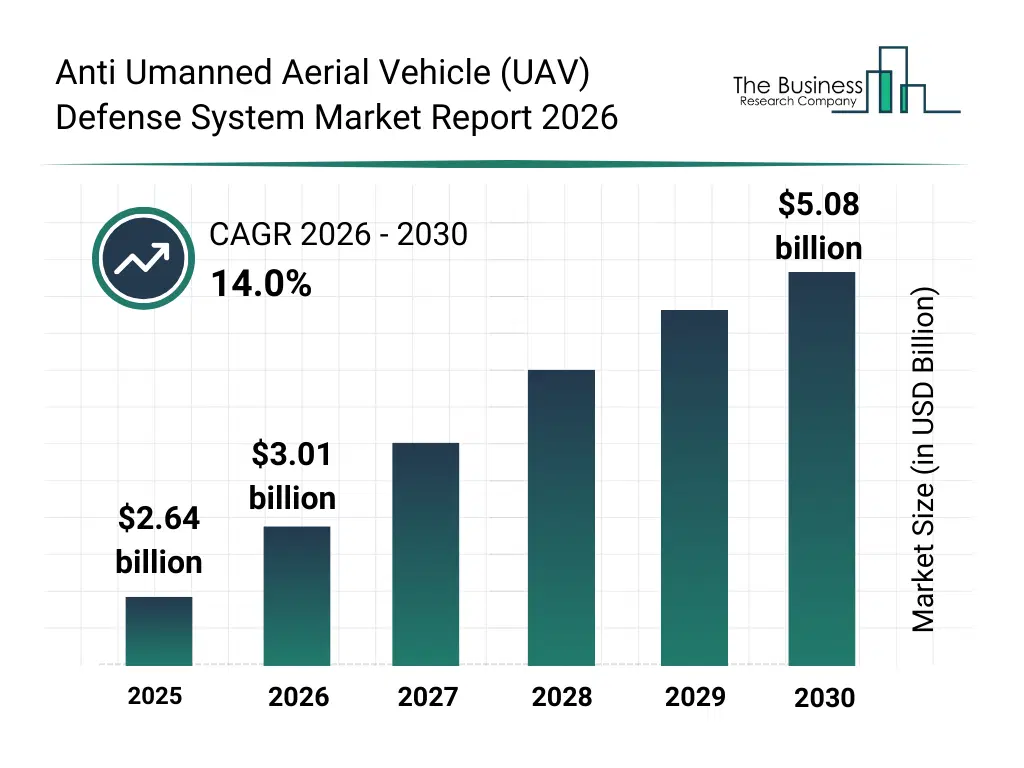
What Is The Anti Umanned Aerial Vehicle (UAV) Defense System Market Size and Share 2026?
The anti umanned aerial vehicle (UAV) defense system market size has grown rapidly in recent years. It will grow from $2.64 billion in 2025 to $3.01 billion in 2026 at a compound annual growth rate (CAGR) of 14.0%. The growth in the historic period can be attributed to increasing deployment of radar-based anti-UAV systems for early threat detection, adoption of radio frequency (RF) jamming devices to neutralize hostile drones, development of electro-optical and infrared sensors for target tracking, rising use of acoustic sensors for UAV identification, implementation of kinetic interceptors for physical threat mitigation.What Is The Anti Umanned Aerial Vehicle (UAV) Defense System Market Growth Forecast?
The anti umanned aerial vehicle (UAV) defense system market size is expected to see rapid growth in the next few years. It will grow to $5.08 billion in 2030 at a compound annual growth rate (CAGR) of 14.0%. The growth in the forecast period can be attributed to growing demand for multisensor fusion systems integrating radar, RF, and optical technologies, expansion of directed energy-based anti-UAV solutions, rising adoption of AI-driven autonomous threat detection and response, increasing procurement for critical infrastructure and military airspace protection, focus on modular and scalable anti-UAV systems for flexible deployment. Major trends in the forecast period include proliferation of counter-uav demand due to rising drone threats, increased defense spending on layered airspace protection, growth in long-range detection and tracking capabilities, higher adoption of multisensor fusion systems, shift toward compact, rapidly deployable neutralization units.
Global Anti Umanned Aerial Vehicle (UAV) Defense System Market Segmentation
1) By Type: Portable, Vehicle Mounted 2) By Technology: High Energy Laser Systems, Directed Energy Weapons, Electromagnetic Pulse Systems, Radio Frequency Jammers, Traditional Kinetic Interceptors 3) By Platform: Land-Based Systems, Naval Systems, Airborne Systems, Portable Systems, Vehicle-Mounted Systems 4) By Application: Military, Homeland Security, Critical Infrastructure Protection, Commercial Facilities 5) By End User: Government Agencies, Military Organizations, Law Enforcement Agencies, Private Security Firms Subsegments: 1) By Portable: Handheld Systems, Backpack Systems, Tripod-Mounted Systems 2) By Vehicle Mounted: Armored Vehicle Systems, Tactical Vehicle Systems, Light Utility Vehicle SystemsWhat Is Driver Of The Anti Umanned Aerial Vehicle (UAV) Defense System Market?
The increasing incidences of security breaches are expected to propel the growth of the anti unmanned aerial vehicle (UAV) defense system market going forward. Security breaches refer to incidents where unauthorized individuals gain access to data, networks, or systems, compromising their confidentiality, integrity, or availability. The rising security breaches are due to growing reliance on interconnected digital systems, as this expands the number of access points and vulnerabilities that cybercriminals can exploit. An anti-unmanned aerial vehicle defense system helps prevent security breaches by detecting and disabling unauthorized drones that pose threats to secure areas and critical infrastructure. For instance, in August 2024, according to ProtectUK, a UK-based government source of free counter terrorism protective security, during 2023, over 6000 incidents involving drones were reported to police. Therefore, the increasing incidences of security breaches are driving growth in the anti unmanned aerial vehicle (UAV) defense system market.Key Players In The Global Anti Umanned Aerial Vehicle (UAV) Defense System Market
Major companies operating in the anti umanned aerial vehicle (UAV) defense system market are Raytheon Technologies Corporation, The Boeing Company, Lockheed Martin Corporation, Airbus SE, Northrop Grumman Corporation, BAE Systems plc, Thales S.A., Leonardo S.p.A., Hangzhou Hikvision Digital Technology Co. Ltd., Rheinmetall AG, Battelle Memorial Institute, Elbit Systems Ltd., Israel Aerospace Industries Ltd., Saab AB, DroneShield Ltd., Echodyne Corporation, Liteye Systems Inc., Aaronia AG, DroneSense Inc., OpenWorks Engineering LLC.
This chart is for illustrative purposes; the full report includes a detailed competitor analysis and comprehensive overview of the top 10 companies in the market.
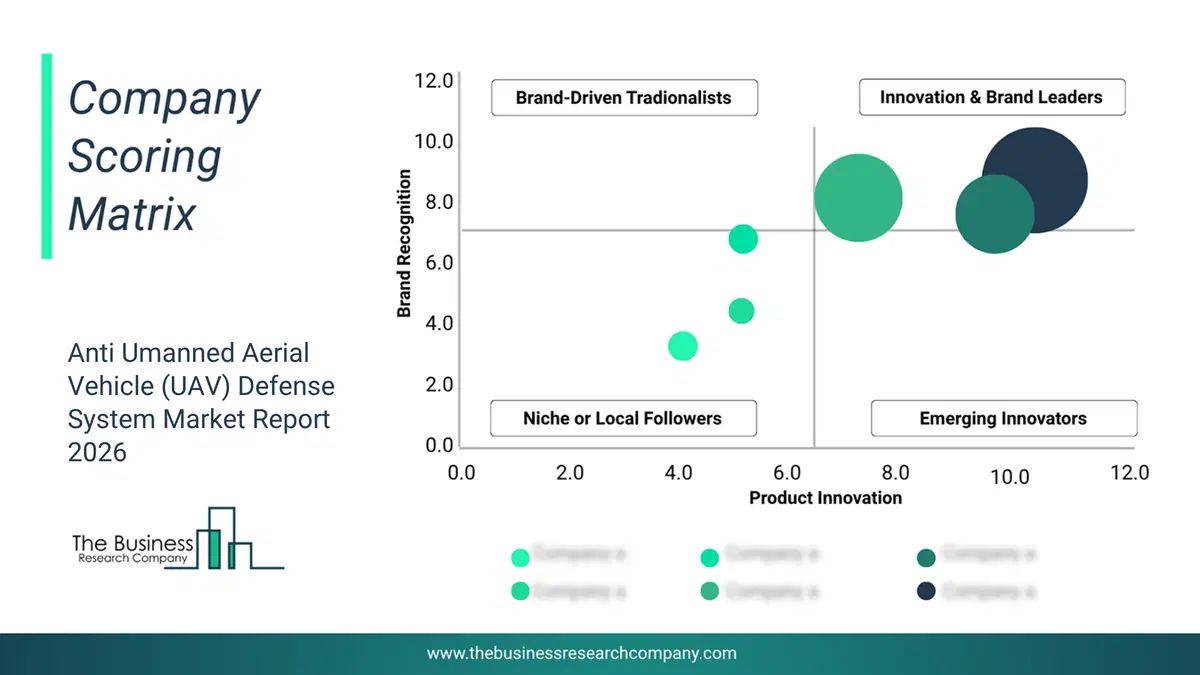
This chart maps companies by product innovation and brand strength, with bubble size indicating relative revenue, helping identify market leaders, challengers, and niche players. This is an illustrative chart; the full report provides a complete and accurate competitive analysis.
Global Anti Umanned Aerial Vehicle (UAV) Defense System Market Trends and Insights
Major companies operating in the anti-unmanned aerial vehicle (UAV) defense system market are increasingly investing in innovative solutions, including disruptive and architectural innovations, to enhance detection accuracy, improve threat classification, and enable rapid response to increasingly sophisticated unmanned aerial threats. Disruptive and architectural innovations involve fundamental advancements in technology and system design that significantly upgrade existing defense capabilities, providing more efficient, scalable, and adaptable solutions against evolving UAV threats. For instance, in March 2025, Airbus SE, a Netherlands-based aerospace and defense corporation, launched the Low Cost Air Defense (LOAD), a missile-launching drone designed for air defense, offering a cost-effective and reusable solution capable of carrying up to three guided missiles per deployment. When integrated with radar or intelligence, surveillance, and reconnaissance (ISR) systems, it enables semi-autonomous threat engagement. Built for strategic versatility, LOAD is free from international traffic in arms regulations (ITAR) and effectively addresses critical gaps in airspace defense.What Are Latest Mergers And Acquisitions In The Anti Umanned Aerial Vehicle (UAV) Defense System Market? Delair Expands Drone Capabilities With Acquisition Of Squadrone System
In October 2024, Delair, a France-based company that provides unmanned aerial vehicles (UAVs) and drone-based solutions, acquired Squadrone System for an undisclosed amount. Through this acquisition, Delair strengthens its technological capabilities and market position by integrating Squadrone System’s advanced UAV swarming and anti-drone combat technologies, accelerating its dual development strategy to balance civil and military drone applications and enhance competitiveness in the European and global drone sectors. Squadrone System is a France-based company that provides drone swarm technology, anti-drone combat systems, and automated industrial inspection solutions.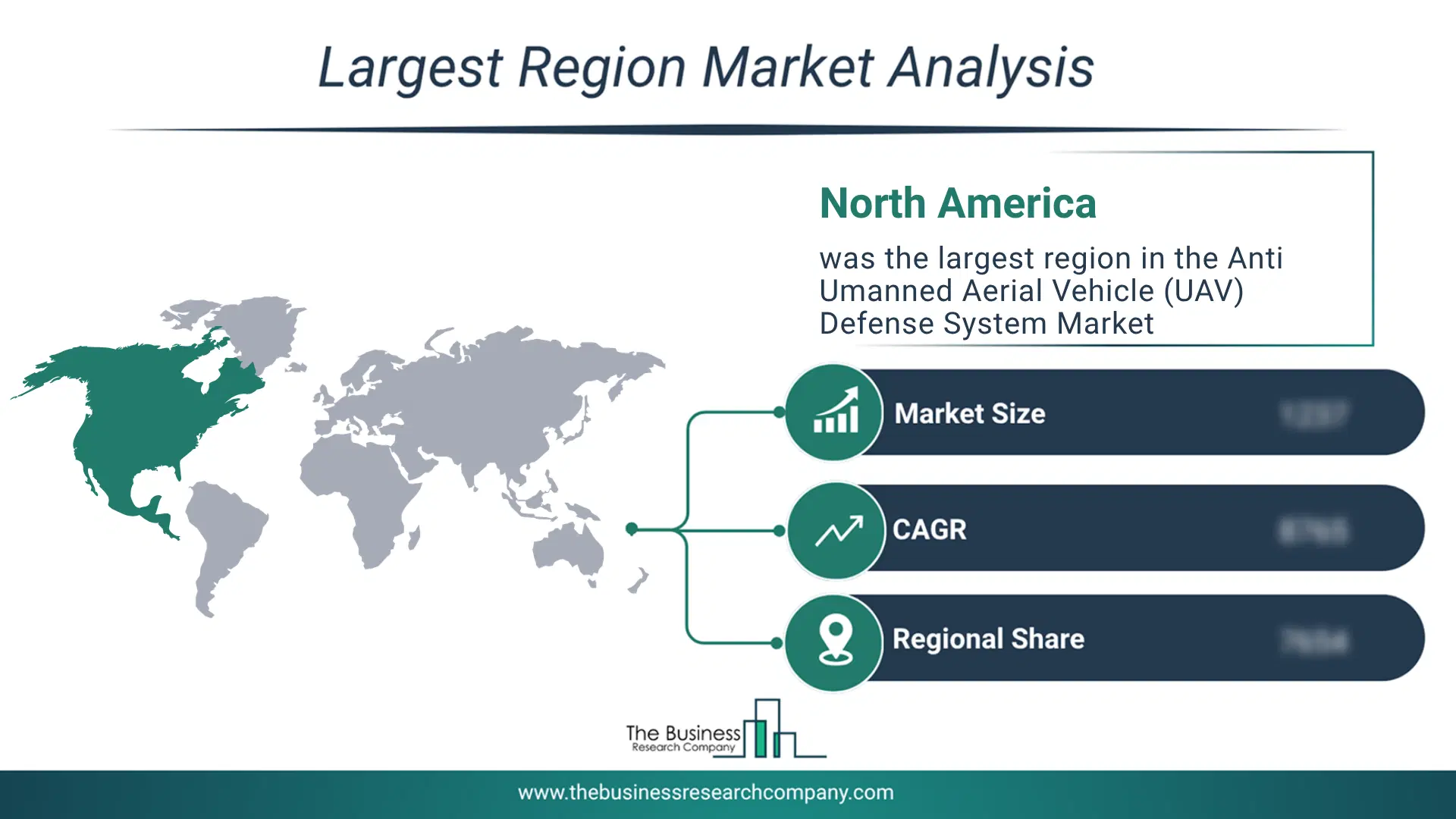
Regional Insights
North America was the largest region in the anti unmanned aerial vehicle (UAV) defense system market in 2025. Asia-Pacific is expected to be the fastest-growing region in the forecast period. The regions covered in this market report are Asia-Pacific, South East Asia, Western Europe, Eastern Europe, North America, South America, Middle East, Africa. The countries covered in this market report are Australia, Brazil, China, France, Germany, India, Indonesia, Japan, Taiwan, Russia, South Korea, UK, USA, Canada, Italy, SpainWhat Defines the Anti Umanned Aerial Vehicle (UAV) Defense System Market?
The anti unmanned aerial vehicle (UAV) defense system market consists of revenues earned by entities by providing services such as radar-based systems, radio frequency-based systems, electro-optical and infrared sensors, acoustic sensors, and multisensor fusion systems. The market value includes the value of related goods sold by the service provider or included within the service offering. The anti unmanned aerial vehicle (UAV) defense system market also includes sales of radar systems, jamming devices, electro-optical and infrared cameras, and kinetic interceptors. Values in this market are ‘factory gate’ values, that is, the value of goods sold by the manufacturers or creators of the goods, whether to other entities (including downstream manufacturers, wholesalers, distributors, and retailers) or directly to end customers. The value of goods in this market includes related services sold by the creators of the goods.How is Market Value Defined and Measured?
The market value is defined as the revenues that enterprises gain from the sale of goods and/or services within the specified market and geography through sales, grants, or donations in terms of the currency (in USD unless otherwise specified). The revenues for a specified geography are consumption values that are revenues generated by organizations in the specified geography within the market, irrespective of where they are produced. It does not include revenues from resales along the supply chain, either further along the supply chain or as part of other products.
This chart presents market attractiveness based on a quantitative evaluation of growth, competition, strategic alignment, and risk, offering a clear view of opportunity areas for decision-making. This chart is for illustrative purposes; the full report contains the complete analysis.

This chart highlights the Total Addressable Market (TAM) by estimating the maximum revenue opportunity using an assumption-driven approach, supporting strategic planning and opportunity sizing across markets. The chart is illustrative; the full report provides a more comprehensive analysis.
What Key Data and Analysis Are Included in the Anti Umanned Aerial Vehicle (UAV) Defense System Market Report 2026?
The anti umanned aerial vehicle (uav) defense system market research report is one of a series of new reports from The Business Research Company that provides market statistics, including industry global market size, regional shares, competitors with the market share, detailed market segments, market trends and opportunities, and any further data you may need to thrive in the anti umanned aerial vehicle (uav) defense system industry. The market research report delivers a complete perspective of everything you need, with an in-depth analysis of the current and future state of the industry.Anti Umanned Aerial Vehicle (UAV) Defense System Market Report Forecast Analysis
| Report Attribute | Details |
|---|---|
| Market Size Value In 2026 | $3.01 billion |
| Revenue Forecast In 2030 | $5.08 billion |
| Growth Rate | CAGR of 14% from 2026 to 2030 |
| Base Year For Estimation | 2025 |
| Actual Estimates/Historical Data | 2020-2025 |
| Forecast Period | 2026 - 2030 |
| Market Representation | Revenue in USD Billion and CAGR from 2026 to 2030 |
| Segments Covered | Type, Technology, Platform, Application, End User |
| Regional Scope | Asia-Pacific, Western Europe, Eastern Europe, North America, South America, Middle East, Africa |
| Country Scope | The countries covered in the anti umanned aerial vehicle (uav) defense system market report are Australia, Brazil, China, France, Germany, India, Indonesia, Japan, Taiwan, Russia, South Korea, UK, USA, Canada, Italy, Spain |
| Key Companies Profiled | Raytheon Technologies Corporation, The Boeing Company, Lockheed Martin Corporation, Airbus SE, Northrop Grumman Corporation, BAE Systems plc, Thales S.A., Leonardo S.p.A., Hangzhou Hikvision Digital Technology Co. Ltd., Rheinmetall AG, Battelle Memorial Institute, Elbit Systems Ltd., Israel Aerospace Industries Ltd., Saab AB, DroneShield Ltd., Echodyne Corporation, Liteye Systems Inc., Aaronia AG, DroneSense Inc., OpenWorks Engineering LLC. |
| Customization Scope | Request for Customization |
| Pricing And Purchase Options | Explore Purchase Options |