

Antifuse Field Programmable Gate Array Market Report 2026
Global Outlook – By Type (One-Time Programmable (OTP) Antifuse Field-Programmable Gate Array (FPGA), Radiation-Hardened (Rad-Hard) Antifuse Field-Programmable Gate Array (FPGA), Standard Antifuse Field-Programmable Gate Array (FPGA) ), By Technology (High-Density Antifuse, Low-Power Antifuse, Radiation-Hardened Antifuse, Ultra-Low Power Antifuse ), By Node Size (Less Than 28 NM, 28–90 NM, More Than 90 NM ), By Application (Aerospace, Telecommunications, Consumer Electronics, Automotive, Medical Devices ), By End User (Industrial, Commercial, Government, Research And Development ) – Market Size, Trends, Strategies, and Forecast to 2030
Antifuse Field Programmable Gate Array Market Overview
• Antifuse Field Programmable Gate Array market size has reached to $0.97 billion in 2025 • Expected to grow to $1.42 billion in 2030 at a compound annual growth rate (CAGR) of 8.0% • Growth Driver: Expansion Of Satellite And Space Missions Driving The Market Growth Due To Increasing Demand For Reliable Radiation-Tolerant Electronics • North America was the largest region in 2025 and Asia-Pacific is the fastest growing region.What Is Covered Under Antifuse Field Programmable Gate Array Market?
Antifuse field programmable gate array (FPGA) is a programmable semiconductor device that uses antifuse technology to establish permanent electrical connections within an integrated circuit after configuration. It enables customized hardware functionality with high reliability, security, and performance by allowing designers to implement application-specific logic while providing resistance to unauthorized modifications and improved operational stability. These devices are designed for applications requiring dependable and long-term hardware configurations. The main types of antifuse field-programmable gate arrays include one-time programmable (OTP) antifuse field-programmable gate arrays (FPGAs), radiation-hardened (rad-hard) antifuse field-programmable gate arrays (FPGAs), and standard antifuse field-programmable gate arrays (FPGAs). One-time programmable (OTP) antifuse field-programmable gate arrays (FPGAs) refer to programmable semiconductor devices that permanently configure their logic connections through antifuse elements, providing reliable and tamper-resistant operation after programming. These devices use high-density antifuse, low-power antifuse, radiation-hardened antifuse, and ultra-low power antifuse technologies and are available in node sizes of less than 28 nanometers (NM), 28–90 nanometers (NM), and more than 90 nanometers (NM). The key applications include aerospace, telecommunications, consumer electronics, automotive, and medical devices, while the end users include industrial, commercial, government, and research and development.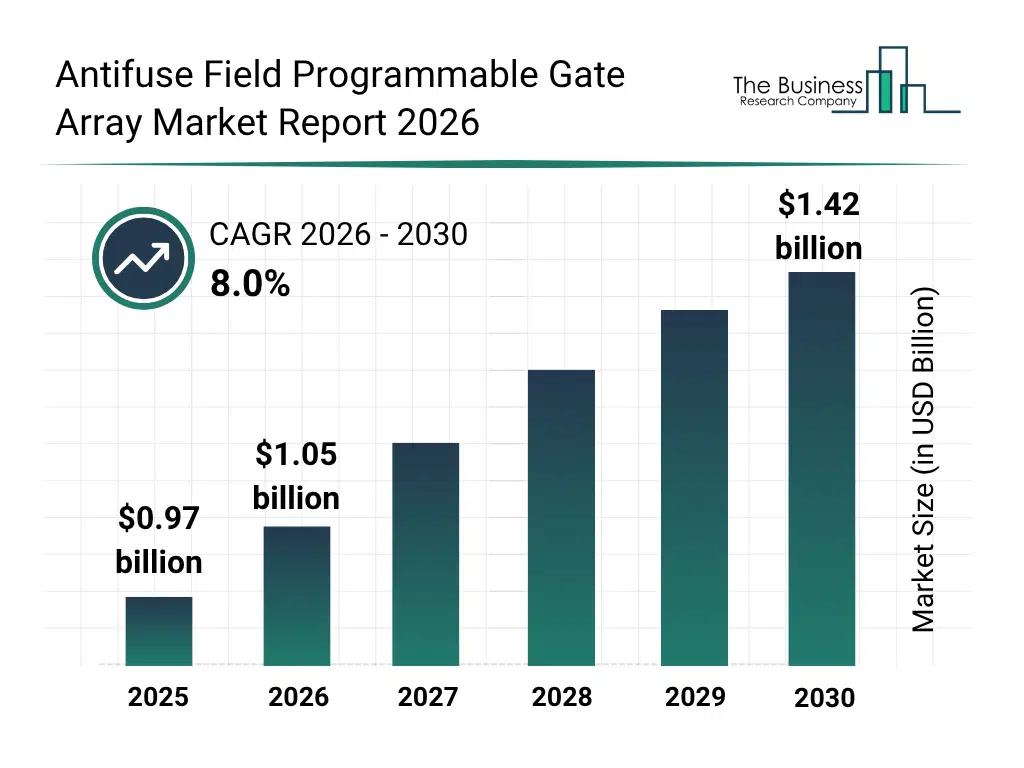
What Is The Antifuse Field Programmable Gate Array Market Size and Share 2026?
The antifuse field programmable gate array market size has grown strongly in recent years. It will grow from $0.97 billion in 2025 to $1.05 billion in 2026 at a compound annual growth rate (CAGR) of 8.4%. The growth in the historic period can be attributed to increasing demand for reliable programmable logic, rising adoption of secure semiconductor devices, growing use of customized hardware architectures, increasing demand for permanent circuit configurations, rising need for hardware security.What Is The Antifuse Field Programmable Gate Array Market Growth Forecast?
The antifuse field programmable gate array market size is expected to see strong growth in the next few years. It will grow to $1.42 billion in 2030 at a compound annual growth rate (CAGR) of 8.0%. The growth in the forecast period can be attributed to increasing demand for radiation-tolerant programmable devices, rising adoption of high-reliability FPGAs, growing demand for secure hardware in critical applications, increasing need for long-term hardware stability, rising demand for application-specific programmable logic. Major trends in the forecast period include increasing demand for permanent hardware configuration, rising adoption of high-reliability programmable logic, growing demand for secure hardware architectures, increasing need for tamper-resistant semiconductor devices, rising demand for long-term operational stability.
Global Antifuse Field Programmable Gate Array Market Segmentation
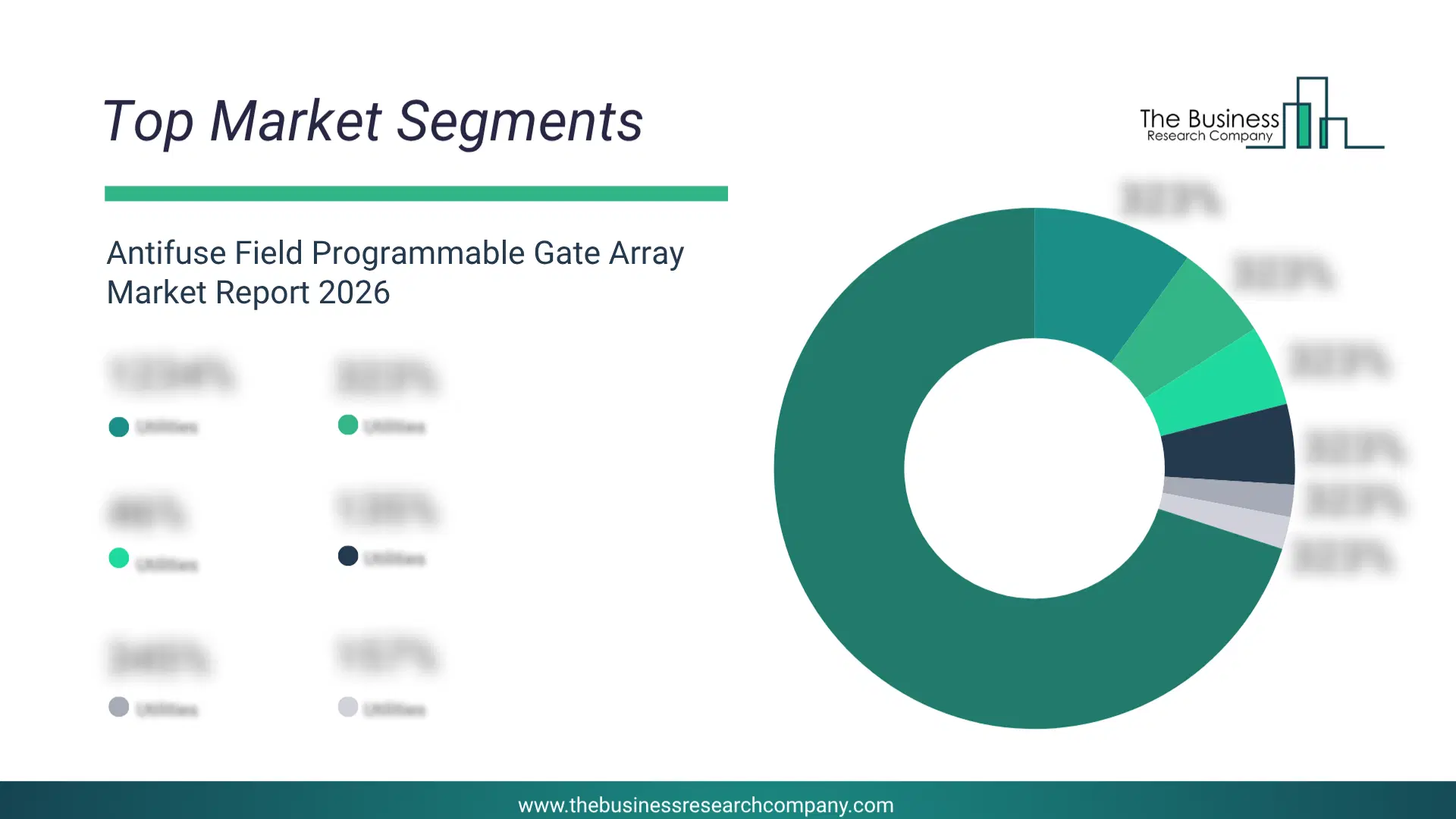
1) By Type: One-Time Programmable (OTP) Antifuse Field-Programmable Gate Array (FPGA), Radiation-Hardened (Rad-Hard) Antifuse Field-Programmable Gate Array (FPGA), Standard Antifuse Field-Programmable Gate Array (FPGA) 2) By Technology: High-Density Antifuse, Low-Power Antifuse, Radiation-Hardened Antifuse, Ultra-Low Power Antifuse 3) By Node Size: Less Than 28 NM, 28–90 NM, More Than 90 NM 4) By Application: Aerospace, Telecommunications, Consumer Electronics, Automotive, Medical Devices 5) By End User: Industrial, Commercial, Government, Research And Development Subsegments: 1) By One-Time Programmable (OTP) Antifuse Field-Programmable Gate Array (FPGA): Low Density One-Time Programmable (OTP) Antifuse Field-Programmable Gate Array (FPGA), High Density One-Time Programmable (OTP) Antifuse Field-Programmable Gate Array (FPGA), Secure One-Time Programmable (OTP) Antifuse Field-Programmable Gate Array (FPGA), Radiation-Tolerant One-Time Programmable (OTP) Antifuse Field-Programmable Gate Array (FPGA) 2) By Radiation-Hardened (Rad-Hard) Antifuse Field-Programmable Gate Array (FPGA): Space-Grade Radiation-Hardened Antifuse Field-Programmable Gate Array (FPGA), Military-Grade Radiation-Hardened Antifuse Field-Programmable Gate Array (FPGA), High Reliability Radiation-Hardened Antifuse Field-Programmable Gate Array (FPGA), Radiation Resistant Antifuse Field-Programmable Gate Array (FPGA) 3) By Standard Antifuse Field-Programmable Gate Array (FPGA): Low Power Standard Antifuse Field-Programmable Gate Array (FPGA), High Performance Standard Antifuse Field-Programmable Gate Array (FPGA), High Density Standard Antifuse Field-Programmable Gate Array (FPGA), General Purpose Standard Antifuse Field-Programmable Gate Array (FPGA)What Are The Drivers Of The Antifuse Field Programmable Gate Array Market?
The expansion of satellite and space missions is expected to propel the growth of the antifuse field programmable gate array (FPGA) market going forward. Satellite and space missions refer to the increasing deployment of spacecraft, satellites, and exploration programs for applications such as communication, navigation, earth observation, scientific research, and defense. Satellite and space missions are growing due to increasing investments in space exploration, as governments and private organizations are allocating more resources toward developing advanced spacecraft. Satellite and space missions drive the adoption of antifuse field programmable gate arrays (FPGAs) by requiring highly reliable, radiation-resistant, and low-power programmable semiconductor solutions that can operate efficiently in extreme space environments while enabling advanced processing, control, and communication capabilities in satellites and spacecraft. For instance, in January 2025, according to the report published by Space Foundation, a US-based non-profit organization, orbital launch attempts increased 16% in 2024, with 259 launches occurring at an average of one every 34 hours, five hours more frequent than in 2023. Therefore, the expansion of satellite and space missions is driving the growth of the antifuse field programmable gate array (FPGA) market. The rising cybersecurity threats is expected to propel the growth of the antifuse field programmable gate array market going forward. Cybersecurity threats refer to malicious activities such as unauthorized access, data breaches, ransomware attacks, and system disruptions that target digital systems, networks, and connected devices to compromise confidentiality, integrity, or availability of data and operations. Cybersecurity threats are increasing due to the rapid expansion of connected industrial systems, which expands the attack surface across operational technology environments. Cybersecurity threats support the growth of antifuse field programmable gate array (FPGA) adoption by increasing demand for tamper-resistant, secure hardware solutions that prevent unauthorized reprogramming, reverse engineering, and malicious modifications in critical systems. For instance, in November 2024, according to the Australian Signals Directorate, an Australia-based government agency, it reported over 36,700 calls to its Australian Cyber Security Hotline in FY2023–24, marking a 12% increase from the previous financial year, and noted that over 11% of the cyber security incidents it responded to were linked to critical infrastructure. Therefore, the rising cybersecurity threats is driving the growth of the antifuse field programmable gate array industry. The increasing investments in defense modernization programs are expected to propel the growth of the antifuse field programmable gate array (FPGA) market going forward. Defense modernization programs refer to government initiatives focused on upgrading military capabilities through the adoption of advanced technologies, including secure communication systems, electronic warfare platforms, radar systems, and aerospace electronics. Investments in defense modernization are rising due to growing geopolitical tensions, as countries are strengthening their military capabilities, upgrading defense infrastructure, and adopting advanced technologies to address emerging security threats and maintain strategic readiness. Investments in defense modernization programs support the adoption of antifuse field programmable gate arrays (FPGAs) by enabling the development of high-performance, radiation-resistant, and highly reliable semiconductor solutions used in mission-critical defense applications such as satellites, avionics, missile systems, and secure communication equipment. For instance, in March 2024, according to the Department of Defense, a US-based government department, the FY 2024 budget continued the department’s efforts to modernize and innovate defense capabilities, including an allocation of $145.0 billion for Research, Development, Test, and Evaluation (RDT&E), representing a 4.0% increase over the FY 2023 enacted level. Therefore, the increasing investments in defense modernization programs are driving the growth of the antifuse field programmable gate array (FPGA) market.Key Players In The Global Antifuse Field Programmable Gate Array Market
Major companies operating in the antifuse field programmable gate array market are BAE Systems plc, Honeywell International Inc., Microchip Technology Incorporated, Teledyne Technologies Incorporated, QuickLogic Corporation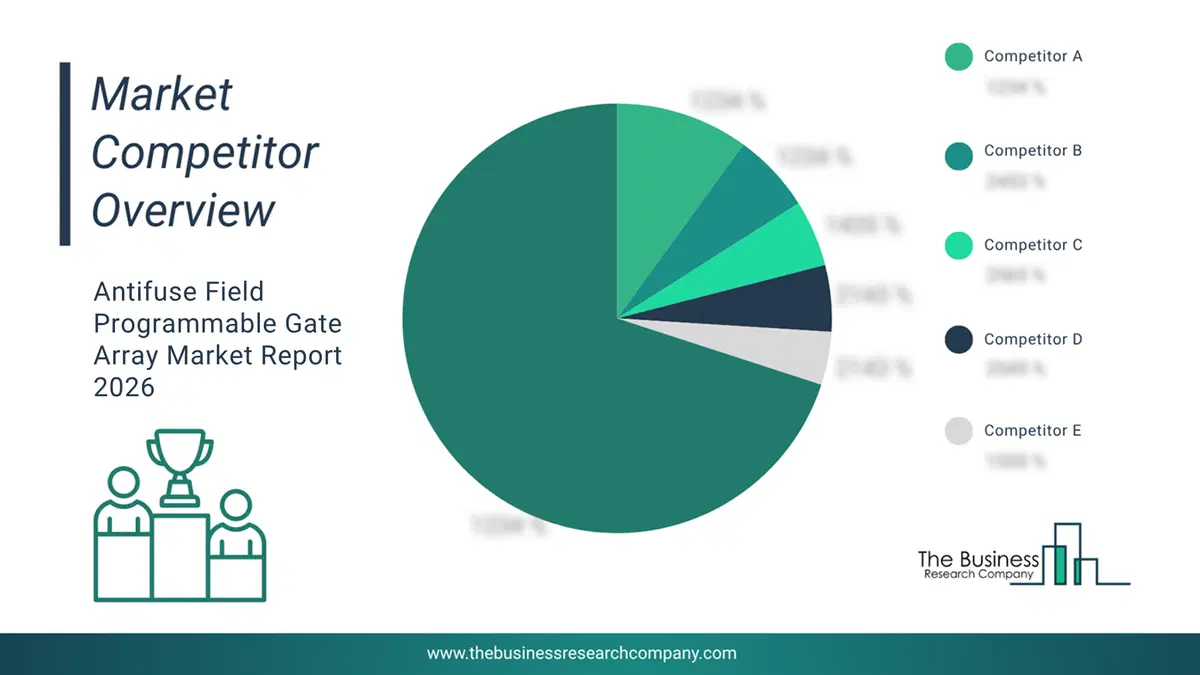
This chart is for illustrative purposes; the full report includes a detailed competitor analysis and comprehensive overview of the top 10 companies in the market.
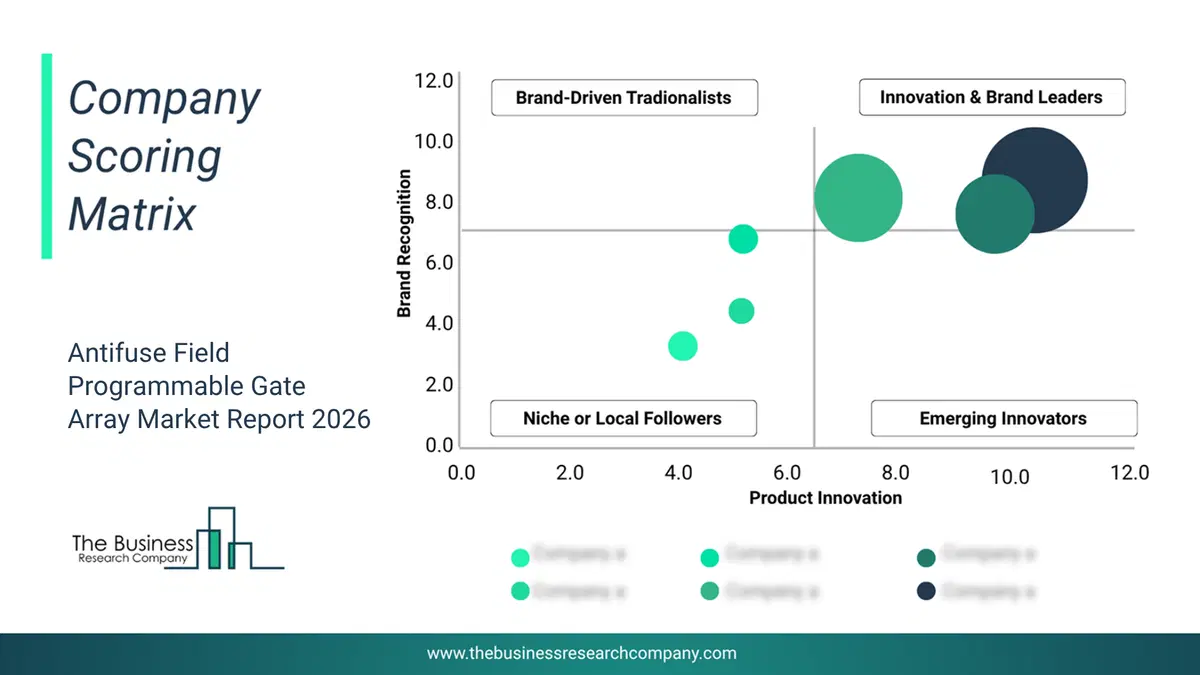
This chart maps companies by product innovation and brand strength, with bubble size indicating relative revenue, helping identify market leaders, challengers, and niche players. This is an illustrative chart; the full report provides a complete and accurate competitive analysis.
Regional Insights
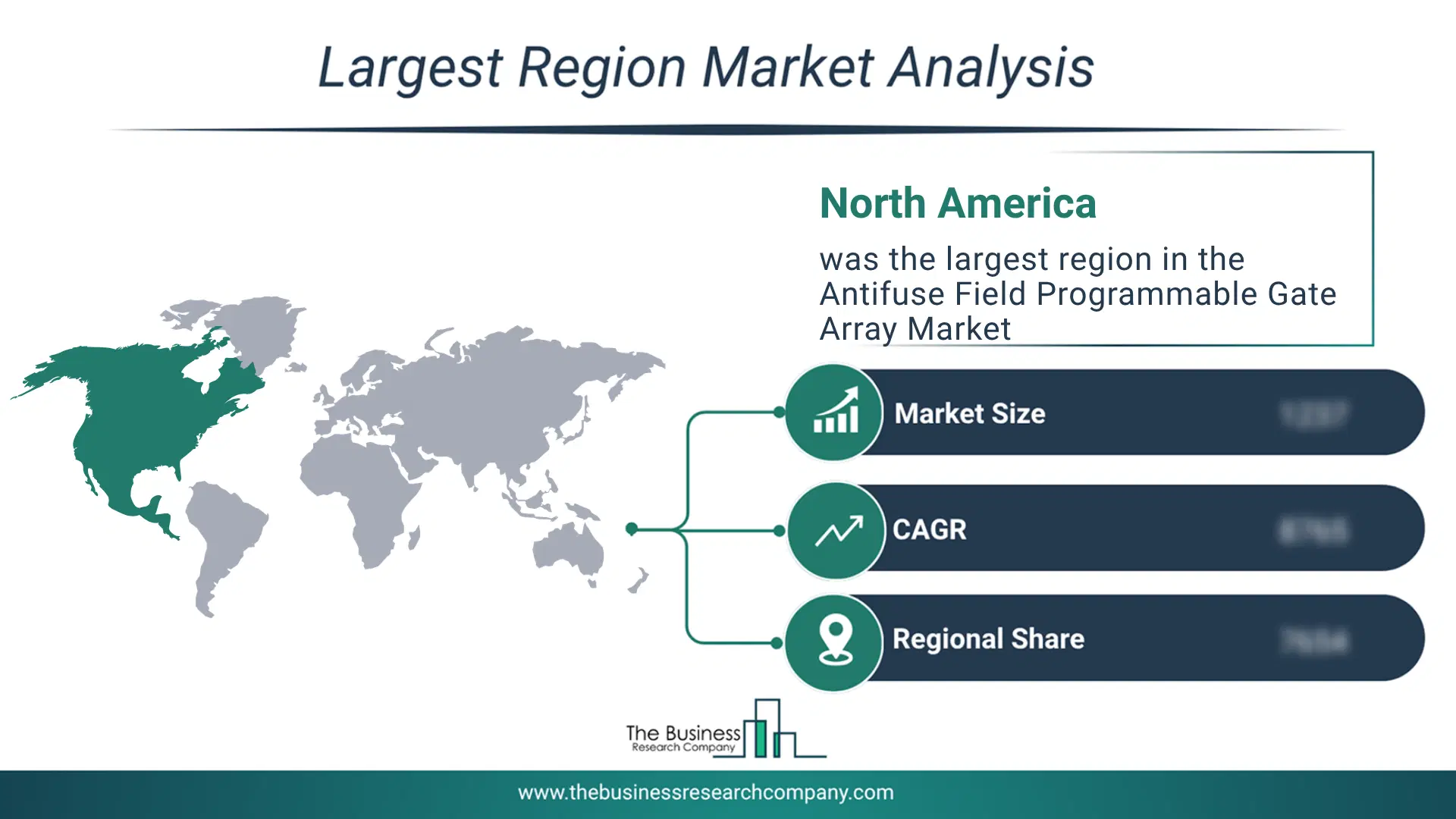
North America was the largest region in the antifuse field programmable gate array market in 2025. Asia-Pacific is expected to be the fastest-growing region in the forecast period. The regions covered in this market report are Asia-Pacific, South East Asia, Western Europe, Eastern Europe, North America, South America, Middle East, Africa. The countries covered in this market report are Australia, Brazil, China, France, Germany, India, Indonesia, Japan, Taiwan, Russia, South Korea, UK, USA, Canada, Italy, Spain.What Defines the Antifuse Field Programmable Gate Array Market?
The antifuse field programmable gate array market consists of sales of antifuse FPGA devices, programmable logic devices, FPGA development boards, semiconductor integrated circuits, and configurable logic components. Values in this market are ‘factory gate’ values, that is, the value of goods sold by the manufacturers or creators of the goods, whether to other entities (including downstream manufacturers, wholesalers, distributors, and retailers) or directly to end customers. The value of goods in this market includes related services sold by the creators of the goods.How is Market Value Defined and Measured?
The market value is defined as the revenues that enterprises gain from the sale of goods and/or services within the specified market and geography through sales, grants, or donations in terms of the currency (in USD unless otherwise specified). The revenues for a specified geography are consumption values that are revenues generated by organizations in the specified geography within the market, irrespective of where they are produced. It does not include revenues from resales along the supply chain, either further along the supply chain or as part of other products.
This chart presents market attractiveness based on a quantitative evaluation of growth, competition, strategic alignment, and risk, offering a clear view of opportunity areas for decision-making. This chart is for illustrative purposes; the full report contains the complete analysis.

This chart highlights the Total Addressable Market (TAM) by estimating the maximum revenue opportunity using an assumption-driven approach, supporting strategic planning and opportunity sizing across markets. The chart is illustrative; the full report provides a more comprehensive analysis.
What Key Data and Analysis Are Included in the Antifuse Field Programmable Gate Array Market Report 2026?
The antifuse field programmable gate array market research report is one of a series of new reports from The Business Research Company that provides market statistics, including industry global market size, regional shares, competitors with the market share, detailed market segments, market trends and opportunities, and any further data you may need to thrive in the antifuse field programmable gate array industry. The market research report delivers a complete perspective of everything you need, with an in-depth analysis of the current and future state of the industry.Antifuse Field Programmable Gate Array Market Report Forecast Analysis
| Report Attribute | Details |
|---|---|
| Market Size Value In 2026 | $1.05 billion |
| Revenue Forecast In 2030 | $1.42 billion |
| Growth Rate | CAGR of 8.0% from 2026 to 2030 |
| Base Year For Estimation | 2025 |
| Actual Estimates/Historical Data | 2020-2025 |
| Forecast Period | 2026 - 2030 |
| Market Representation | Revenue in USD Billion and CAGR from 2026 to 2030 |
| Segments Covered | Type, Technology, Node Size, Application, End User |
| Regional Scope | Asia-Pacific, Western Europe, Eastern Europe, North America, South America, Middle East, Africa |
| Country Scope | The countries covered in the report are Australia, Brazil, China, France, Germany, India, Indonesia, Japan, Taiwan, Russia, South Korea, UK, USA, Canada, Italy, Spain. |
| Key Companies Profiled | BAE Systems plc, Honeywell International Inc., Microchip Technology Incorporated, Teledyne Technologies Incorporated, QuickLogic Corporation |
| Customization Scope | Request for Customization |
| Pricing And Purchase Options | Explore Purchase Options |