
Application of Nanotechnology in the Satellite Market Report 2026
Global Outlook – By Type (Nanosatellite, Microsatellite), By Application (Scientific Research, Mapping, Signal Communication, Monitor, National Defense), By End User (Space And Defense, Commercial Aviation) – Market Size, Trends, Strategies, and Forecast to 2030
Application of Nanotechnology in the Satellite Market Overview
• Application of Nanotechnology in the Satellite market size has reached to $6.98 billion in 2025 • Expected to grow to $9.31 billion in 2030 at a compound annual growth rate (CAGR) of 5.9% • Growth Driver: Rapid Growth In The Space Industry Fuels The Application Of Nanotechnology In Satellite Market • Market Trend: Advancing Secure, High-Speed Data Transmission Through Quantum-Enabled Nanosatellite Systems • Europe was the largest region in 2025 and Asia-Pacific is the fastest growing region.What Is Covered Under Application of Nanotechnology in the Satellite Market?
Applications of nanotechnology in satellites refer to the specific applications of nanotechnology that are being used to improve satellite systems. It includes using nanoscale materials, structures, and devices in real-world applications to advance satellite technology. The main types of applications of nanotechnology in the satellite are nanosatellites and microsatellites. Nanosatellite is a particular kind of microsatellite that is much lighter and smaller than conventional satellites. The various applications include scientific research, mapping, signal communication, monitoring, and national defense, which are used by for space and defense, and commercial aviation.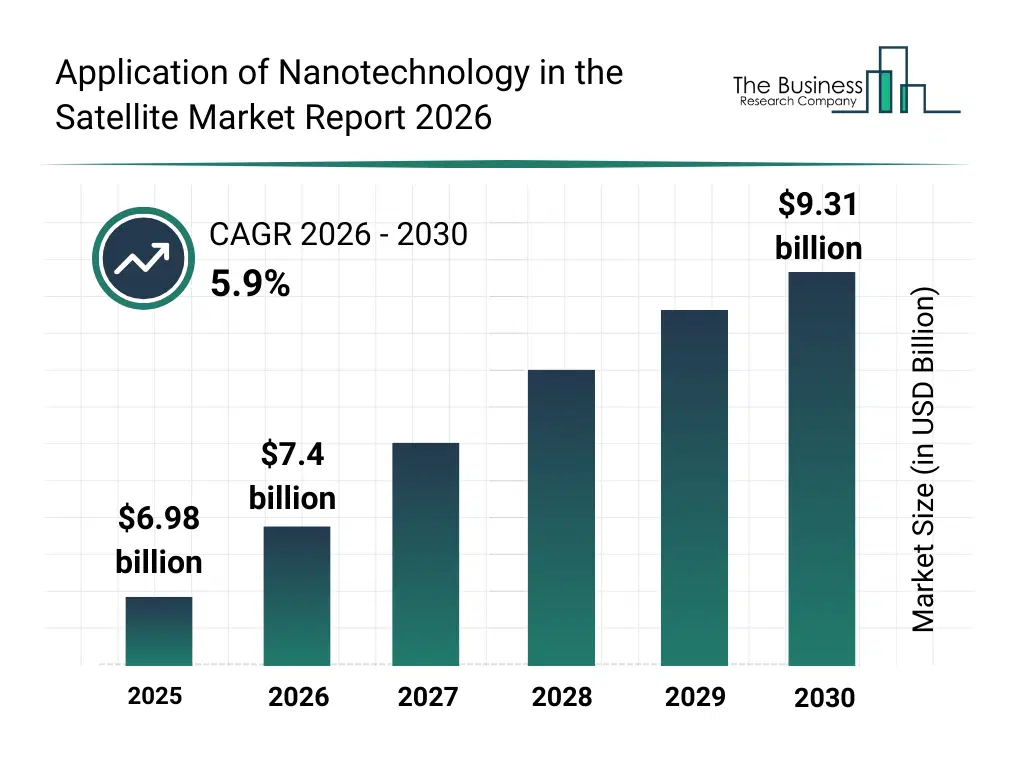
What Is The Application of Nanotechnology in the Satellite Market Size and Share 2026?
The application of nanotechnology in the satellite market size has grown strongly in recent years. It will grow from $6.98 billion in 2025 to $7.4 billion in 2026 at a compound annual growth rate (CAGR) of 6.0%. The growth in the historic period can be attributed to early integration of nanoscale materials to reduce satellite mass and improve structural efficiency, growing use of nanotechnology-enhanced sensors to improve remote sensing accuracy, rising adoption of nanomaterials to extend satellite lifespan and thermal stability, development of nanoscale components enabling miniaturized communication systems, increased deployment of satellites for earth observation and scientific research requiring advanced nanotechnology solutions.What Is The Application of Nanotechnology in the Satellite Market Growth Forecast?
The application of nanotechnology in the satellite market size is expected to see strong growth in the next few years. It will grow to $9.31 billion in 2030 at a compound annual growth rate (CAGR) of 5.9%. The growth in the forecast period can be attributed to growing demand for high-performance nanoscale devices to enhance satellite communication capabilities, increasing adoption of nanotechnology to improve navigation and positioning precision, rising investment in next-generation remote sensing platforms leveraging nanomaterial-based detectors, expansion of small satellite constellations requiring lightweight and energy-efficient nanotech components, technological advancements enabling multifunctional nanostructures for superior satellite performance. Major trends in the forecast period include miniaturization of nanoscale components for satellite payloads, advanced nanomaterial-based thermal control systems, high-durability nanocoatings for radiation and debris protection, nanotechnology-enabled propulsion efficiency enhancements, increased integration of nanostructured sensors for precision sensing.
Global Application of Nanotechnology in the Satellite Market Segmentation
1) By Type: Nanosatellite, Microsatellite 2) By Application: Scientific Research, Mapping, Signal Communication, Monitor, National Defense 3) By End User: Space And Defense, Commercial Aviation Subsegments: 1) By Nanosatellite: CubeSats, PocketQubes, Picosatellites, Nanosatellites For Specific Applications 2) By Microsatellite: Standard Microsatellites, Specialized MicrosatellitesWhat Is Driver Of The Application of Nanotechnology in the Satellite Market?
The increasing focus on space debris mitigation is expected to propel the application of nanotechnology in the satellite market. Space debris mitigation refers to the intentional efforts and strategies aimed at minimizing the creation and impact of space debris or orbital debris in Earth's orbit. Nanotechnology plays a crucial role in developing materials and coatings that can mitigate the impact of space debris on satellite surfaces, thereby extending the operational life of satellites and minimizing collision risks in orbit. For instance, in January 2023, according to a report published by the Inter-Agency Space Debris Coordination Committee, a Russia-based inter-governmental forum, the escalation in the quantity of debris items was indicated by statistical models, projecting over 30,000 space debris objects surpassing 10 cm in Earth's orbit, with approximately 900,000 objects exceeding 1 cm in size. Thus, an increasing focus on space debris mitigation will drive the application of nanotechnology in the satellite industry going forward.Key Players In The Global Application of Nanotechnology in the Satellite Market
Major companies operating in the application of nanotechnology in the satellite market are Raytheon Company, Boeing Company, Lockheed Martin Corporation, Airbus SE, China Aerospace Science and Technology Corporation, Northrop Gruman Corporation, L3Harris Technologies Inc., ViaSat Inc., Thales Alenia Space, Sierra Nevada Corporation, Blue Origin LLC, Planet Labs PBC, Surrey Satellite Technology Ltd., Spire Global Inc., ICEYE, GomSpace Group AB, NanoAvionics Corp., Tyvak International, AAC Clyde Space Ltd., Kepler Communications Inc., ISISPACE BV., Open Cosmos, Axelspace Corporation, NanoRacks LLC, Astro Digital Inc., Dauria Aerospace, Orbital Solutions Monaco, SpacePharma SA., D-Orbit SpA, HPS GmbH
This chart is for illustrative purposes; the full report includes a detailed competitor analysis and comprehensive overview of the top 10 companies in the market.
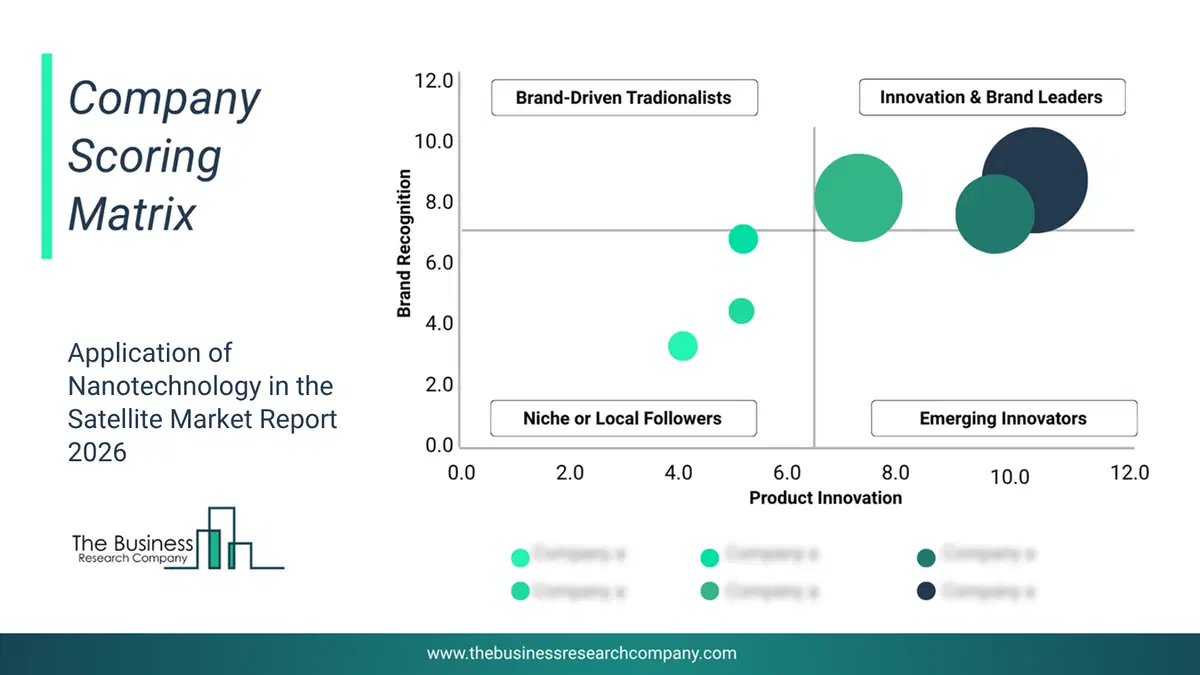
This chart maps companies by product innovation and brand strength, with bubble size indicating relative revenue, helping identify market leaders, challengers, and niche players. This is an illustrative chart; the full report provides a complete and accurate competitive analysis.
Global Application of Nanotechnology in the Satellite Market Trends and Insights
Major companies operating in the application of nanotechnology in the satellite market are focusing on developing innovative solutions, such as nano satellite systems with quantum communication components to enhance secure, high-speed data transmission and connectivity. Nano satellite systems with quantum communication components are small, cost-effective satellites that use quantum technology, such as entanglement, to enable ultra-secure, faster, and more reliable data transmission, enhancing encryption and communication even in remote areas with limited infrastructure. For instance, in June 2025, the Technical University of Munich (TUM), a Germany-based research university, launched the QUICK³ nanosatellite, an innovative platform designed to test quantum communication components in space, measuring no more than a shoebox in size and weighing approximately 4 kg, featuring a single-photon source integrated with an optical chip for fully secure communication, while electronic systems from international partners control experiments and interfaces, enabling secure, high-speed data transmission over long distances with minimal atmospheric interference and serving as a prototype for future large-scale quantum satellite networks.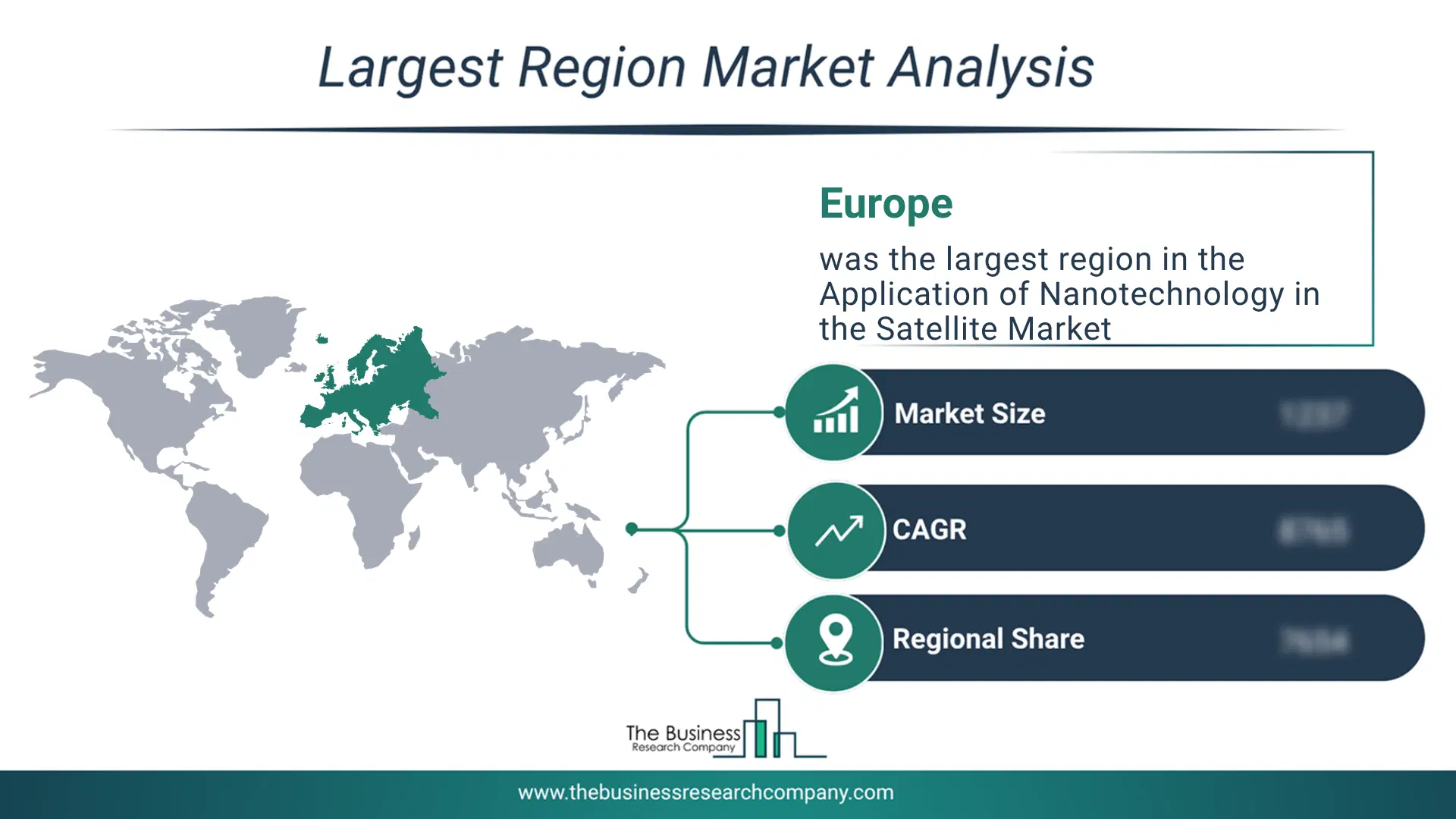
Regional Insights
Europe was the largest region in the application of nanotechnology in the satellite market in 2025. Asia-Pacific is expected to be the fastest-growing region in the forecast period. The regions covered in this market report are Asia-Pacific, South East Asia, Western Europe, Eastern Europe, North America, South America, Middle East, Africa. The countries covered in this market report are Australia, Brazil, China, France, Germany, India, Indonesia, Japan, Taiwan, Russia, South Korea, UK, USA, Canada, Italy, SpainWhat Defines the Application of Nanotechnology in the Satellite Market?
The applications of nanotechnology in the satellites market include revenues earned by entities by providing services such as advanced communication, remote sensing, earth observation, scientific research, navigation, and positioning. The market value includes the value of related goods sold by the service provider or included within the service offering. Only goods and services traded between entities or sold to end consumers are included.How is Market Value Defined and Measured?
The market value is defined as the revenues that enterprises gain from the sale of goods and/or services within the specified market and geography through sales, grants, or donations in terms of the currency (in USD unless otherwise specified). The revenues for a specified geography are consumption values that are revenues generated by organizations in the specified geography within the market, irrespective of where they are produced. It does not include revenues from resales along the supply chain, either further along the supply chain or as part of other products.
This chart presents market attractiveness based on a quantitative evaluation of growth, competition, strategic alignment, and risk, offering a clear view of opportunity areas for decision-making. This chart is for illustrative purposes; the full report contains the complete analysis.

This chart highlights the Total Addressable Market (TAM) by estimating the maximum revenue opportunity using an assumption-driven approach, supporting strategic planning and opportunity sizing across markets. The chart is illustrative; the full report provides a more comprehensive analysis.
What Key Data and Analysis Are Included in the Application of Nanotechnology in the Satellite Market Report 2026?
The application of nanotechnology in the satellite market research report is one of a series of new reports from The Business Research Company that provides market statistics, including industry global market size, regional shares, competitors with the market share, detailed market segments, market trends and opportunities, and any further data you may need to thrive in the application of nanotechnology in the satellite industry. The market research report delivers a complete perspective of everything you need, with an in-depth analysis of the current and future state of the industry.Application of Nanotechnology in the Satellite Market Report Forecast Analysis
| Report Attribute | Details |
|---|---|
| Market Size Value In 2026 | $7.4 billion |
| Revenue Forecast In 2030 | $9.31 billion |
| Growth Rate | CAGR of 5.9% from 2026 to 2030 |
| Base Year For Estimation | 2025 |
| Actual Estimates/Historical Data | 2020-2025 |
| Forecast Period | 2026 - 2030 |
| Market Representation | Revenue in USD Billion and CAGR from 2026 to 2030 |
| Segments Covered | Type, Application, End User |
| Regional Scope | Asia-Pacific, Western Europe, Eastern Europe, North America, South America, Middle East, Africa |
| Country Scope | The countries covered in the application of nanotechnology in the satellite market report are Australia, Brazil, China, France, Germany, India, Indonesia, Japan, Taiwan, Russia, South Korea, UK, USA, Canada, Italy, Spain |
| Key Companies Profiled | Raytheon Company, Boeing Company, Lockheed Martin Corporation, Airbus SE, China Aerospace Science and Technology Corporation, Northrop Gruman Corporation, L3Harris Technologies Inc., ViaSat Inc., Thales Alenia Space, Sierra Nevada Corporation, Blue Origin LLC, Planet Labs PBC, Surrey Satellite Technology Ltd., Spire Global Inc., ICEYE, GomSpace Group AB, NanoAvionics Corp., Tyvak International, AAC Clyde Space Ltd., Kepler Communications Inc., ISISPACE BV., Open Cosmos, Axelspace Corporation, NanoRacks LLC, Astro Digital Inc., Dauria Aerospace, Orbital Solutions Monaco, SpacePharma SA., D-Orbit SpA, HPS GmbH |
| Customization Scope | Request for Customization |
| Pricing And Purchase Options | Explore Purchase Options |