
Architectural lighting Market Report 2026
Global Outlook – By Type ( Incandescent Lights, Fluorescent Lights, High Intensity Discharge (HID) Lights, Light Emitting Diode (LED) Lights, Other Types), By Lighting Type ( Ambient, Task, Accent), By Application ( Wall Wash, Cove Lighting, Backlighting, Other Applications), By End-User ( Residential, Commercial, Other End-Users) – Market Size, Trends, Strategies, and Forecast to 2030
Architectural lighting Market Overview
• Architectural lighting market size has reached to $9.48 billion in 2025 • Expected to grow to $13.48 billion in 2030 at a compound annual growth rate (CAGR) of 7.2% • Growth Driver: Growth In The Construction Industry Is Anticipated To Fuel Architectural Lighting Market • Market Trend: Advanced Lighting System For Designers And Homeowners • Asia-Pacific was the largest region in 2025 and North America is the fastest growing region.Market Gains By 2030 – Top Opportunities By Segment
Market Gain identifies the most promising market opportunities by highlighting the segments or products expected to generate the highest incremental revenue growth over the next five years.
What Is Covered Under Architectural lighting Market?
Architectural lighting is illumination for building design and function. It serves and improves specific architectural aspects to develop, establish, or accentuate a building's aesthetic, history, and function. The main types of architectural lighting are incandescent lights, fluorescent lights, high-intensity discharge (HID) lights, light-emitting diode (LED) lights, and others. An incandescent light bulb refers to a glass and metal device that creates light by heating a thin wire filament with an electrical current going through it. The various lighting types involved are ambient, task, and accent which are applied for wall wash, cove lighting, backlighting, and others. It is used for residential, commercial, and others.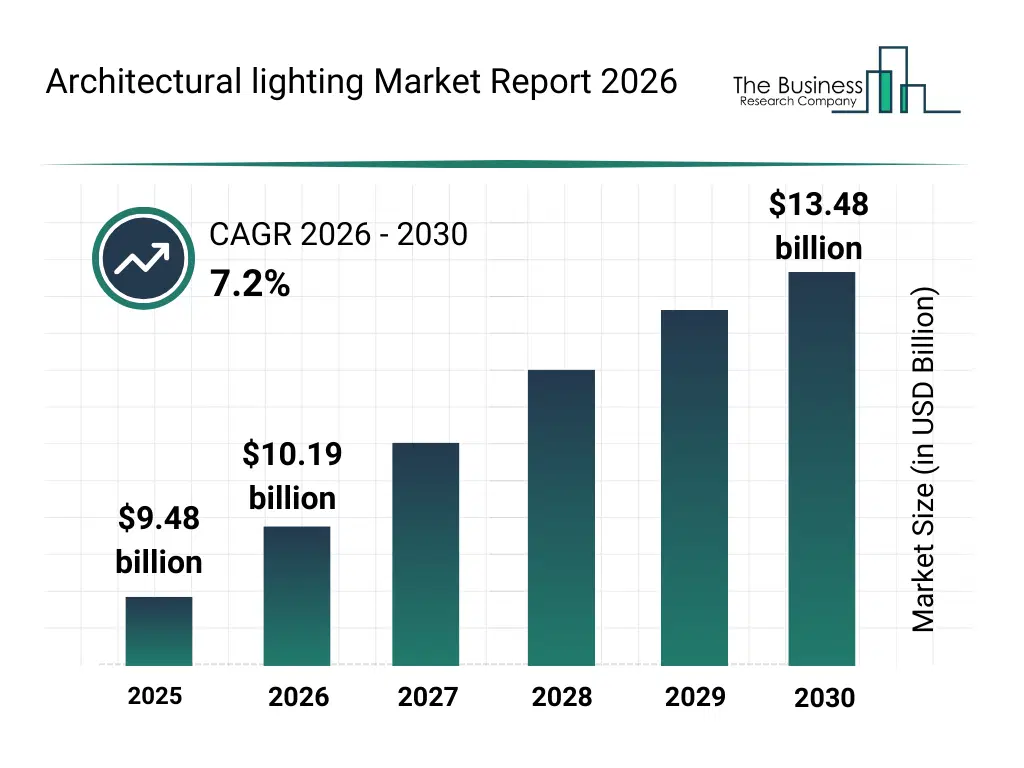
What Is The Architectural lighting Market Size 2026 And Growth Rate?
The architectural lighting market size has grown strongly in recent years. It will grow from $9.48 billion in 2025 to $10.19 billion in 2026 at a compound annual growth rate (CAGR) of 7.4%. The growth in the historic period can be attributed to growth in traditional incandescent lighting use, adoption of fluorescent and hid systems, expansion in commercial construction projects, early use of decorative lighting solutions, rise of initial led installations.What Is The Architectural lighting Market Growth Forecast?
The architectural lighting market size is expected to see strong growth in the next few years. It will grow to $13.48 billion in 2030 at a compound annual growth rate (CAGR) of 7.2%. The growth in the forecast period can be attributed to rising shift toward smart led technologies, increasing adoption of dynamic architectural lighting, expansion of energy-efficient building solutions, development of customizable lighting aesthetics, growing demand for sustainable illumination technologies. Major trends in the forecast period include adoption of energy-efficient architectural lighting solutions, integration of IoT-connected smart lighting systems, advancement of automated lighting control technologies, expansion of digital lighting management platforms, development of AI-enhanced illumination systems.
Global Architectural lighting Market Segmentation
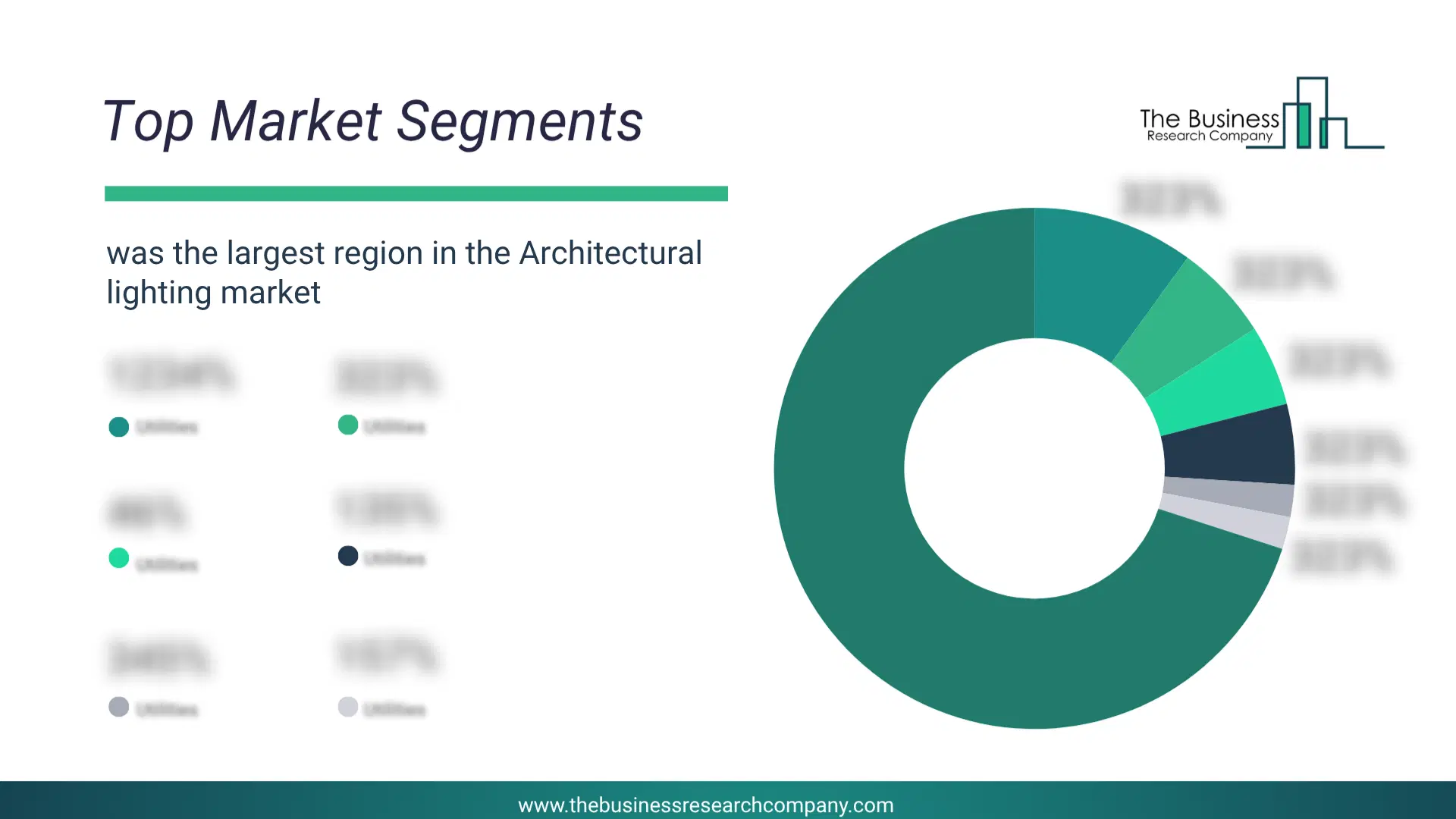
1) By Type: Incandescent Lights, Fluorescent Lights, High Intensity Discharge (HID) Lights, Light Emitting Diode (LED) Lights, Other Types 2) By Lighting Type: Ambient, Task, Accent 3) By Application: Wall Wash, Cove Lighting, Backlighting, Other Applications 4) By End-User: Residential, Commercial, Other End-Users Subsegments: 1) By Incandescent Lights: Standard Bulbs, Decorative Bulbs 2) By Fluorescent Lights: Linear Fluorescent, Compact Fluorescent (CFL) 3) By High Intensity Discharge (HID) Lights: Metal Halide, High-Pressure Sodium, Mercury Vapor 4) By Light Emitting Diode (LED) Lights: Standard LED, Smart LED, RGB LED 5) By Other Types: Halogen Lights, Neon Lights, Induction Lights The top segments in the architectural lighting market will be: • Light Emitting Diode (LED) Lights will reach $5945.65 Million by 2025. • Commercial will reach $4925.93 Million by 2025. • Wall Wash will reach $3601.47 Million by 2025. • Residential will reach $2879.84 Million by 2025. • Cove Lighting will reach $2707.4 Million by 2025.What Is The Driver Of The Architectural lighting Market?
The growth in the construction industry is expected to propel the growth of the architectural lighting market going forward. The construction industry involves the planning, design, execution, and management of infrastructure, buildings, and related projects, encompassing various sectors such as residential, commercial, and civil engineering. Architectural lighting in the construction industry serves to enhance aesthetics, functionality, and safety by strategically illuminating buildings and spaces, contributing to design goals, and creating visually appealing environments. For instance, in September 2025, according to the Census Bureau, a US-based government agency, public construction spending reached an estimated seasonally adjusted annual rate of $515.8 billion in July, marking a 0.3% (±1.6%) increase from the revised June figure of $514.3 billion. Therefore, the growth in the construction industry is driving the architectural lighting industry.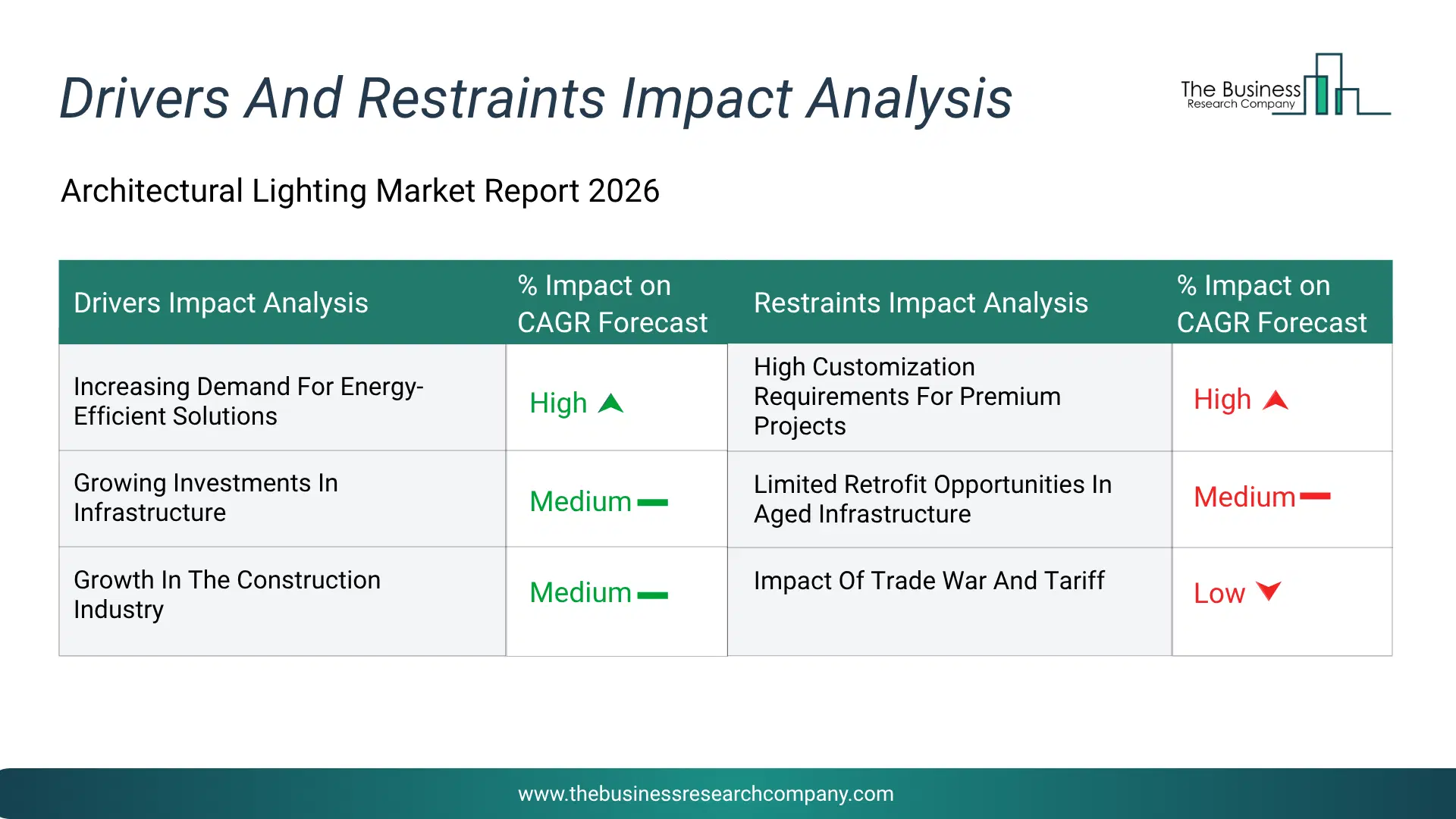
Infographic Chart Showing Key Market Drivers Analysis And Restraints For Architectural Lighting Market
The chart presents an impact analysis of key drivers and restraints, quantifying their relative influence on the market's growth rate and helping assess the balance between growth enablers and limiting factors. This chart offers a high-level perspective; the full report contains more detailed insights.
How Will The Drivers Impact Growth In The Global Architectural Lighting Market?
• Increasing Demand For Energy-Efficient Solutions (High) – The increasing demand for energy-efficient solutions will become a key driver of growth in the architectural lighting global market by 2030. As retailers modernize adoption of advanced architectural lighting technologies across commercial, residential and public infrastructure projects. Governments and institutions are prioritizing sustainable building practices, often incentivizing the use of low-energy lighting through regulations, green certifications and funding programs. Modern architectural lighting systems such as LED fixtures, daylight-integrated designs and smart controls offer significant energy savings while enhancing aesthetics and functionality. This growing emphasis on efficiency supports the widespread integration of intelligent lighting as a core component of sustainable development strategies. As a result, the increasing demand for energy-efficient solutions is anticipated to contributing to a 2.0% annual growth in the market. • Growing Investments In Infrastructure (Medium) – The growing investments in infrastructure will emerge as a major factor driving the expansion of the architectural lighting global market by 2030. Growing investments in infrastructure are significantly boosting demand for architectural lighting, as modern construction projects prioritize energy efficiency, design flexibility and smart technologies. From commercial complexes and transportation hubs to urban redevelopment and public infrastructure, lighting plays a vital role in enhancing functionality, safety and visual appeal. As governments and private developers scale up infrastructure spending, they increasingly integrate advanced lighting systems to meet sustainability goals, improve user experience and comply with evolving building standards. This trend is creating strong market momentum for innovative, scalable architectural lighting solutions. Consequently, the growing investment in infrastructure is projected to contributing to an 1.5% annual growth in the market. • Growth In The Construction Industry (Medium) – The growth in the construction industry will serve as a key growth catalyst for the architectural lighting global market by 2030. The growth in the construction industry is driving demand for architectural lighting, as new residential, commercial projects increasingly prioritize modern, energy-efficient and visually impactful lighting solutions. As construction activity expands globally particularly in urban development and smart infrastructure, there is a rising need for integrated lighting systems that enhance building aesthetics, safety and functionality. This surge fuels market growth by encouraging innovation in lighting design, automation and sustainability to meet the diverse requirements of contemporary architectural projects. Therefore, the growth in the construction industry is projected to supporting to a 1.0% annual growth in the market. • Growth In Hospitality Sector (Low) – The growth in hospitality sector will serve as a key growth catalyst for the architectural lighting global market by 2030. The expanding hospitality sector is driving increased demand for architectural lighting, as hotels, resorts and restaurants seek to create immersive, energy-efficient and visually appealing environments. As competition intensifies, hospitality brands are investing in advanced lighting designs that enhance guest experience, reflect brand identity and support wellness-focused amenities. Architectural lighting solutions such as ambient, accent and dynamic lighting systems enable flexible, mood-driven settings that elevate comfort and luxury. This growth in the hospitality industry directly fuels innovation and adoption of high-performance lighting technologies tailored to modern guest expectations. Therefore, the growth in the construction industry is projected to supporting to a 0.8% annual growth in the market.How Will The Restraints Impact Growth In The Global Architectural Lighting Market?
• High Customization Requirements For Premium Projects (High) – High Customization Requirements For Premium Projects will restrict the growth of the Architectural Lighting market during the forecast period. Premium architectural lighting projects demand high levels of customization in design, color temperature, and control systems. Meeting these custom requirements increases design and production costs, limiting the addressable market to high-budget projects. The need for extensive customization also extends project timelines and creates complexity in manufacturing and installation. • Limited Retrofit Opportunities In Aged Infrastructure (Medium) – Limited Retrofit Opportunities In Aged Infrastructure will restrict the growth of the Architectural Lighting market during the forecast period. Retrofitting aged buildings with modern architectural lighting presents significant challenges, including structural limitations, outdated electrical systems, and compatibility issues. The high cost and complexity of retrofitting historic or older buildings often discourages lighting upgrades. This limits the replacement market potential in aging infrastructure segments. • Impact Of Trade War And Tariff (Medium) – Impact Of Trade War And Tariff will restrict the growth of the Architectural Lighting market during the forecast period. Architectural lighting depends on imported components including LEDs, drivers, and control systems. Trade tariffs on these components increase production costs and may affect product availability. Trade barriers can also impact export opportunities for architectural lighting manufacturers, limiting international market growth.Key Players In The Global Architectural lighting Market
Major companies operating in the architectural lighting market are Acuity Brands Lighting Inc., Siteco Beleuchtungstechnik GmbH, Signify Holdings BV, OSRAM GmbH, Cree Inc., Jag Products LLC, Louis Poulsen A/S, Targetti Sankey SpA, Reggiani Illuminazione SpA, Lutron Electronics, Lithonia Lighting, ERCO, Radiant Lighting, Hubbell Lighting, Eaton, Zumtobel Group, Fagerhult, Delta Light, GVA Lighting, Sylvania, Kichler Lighting, Legrand, Vibia, Flos, Artemide, Bega, Selux, iGuzzini, Auralight, Bega Licht, Lumenpulse, RAB Lighting, Vossloh-Schwabe, WAC Lighting, Edge Lighting, Focal Point LLC, Lightolier, Cantalupi Illuminazione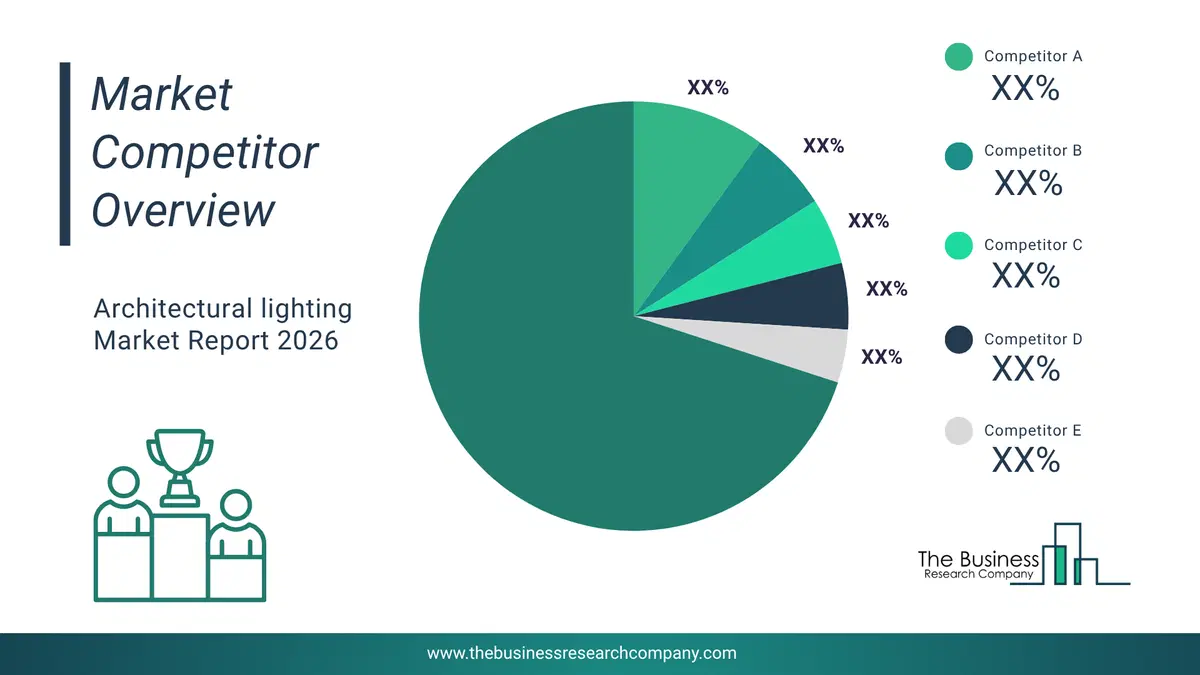
This chart is for illustrative purposes; the full report includes a detailed competitor analysis and comprehensive overview of the top 10 companies in the market.
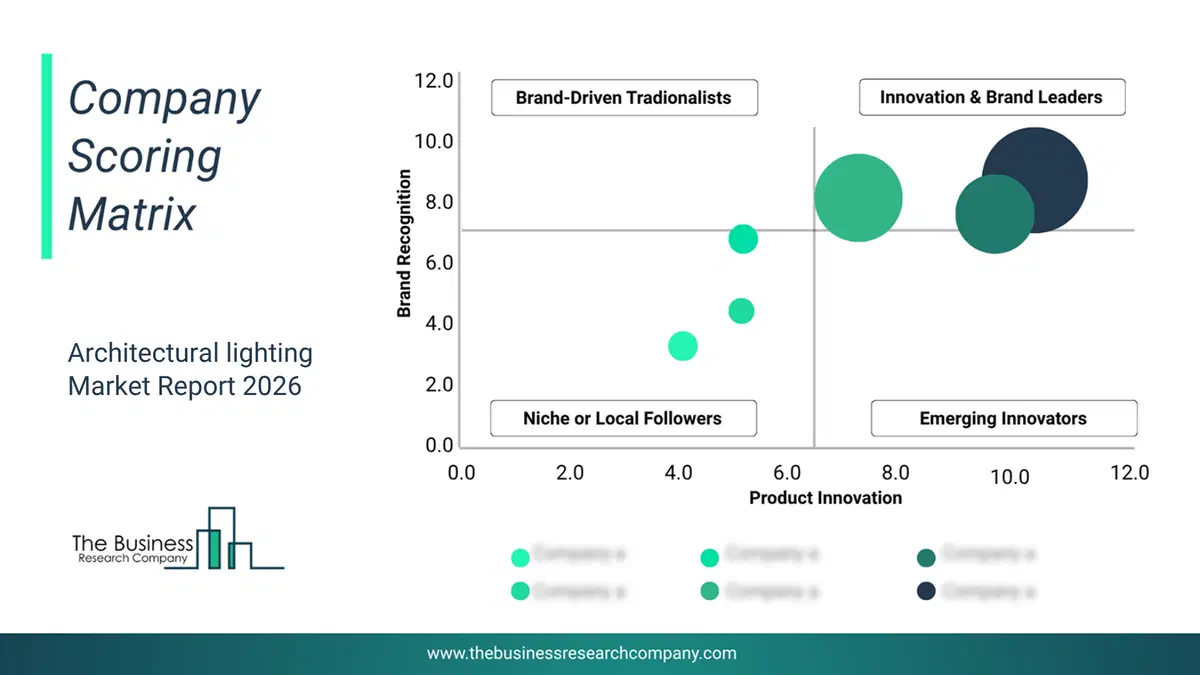
This chart maps companies by product innovation and brand strength, with bubble size indicating relative revenue, helping identify market leaders, challengers, and niche players. This is an illustrative chart; the full report provides a complete and accurate competitive analysis.
Global Architectural lighting Market Trends and Insights
Major companies operating in the architectural lighting market are focused on developing advanced lighting system that incorporates cutting-edge technology for designers and homeowner. For instance, in June 2023, PureEdge Lighting, a US-based manufacturer of contemporary, specification-grade architectural lighting, launched Pure Smart architectural lighting and smart controls powered by WiZ Pro, in collaboration with Signify. Pure Smart incorporates TruColor RGBTW, offering over 16 million colors and 85,000 tunable white tones. The comprehensive wireless solution includes WiZ Pro software, the WiZ app, Pure Smart wireless wall controls, and voice integration with virtual assistants. The TruColor technology ensures precise color quality and consistency across its spectrum. With an easy setup, no hub requirement, and limitless control, Pure Smart promotes a personalized ambiance, providing both design flexibility and wellness benefits through circadian rhythm adjustments.What Are Latest Mergers And Acquisitions In The Architectural lighting Market?
In February 2023, LMPG Inc., a Canada-based LED lighting solutions group, acquired Architectural Lighting Works (ALW) for an undisclosed amount. The acquisition strengthens LMPG's position in the architectural lighting market. Architectural Lighting Works (ALW) is a US-based innovative provider of interior and exterior architectural LED lighting solutions.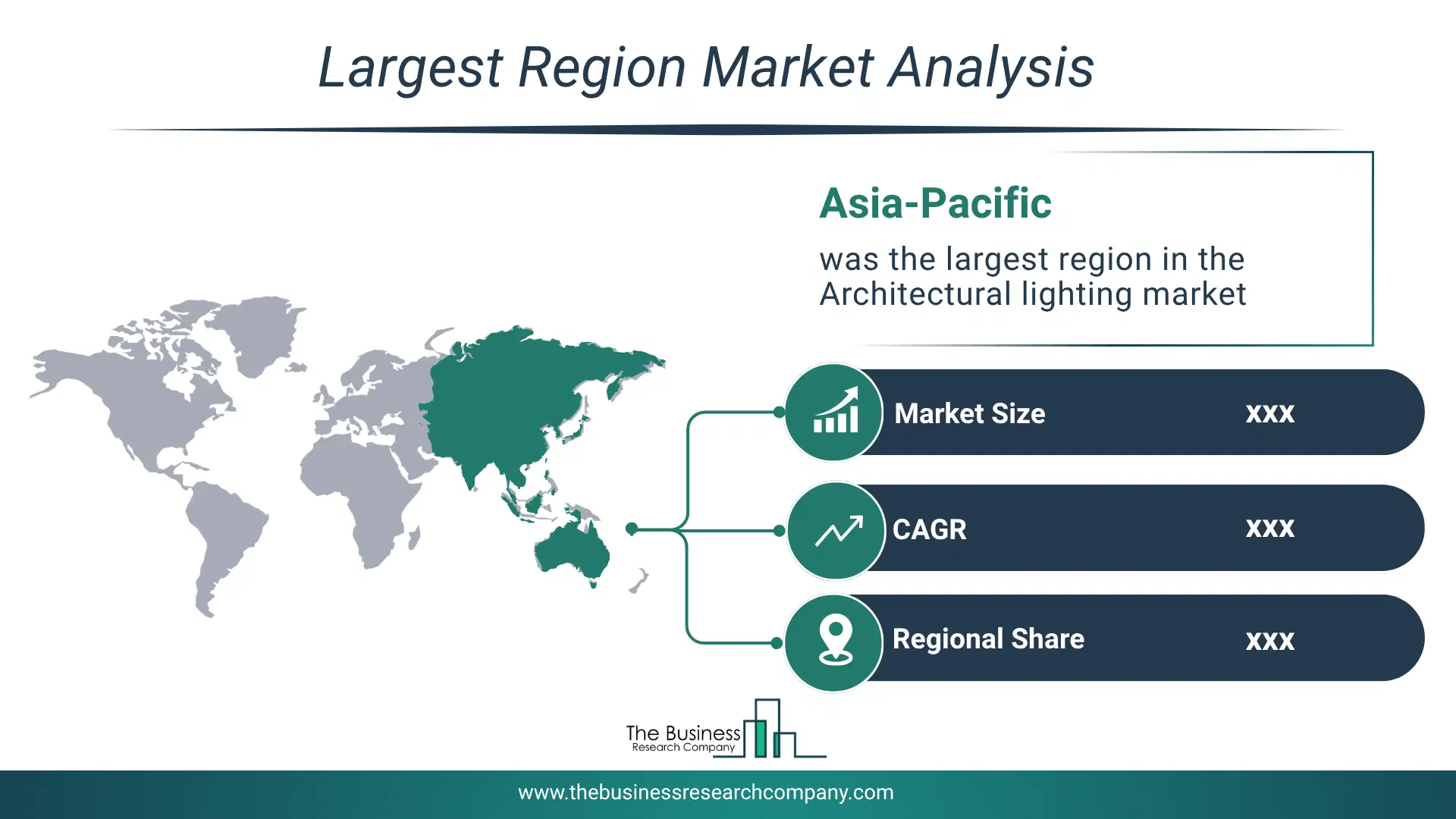
Regional Outlook
Asia-Pacific was the largest region in the architectural lighting market in 2025. North America is expected to be the fastest-growing region in the architectural lighting market report during the forecast period. The regions covered in this market report are Asia-Pacific, South East Asia, Western Europe, Eastern Europe, North America, South America, Middle East, Africa. The countries covered in this market report are Australia, Brazil, China, France, Germany, India, Indonesia, Japan, Taiwan, Russia, South Korea, UK, USA, Canada, Italy, Spain.What Defines the Architectural lighting Market?
The architectural lighting market consists of sales of spotlights, floodlights, cove lighting, soffit lighting, and valance lighting. Values in this market are ‘factory gate’ values, that is the value of goods sold by the manufacturers or creators of the goods, whether to other entities (including downstream manufacturers, wholesalers, distributors, and retailers) or directly to end customers. The value of goods in this market includes related services sold by the creators of the goods.How is Market Value Defined and Measured?
The market value is defined as the revenues that enterprises gain from the sale of goods and/or services within the specified market and geography through sales, grants, or donations in terms of the currency (in USD unless otherwise specified). The revenues for a specified geography are consumption values that are revenues generated by organizations in the specified geography within the market, irrespective of where they are produced. It does not include revenues from resales along the supply chain, either further along the supply chain or as part of other products.
This chart presents market attractiveness based on a quantitative evaluation of growth, competition, strategic alignment, and risk, offering a clear view of opportunity areas for decision-making. This chart is for illustrative purposes; the full report contains the complete analysis.

This chart highlights the Total Addressable Market (TAM) by estimating the maximum revenue opportunity using an assumption-driven approach, supporting strategic planning and opportunity sizing across markets. The chart is illustrative; the full report provides a more comprehensive analysis.
What Key Data and Analysis Are Included in the Architectural lighting Market Report 2026?
The architectural lighting market research report is one of a series of new reports from The Business Research Company that provides market statistics, including industry global market size, regional shares, competitors with the market share, detailed market segments, market trends and opportunities, and any further data you may need to thrive in the architectural lighting industry. The market research report delivers a complete perspective of everything you need, with an in-depth analysis of the current and future state of the industry.Architectural lighting Market Report 2026 Market Report Forecast Analysis
| Report Attribute | Details |
|---|---|
| Market Size Value In 2026 | $10.19 billion |
| Revenue Forecast In 2030 | $13.48 billion |
| Growth Rate | CAGR of 7.4% from 2026 to 2030 |
| Base Year For Estimation | 2025 |
| Actual Estimates/Historical Data | 2020-2025 |
| Forecast Period | 2026 - 2030 |
| Market Representation | Revenue in USD Billion and CAGR from 2026 to 2030 |
| Segments Covered | Type, Lighting Type, Application, End-User |
| Regional Scope | Asia-Pacific, Western Europe, Eastern Europe, North America, South America, Middle East, Africa |
| Country Scope | The countries covered in the report are Australia, Brazil, China, France, Germany, India, Indonesia, Japan, Taiwan, Russia, South Korea, UK, USA, Canada, Italy, Spain. |
| Key Companies Profiled | Acuity Brands Lighting Inc., Siteco Beleuchtungstechnik GmbH, Signify Holdings BV, OSRAM GmbH, Cree Inc., Jag Products LLC, Louis Poulsen A/S, Targetti Sankey SpA, Reggiani Illuminazione SpA, Lutron Electronics, Lithonia Lighting, ERCO, Radiant Lighting, Hubbell Lighting, Eaton, Zumtobel Group, Fagerhult, Delta Light, GVA Lighting, Sylvania, Kichler Lighting, Legrand, Vibia, Flos, Artemide, Bega, Selux, iGuzzini, Auralight, Bega Licht, Lumenpulse, RAB Lighting, Vossloh-Schwabe, WAC Lighting, Edge Lighting, Focal Point LLC, Lightolier, Cantalupi Illuminazione |
| Customization Scope | Request for Customization |
| Pricing And Purchase Options | Explore Purchase Options |