
Architectural Membrane Market Report 2026
Global Outlook – By Material Type (Polytetrafluoroethylene (PTFE), Ethylene Tetrafluoroethylene (ETFE), Polyvinyl Chloride (PVC), Other Material Types), By Functionality (Weather Protection, Acoustic Control, Ultra Violet (UV) Protection, Light Diffusion, Thermal Insulation), By Application (Tensile Architecture, Canopies, Facades, Roofs, Other Applications), By End-User (Commercial, Residential, Industrial, Institutional, Other End-Users) – Market Size, Trends, Strategies, and Forecast to 2030
Architectural Membrane Market Overview
• Architectural Membrane market size has reached to $3.63 billion in 2025 • Expected to grow to $5.04 billion in 2030 at a compound annual growth rate (CAGR) of 6.8% • Growth Driver: Rising Demand For Sustainable Building Fueling The Growth Of The Market Due To Stringent Environmental Regulations And Green Construction Initiatives • Market Trend: Innovations In Waterproof Membrane Fabric Enhance Durability And Performance In Architectural Structures • North America was the largest region in 2025 and Asia-Pacific is the fastest growing region.What Is Covered Under Architectural Membrane Market?
Architectural membrane is a flexible, lightweight construction material used to create tensile and fabric-based building structures. It is typically made from high-performance materials that provide durability, weather resistance, and light transmission. Architectural membranes are commonly used to achieve innovative, energy-efficient, and aesthetically distinctive designs. The main material types of architectural membrane include polytetrafluoroethylene, ethylene tetrafluoroethylene, polyvinyl chloride, and other material types. Polytetrafluoroethylene is a high-performance membrane material known for its durability, weather resistance, and long service life in tensile structures. These membranes provide functionalities such as weather protection, acoustic control, ultra violet protection, light diffusion, and thermal insulation. The various applications involved are tensile architecture, canopies, facades, roofs, and other applications, and are used by several end users such as commercial, residential, industrial, institutional, and other end users.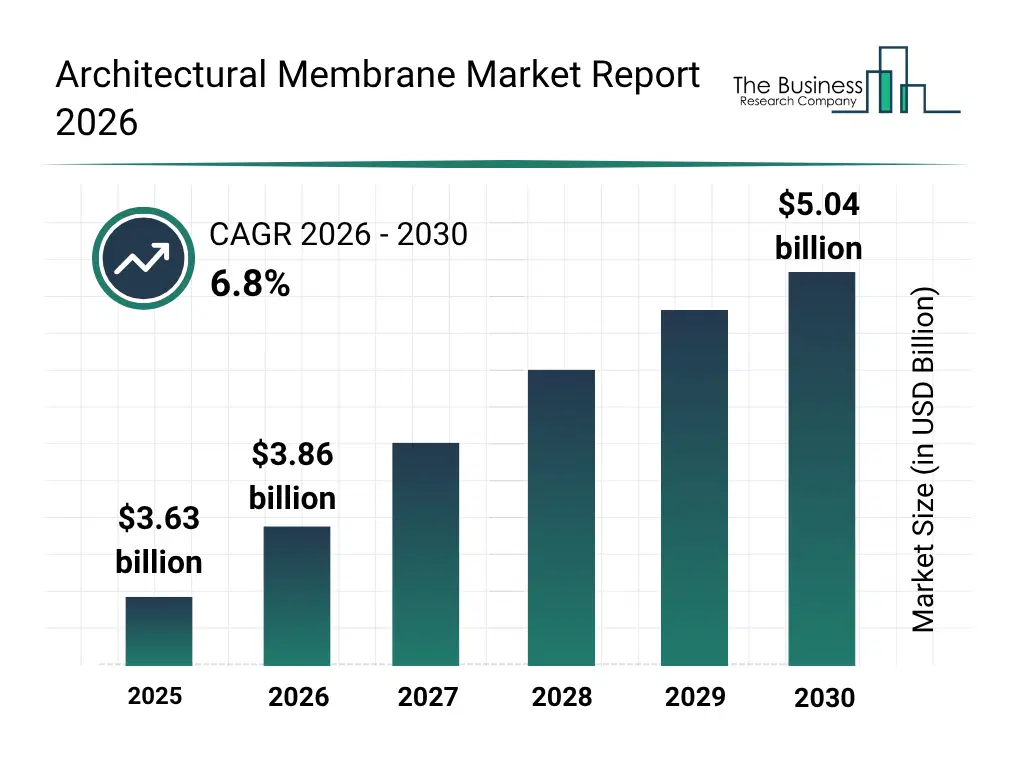
What Is The Architectural Membrane Market Size and Share 2026?
The architectural membrane market size has grown strongly in recent years. It will grow from $3.63 billion in 2025 to $3.86 billion in 2026 at a compound annual growth rate (CAGR) of 6.6%. The growth in the historic period can be attributed to increasing demand for modern architectural designs, adoption of PTFE and PVC membranes, growth in commercial and institutional construction, rising awareness of weather and UV protection, technological improvements in membrane materials.What Is The Architectural Membrane Market Growth Forecast?
The architectural membrane market size is expected to see strong growth in the next few years. It will grow to $5.04 billion in 2030 at a compound annual growth rate (CAGR) of 6.8%. The growth in the forecast period can be attributed to growing emphasis on sustainable and energy-efficient buildings, increasing use of ETFE and high-strength structural membranes, rising application in canopies and facades, expansion of residential and industrial construction projects, adoption of smart and digitally integrated membrane systems. Major trends in the forecast period include increasing use of lightweight and high-performance materials, rising demand for energy-efficient architectural designs, growing adoption of tensile and fabric-based structures, expansion of multi-functional membrane applications, rising focus on aesthetic and innovative building designs.
Global Architectural Membrane Market Segmentation
1) By Material Type: Polytetrafluoroethylene (PTFE), Ethylene Tetrafluoroethylene (ETFE), Polyvinyl Chloride (PVC), Other Material Types 2) By Functionality: Weather Protection, Acoustic Control, Ultra Violet (UV) Protection, Light Diffusion, Thermal Insulation 3) By Application: Tensile Architecture, Canopies, Facades, Roofs, Other Applications 4) By End-User: Commercial, Residential, Industrial, Institutional, Other End-Users Subsegments: 1) By Polytetrafluoroethylene Membrane: Glass Fiber Based Membrane, Woven Fabric Membrane, Non Woven Fabric Membrane, High Strength Structural Membrane 2) By Ethylene Tetrafluoroethylene Membrane: Single Layer Film Membrane, Multi Layer Cushion Membrane, Printed Film Membrane, Inflatable Cushion Membrane 3) By Polyvinyl Chloride Membrane: Polyester Fabric Reinforced Membrane, Polyamide Fabric Reinforced Membrane, Flame Retardant Membrane, UV Resistant Membrane 4) By Other Material Types: Silicone Coated Glass Fiber Membrane, Polyvinylidene Fluoride Coated Membrane, Thermoplastic Polyolefin Membrane, Polyurethane Coated Fabric MembraneWhat Are The Drivers Of The Architectural Membrane Market?
The rising demand for sustainable building is expected to propel the growth of the architectural membrane forward. Sustainable buildings are eco-friendly constructions designed to minimize environmental impact by reducing resource consumption, waste, and carbon emissions throughout their lifecycle. The increasing demand for sustainable building is rising due to stricter government regulations and green building certifications, which incentivize the use of eco-friendly, energy-efficient, and low-carbon materials in construction projects. Architectural membranes support demand for sustainable building by offering lightweight, durable, and energy-efficient solutions that reduce material use, improve natural lighting, and lower environmental impact in modern construction. For instance, in May 2024, according to the U.S. Environmental Protection Agency, a US-based federal government agency responsible for environmental protection, the number of commercial buildings that earned ENERGY STAR certification rose from more than 7,000 in 2022 to more than 8,800 in 2023, reflecting an increase of approximately 1,800 buildings. Therefore, rising demand for sustainable buildings is driving the growth of the architectural membrane industry. The rising infrastructure development is expected to propel the growth of the architectural membrane market going forward. Infrastructure development refers to the planning, construction, and expansion of physical systems such as transportation networks, stadiums, airports, and public facilities that support economic and social activity. The growing scale of infrastructure development is largely driven by increasing government investments and policy-driven spending on public construction, as rapid urbanization and population growth generate sustained demand for new and upgraded built environments worldwide. The surge in large-scale infrastructure projects creates demand for durable, lightweight, and large-span structural solutions such as architectural membranes, which are widely used for roofing, facades, and tensile coverings in airports, transit hubs, stadiums, and commercial complexes. For instance, in July 2025, according to the Office for National Statistics, a UK-based government department, total investment in the infrastructure sector reached £20.3 billion ($23.64 billion) in 2024, marking a 16.9% increase compared to 2023. Therefore, the rising infrastructure development is driving the growth of the architectural membrane industryKey Players In The Global Architectural Membrane Market
Major companies operating in the architectural membrane market are Saint-Gobain S.A., Sika AG, Shanghai Shenda Kobond New Materials Co. Ltd., SergeFerrari Group, Sprung Instant Structures LLC, Seaman Corporation, GKD – Gebr. Kufferath AG, Jiangsu VEIK Technology & Materials Co. Ltd., Endutex Coated Technical Textiles S.A., 3dtex GmbH, Fujian Sijia Industrial Material Co. Ltd., Fiberflon Ltd., DERFLEX (Shanghai DER New Material Co. Ltd.), Taiyo Kogyo Corporation, Structurflex Ltd., Hiraoka & Co. Ltd., Chukoh Chemical Industries Ltd., LUCKY-TECH Membranes Pvt Ltd, Arcway Tech Structures, Ningbo WellFlon New Materials Technology Co. Ltd., Architen Landrell Associates Ltd., Archway Tensile Ltd., Zhejiang Kaiao New Material Co. Ltd., GSTARP (Jiaxing Green Shield New Materials Co. Ltd.).
This chart is for illustrative purposes; the full report includes a detailed competitor analysis and comprehensive overview of the top 10 companies in the market.
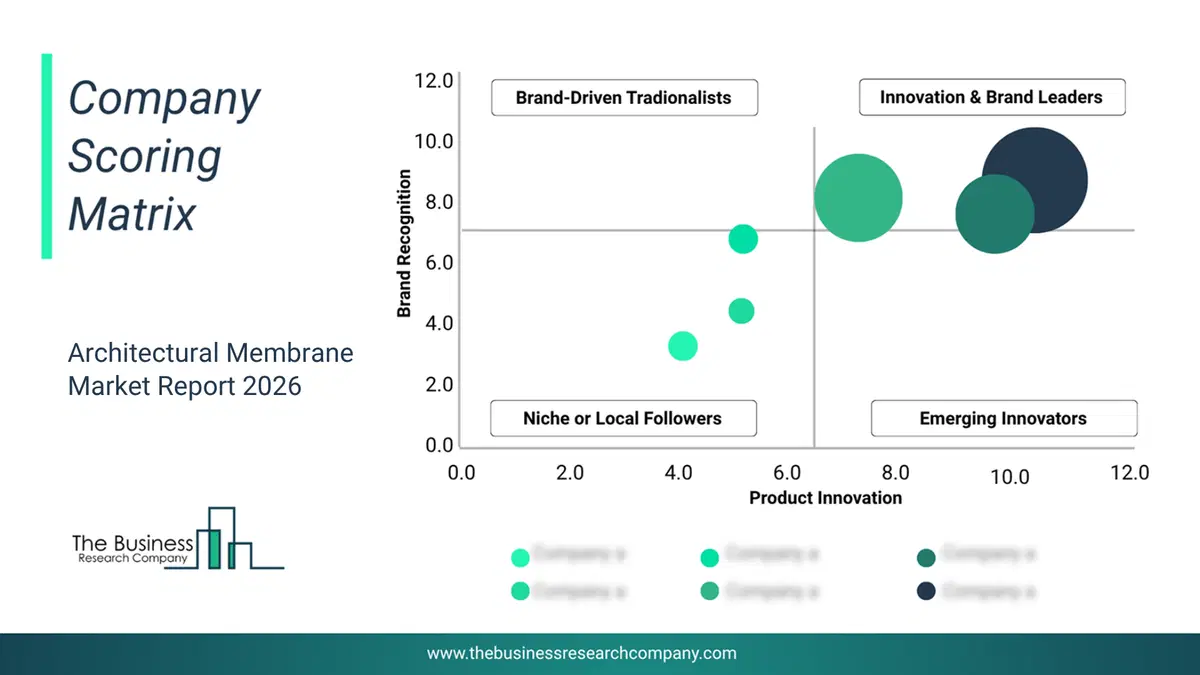
This chart maps companies by product innovation and brand strength, with bubble size indicating relative revenue, helping identify market leaders, challengers, and niche players. This is an illustrative chart; the full report provides a complete and accurate competitive analysis.
Global Architectural Membrane Market Trends and Insights
Major companies operating in the architectural membrane market are focusing on developing advanced products, such as waterproof architectural membrane fabric, to ensure long-term performance in harsh environmental conditions. Waterproof architectural membrane fabric is an engineered coated or laminated textile solution developed to block water infiltration while delivering high tensile strength, flexibility, UV stability, and extended durability for use in roofing systems, façades, and tensile architectural structures. For instance, in October 2023, Serge Ferrari Group, a France-based technical textile manufacturer, launched a custom anniversary color, Revival Blue, for its best-selling waterproof membrane fabric, Soltis Proof 502. The launch occurred at the Advanced Textiles Expo (ATA Exposition). This durable, lightweight fabric, ideal for awnings, shade sails, and pergolas, features patented Précontraint technology for UV protection and a 10-year warranty.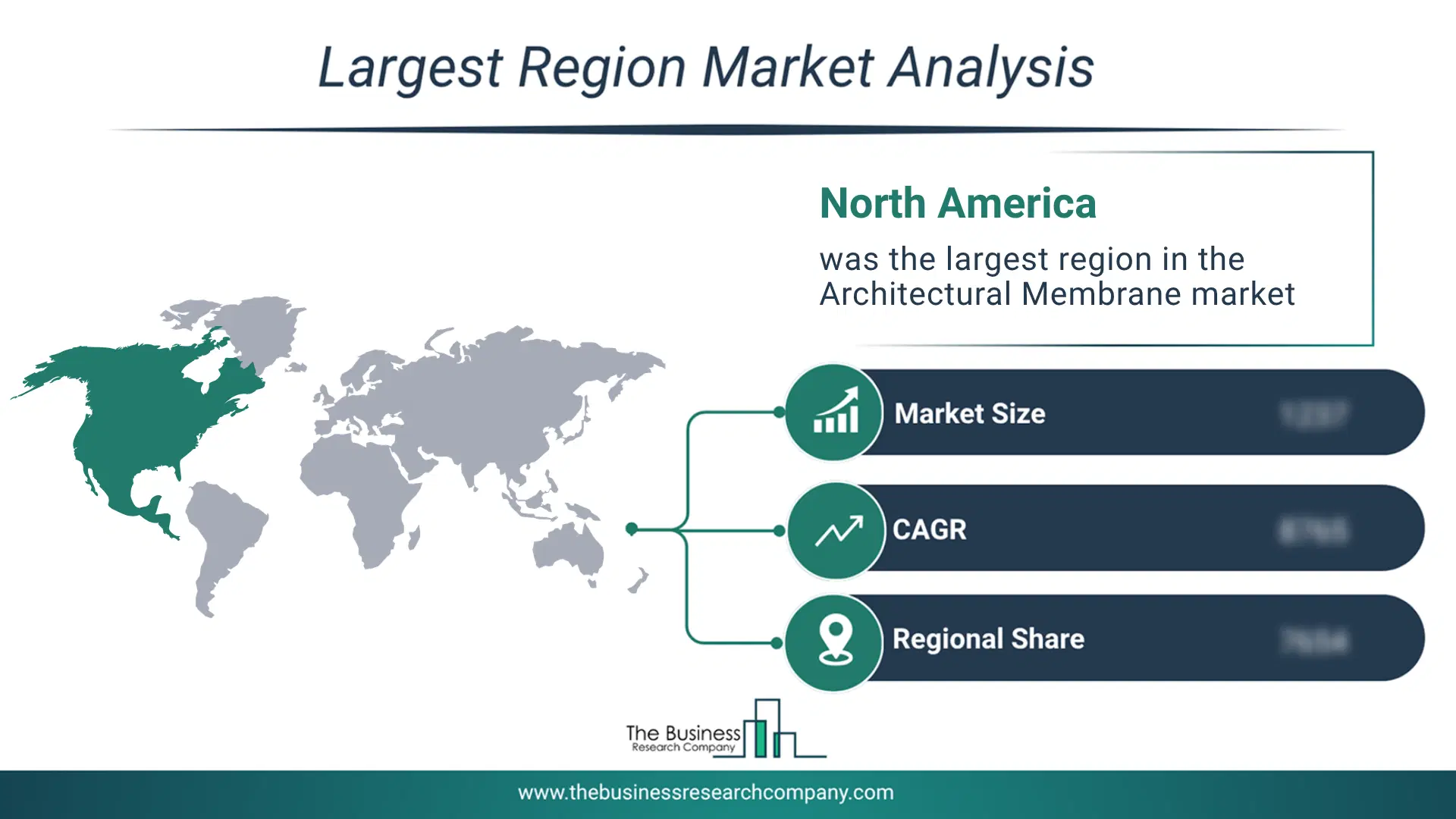
Regional Insights
North America was the largest region in the architectural membrane market in 2025. Asia-Pacific is expected to be the fastest-growing region in the forecast period. The regions covered in this market report are Asia-Pacific, South East Asia, Western Europe, Eastern Europe, North America, South America, Middle East, Africa. The countries covered in this market report are Australia, Brazil, China, France, Germany, India, Indonesia, Japan, Taiwan, Russia, South Korea, UK, USA, Canada, Italy, Spain.What Defines the Architectural Membrane Market?
The architectural membrane market consists of sales of coated polyester (CP), silicone-coated fiberglass (SCF), polycarbonate (PC), fabric-glass composite (FGC), translucent polyvinyl chloride (TPVC), polyvinylidene fluoride-coated fabrics (PVDF), and polyamide fabrics (PA). Values in this market are ‘factory gate’ values, that is, the value of goods sold by the manufacturers or creators of the goods, whether to other entities (including downstream manufacturers, wholesalers, distributors, and retailers) or directly to end customers. The value of goods in this market includes related services sold by the creators of the goods.How is Market Value Defined and Measured?
The market value is defined as the revenues that enterprises gain from the sale of goods and/or services within the specified market and geography through sales, grants, or donations in terms of the currency (in USD unless otherwise specified). The revenues for a specified geography are consumption values that are revenues generated by organizations in the specified geography within the market, irrespective of where they are produced. It does not include revenues from resales along the supply chain, either further along the supply chain or as part of other products.
This chart presents market attractiveness based on a quantitative evaluation of growth, competition, strategic alignment, and risk, offering a clear view of opportunity areas for decision-making. This chart is for illustrative purposes; the full report contains the complete analysis.

This chart highlights the Total Addressable Market (TAM) by estimating the maximum revenue opportunity using an assumption-driven approach, supporting strategic planning and opportunity sizing across markets. The chart is illustrative; the full report provides a more comprehensive analysis.
What Key Data And Analysis Are Included In The Architectural Membrane Market Report 2026?
The architectural membrane market research report is one of a series of new reports from The Business Research Company that provides market statistics, including industry global market size, regional shares, competitors with the market share, detailed market segments, market trends and opportunities, and any further data you may need to thrive in the architectural membrane industry. The market research report delivers a complete perspective of everything you need, with an in-depth analysis of the current and future state of the industry.Architectural Membrane Market Report Forecast Analysis
| Report Attribute | Details |
|---|---|
| Market Size Value In 2026 | $3.86 billion |
| Revenue Forecast In 2030 | $5.04 billion |
| Growth Rate | CAGR of 6.6% from 2026 to 2030 |
| Base Year For Estimation | 2025 |
| Actual Estimates/Historical Data | 2020-2025 |
| Forecast Period | 2026 - 2030 |
| Market Representation | Revenue in USD Billion and CAGR from 2026 to 2030 |
| Segments Covered | Material Type, Functionality, Application, End-User |
| Regional Scope | Asia-Pacific, Western Europe, Eastern Europe, North America, South America, Middle East, Africa |
| Country Scope | The countries covered in this market report are Australia, Brazil, China, France, Germany, India, Indonesia, Japan, Taiwan, Russia, South Korea, UK, USA, Canada, Italy, Spain |
| Key Companies Profiled | Saint-Gobain S.A., Sika AG, Shanghai Shenda Kobond New Materials Co. Ltd., SergeFerrari Group, Sprung Instant Structures LLC, Seaman Corporation, GKD – Gebr. Kufferath AG, Jiangsu VEIK Technology & Materials Co. Ltd., Endutex Coated Technical Textiles S.A., 3dtex GmbH, Fujian Sijia Industrial Material Co. Ltd., Fiberflon Ltd., DERFLEX (Shanghai DER New Material Co. Ltd.), Taiyo Kogyo Corporation, Structurflex Ltd., Hiraoka & Co. Ltd., Chukoh Chemical Industries Ltd., LUCKY-TECH Membranes Pvt Ltd, Arcway Tech Structures, Ningbo WellFlon New Materials Technology Co. Ltd., Architen Landrell Associates Ltd., Archway Tensile Ltd., Zhejiang Kaiao New Material Co. Ltd., GSTARP (Jiaxing Green Shield New Materials Co. Ltd.). |
| Customization Scope | Request for Customization |
| Pricing And Purchase Options | Explore Purchase Options |