
Area Sensors Market Report 2026
Global Outlook – By Product Type (General-Purpose Area Sensors, Cross-Beam Area Sensors), By Technology Type (Photoelectric Sensing, Infrared Sensing, Laser-Based Sensing, Vision-Based Sensing), By Sensing Range (Less Than 1 Meter, 1 Meter–3 Meters, 3 Meters–5 Meters, More Than 5 Meters), By Application Type (Object Detection, Picking Systems, Personnel Safety, Equipment Protection, Other Application Types), By End User (Automotive, Manufacturing, Electronics And Semiconductor, Food And Beverage, Pharmaceuticals, Logistics And Warehousing) – Market Size, Trends, Strategies, and Forecast to 2030
Area Sensors Market Overview
• Area Sensors market size has reached to $6.36 billion in 2025 • Expected to grow to $11.75 billion in 2030 at a compound annual growth rate (CAGR) of 13.0% • Growth Driver: Rising Adoption Of Industry 4.0 Driving The Market Growth Due To Increasing Demand For Smart Industrial Automation • Market Trend: High-Resolution Retroreflective Optical Sensing Technology Enhances Small-Object Detection Accuracy And Process Reliability In Industrial Automation • North America was the largest region in 2025 and Asia-Pacific is the fastest growing region.What Is Covered Under Area Sensors Market?
Area sensors refer to two-dimensional image sensors that capture visual information across an array of pixels simultaneously to produce digital images. They convert incident light into electrical signals, enabling high-resolution image acquisition, accurate spatial analysis, and rapid image processing. These sensors support imaging applications requiring detailed image capture, precise measurement, and reliable visual data generation. The main product types of area sensors include general-purpose area sensors and cross-beam area sensors. General-purpose area sensors refer to sensing devices designed to detect objects, movements, or interruptions across a defined area using multiple sensing elements, supporting automated monitoring and safety applications. These sensors use technologies such as photoelectric sensing, infrared sensing, laser-based sensing, and vision-based sensing and are available with sensing ranges of less than 1 meter, 1 meter–3 meters, 3 meters–5 meters, and more than 5 meters. The various applications involved are object detection, picking systems, personnel safety, equipment protection, and others and they are utilized by end users including automotive, manufacturing, electronics and semiconductor, food and beverage, pharmaceuticals, and logistics and warehousing.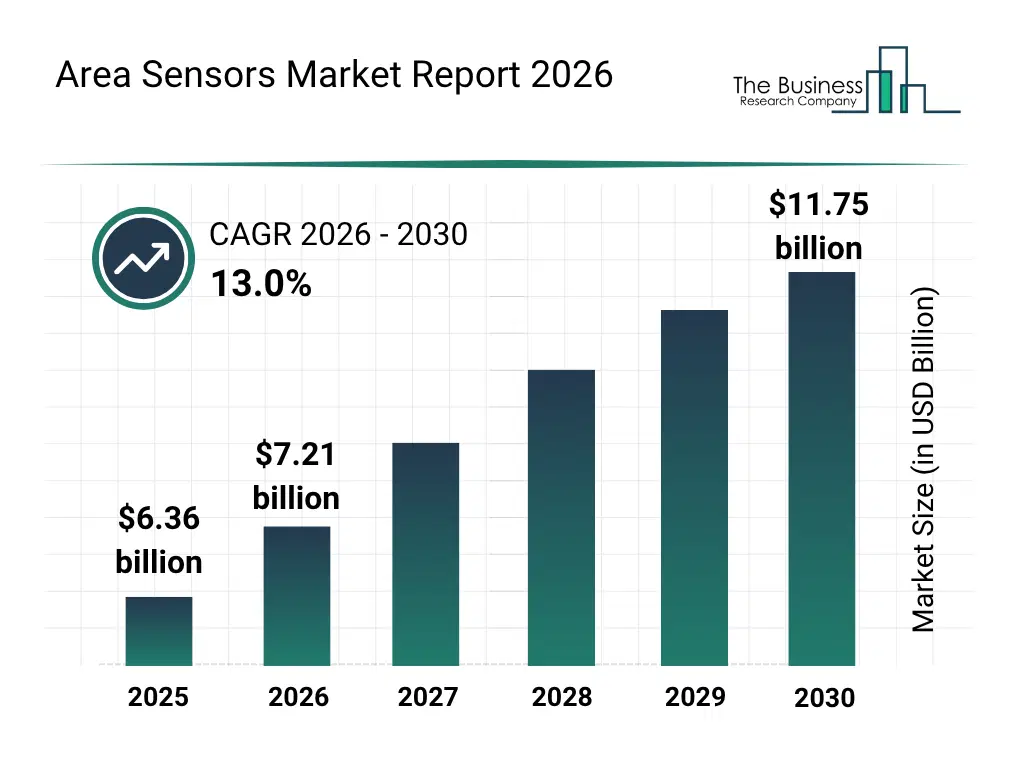
What Is The Area Sensors Market Size and Share 2026?
The area sensors market size has grown rapidly in recent years. It will grow from $6.36 billion in 2025 to $7.21 billion in 2026 at a compound annual growth rate (CAGR) of 13.4%. The growth in the historic period can be attributed to increasing demand for automated object detection systems, rising industrial safety requirements, growing adoption of photoelectric sensing technologies, increasing need for accurate personnel detection, rising demand for equipment protection systems.What Is The Area Sensors Market Growth Forecast?
The area sensors market size is expected to see rapid growth in the next few years. It will grow to $11.75 billion in 2030 at a compound annual growth rate (CAGR) of 13.0%. The growth in the forecast period can be attributed to increasing demand for high-resolution visual sensing, rising adoption of laser-based sensing technologies, growing need for extended sensing ranges, increasing demand for multi-axis detection capabilities, rising deployment of advanced area sensing in logistics and warehousing. Major trends in the forecast period include increasing adoption of high-resolution area sensing technologies, rising demand for wider sensing coverage and detection accuracy, growing use of compact and adjustable detection area sensors, increasing integration of multi-beam and cross-beam sensing architectures, rising demand for long-range and precise object detection capabilities.
Global Area Sensors Market Segmentation
1) By Product Type: General-Purpose Area Sensors, Cross-Beam Area Sensors 2) By Technology Type: Photoelectric Sensing, Infrared Sensing, Laser-Based Sensing, Vision-Based Sensing 3) By Sensing Range: Less Than 1 Meter, 1 Meter–3 Meters, 3 Meters–5 Meters, More Than 5 Meters 4) By Application Type: Object Detection, Picking Systems, Personnel Safety, Equipment Protection, Other Application Types 5) By End User: Automotive, Manufacturing, Electronics And Semiconductor, Food And Beverage, Pharmaceuticals, Logistics And Warehousing Subsegments: 1) By General-Purpose Area Sensors: Single-Beam Area Sensors, Multi-Beam Area Sensors, Wide-Area Detection Sensors, Adjustable Detection Area Sensors, Compact Area Sensors 2) By Cross-Beam Area Sensors: Through-Beam Area Sensors, Opposed-Beam Area Sensors, Parallel-Beam Area Sensors, Multi-Axis Cross-Beam Area Sensors, Long-Range Cross-Beam Area SensorsWhat Is The Driver Of The Area Sensors Market?
The rising adoption of industry 4.0 is expected to propel the growth of the area sensors market going forward. Industry 4.0 refers to the integration of advanced digital technologies such as the internet of things (IoT), artificial intelligence (AI), robotics, cloud computing, and industrial automation into manufacturing and industrial operations. The adoption of industry 4.0 is increasing due to the growing need for intelligent manufacturing systems that improve productivity, operational efficiency, and real-time decision-making. Industry 4.0 enhances the use of area sensors by enabling intelligent manufacturing, autonomous robotics, and connected production systems, where sensors provide precise detection, safety monitoring, and real-time data acquisition to improve efficiency, reduce downtime, optimize workflows, and support smart factory integration. For instance, in March 2024, according to Rockwell Automation Inc., a US-based automation company, manufacturers consider AI the leading capability for achieving significant business impact, with 83% anticipating the adoption of generative AI (GenAI) in their operations. Furthermore, 95% of manufacturers are either using or evaluating smart manufacturing technologies, up from 84% in 2023. Therefore, the rising adoption of industry 4.0 is driving the growth of the area sensors industry.Key Players In The Global Area Sensors Market
Major companies operating in the area sensors market are Siemens AG, Panasonic Industry Co. Ltd., Honeywell International Inc., Mitsubishi Electric Corporation, Eaton Corporation plc, Rockwell Automation Inc., KEYENCE Corporation, OMRON Corporation, SICK AG, ifm electronic GmbH, Banner Engineering Corp., Hans Turck GmbH & Co. KG, Pepperl+Fuchs SE, Baumer Holding AG, Balluff GmbH, IDEC Corporation, Pilz GmbH & Co. KG, Leuze electronic GmbH + Co. KG, wenglor sensoric GmbH, Autonics Corporation, Contrinex AG
This chart is for illustrative purposes; the full report includes a detailed competitor analysis and comprehensive overview of the top 10 companies in the market.
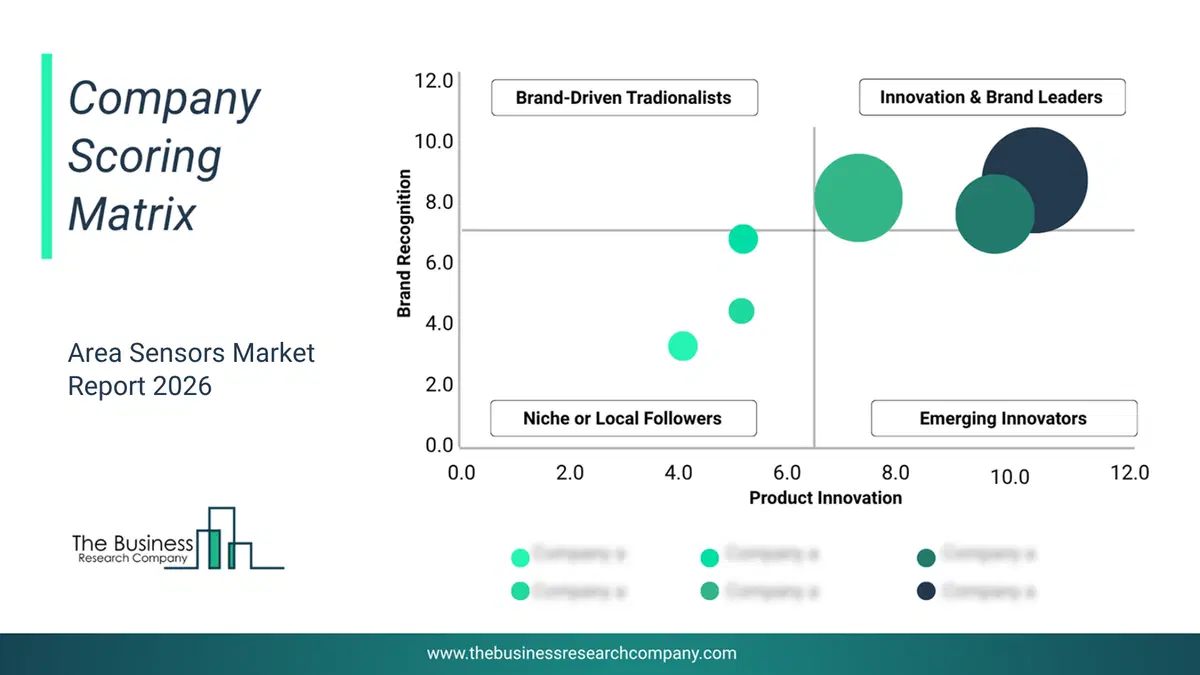
This chart maps companies by product innovation and brand strength, with bubble size indicating relative revenue, helping identify market leaders, challengers, and niche players. This is an illustrative chart; the full report provides a complete and accurate competitive analysis.
Global Area Sensors Market Trends and Insights
Major companies operating in the area sensors market are focusing on developing advanced products, such as high-resolution retroreflective area sensors, to enhance small-object detection accuracy, improve process reliability, and enable advanced quality monitoring in industrial automation applications. High-resolution retroreflective area sensors are advanced optical sensing devices that use a wide light band composed of multiple beams instead of a single-point detection method, enabling them to detect small, thin, or irregularly shaped objects with greater precision and reduced false triggering compared to traditional photoelectric sensors. For instance, in September 2026, Pepperl+Fuchs SE, a Germany-based sensor manufacturer, launched the R305 retroreflective area sensor designed specifically for detecting thin and irregular objects from a distance of just 2 mm. The sensor uses a five-beam light band with individually switchable beams, enabling flexible adaptation to narrow openings and exclusion of interfering objects, while its high-resolution mode allows detection of extremely small targets with high reliability. Additionally, the system supports IO-Link communication for transmitting object height data, integrated trend evaluation for process monitoring such as packaging fill level analysis, and Auto-Teach functionality for simplified setup and maintenance.What Are Latest Mergers And Acquisitions In The Area Sensors Market?
In February 2026, Infineon Technologies AG, a Germany-based semiconductor manufacturing company, acquired the non-optical analog or mixed-signal sensor portfolio from ams OSRAM for an undisclosed amount. With this acquisition, Infineon aimed to strengthen its leadership position in the global sensor market by expanding its analog and mixed-signal sensing capabilities, enhancing its automotive and industrial sensing portfolio, and accelerating growth in high-precision sensing applications. Ams-OSRAM AG is an Austria-based semiconductor manufacturing company that offers a strong portfolio of CMOS image-based area sensors for industrial, professional, and machine vision applications.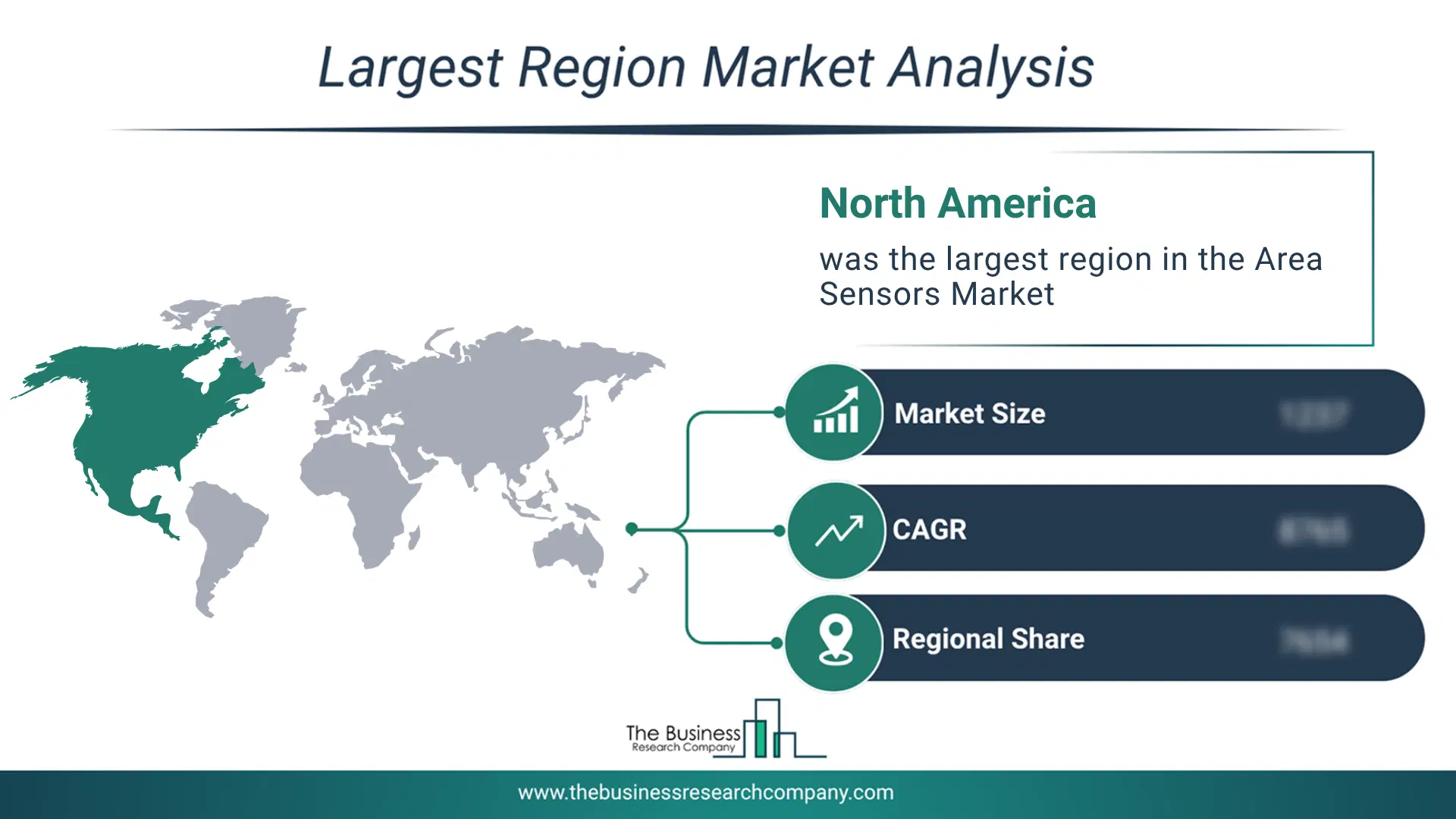
Regional Insights
North America was the largest region in the area sensors market in 2025. Asia-Pacific is expected to be the fastest-growing region in the forecast period. The regions covered in this market report are Asia-Pacific, South East Asia, Western Europe, Eastern Europe, North America, South America, Middle East, Africa. The countries covered in this market report are Australia, Brazil, China, France, Germany, India, Indonesia, Japan, Taiwan, Russia, South Korea, UK, USA, Canada, Italy, Spain.What Defines the Area Sensors Market?
The area sensors market consists of revenues earned by entities by providing services such as object detection services, safety monitoring services, position and presence sensing services, automation and process control services, and machine vision inspection services. The market value includes the value of related goods sold by the service provider or included within the service offering. The area sensors market also includes sales of safety light curtains, presence detection sensors, motion detection sensors, proximity sensing devices, and industrial safety sensor systems. Values in this market are ‘factory gate’ values, that is, the value of goods sold by the manufacturers or creators of the goods, whether to other entities (including downstream manufacturers, wholesalers, distributors, and retailers) or directly to end customers. The value of goods in this market includes related services sold by the creators of the goods.How is Market Value Defined and Measured?
The market value is defined as the revenues that enterprises gain from the sale of goods and/or services within the specified market and geography through sales, grants, or donations in terms of the currency (in USD unless otherwise specified). The revenues for a specified geography are consumption values that are revenues generated by organizations in the specified geography within the market, irrespective of where they are produced. It does not include revenues from resales along the supply chain, either further along the supply chain or as part of other products.
This chart presents market attractiveness based on a quantitative evaluation of growth, competition, strategic alignment, and risk, offering a clear view of opportunity areas for decision-making. This chart is for illustrative purposes; the full report contains the complete analysis.

This chart highlights the Total Addressable Market (TAM) by estimating the maximum revenue opportunity using an assumption-driven approach, supporting strategic planning and opportunity sizing across markets. The chart is illustrative; the full report provides a more comprehensive analysis.
What Key Data and Analysis Are Included in the Area Sensors Market Report 2026?
The area sensors market research report is one of a series of new reports from The Business Research Company that provides market statistics, including industry global market size, regional shares, competitors with the market share, detailed market segments, market trends and opportunities, and any further data you may need to thrive in the area sensors industry. The market research report delivers a complete perspective of everything you need, with an in-depth analysis of the current and future state of the industry.Area Sensors Market Report Forecast Analysis
| Report Attribute | Details |
|---|---|
| Market Size Value In 2026 | $7.21 billion |
| Revenue Forecast In 2030 | $11.75 billion |
| Growth Rate | CAGR of 13.0% from 2026 to 2030 |
| Base Year For Estimation | 2025 |
| Actual Estimates/Historical Data | 2020-2025 |
| Forecast Period | 2026 - 2030 |
| Market Representation | Revenue in USD Billion and CAGR from 2026 to 2030 |
| Segments Covered | Product Type, Technology Type, Sensing Range, Application Type, End User |
| Regional Scope | Asia-Pacific, Western Europe, Eastern Europe, North America, South America, Middle East, Africa |
| Country Scope | The countries covered in the report are Australia, Brazil, China, France, Germany, India, Indonesia, Japan, Taiwan, Russia, South Korea, UK, USA, Canada, Italy, Spain. |
| Key Companies Profiled | Siemens AG, Panasonic Industry Co. Ltd., Honeywell International Inc., Mitsubishi Electric Corporation, Eaton Corporation plc, Rockwell Automation Inc., KEYENCE Corporation, OMRON Corporation, SICK AG, ifm electronic GmbH, Banner Engineering Corp., Hans Turck GmbH & Co. KG, Pepperl+Fuchs SE, Baumer Holding AG, Balluff GmbH, IDEC Corporation, Pilz GmbH & Co. KG, Leuze electronic GmbH + Co. KG, wenglor sensoric GmbH, Autonics Corporation, Contrinex AG |
| Customization Scope | Request for Customization |
| Pricing And Purchase Options | Explore Purchase Options |